

Digital marketing transforms how businesses connect with customers in 2025, driving global ad spending to an impressive $734.6 billion while delivering an average return of $5 for every $1 invested.
Small businesses lead the charge, with 58% relying on digital channels to engage audiences, build loyalty, and increase sales. Marketers harness tools like SEO, email campaigns, social media ads, and AI-powered personalization to create targeted experiences that resonate deeply.
You benefit directly by reaching potential buyers exactly when they search for products or services, turning casual browsers into loyal customers.
This comprehensive guide explores the latest digital marketing statistics for 2025, blending market growth data, channel-specific insights, and practical tips to help you apply these trends for maximum impact.
We incorporate fresh discussions from Quora and Reddit to keep you ahead with real-time user concerns, such as AI ethics in ads or hyper-local targeting.
By understanding these figures, you craft strategies that lower costs, boost conversions, and scale your operations efficiently.
Whether you run a local shop in Panipat or an e-commerce store serving global markets, digital marketing empowers you to compete effectively and achieve sustainable growth.
The Explosive Scale of Digital Marketing
Digital marketing dominates the advertising landscape in 2025, with worldwide spending reaching $734.6 billion, up from previous years as businesses shift budgets online.
This massive investment reflects the channel’s proven effectiveness, where companies allocate 72% of their marketing funds to digital efforts according to Gartner surveys.
You see this in action when a well-placed social ad introduces your brand to thousands, generating leads without the high costs of traditional media.
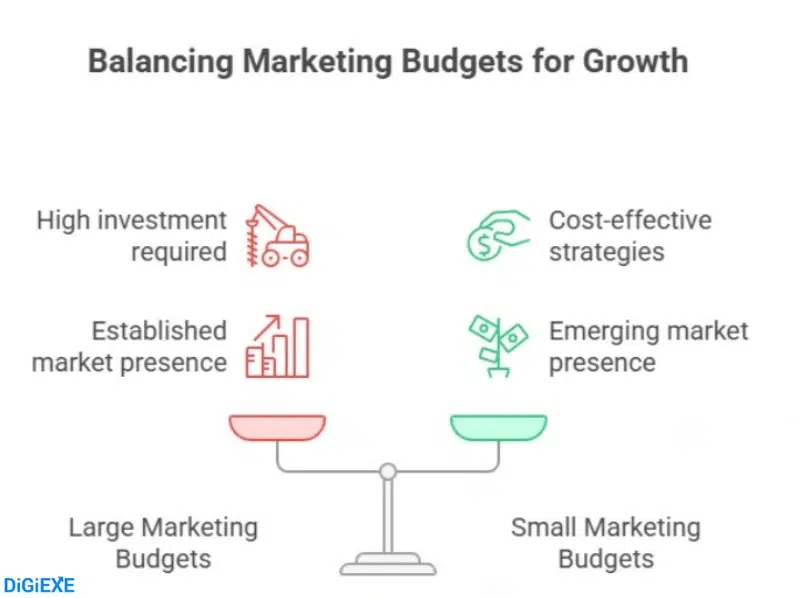
The market expands at a compound annual growth rate (CAGR) of 13.1% from 2024 to 2032, starting from $363.05 billion in 2023 and projected to hit $1,099.33 billion by 2032.
Asia-Pacific regions fuel this surge, driven by booming sectors like education, banking, and entertainment that demand interactive, niche content.
Growth accelerates through mobile dominance and AI integration, enabling you to personalize offers in real-time.
For instance, programmatic advertising captures 87% of digital ad revenue by 2026, automating buys for precision targeting that minimizes waste.
Businesses earn $5 ROI per dollar spent overall, but channels vary: email yields $36, SEO $22, and PPC $2. You capitalize by diversifying—combine SEO for long-term traffic with PPC for quick wins.
The table below outlines projected digital ad spending by type, showing where to focus budgets:
| Type of Advertising | 2024 (billion USD) | 2025* (billion USD) | 2026* (billion USD) | 2027* (billion USD) | 2028* (billion USD) |
| Audio Advertising | 11.1 | 11.9 | 12.4 | 12.8 | 13.2 |
| Banner Advertising | 174.4 | 185.9 | 196.5 | 207 | 217.6 |
| Classifieds | 21.7 | 22.1 | 22.5 | 23 | 23.4 |
| Influencer Advertising | 35.1 | 39.3 | 43.5 | 47.8 | 52 |
| Search Advertising | 306.7 | 334.4 | 362.3 | 389.8 | 417.4 |
| Video Advertising | 191.3 | 205.1 | 217.7 | 229.8 | 241.9 |
| Total | 740.3 | 798.7 | 854.9 | 910.3 | 965.6 |
*Projected. This data guides your allocation—prioritize search for high-intent users, yielding 53% of website traffic via organic means.
Also read about: Email Marketing Statistics
Adoption Rates: How Businesses Embrace Digital Marketing
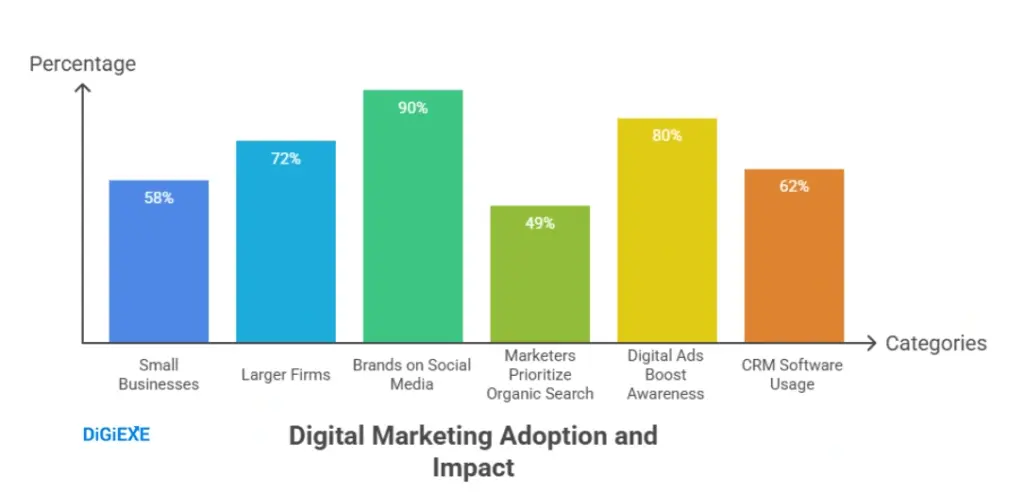
Companies of all sizes adopt digital marketing aggressively, with 58% of small businesses using it to forge customer connections through social media, email, and SEO.
Larger firms dedicate even more, with 72% of budgets digital per Gartner. You start small by claiming a Google Business Profile, instantly appearing in local searches that drive 88% of visitors to stores within 24 hours.
Demand for marketing jobs rises 10% by 2026, per the Bureau of Labor, creating opportunities for skilled professionals. Ninety percent of brands engage in social media marketing, proving its universality.
Metrics show success: 49% of marketers rank organic search highest for ROI, while 20% measure leads generated. You track these to refine campaigns—respond to reviews, and customers spend 50% more.
Digital ads boost brand awareness by 80%, and 62% use CRM software for data-driven decisions. The industry values $50 billion for SEO alone, underscoring investment returns.
ROI Breakdown: Maximizing Returns Across Channels
Digital marketing delivers exceptional ROI, averaging 5x overall and soaring to 3600% for email. You achieve this by segmenting lists and adding CTAs, lifting click-through rates 37%.
SEO returns $22 per dollar, closing leads at 15%—far above PPC’s 200% but quicker. Businesses spend $45.11 per user on social ads, reaping $219.8 billion globally. Influencer campaigns yield 650%, or $6.50 per dollar, as 49% of consumers trust recommendations.
PPC drives 2x visitors over SEO, with 65% of SMBs running campaigns at $9,000-$10,000 monthly. You layer strategies: use PPC for traffic while SEO builds authority. Content marketing shines—short videos ROI 31%, blogs 15%.
The table details content format ROIs:
| Content Format | ROI (%) |
| Short Form Video | 31 |
| Images | 22 |
| Blog posts | 15 |
| Case studies | 15 |
| Podcasts and other audio content | 14 |
Invest here to engage audiences researching your niche.
Also read about: Benefits of Digital Marketing in 2025
Email Marketing: The High-ROI Powerhouse
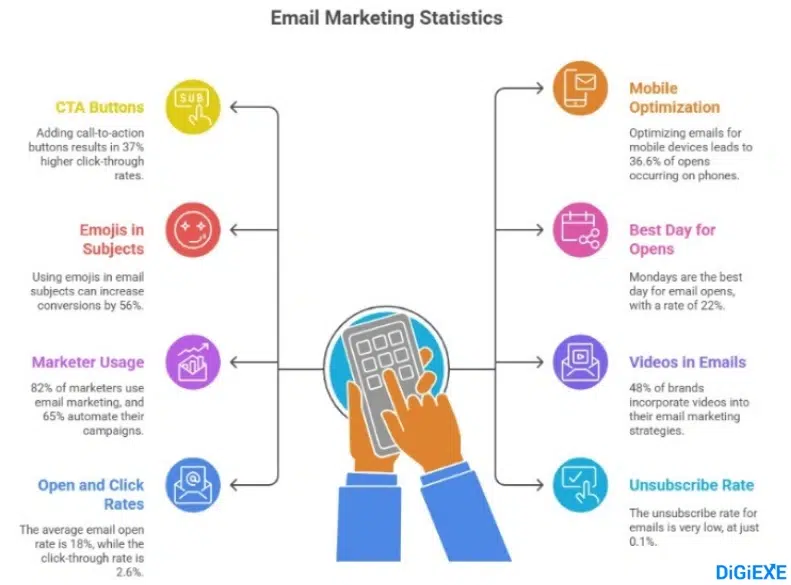
Email remains a cornerstone, with 4.37 billion users sending 347.3 billion messages daily, growing to 4.73 billion by 2026. You earn $36 per dollar by optimizing—mobile-friendly designs, as 36.6% open on phones, and emojis boost conversions 56%.
Global open rates hit 18%, CTR 2.6%, with Mondays highest at 22%. Automated emails engage 65% of marketers, while videos appear in 48% of campaigns.
Seventy percent spot spam by subject lines, so craft compelling ones. Customers prefer email contact (46%), spending 10 seconds per message.
Revenue reaches $8.49 billion. You build lists ethically, segment for relevance, and track unsubscribes at 0.1% to maintain health.
Digital Advertising
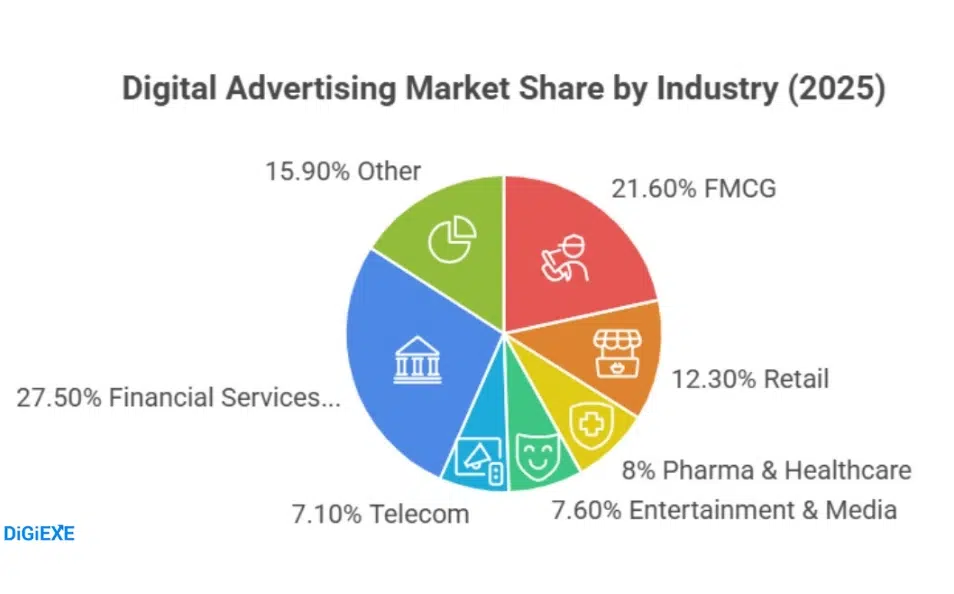
Advertising spends hit $740.3 billion in 2025, with mobiles generating 65% and smartphones 69% by 2026. The US leads at $298 billion.
Programmatic holds 80%, non-programmatic 20%. FMCG claims 21.6% share. You target precisely, reducing costs.
The industry table by sector:
| Industry | Share of Digital Ad Spending (%) |
| FMCG | 21.60 |
| Retail | 12.30 |
| Pharma & Healthcare | 8.00 |
| Entertainment & Media | 7.60 |
| Telecommunications | 7.10 |
| Financial Services | 6.80 |
| Travel & Leisure | 6.80 |
| Business Services | 5.60 |
| Automobiles | 4.30 |
| Government | 4.00 |
| Other | 15.90 |
Search ads grow to $190.5 billion, in-app $63.7 per user.
E-Commerce and Mobile Commerce: Shopping Revolution
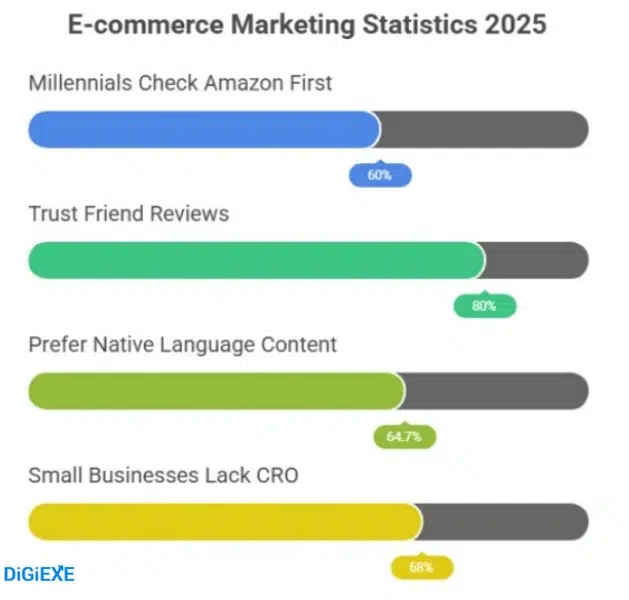
E-commerce values $4.9 trillion, with 2.14 billion shoppers (27% global). Organic drives 69% traffic, Amazon precedes 60% millennial purchases.
Conversions average 2.90%, reviews influence 80%. Shopify hosts 5.6 million sites.
Mobiles account for 70% visits, $3.4 trillion sales. Ninety-three percent of millennials compare deals, 53% prefer brand apps. Bounce rates rise 32% over 3-second loads.
You optimize sites—add filters (61% preference), CTAs (45% clicks boost). Bad experiences deter 62% repeats.
SEO Mastery: Driving Organic Traffic
SEO industry exceeds $50 billion, organic 53% traffic. Blogs increase visits 55%, #1 results click 32%. Leads close 15%, 75% stay on page one. You write 1500-word articles, use H1 tags (75% small sites lack). Semrush leads tools.
Local SEO: 46% searches local intent, 88% visit post-search. Ninety-three percent use Google Maps, photos boost clicks 1065%. You claim profiles, gather reviews (82% read).
Content Marketing: Engaging and Converting
Eighty percent of successful marketers budget over 10% here. Audience research tops success (47%), SEO 46%. Challenges: quality leads 45%. Videos perform best (45%).
Top factors table:
| Factor | Share of Votes (%) |
| Researching the audience | 47 |
| Search Engine Optimization | 46 |
| Publishing More Content | 45 |
| Improving Quality | 44 |
| Updating Existing Content | 42 |
| Analyzing Competition | 41 |
Budgets vary, 27% under $1000 monthly.
Social Media: Connection Hub
Sector worth $160 billion, growing to $223 billion. 4.95 billion users, 2:31 daily. Ninety percent brands market here, Facebook ads 86%. ROI: Facebook/Instagram 29%.
Platforms table:
| Social Media Platform | Monthly Active Users (billion) |
| 3.07 | |
| YouTube | 2.50 |
| 2.0 | |
| 2.0 | |
| TikTok | 1.60 |
| 1.36 | |
| Facebook Messenger | 0.977 |
| Telegram | 0.900 |
| Snapchat | 0.800 |
| Douyin | 0.755 |
| Kuaishou | 0.697 |
| 0.588 | |
| X/Twitter | 0.586 |
TikTok grows fastest.
Emerging Trends: Influencers, Memes, AI, and More
Influencer market $14 billion, ROI 650%, growing to $85 billion by 2028. Seventy-two percent Gen Z/Millennials follow, micro-influencers preferred.
- Memes: 60% seek funny content, millennials 30 daily. CTR 14% higher, industry to $6.1 billion.
- AI: 76% use for content, 30% messages AI-generated by 2025. Ninety-one percent Fortune 1000 invest, 37% adoption in marketing.
- Infographics: traffic +12%, engagement +650%.
- PPC: $190.5 billion search, 50%+ mobile clicks.
- Websites: opinions in 0.05s, 88.5% leave slow loads. Videos +88% time.
- Digital PR: 96% expect budget growth.
- Future: 69% spend mobile, AR to $461.25 billion by 2030.
Fresh Insights from Quora and Reddit: 2025 User Discussions
Quora users debate AI in personalization—many worry about privacy, with threads on ethical data use pushing for transparent opt-ins. You address this by highlighting consent in campaigns, building trust.
Reddit’s r/digitalmarketing buzzes with hyper-local ads via Google’s Performance Max, users reporting 30% better ROAS for small businesses targeting neighborhoods.
Threads in r/PPC share voice search optimization, as 50%+ baby boomers use assistants—incorporate natural language in ads.
Quora questions on meme virality reveal timing matters; post within hours of events for 10x shares. Reddit r/marketing discusses TikTok Shop integration, driving 20% e-commerce sales for beauty brands.
Users ask about sustainable marketing—eco-friendly claims boost loyalty 40%, per discussions. You adapt by testing AR try-ons, preferred by 61% shoppers.
Applying Digital Marketing for Your Benefit
You start with SEO—create blog content answering customer queries, driving 53% traffic. Layer email nurture sequences for 3600% ROI. Run mobile-optimized PPC, capturing 65% spends.
Use influencers for authentic reach, memes for engagement. AI predicts behavior (60% marketers), personalizing offers.
Local businesses claim Google profiles, add photos. Track ROI across channels, adjust budgets. Over 50% increase content spends—follow suit for leads.
FAQs About Digital Marketing Statistics
1. How does digital marketing deliver high ROI for small businesses in 2025?
Digital marketing offers high ROI by targeting specific audiences with low-cost strategies like SEO and PPC, driving efficient leads and organic traffic.
2. What role does mobile play in digital marketing strategies this year?
Mobile marketing dominates in 2025, with 65% of ad spend and 70% of e-commerce visits, boosting conversions through mobile-friendly content and apps.
3. Why should businesses prioritize SEO according to 2025 statistics?
SEO drives 53% of website traffic, delivers high ROI, and helps businesses rank on Google’s first page, outperforming paid ads long-term.
4. How can AI enhance digital marketing campaigns effectively?
AI personalizes content and predicts customer behavior, boosting engagement and improving ROI by automating tasks like copywriting and analytics.
5. What makes local SEO essential for brick-and-mortar stores?
Local SEO increases foot traffic, as 46% of searches have local intent, and optimizing Google Business Profiles boosts visibility and leads to in-store visits.
Also Read:
- WhatsApp Users Statistics
- Online Gaming Statistics
- Content Marketing Statistics
- Gemini Users Statistics
- Apple Music Users Statistics
Conclusion:
Digital marketing in 2025 is revolutionizing how businesses connect with customers. With a projected global spend of $734.6 billion, digital channels like SEO, mobile ads, and influencer marketing are driving massive returns.
Small businesses can thrive by leveraging these tools, which offer high ROI and efficient customer targeting. Mobile optimization, AI-driven personalization, and local SEO are key strategies for success.
As the industry grows, businesses must adapt by focusing on personalization, content quality, and targeted campaigns to stay ahead.
By understanding and applying these trends, businesses can boost sales, enhance brand visibility, and achieve sustainable growth in an ever-evolving market.
(Source: Statista, Shopify)
