

Voice search is transforming how we interact with information in 2025, powered by 8.4 billion devices and engaging 1.6 billion users globally.
With the speech recognition market set to reach $8.77 billion, voice search is now a necessity, driving $40 billion in voice commerce and boosting foot traffic with 76% of local “near me” queries. Users rely on it for tasks like music (74%), fact-checking (68%), and product ratings (20%).
For marketers, voice search requires optimization for conversational keywords, featured snippets, and fast-loading content to capture top results.
With 75% of U.S. households owning smart speakers, businesses can leverage VSEO to increase visibility, drive e-commerce (45% voice-driven), and enhance accessibility, particularly for visually impaired users.
Despite privacy concerns (40%) and accidental activations, voice search is set to continue its rapid growth, making it crucial for business strategies.
Top Voice Search Statistics 2026
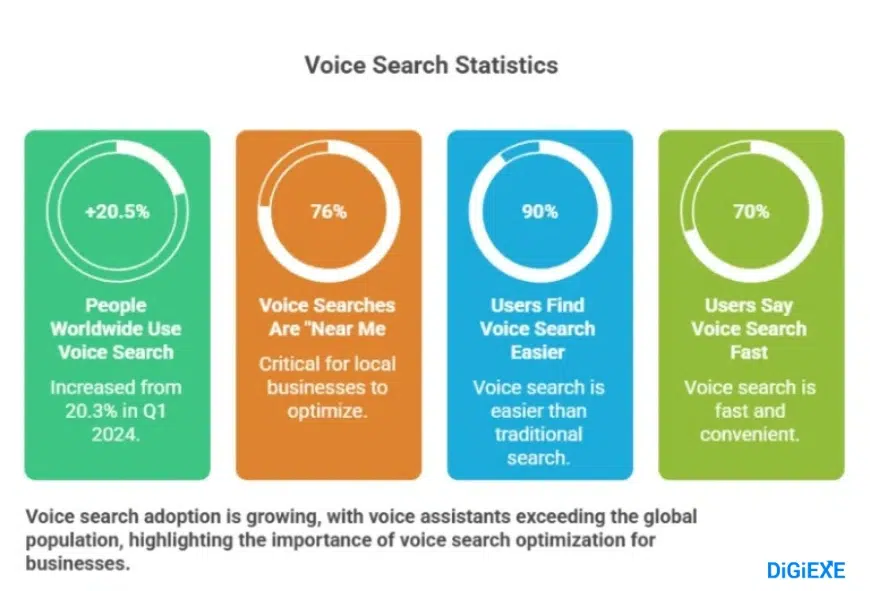
Voice search engages 20.5% of global internet users in 2025, up 1% from 2024’s 20.3%, equating to 1.6 billion individuals who prefer its natural, conversational flow for tasks spanning weather (66%) to music playback (74%), with U.S. penetration at 58.6% (153.5 million users) and daily reliance at 41%.
Smart assistants number 8.4 billion, led by Siri (500 million global, 86.5 million U.S.), Google Assistant (92 million U.S.), and Alexa (77.2 million global), powering 1 billion monthly queries where 76% seek local “near me” info, driving 28% direct calls to businesses.
Accuracy impresses at 93.7% overall (Google 92.9%, Siri 83.1%), yet only 22% align across devices, underscoring optimization needs.
For everyday benefits, use voice for 90% easier queries—52% faster results—saving time on fact-checks (68%); businesses tap 52% promotion interest for $40 billion commerce. 27% mobile usage suits commuters, while 75% of 25-49-year-olds speak daily, making it intergenerational.
The table below highlights pivotal 2025 stats:
| Metric | 2025 Value | Benefit for You |
| Global Usage Share | 20.5% (1.6B users) | Hands-free daily tasks |
| U.S. Users | 153.5 million | Local business discovery |
| Voice Assistants in Use | 8.4 billion | Ubiquitous access |
| Top Query Intent (Local) | 76% “near me” | Faster foot traffic |
| Accuracy (Google Assistant) | 92.9% | Reliable answers |
| Daily U.S. Reliance | 41% | Routine efficiency |
| Market Size (Speech Rec.) | $8.77 billion | Growing tech investment |
Apply these: Optimize Google My Business for 28% call conversions.
Also read about: Google Searches Statistics
Historical Evolution of Voice Search Usage: From Novelty to 2025 Standard
Voice search usage hovered at 19-20% from Q3 2023 (19.6%) to Q2 2025 (20.5%), peaking at 22.5% in Q2 2022 amid pandemic hands-free needs, then stabilizing as adoption normalized post-lockdowns.
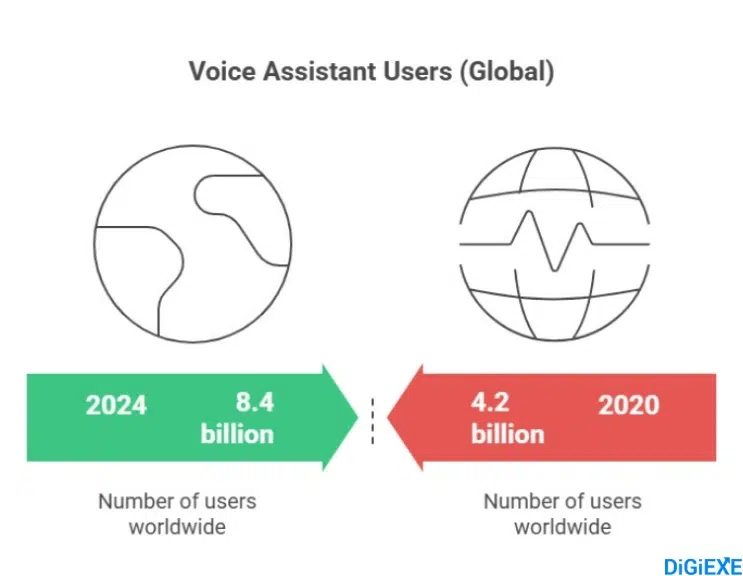
Device proliferation doubled from 4.2 billion in 2020 to 8.4 billion in 2025, with U.S. users jumping 8.1% from 142 million in 2022 to 153.5 million.
Para: This trajectory shows maturation—early spikes from smart speaker sales (75% households by 2025) to integrated AI in 73% mobiles—benefiting users with 52% daily interactions (65% 25-49-year-olds) and businesses via 30% e-commerce growth.
Growth table:
| Year/Quarter | Usage (%) | Devices (Billions) | Key Driver |
| 2025 Q2 | 20.5 | 8.4 | AI mood detection |
| 2024 Q1 | 20.3 | 8.0 | Multilingual 60% surge |
| 2023 Q4 | 20.1 | 7.5 | Voice commerce $40B |
| 2023 Q3 | 19.6 | 7.0 | Post-peak stabilization |
| 2022 Q2 | 22.5 | 6.5 | Pandemic peak |
| 2022 Q1 | 20.1 | 6.0 | Smart speaker 46.9% U.S. |
| 2020 | 19.0 | 4.2 | Initial boom |
Use history to predict: Prep for 50% voice commerce by optimizing long-tail queries.
Also read about: 12 Search Engine Statistics & Trends
Worldwide and U.S. Voice Search Users 2025: Demographics and Device Breakdowns
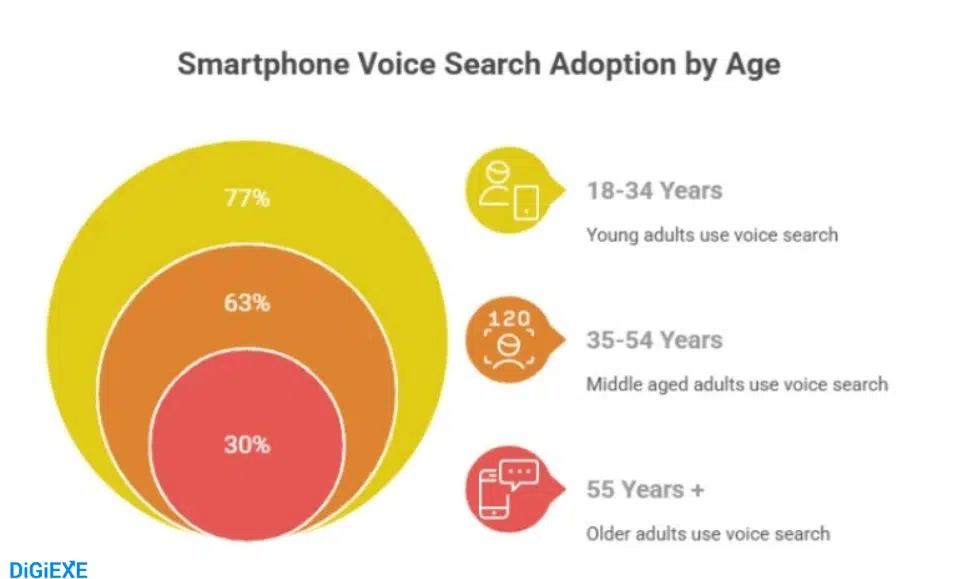
U.S. users hit 153.5 million (48.2% adults), up 2.5% from 2024’s 149.8 million, with 36.6% relying on assistants; globally, 20.5% (1.6B) use, led by 18-34-year-olds (77% smartphone). 27% mobile, 56% smartphones, 35% speakers, 34% TVs.
Para: Demographics skew young (77% 18-34 mobile), but 65% 25-49 daily use spans generations—benefit by voice-proofing apps for multitasking (52% speakers in family rooms).
Age/device table:
| Age Group | Smartphone (%) | Speaker (%) | TV/Remote (%) |
| 18-34 | 77 | 34 | 36 |
| 35-54 | 63 | 19 | 34 |
| 55+ | 30 | 4 | 29 |
Enable voice for 72% digital assistant queries.
Also read about: YouTube Statistics
Popularity Drivers By Activity: Why 90% Find Voice Search Easier
90% deem voice easier than typing, 70% for speed; top uses: music 74%, weather 66%, reminders 58%. U.S.: 75% weather, 71% music, 64% news.
Para: This ease saves time—68% fact-check, 51% restaurant research—benefit consumers with 52% daily speaker use, businesses with 52% promotion interest.
Activity table:
| Activity | % U.S. Users | Personal Benefit |
| Weather | 75 | Quick daily prep |
| Music | 71 | Hands-free entertainment |
| News | 64 | Instant updates |
| Entertainment | 62 | On-the-go relaxation |
| Retail | 54 | Deal hunting |
| Food/Restaurants | 52 | Local discovery |
Query “near me” for 76% local wins.
Voice Search Accuracy and Smart Speaker Stats 2025: Reliability for Routine Tasks
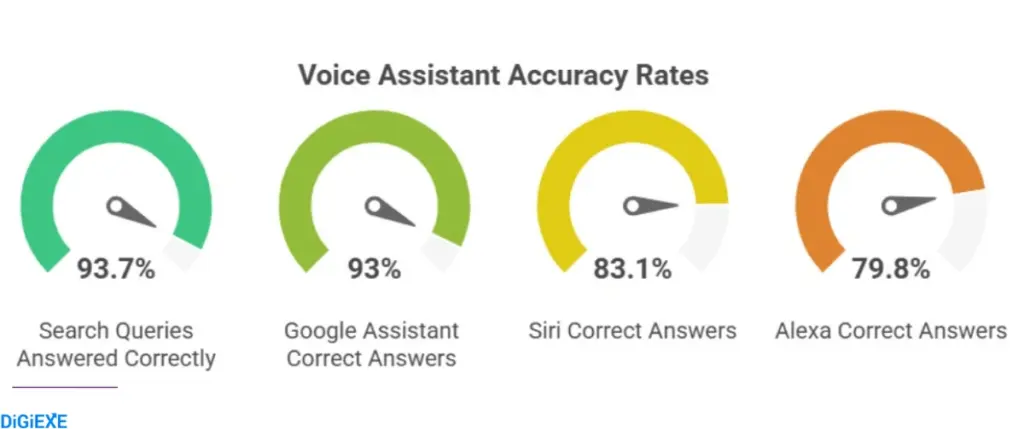
Assistants answer 93.7% queries; Google 100% understood/92.9% correct, Siri 99.8%/83.1%, Alexa 99.9%/79.8%. 52% daily speaker use, 52% family rooms, 59% own one, 30% two.
Para: High accuracy (93.7%) builds trust—use for 65% 25-49 daily reliance, avoiding 22% device misalignment by consistent queries.
Accuracy table:
| Assistant | Understood (%) | Correct (%) |
| 100 | 92.9 | |
| Siri | 99.8 | 83.1 |
| Alexa | 99.9 | 79.8 |
Prep for 75% household ownership.
Business and SEO Impacts: VSEO for Visibility and Sales
80% answers from top-3 results, 22.8% SEO pros rank VSEO top emerging factor; pages 2,312 words, 70% HTTPS, 1.71% exact titles. 52% want promotions, 56% brand searches on phones.
Para: VSEO boosts local (76% queries)—optimize for 52% faster loads, 10-15x call revenue (28% from voice).
VSEO table:
| Factor | 2025 Stat | Optimization Tip |
| Top-3 Sourcing | 80% | Featured snippets |
| Word Count | 2,312 | Conversational long-form |
| HTTPS Share | 70% | Secure site |
| Title Match | 1.71% | Natural phrases |
51% research products via voice.
Consumer Patterns and Purchasing: $40B Voice Commerce
51% U.S. shoppers research products, 30% track packages, 20% rate, 17% repurchase. 38% find voice ads less invasive, 40% buy after; 38.8M shop via speakers (13.6%).
Para: Voice drives $40B commerce—use for 43% purchases, 45% e-com transactions; address 72% digital assistant reliance.
Purchase table:
| Activity | % Users | Benefit |
| Research | 51 | Informed buys |
| Track Packages | 30 | Seamless logistics |
| Rate Products | 20 | Feedback loop |
| Repurchase | 17 | Loyalty retention |
72% use for calls.
Challenges and Trends: Privacy, Accuracy, and Future Innovations
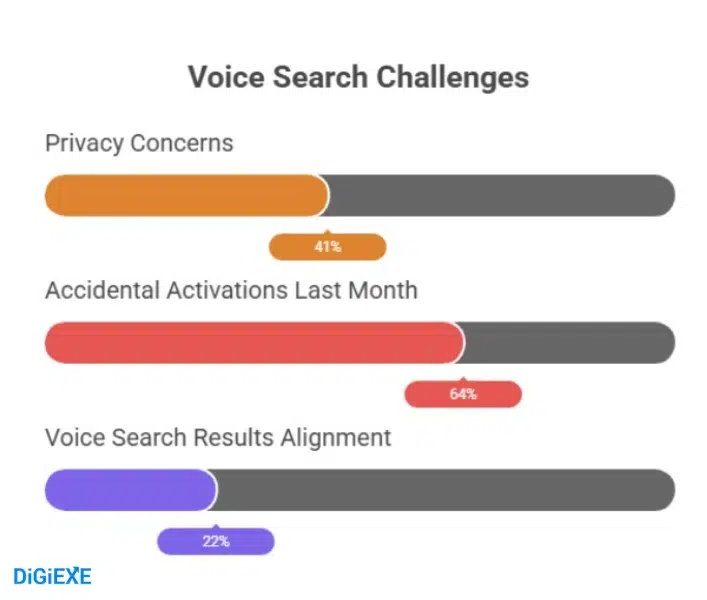
- Privacy Concerns: 41% of people fear their digital assistants actively listen or record them, and over 40% are concerned about privacy when having digital assistants in their homes. Addressing these concerns with clear privacy policies and robust security is vital for continued adoption.
- Accidental Activations: 64% of people reported accidentally using a voice assistant in the last month, which can be disruptive and frustrating.
- Device Alignment: Only 22% of the time do voice search results align across different devices, which can lead to inconsistent user experiences.
Latest from Quora and Reddit: Fresh 2025 Insights
Quora threads query “Voice SEO 2025?”—users seek VSEO for 76% local, AI for mood AI.
Reddit r/SEO debates “Voice vs. text?”—consensus: optimize snippets for 80% top-3, multilingual for 60% growth.
r/digital_marketing asks “Voice commerce tips?”—recommend skills for $40B.
FAQs About Voice Search Statistics
1. How can individuals use 2025 voice search statistics to simplify daily routines?
Individuals can use voice search for local queries (76% “near me”) and tasks like package tracking (30%) or repurchasing (17%), saving time with 52% faster results and 90% ease.
2. What strategies help businesses optimize for voice commerce and local SEO?
Businesses can optimize for voice commerce by focusing on 2,312-word pages, targeting top-3 snippets, and multilingual content. HTTPS for trust and conversational FAQs boost visibility and purchases.
3. How should content creators adapt for 18-34-year-olds in voice search?
Creators should produce quick tutorials, optimize for 29-word queries, and target mobile searches with mood AI and product-related voice commands to engage this age group.
4. What do Quora and Reddit reveal about privacy challenges in voice search 2025?
Privacy concerns include fears of recording (41%) and accidental activations (64%). Mitigate by adjusting wake-words, using incognito modes, and ensuring transparency to build trust.
5. How does voice search accuracy benefit e-commerce in 2025, and what optimizations are key?
Voice search accuracy (93.7%) drives 45% of transactions and 51% of research. Key optimizations include 2,312-word FAQs, top-3 snippets, and HTTPS to increase conversions and trust.
Also Read:
- DeepSeek AI Statistics
- iPhone Users Statistics
- WhatsApp Users Statistics
- Mobile App Download Statistics
- Digital Marketing Statistics
Conclusion
Voice search statistics 2025 reveal a transformative technology that empowers over 1.6 billion users worldwide—20.5% of internet adopters—with hands-free convenience, 93.7% accuracy, and seamless integration into daily life, from 76% local “near me” discoveries to $40 billion in voice-driven commerce, while 8.4 billion assistants outnumber humanity itself.
For individuals in India and beyond, this means effortless multitasking through 27% mobile queries and 90% perceived ease; for businesses, it demands VSEO mastery—conversational content, top-3 snippet dominance, and multilingual optimization—to capture 28% direct calls and 52% promotion-seeking smart speaker owners.
As Quora and Reddit echo AI personalization, mood-responsive assistants, and UGC-powered growth, embracing these insights today ensures you thrive in a voice-first future where privacy-aware, lightning-fast interactions redefine discovery, efficiency, and opportunity.
