
Marketing automation revolutionizes how businesses connect with audiences in 2025, streamlining repetitive tasks while amplifying personalized outreach that drives real results.
Companies harness these tools to nurture leads efficiently, boost engagement across channels, and measure every campaign’s impact with precision.
The industry generates an impressive $5.44 in return for every dollar invested, compelling 84 percent of marketers to prioritize it for achieving core objectives like lead generation and revenue growth.
Readers curious about marketing automation and eager to apply it for tangible benefits—whether scaling a small business, optimizing B2B pipelines, or enhancing personal branding—will uncover in this comprehensive guide fresh statistics, practical tips, and emerging trends.
As artificial intelligence integrates deeper into workflows, 96 percent of marketers either use or plan to adopt these platforms, transforming overwhelming to-do lists into automated powerhouses that free up time for creative strategy.
Businesses report up to 451 percent increases in qualified leads through video automation alone, proving that smart implementation turns data into dollars.
Dive into the details below to see how you can leverage these insights for your own success, from crafting triggered email sequences that skyrocket open rates to automating social media for consistent visibility.
The Explosive Growth of Marketing Automation
Businesses embrace marketing automation at unprecedented rates in 2025, with 96 percent of marketers actively using or planning to deploy these platforms within the year.
This surge stems from its proven ability to save time and resources, allowing teams to focus on high-value activities like relationship building rather than manual data entry.
On average, 56 percent of companies worldwide now integrate marketing automation into their operations, while 40 percent of B2B firms gear up for adoption, signaling a shift toward scalable, tech-driven marketing.
Nearly half of organizations—precisely 50 percent—launched their first automation platform within the last four years, despite tools existing for over 15 years, which highlights accelerating awareness and accessibility.
Marketers rank it as the second most effective digital technique after content marketing, with 17.4 percent affirming its superiority in efficiency.
The global market reflects this enthusiasm, valued at $6.62 billion in 2024 and projected to climb to $7.47 billion in 2025, growing at a compound annual rate of 12.9 percent through 2030 when it reaches $13.71 billion.
Frost & Sullivan forecasts vendor revenues hitting $6.6 billion by 2026, up from $2.9 billion in 2020, fueled by demand for AI-enhanced features. In 2021, the industry stood at $4.79 billion, demonstrating a 38.2 percent rise by 2024 alone.
Polaris Market Research anticipates further expansion, with the market surpassing $8 billion this year as small and medium enterprises join the fray. Over 398 companies offer solutions as of early 2025, providing options for every budget and need.
For readers new to automation, start small: Integrate a basic email tool to automate welcome sequences, which can increase engagement by 86 percent right away.
Businesses that do this report 80 percent improved lead generation, turning one-time visitors into loyal prospects without extra effort.
To capture the market’s trajectory, consider this table outlining projected revenues:
| Year | Worldwide Market Revenue (in billions USD) |
| 2021 | $4.79 |
| 2022 | $5.19 |
| 2023 | $5.86 |
| 2024 | $6.62 |
| 2025 | $7.47 |
| 2026 | $8.44 |
| 2027 | $9.53 |
| 2028 | $10.76 |
| 2029 | $12.14 |
| 2030 | $13.71 |
These figures empower you to benchmark your investments, ensuring automation aligns with industry growth for maximum returns.
Also read about: Digital Marketing Statistics
Why Invest in Marketing Automation? Key Benefits and ROI Insights
Marketers uncover profound benefits from automation, starting with a staggering $5.44 return on every dollar spent, which draws 84 percent to allocate budgets accordingly.
Over 80 percent of users witness enhanced lead generation, while 77 percent report higher conversions, directly tying tools to bottom-line growth.
Productivity surges by 20 percent as automation handles repetitive tasks, freeing staff for strategic pursuits like audience analysis.
B2B teams see 10 percent pipeline expansions, and overall sales productivity rises 14.5 percent, with marketing overhead dropping 12.2 percent.
Sixty-three percent of brands outperform competitors post-implementation, attributing success to data-driven decisions that 35 percent highlight as a top advantage.
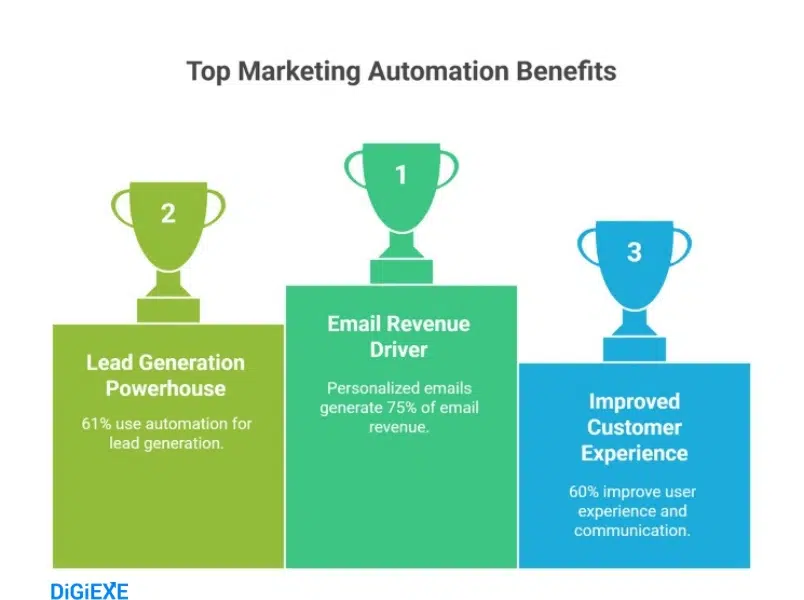
Customer experience improves for 43 percent, enabling personalized communications that 49 percent praise for building trust. Better staff time utilization ranks high at 38 percent, and 34 percent note superior lead nurturing.
Video automation alone boosts qualified leads by 451 percent, while triggered emails drive 75 percent of email revenue.
Omnichannel approaches yield 90 percent higher retention than single-channel efforts, and chatbots slash support costs by 30 percent. For individuals, these perks mean automating social posts to grow personal networks effortlessly, saving up to six hours weekly.
Seventy-six percent of companies recoup investments within the first year, with 66 percent deeming efforts “somewhat successful” and 25 percent “very successful” in meeting objectives.
Personalization emerges as a game-changer, with 49 percent noting its role in tailored messaging that resonates deeply.
Readers can replicate this by auditing workflows: Identify three repetitive tasks, like follow-up emails, and automate them to reclaim hours for content creation, mirroring the 20 percent productivity gain.
The following table summarizes top benefits reported by users:
| Benefit | Percentage of Users Reporting |
| Improved customer experience | 43% |
| Better use of staff time | 38% |
| Enhanced data and decision-making | 35% |
| Superior lead generation/nurturing | 34% |
| Optimized budget use | 33% |
| Increased personalization options | 24% |
| Measurable KPIs | 23% |
| Alignment with other departments | 21% |
This breakdown guides prioritization, helping you select features that deliver quickest wins.
Also read about: Email Marketing Statistics
Top Channels and Use Cases
Email dominates automation landscapes, with 63 percent of marketers deploying it for campaigns that yield 46 percent higher open rates when targeted.
Triggered emails boast 38 percent opens versus 18.7 percent for newsletters, and welcome series hit 86 percent. Cart abandonment flows achieve 29.64 percent opens, generating 18 times more revenue than broadcasts.
Businesses sending automated emails prove 133 percent more likely to deliver relevance, making email the fourth most popular tactic overall.
Social media follows closely, automated by 50 percent for management that saves six hours weekly and 175 hours monthly on moderation.
Forty-seven percent of small businesses use it here, ranking it second after email. Paid ads attract 40 percent, with 29 percent planning expansions.
Content management engages 35 percent, landing pages 29 percent, and SMS 28 percent. Lead scoring and workflows draw 14 to 17 percent, while live chat and push notifications each claim 13 to 21 percent.
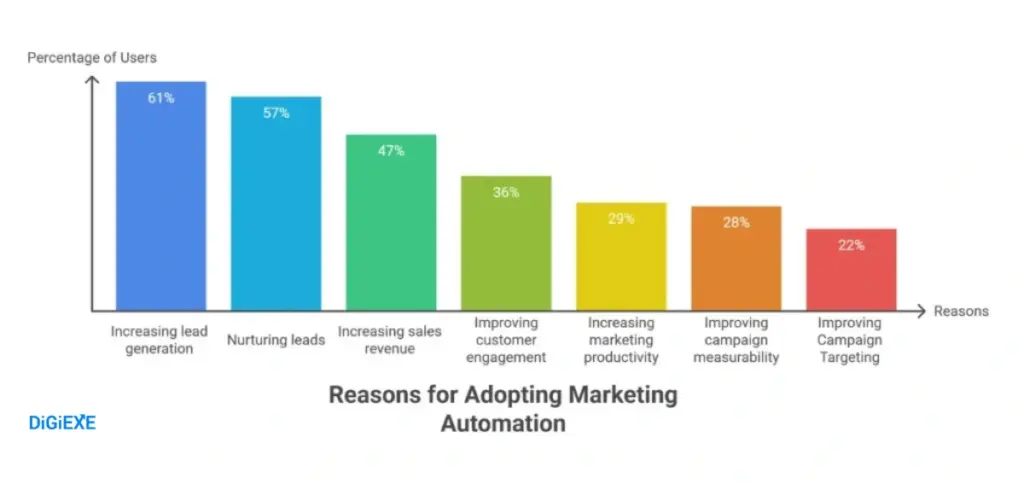
B2B professionals favor email at 71 percent, social at 39 percent, and landing pages at 35 percent. Goals center on lead generation for 61 percent, nurturing 57 percent, and revenue boosts 47 percent.
Campaign targeting improves for 22 percent, and 65 percent overall use for email.
For practical application, solopreneurs automate LinkedIn posts via tools like Buffer, fostering connections without daily logins. Teams nurture leads through segmented drips, increasing qualified pipelines by 92 percent.
Explore usage across channels in this table:
| Channel/Area | Current Usage Percentage |
| Email Marketing | 63% |
| Social Media Management | 50% |
| Paid Ads | 40% |
| Content Management | 35% |
| Landing Pages | 29% |
| SMS Marketing | 28% |
| Campaign Tracking | 26% |
| Account-Based Marketing | 24% |
| Push Notifications | 22% |
| Live Chat | 21% |
| Workflows/Visualization | 20% |
| SEO Efforts | 18% |
| Sales Funnel Communications | 16% |
| Dynamic Web Forms | 16% |
| Lead Scoring | 14% |
These stats reveal high-impact areas, urging focus on email and social for immediate gains.
Also read about: Content Marketing Statistics
Essential Features and Tools
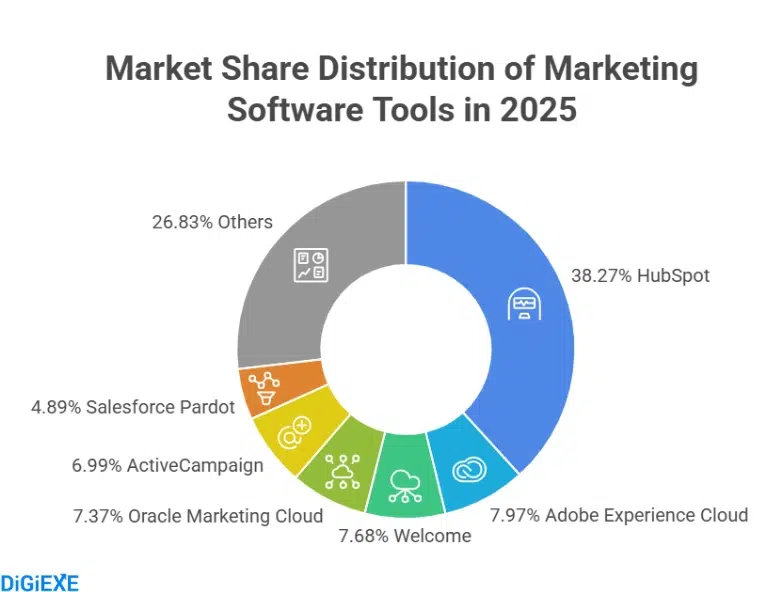
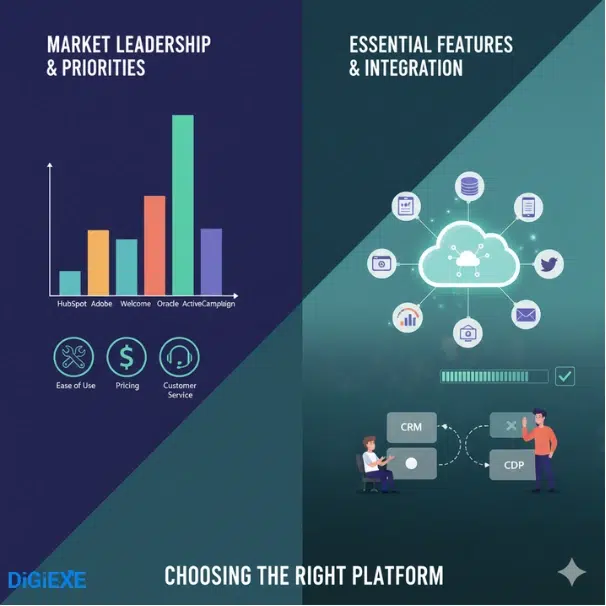
HubSpot commands 38.27 percent market share in 2025, followed by Adobe Experience Cloud at 7.97 percent, Welcome at 7.68 percent, Oracle at 7.37 percent, and ActiveCampaign at 6.99 percent.
Earlier data shows HubSpot at 29.51 percent, Adobe at 12.11 percent, Oracle at 8.63 percent, and ActiveCampaign at 8.01 percent, with Salesforce Pardot at 4.89 percent—trends indicate consolidation around user-friendly leaders.
Marketers prioritize ease of use at 54 percent, pricing at 53 percent, and customer service at 27 percent when selecting tools.
Integration with CRMs ranks crucial for 55 percent, lead scoring for 45 percent, and email creation for 35 percent. Social distribution appeals to 24 percent.
Only 18 percent of B2B users integrate with customer data platforms, though 40 percent possess both but lack synergy.
For beginners, test free tiers of ActiveCampaign for email automation, integrating seamlessly to track opens and clicks, enhancing future campaigns.
This table ranks leading tools by market share:
| Software/Tool | Market Share Percentage |
| HubSpot | 38.27% |
| Adobe Experience Cloud | 7.97% |
| Welcome | 7.68% |
| Oracle Marketing Cloud | 7.37% |
| ActiveCampaign | 6.99% |
| Salesforce Pardot | 4.89% |
Select based on needs: HubSpot for all-in-one, ActiveCampaign for affordability.
Emerging Trends in Marketing Automation
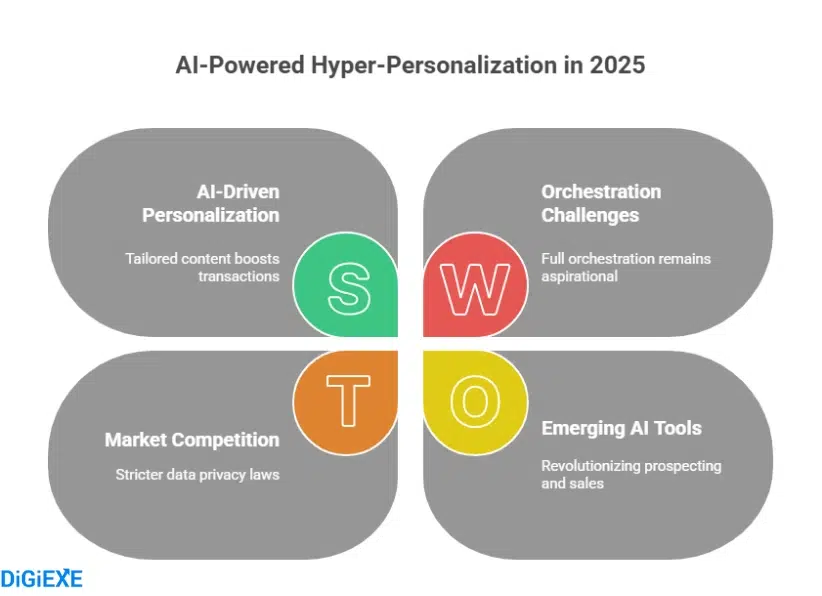
Automation trends pivot toward AI-powered hyper-personalization in 2025, where tools analyze real-time data for tailored content, emails, and ads. Predictive analytics and smart segmentation emerge, with 77 percent of content AI-generated.
Omnichannel workflows gain traction for high-value sequences like onboarding, though full orchestration remains aspirational below certain scales. Behavioral trigger stacking outperforms broad AI for ROI, focusing on post-purchase and retention.
Voice search optimization and AR/VR integrations blend with sustainability branding, while 19.65 percent of marketers adopt AI agents.
Global AI markets hit $190 billion, boosting productivity 5-15 percent. Reddit threads emphasize AI for send-time optimization over content gen, and Quora highlights challenges like data privacy under stricter laws.
Users on platforms query ROI from trends: Quora asks about evaluating software, stressing goals documentation; Reddit debates if automation delivers, favoring integrated stacks for sales funnels. Emerging: Tools like Salesforge for cold emails, Regie.ai for copy—revolutionizing prospecting.
Incorporate by piloting AI for segmentation, personalizing drips to lift transactions 58 percent.
Challenges and Solutions
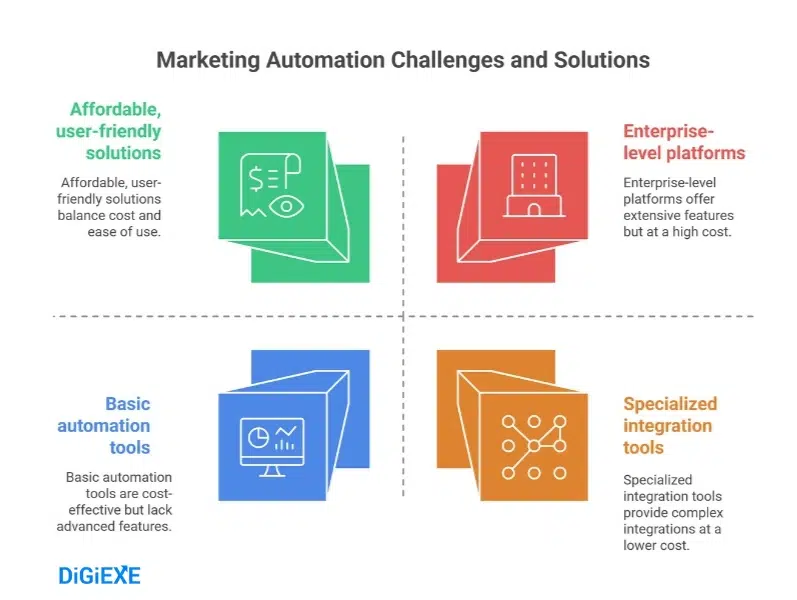
Despite allure, 54 percent of marketers underutilize tools, with 26 percent uncertain of optimization. Training gaps hinder 39 percent, resources 32 percent, and budgets 31 percent.
Setup complexity affects 25 percent, expertise lacks for 33 percent, and low priority stalls 24 percent. Systems overwhelm 20 percent, and quality creation challenges 16 percent.
Solutions: Start with user-friendly platforms, invest in training—91 percent deem automation vital for success. Sixty-three percent plan budget hikes, focusing on data quality (37 percent) and strategy (43 percent).
Readers mitigate by auditing stacks quarterly, ensuring 22 percent ease in journey building.
This table details common challenges:
| Challenge | Percentage Affected |
| Lack of training/knowledge | 39% |
| Lack of resources | 32% |
| Lack of budget | 31% |
| Complicated setup | 25% |
| Insufficient expertise | 33% |
| Low priority | 24% |
| System complexity | 20% |
| Creating quality automations | 16% |
Address head-on for 66 percent success rates.
Real-World Applications
Small businesses automate 50 percent of emails, saving hours while nurturing leads—66 percent use for this, yielding 75 percent revenue from triggers.
Social automation by 47 percent cuts moderation time, boosting engagement 36 percent.
Advertising sees 80 percent automation, with programmatic at $129.1 billion in 2020, now higher. Upselling via one-click ads lifts order sizes 360 percent, personalized offers 20 percent sales.
B2C brands favor email (2.8 percent conversion), B2B 2.4 percent. Individuals automate newsletters for audience growth, freelancers score leads for priority outreach.
Apply: Set drip campaigns for new subscribers, tracking 58 percent conversion uplift.
Insights from Quora and Reddit
Communities buzz with 2025 queries. Quora users ask, “What trends shape automation?” citing AI hyper-personalization and ethical AI amid privacy hikes. “Will marketing fully automate by 2025?” draws consensus: No, but 80-90 percent adoption, blending human creativity.
Reddit’s r/MarketingAutomation debates ROI: Behavioral triggers win over AI hype, omnichannel for retention only. r/DigitalMarketing predicts AI agents (19.65 percent adoption), voice/AR trends.
Users seek tools like Google AIO, ChatGPT for content; challenges include compliance, integration. r/Emailmarketing notes smarter personalization, SMS blends.
Emerging: AI for predictive sending, ethical frameworks—68 percent Gen Z demand transparency. Solopreneurs query stacks: Salesforce certifications boom. These dialogues stress strategy over tools, niche focus for viability.
FAQs About Marketing Automation Statistics
1. How does marketing automation improve lead generation in 2025?
Marketing automation enhances lead generation by nurturing prospects through targeted sequences, with 61 percent of users reporting higher qualified pipelines and 80 percent seeing overall increases, allowing businesses to convert visitors into customers efficiently while saving manual effort.
2. What role does AI play in marketing automation trends this year?
AI drives hyper-personalization and predictive analytics in 2025, powering 77 percent of content creation and boosting productivity by 5 to 15 percent, enabling marketers to deliver real-time, tailored experiences that lift engagement without constant oversight.
3. Which channels benefit most from automation for small businesses?
Small businesses gain most from email and social media automation, where 50 percent manage campaigns to save six hours weekly, generating 75 percent revenue from triggers and fostering consistent outreach that builds loyalty on limited budgets.
4. How can individuals use marketing automation for personal branding?
Individuals apply marketing automation by scheduling social posts and email newsletters via tools like ActiveCampaign, growing audiences 20 percent more productively and nurturing networks with personalized follow-ups that position them as thought leaders effortlessly.
5. What challenges arise with marketing automation, and how to overcome them?
Common challenges include training gaps for 39 percent and setup complexity for 25 percent, overcome by starting with intuitive platforms like HubSpot, investing in quick certifications, and piloting small workflows to build expertise gradually for sustained success.
Also Read:
- DeepSeek AI Statistics
- WhatsApp Users Statistics
- Online Gaming Statistics
- Digital Marketing Statistics
- ChatGPT Statistics
Conclusion
Marketing automation empowers 2025 triumphs, with 91 percent noting demand surges and $7.47 billion markets. From 63 percent email usage to 43 percent experience gains, it delivers $5.44 ROI.
Overcome 39 percent training barriers for 80 percent lead boosts. Embrace AI trends from forums for scalable growth—start today to automate tomorrow’s success.
