

In 2025, eLearning continues to revolutionize education, offering dynamic, flexible learning experiences for students and professionals alike.
With the global eLearning market valued at $320.96 billion and projected to grow to $539.88 billion by 2028, more people are choosing online courses to master new skills.
Learners enjoy higher retention rates and time savings compared to traditional classrooms, with many completing courses faster and more effectively.
Businesses embrace eLearning for employee training, boosting revenue and engagement, while K-12 programs cut costs and reduce environmental impact.
AI-driven tools like ChatGPT plugins enhance learning, saving time and increasing engagement.
This guide explores eLearning trends, retention strategies, and market forecasts, offering practical insights for anyone looking to upskill or expand their knowledge.
Market Growth and Revenue Projections
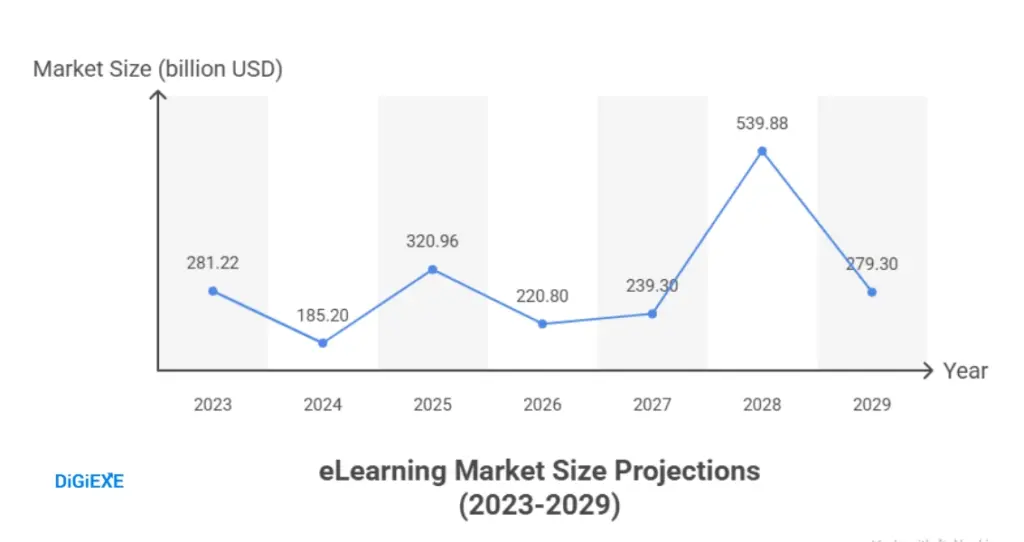
The eLearning market is expanding rapidly. In 2025, it reaches $320.96 billion, up from $281.22 billion in 2023, and is projected to grow to $539.88 billion by 2028, driven by a 14.1% CAGR.
The global demand for online learning is driven by multiple sectors: platforms are expected to account for $58.45 billion, universities $120.70 billion, and certifications $6.04 billion, totaling $203.81 billion in 2025, with growth expected to continue.
MOOCs (Massive Open Online Courses) are a major segment, contributing $31.74 billion in 2025 and projected to grow at a 39.2% CAGR through 2030.
The mobile eLearning market is also expanding, with projections reaching $80.1 billion by 2027, up from $22.4 billion in 2020.
Yearly Growth Projections
| Year | Market Size (Billion USD) | CAGR (%) |
|---|---|---|
| 2023 | 281.22 | N/A |
| 2024 | 185.20 | N/A |
| 2025 | 320.96 | 14.1 |
| 2026 | 220.80 | N/A |
| 2027 | 239.30 | 9.48 |
| 2028 | 539.88 | 14.1 |
| 2029 | 279.30 | N/A |
This table highlights the impressive growth and projected ROI for eLearning platforms.
Also read about: Coursera Review
Global Adoption and User Demographics
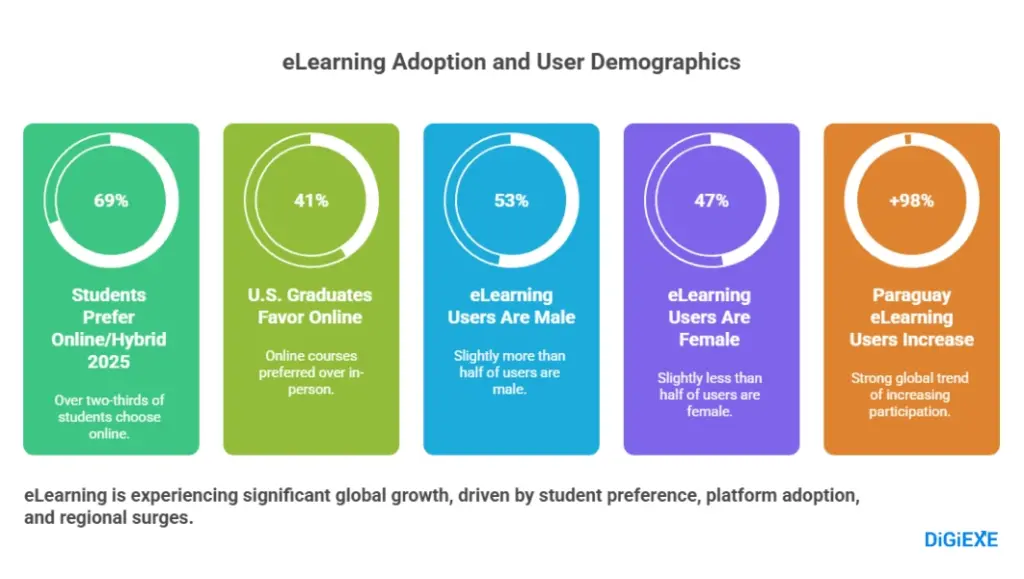
The adoption of eLearning continues to grow globally. In 2025, over 69% of students prefer online or hybrid learning formats, and 41% of U.S. graduates now favor online courses over traditional in-person classes.
The average age of eLearning users is 32 years, and 53% are male, while 47% are female.
Coursera, a major eLearning platform, leads with 17.3 million learners in the U.S., followed by India at 13.6 million.
In regions like Latin America, adoption is surging.
For example, Paraguay saw a 98% increase in users, reflecting a strong global trend of increasing participation in online education.
Country Adoption Breakdown
| Country | Coursera Learners (Millions) | Growth Rate (%) |
|---|---|---|
| U.S. | 17.3 | N/A |
| India | 13.6 | N/A |
| Paraguay | N/A | 98 |
This table provides a snapshot of Coursera’s growth in different countries, highlighting key regions for localized content.
Also read about: Best Udacity Alternatives in 2025
Corporate Training Efficiency and ROI
Businesses are increasingly adopting eLearning for corporate training. In 2025, 93% of companies are using some form of eLearning, with 90% offering digital learning options.
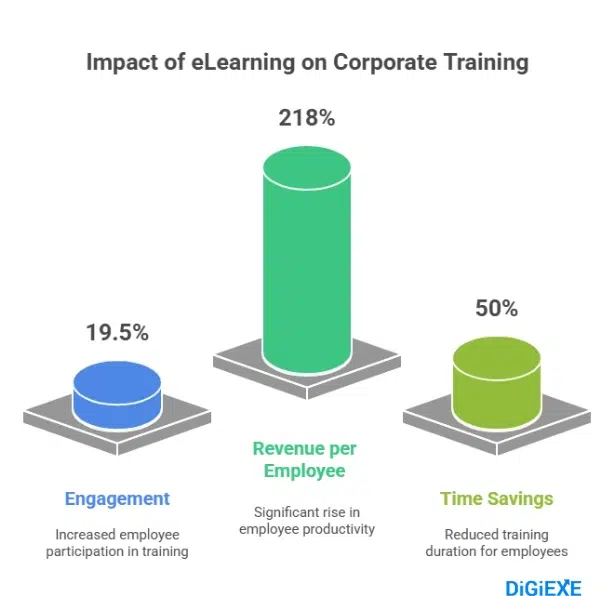
Companies that incorporate eLearning see significant benefits, including an 18-21% increase in engagement, a 218% rise in revenue per employee, and a 40-60% reduction in training time.
For example, IBM’s eLearning initiatives have saved the company $200 million, demonstrating the effectiveness of training programs.
Corporate training platforms help businesses save time and increase employee performance while providing flexibility for employees to learn at their own pace.
Corporate Training Results
| Metric | Improvement (%) |
|---|---|
| Engagement | 18-21 |
| Revenue per Employee | 218 |
| Time Savings | 40-60 |
This table showcases the positive impacts of eLearning on corporate training and employee productivity.
Also read about: LearnWorlds Black Friday Deals & Cyber Monday Sale 2025
Academic Outcomes and Retention Boosts
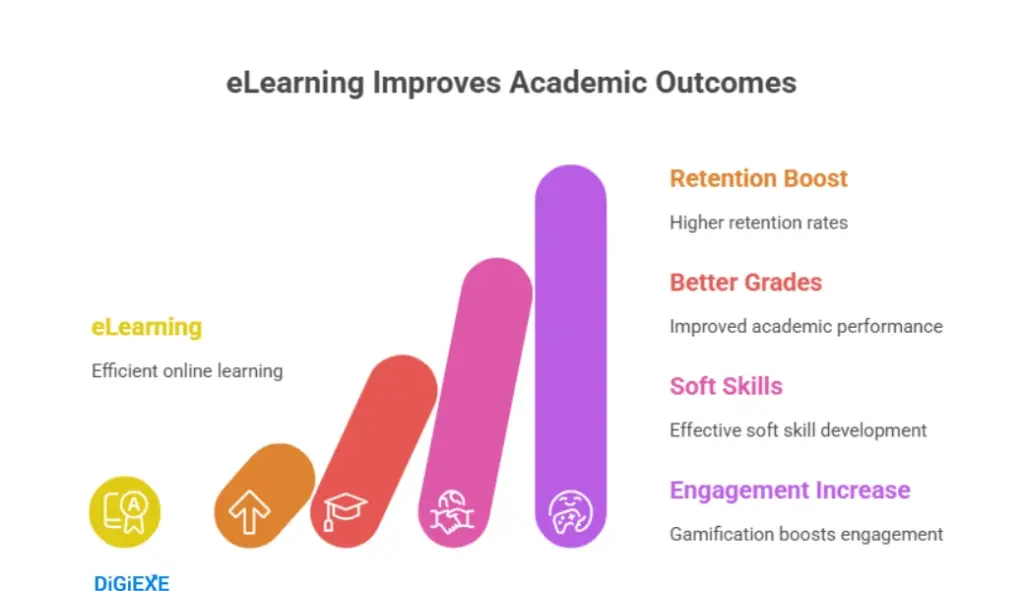
eLearning is not just efficient; it also helps learners achieve better academic outcomes.
Studies show that retention rates in eLearning are 25% to 60% higher than in traditional classrooms.
Furthermore, students who use eLearning tools tend to perform better academically.
For example, 81% of students report better grades with eLearning tools, and 60% develop soft skills more effectively through online platforms.
In 2025, 73% of U.S. students continue their education in post-pandemic formats, with a 36% easier completion rate for online programs.
Gamification, a key feature in many eLearning platforms, increases engagement by 55% and retention by 18%.
Learning Outcomes
| Metric | Improvement (%) |
|---|---|
| Retention | 25-60 |
| Success | 72 |
| Better Grades | 81 |
This table emphasizes the effectiveness of eLearning for improving learning outcomes and retention.
AI, VR, and Emerging Tech Integration
In 2025, AI and VR technologies are playing a pivotal role in enhancing the eLearning experience.
AI is used in 47% of Learning Management Systems (LMS), boosting engagement by 80% and saving creators up to 26 hours a week.
Virtual Reality (VR) technology is also growing, with the VR education market expected to reach $1.4 billion by 2027.
VR is especially useful for soft skills training, making them 4 times faster than traditional methods.
Generative AI in education is projected to reach $8.32 billion by 2033, growing at a 41% CAGR, while 60% of teachers in 2025 are adopting adaptive learning platforms for personalized learning paths.
Technology Adoption in eLearning
| Tech | Market (2025/2027) | CAGR (%) |
|---|---|---|
| AI | N/A | 41 |
| VR | N/A / 1.4 | 42.9 |
This table highlights the growing role of AI and VR in eLearning, driving greater engagement and retention.
Platform Leaders and MOOC Ecosystems
Several major platforms dominate the eLearning space. Coursera, for example, boasts 175 million learners and $694.7 million in revenue in 2024.
Other notable platforms include Udemy (52 million learners) and edX (100 million learners). These platforms offer millions of courses, with Udemy alone hosting 196,000 courses.
MOOCs (Massive Open Online Courses) are seeing strong growth, with Coursera leading the way.
Gamification and badges continue to engage learners, with 78% of users reporting higher engagement when using these features.
Top eLearning Platforms and Growth
| Platform | Learners (Millions) | Courses |
|---|---|---|
| Coursera | 175 | 10,000+ |
| Udemy | 52 | 196,000 |
This table highlights the top eLearning platforms and their growing user bases.
COVID-19 Legacy and Sustainability
The COVID-19 pandemic played a significant role in accelerating the adoption of eLearning. Searches for online learning surged by 900%, and 59% of new enrollees continued their studies post-pandemic.
eLearning has also contributed to environmental sustainability, with 90% less energy use and 85% less CO2 emissions compared to traditional education formats.
Impact of COVID-19 on eLearning
| Metric | Increase (%) |
|---|---|
| Searches | 900 |
| Adoption | 300 |
This table underscores the lasting impact of the pandemic on the eLearning landscape.
Community Insights from Quora and Reddit
Quora and Reddit users continue to share valuable insights on the future of eLearning.
In 2025, users recommend AI tutors like ChatGPT for boosting engagement by 80%.
They also discuss the effectiveness of gamification, with 67% of learners reporting increased motivation.
Additionally, microlearning and VR are popular strategies for improving retention and soft skills development.
Key eLearning Strategies
| Strategy | Improvement (%) |
|---|---|
| Gamified MOOCs | 55 |
| Microlearning | 15 |
| AI Tutors | 80 |
FAQs About eLearning Statistics
1. What is the global eLearning market size in 2025?
The eLearning market reaches $320.96 billion in 2025, growing from $281.22 billion in 2023 at a 14.1 percent CAGR, with segments like online universities contributing $120.70 billion for accessible degrees.
2. How does eLearning improve retention and efficiency in 2025?
eLearning boosts retention 25 to 60 percent higher than classrooms in 2025, cutting time 40 to 60 percent via self-paced modules, with gamification adding 18 percent knowledge gains.
3. What demographics dominate eLearning users in 2025?
eLearning users average 32 years old in 2025, with 53 percent male and 47 percent female on platforms like Coursera, 69 percent preferring hybrid for flexibility balancing work and study.
4. How has AI impacted eLearning engagement in 2025?
AI enhances engagement 80 percent in 2025, powering 47 percent LMS tools and saving creators 26 hours weekly, with 60 percent teachers using adaptive platforms for personalized paths.
5. What trends do Quora and Reddit users discuss for eLearning in 2025?
Quora and Reddit users highlight microlearning for 25 percent retention and VR for 4x soft skills in 2025, sharing AI tutors cutting prep time and gamification motivating 67 percent learners.
Also Read:
- Google Chrome Statistics
- AI Recruitment Statistics
- Snapchat User Statistics
- Android Usage Statistics
- Link Building Statistics
Conclusion
eLearning is reshaping education and professional development in 2025.
With a rapidly growing market, new technologies, and diverse user demographics, the eLearning sector offers immense opportunities for individuals and businesses alike.
Whether you’re looking to upskill, enhance academic performance, or optimize corporate training, eLearning provides an accessible and effective solution.
By leveraging AI, gamification, and emerging technologies, eLearning continues to deliver personalized, engaging, and impactful learning experiences.
Source: eLearningstats.education, Statista.
