
Chatbots transform the way individuals and businesses interact with technology in 2025, offering instant solutions that save time and enhance experiences.
Businesses integrate chatbots to streamline operations, while everyday users rely on them for quick answers and personalized advice.
The global chatbot market reaches an impressive $15.57 billion this year, reflecting rapid growth driven by advancements in artificial intelligence and machine learning.
Projections indicate that this market will expand to $46.64 billion by 2029, growing at a compound annual growth rate of 24.53 percent.
Over 987 million people worldwide actively use AI chatbots, making them indispensable tools for tasks ranging from customer inquiries to creative brainstorming.
Readers who seek to understand chatbots and apply them for personal or professional benefits will discover in this article how these technologies deliver efficiency, cost savings, and innovation.
Businesses save up to $11 billion annually through chatbot implementations, and individuals gain access to 24/7 support that boosts productivity in daily life.
Chatbot Statistics: How Many AI Chatbots Exist
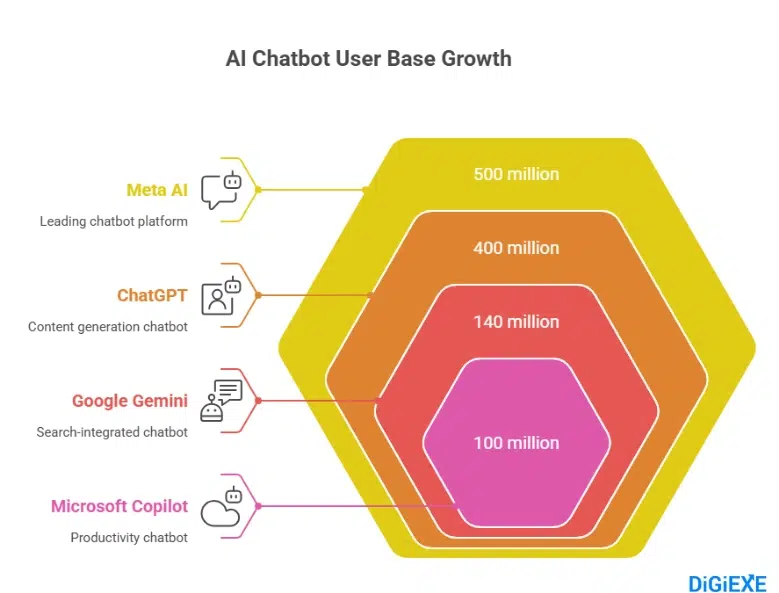
The chatbot landscape evolves quickly, with millions of AI chatbots operating globally, though exact counts remain elusive due to constant development.
Developers create new chatbots daily, catering to niche needs like health advice or financial planning. Popular platforms dominate the scene, drawing massive user bases that demonstrate their reliability and versatility.
For instance, Meta AI leads with 500 million active users, providing seamless integration across social platforms. ChatGPT follows closely with 400 million users, excelling in content generation and problem-solving.
Google Gemini attracts 140 million users, leveraging its search capabilities for accurate information retrieval.
Microsoft Copilot, with 100 million users, integrates deeply into productivity tools like Office suites. Grok gains traction rapidly, boasting 35 million users for its witty and informative responses.
Claude serves 20 million users, focusing on ethical AI interactions. Perplexity appeals to 15 million users who prioritize accuracy in research.
Pi engages 6 million users with empathetic conversations. Poe reaches 4 million users through its multi-model access. HuggingChat rounds out the top with 1.2 million users, emphasizing open-source collaboration.
To visualize the popularity of these chatbots, consider the following table that ranks them by total active users:
| Rank | AI Chatbot | Total Active Users |
| 1 | Meta AI | 500 million |
| 2 | ChatGPT | 400 million |
| 3 | Google Gemini | 140 million |
| 4 | Microsoft Copilot | 100 million |
| 5 | Grok | 35 million |
| 6 | Claude | 20 million |
| 7 | Perplexity | 15 million |
| 8 | Pi | 6 million |
| 9 | Poe | 4 million |
| 10 | HuggingChat | 1.2 million |
These numbers highlight how chatbots cater to diverse needs, allowing users to choose based on specific requirements such as speed or integration.
Businesses leverage these tools to engage customers more effectively, while individuals use them to automate routine tasks like scheduling or learning new skills.
Also read about: ChatGPT Statistics
Chatbot Market Revenue and Future Projections
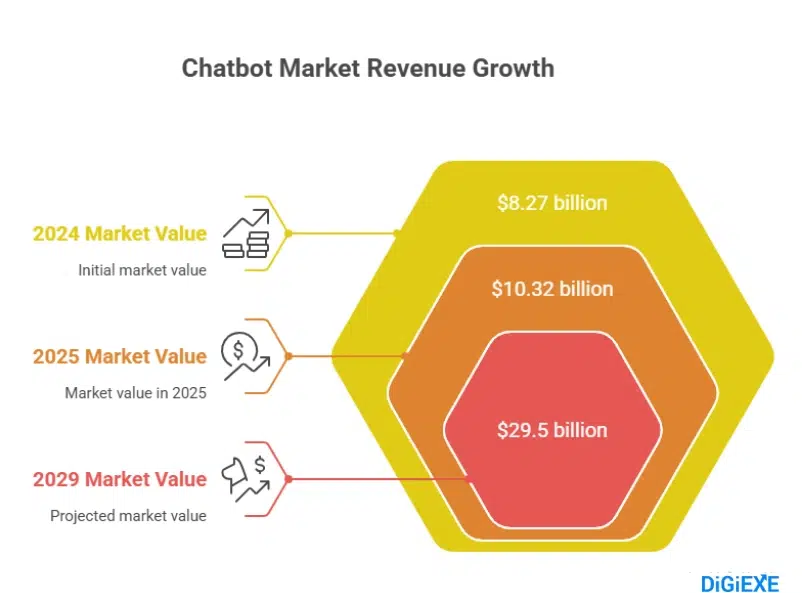
Market revenue underscores the economic impact of chatbots in 2025. The industry achieves $10.32 billion in value, up from $8.27 billion in 2024, with expectations to soar to $29.5 billion by 2029 at a 30 percent compound annual growth rate.
Another estimate places the 2025 market at $15.57 billion, emphasizing variations in projections but consistent upward momentum.
Advancements in personalization drive this expansion, as chatbots tailor responses to user preferences, enhancing satisfaction.
Industry-specific adaptations further fuel growth; for example, healthcare chatbots assist with symptom checking, while recruitment bots screen candidates efficiently.
Security improvements ensure safe data handling, building trust among users. Major trends include the rise of voice-based chatbots that respond to spoken commands, omnichannel support across devices, and ethical AI practices that prioritize fairness and transparency.
Businesses integrate chatbots with virtual assistants and smart devices, creating seamless ecosystems that benefit users by simplifying interactions.
Also read about: DeepSeek AI Statistics
Chatbots in eCommerce: Boosting Sales and Cutting Costs
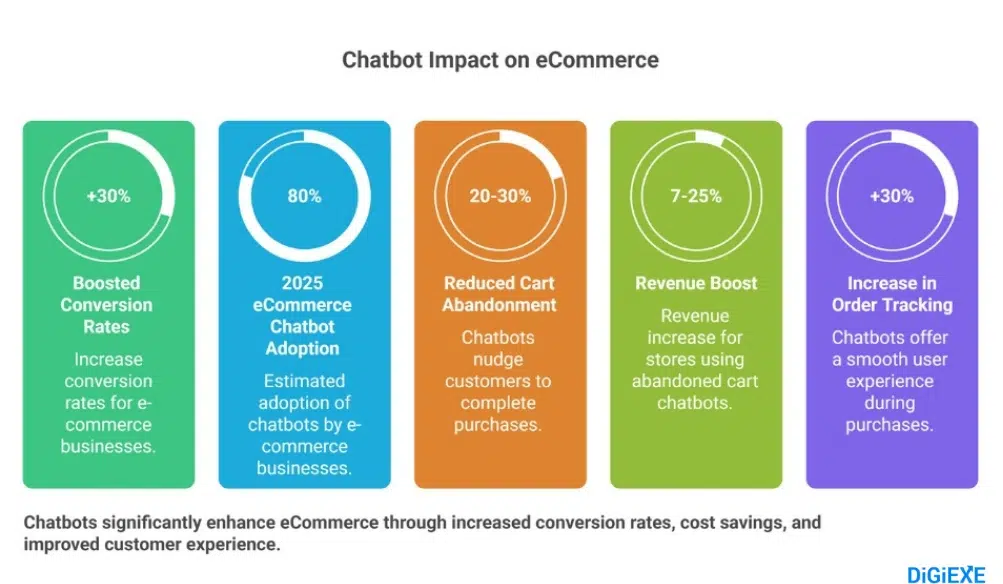
In eCommerce, chatbots prove invaluable by boosting conversion rates and reducing costs. They elevate sales by up to 30 percent through personalized recommendations that guide shoppers toward purchases.
ECommerce businesses cut customer service expenses significantly, as chatbot interactions cost only $0.50 on average compared to $6 for human agents.
Projections show that 80 percent of eCommerce operations will adopt chatbots by 2025, addressing issues like cart abandonment, which decreases by 20 to 30 percent when bots send reminders. Stores using platforms like Facebook Messenger with abandoned cart features experience revenue increases of 7 to 25 percent.
Order tracking improves by 30 percent, providing users with real-time updates that enhance the shopping experience. Overall, chatbots are poised to generate $112 billion in retail sales, empowering small business owners to compete with larger retailers by offering instant support.
Readers interested in applying chatbots for personal gain can start by integrating them into online shopping routines.
For example, a chatbot on a retail site recommends products based on past browsing, saving time and uncovering deals.
Businesses implement these tools to persuade customers back to incomplete purchases, directly increasing profits.
Also read about: Perplexity AI Statistics
Key Benefits of Using Chatbots for Businesses and Individuals
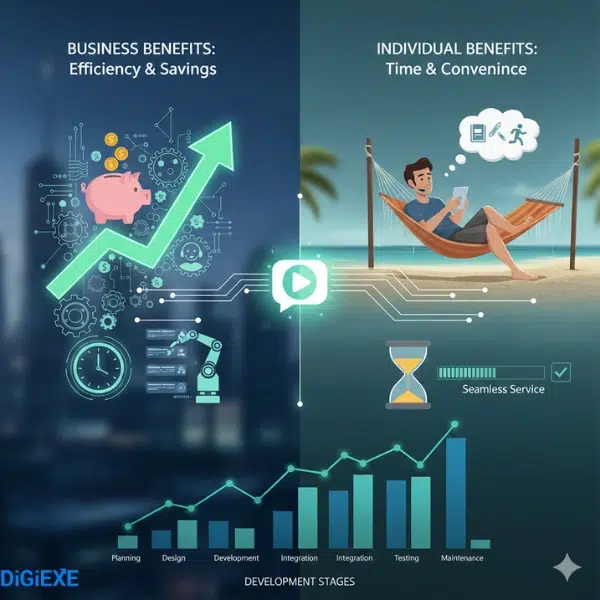
Benefits of chatbots extend beyond commerce, delivering substantial savings and efficiency gains. They save businesses up to 30 percent on customer support costs, amounting to $11 billion in total savings as of recent years.
Chatbots provide 24/7 support across time zones, ensuring users receive help whenever needed. IBM reports that chatbots reduce overall business costs by 30 percent by handling routine inquiries, freeing human staff for complex tasks.
Nearly 42 percent of online shoppers prefer chatbots for seamless service, appreciating the quick resolutions. Consumer satisfaction reaches 80 percent with well-programmed bots that deliver accurate information.
High-quality chatbots achieve response rates of 80 to 90 percent, outperforming traditional agents in speed.
In everyday use, chatbots save 2.5 billion working hours globally, translating to more time for innovation and leisure.
To illustrate the cost savings across development stages, the following table outlines typical ranges for building a chatbot:
| Development Stage | Cost Range |
| Planning and Research | $3,000 – $8,000 |
| Design (UX/UI) | $10,000 – $20,000 |
| Front-end Development | $12,000 – $30,000 |
| Back-end Development | $18,000 – $35,000 |
| Integration | $8,000 – $20,000 |
| Testing | $3,000 – $10,000 |
| Deployment | $4,000 – $12,000 |
| Maintenance and Updates | $8,000 – $20,000 per year |
These figures vary by complexity, with basic rule-based bots costing $5,000 to $25,000 and advanced AI versions ranging from $25,000 to over $500,000.
Industries like SaaS incur higher costs at $50,000 to $80,000 due to integration needs, while education bots range from $25,000 to $70,000.
Chatbots in Business Operations
Businesses incorporate chatbots to enhance sales and operations. They save $8 billion by minimizing support expenses, and 55 percent of companies report higher sales after adoption.
Only 9 percent of users advocate for removing chatbots, indicating widespread acceptance. Customers favor chatbots for reservations, with 33 percent preferring them over phone calls for hotels and restaurants.
Chatbots resolve 90 percent of complaints instantly when queries are clear.
Organizations actively seek ways to implement chatbots, with 80 percent exploring integrations.
Character.AI users have created over 16 million custom chatbots, showcasing creativity that individuals can replicate for personal projects like virtual companions.
Customer Support Revolutionized by Chatbots
In customer support, chatbots personalize interactions effectively. Businesses trust them for tailored service 64 percent of the time, surpassing traditional methods.
Thirty-four percent of customers choose chatbots over phone or in-person contact for convenience. Satisfaction ratings for chatbot support hit 85 percent, trailing only phone support at 91 percent.
While some issues require human intervention, chatbots handle 40 percent of queries without delays.
Forty-eight percent of customers remain indifferent to whether a bot or human assists, as long as resolutions are swift. The insurance sector anticipates $1.3 billion in savings through chatbot adoption.
Chatbots in Everyday Work and Productivity
Everyday work benefits from chatbot integration across sectors. Sales teams use them 41 percent of the time, support functions 37 percent, and marketing 17 percent.
White-collar workers employ chatbots for 70 percent of daily tasks, boosting efficiency. Employees focus on strategic work 64 percent more when bots manage support.
Millennials in the US make purchases via chatbots 67 percent of the time for smoother experiences and offers. Chatbots resolve over 75 percent of user queries, and 40 percent of millennials consult them for deals.
Global Adoption and Regional Insights
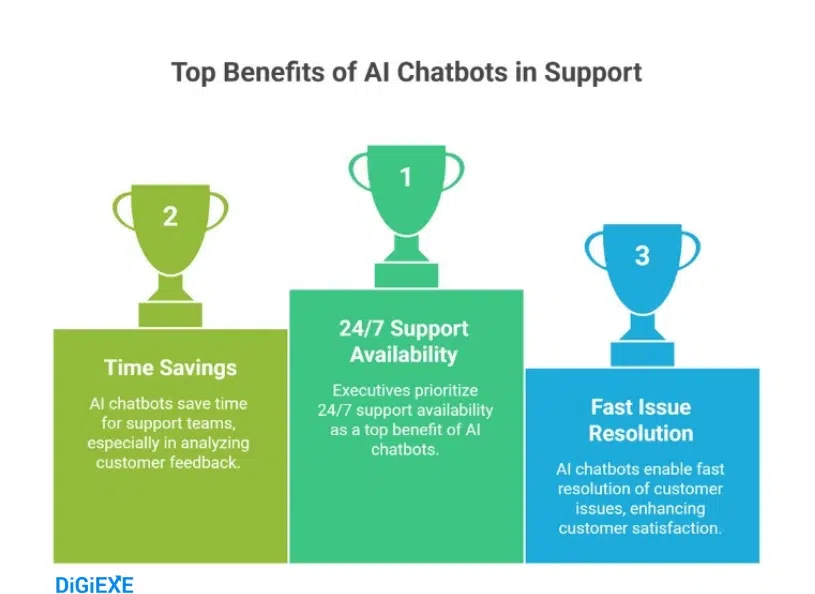
Global adoption reveals strong positive feedback. Eighty-eight percent of customers interacted with chatbots in recent years, and 87 percent rate experiences positively.
Healthcare sees a 10 percent growth spike post-adoption. However, 46 percent prefer human agents for time savings in some cases. Investments reach $4.5 billion for chatbot integrations.
Revenue projections hit $455 million by 2027 with continued adoption. Twenty-seven percent of users cannot distinguish bots from humans, enhancing realism.
A 2018 flashback shows $41 million in revenue, paling against today’s figures. Brands prioritize chatbot development over apps in 2021 trends that persist.
North America holds 30.72 percent market share, Asia Pacific 28.45 percent, Europe 25.34 percent, Latin America 9.52 percent, and Middle East/Africa 5.97 percent. The US leads ChatGPT traffic at 14.18 percent.
Challenges and Limitations of Chatbot Technology
Challenges persist despite advantages. Sixty percent of consumers worry chatbots misunderstand queries. Forty-six percent opt for live support even if bots are faster.
Twenty-five percent report data mishandling like storing sensitive information. Fifty-three percent experience frustration during interactions. Chatbots manage 58 percent of returns but only 17 percent of billing disputes.
Public Perception: Chatbots and Job Impact in the US
US citizens view chatbots’ job impact variably. AI automates tasks like customer service and data entry, creating roles for developers while displacing others. Eighteen percent believe AI reduces jobs, but 25 percent in the 30-44 age group see job creation.
The following table shows US opinions on AI’s job impact by age group:
| Age Group | AI Will Create More Jobs | AI Will Lessen The Number Of Jobs |
| 18 to 29 | 17% | 15% |
| 30 to 44 | 25% | 16% |
| 45 to 64 | 3% | 23% |
| Above 65 | 3% | 27% |
Spotlight on Leading Chatbots: ChatGPT and Google Gemini
ChatGPT dominates with 300 million monthly active users and 100 million weekly ones, surpassing 1 million users in its first week.
Over 2 million developers and 92 percent of Fortune 500 companies utilize it. The site garners over 1 billion monthly visits, totaling 16 billion all-time. Revenue hits $1 billion in 2024.
Google Gemini, rebranded from Bard, attracts 330.9 million monthly visits, trained on 1.56 trillion words. US traffic leads at 37.24 percent, followed by India and Japan.
Market Share Trends in Generative AI Chatbots (November 2025)
Market share in generative AI chatbots as of November 2025 shows ChatGPT at 61.0 percent, Microsoft Copilot at 14.1 percent, Google Gemini at 13.4 percent, Perplexity at 6.4 percent, and Claude at 3.8 percent.
Fastest growers include Claude at 14 percent quarterly increase and Perplexity at 13 percent.
Latest User Insights from Quora and Reddit
Recent discussions on platforms like Quora and Reddit reveal user insights. On Quora, users emphasize hyper-personalization, where chatbots anticipate needs proactively, and multimodal capabilities handling text, voice, and images. Ethical frameworks gain attention, ensuring bias-free responses.
Reddit users highlight shopping integrations, with chatbots enabling instant payments and recommendations. One study notes 55.88 billion visits to top chatbots, underscoring massive engagement.
Users ask about best tools for 2025, favoring ChatGPT for versatility, Claude for business, and Perplexity for accuracy. Concerns include AI’s workplace impact, with studies showing no significant earnings changes yet, but growth in AI job postings by 448 percent.
Small businesses use chatbots for automation, questioning if new launches remain viable in crowded markets—experts suggest niche focus succeeds.
FAQs About Chatbot Statistics
1. What growth does the chatbot market expect in 2025?
The chatbot market achieves significant expansion in 2025, reaching values between $10.32 billion and $15.57 billion, driven by increased adoption in customer service and eCommerce, which allows businesses to enhance efficiency and users to enjoy faster interactions.
2. How do chatbots benefit small businesses?
Chatbots empower small businesses by providing 24/7 customer support without additional staff, reducing costs by up to 30 percent, and increasing sales through personalized recommendations, enabling owners to focus on growth while automating routine tasks.
3. What challenges do users face with chatbots?
Users encounter challenges such as misunderstandings of complex queries in 60 percent of cases, frustration during interactions for 53 percent, and preferences for human support in 46 percent of scenarios, though ongoing improvements in AI address these issues gradually.
4. Which chatbot suits creative tasks best?
ChatGPT excels for creative tasks like writing and idea generation, with over 300 million active users relying on its capabilities to rephrase content, check grammar, and brainstorm, making it ideal for individuals seeking innovative personal or professional applications.
5. How will chatbots evolve in the near future?
Chatbots will incorporate more hyper-personalization and multimodal inputs like voice and images, integrating ethical AI to ensure fair responses, and expanding into shopping with instant payments, benefiting users by creating more intuitive and proactive experiences.
Also Read:
- iPhone Users Statistics
- WhatsApp Users Statistics
- Online Advertising Statistics
- Online Gaming Statistics
- Google Ads Statistics
Conclusion: The Future of Chatbots and How You Can Benefit
Chatbots shape futures by improving efficiency and engagement. Over 987 million users benefit daily, with markets growing to $29.5 billion by 2029.
Companies depend on them for 25 percent of operations by 2027, handling 70 percent of conversations and saving 2.5 billion hours. AI advancements position chatbots as central to productivity.
Source: StatCounter, Statista
