
Personalization reshapes the landscape of customer interactions in 2025, delivering experiences that feel uniquely crafted for each individual.
Businesses that embrace this approach foster deeper connections, while consumers enjoy seamless journeys that anticipate their needs.
Over 71 percent of shoppers express frustration with impersonal encounters, yet 76 percent gravitate toward brands that offer tailored touches.
Moreover, 82 percent of consumers willingly share data when it promises more relevant engagements, highlighting a mutual eagerness for customized value.
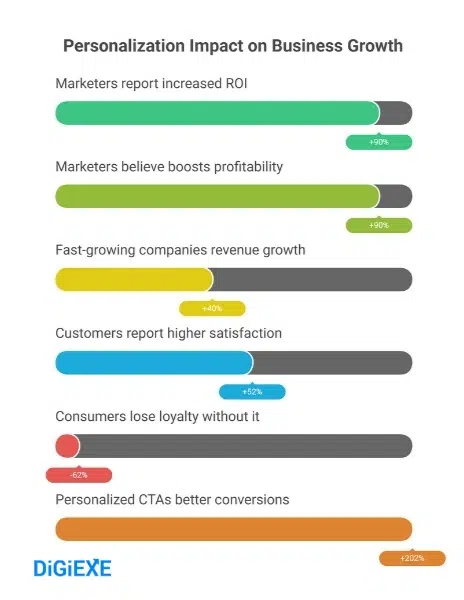
Marketers witness remarkable returns, with nine out of ten reporting improved ROI from these strategies, and 90 percent affirming that personalization elevates profitability.
Despite these advantages, only 35 percent of companies deliver omnichannel personalization, creating opportunities for innovators to stand out.
As artificial intelligence propels 95 percent of customer interactions, personalization becomes not just a trend but a necessity for growth and loyalty.
Readers eager to explore personalization and harness it for personal or business benefits will find in this detailed guide actionable insights, backed by fresh statistics, to transform everyday engagements into powerful advantages.
The Current State of Personalization in [Year]
Businesses declare that over 85 percent of them provide personalized experiences to consumers, yet only 60 percent of shoppers agree they receive such tailoring from brands.
This discrepancy reveals a gap between intent and execution, urging companies to refine their approaches.
Online shoppers, comprising 59 percent, find it simpler to discover appealing products in stores that adapt to their preferences, underscoring personalization’s role in easing navigation.
Brands rely on first-party data for 37 percent of their personalization efforts, ensuring authenticity while navigating privacy concerns.
Consumers demonstrate heightened loyalty, with 80 percent more likely to buy from firms offering customized interactions, a statistic that empowers small business owners to compete through thoughtful adaptations.
Retailers face hurdles, as 96 percent struggle to implement effective personalization, often due to fragmented data or outdated tools.
However, the recommendation engine market surges to $12 billion in 2025, up from $1 billion in 2018, enabling sophisticated suggestions that drive sales.
Loyalty erodes for 62 percent of consumers when brands neglect personalization, emphasizing the cost of inaction.
Quick transactions appeal to 65 percent of shoppers, and 66 percent expect brands to intuitively grasp their desires, fostering satisfaction that rises by 52 percent through targeted efforts.
Privacy worries affect 62 percent, who feel a loss of control over information, yet 36 percent remain loyal to brands that personalize thoughtfully.
Shoppers, at 40 percent, yearn for deeper insights into their styles, while 72 percent rank personalization as their utmost priority.
Marketers, numbering 90 percent among leaders, credit personalization for profitability gains, and a tailored call-to-action boosts conversions by 202 percent.
These dynamics position personalization as a cornerstone for 2025 success, allowing individuals to curate personal brand interactions and businesses to amplify engagement.
To illustrate the variance in adoption, the following table captures key state-of-personalization metrics:
| Metric | Percentage | Insight |
| Businesses claiming personalized delivery | 85% | High intent, but execution lags |
| Consumers confirming receipt | 60% | Gap highlights refinement needs |
| Shoppers finding easier discovery | 59% | Tailoring simplifies journeys |
| Brands using first-party data | 37% | Focus on owned data for trust |
| Increased purchase likelihood | 80% | Loyalty surges with customization |
| Retailers struggling with execution | 96% | Common challenge in scaling |
| Loyalty loss without personalization | 62% | Risk of inaction on retention |
| Expectation of brand understanding | 66% | Core to satisfaction building |
This table empowers readers to assess their own experiences, identifying areas where personalization enhances daily interactions like shopping or content consumption.
Also read about: Infographics Statistics
Business Personalization Statistics: Fueling Revenue and Innovation
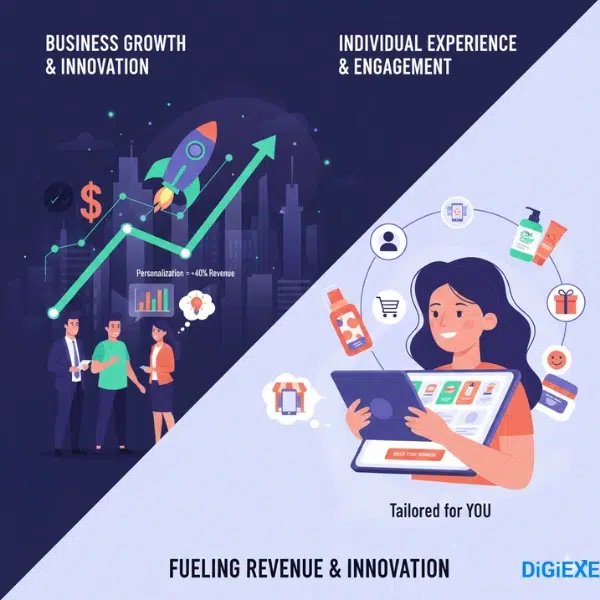
Companies that prioritize personalized experiences generate 40 percent more revenue, a finding from McKinsey that positions tailoring as a growth engine.
United States firms could unlock $1 trillion through intensified efforts, transforming personalization into a trillion-dollar opportunity.
Business leaders, at 75 percent, view it as pivotal to success, enhancing brand image and satisfaction rates. Executives, comprising 43 percent, invest in hybrid experiences where personalization bridges digital and physical realms, boosting overall revenue.
The beauty sector exemplifies innovation, with startups raising $1 billion in 2021 funding, a trend continuing into 2025.
Function of Beauty secures $345 million by quizzing customers on hair needs to craft custom formulas, while Proven Skincare garners $130 million for tailored regimens.
Atolla raises $40 million for skin analysis kits, and ZitSticka! attracts $25 million for acne solutions. Online businesses, at 90 percent, actively invest, particularly post-pandemic small ventures emphasizing customization as their unique selling point.
ECommerce platforms personalize 74 percent of sites, extending to emails and ads for holistic engagement.
Readers can apply these insights by launching personal quizzes on their websites, mirroring Function of Beauty to build direct consumer bonds and increase repeat visits. Such strategies not only drive revenue but also create fulfilling user experiences.
The table below details funding in personalization-focused beauty startups:
| Startup | Funding Raised |
| Function of Beauty | $345 million |
| Proven Skincare | $130 million |
| Atolla | $40 million |
| ZitSticka! | $25 million |
These examples inspire entrepreneurs to seek niche personalization, turning data into bespoke offerings that resonate deeply.
Also read about: Digital Marketing Statistics
B2B Personalization Statistics
B2B companies harness behavioral and transactional data for 68 percent of website personalization, with 72 percent collecting such insights to refine experiences.
Unifying data from multiple systems aids 67 percent, while 61 percent analyze for actionable gains. Backend leverage deepens personalization for 58 percent, and 57 percent extend it across platforms.
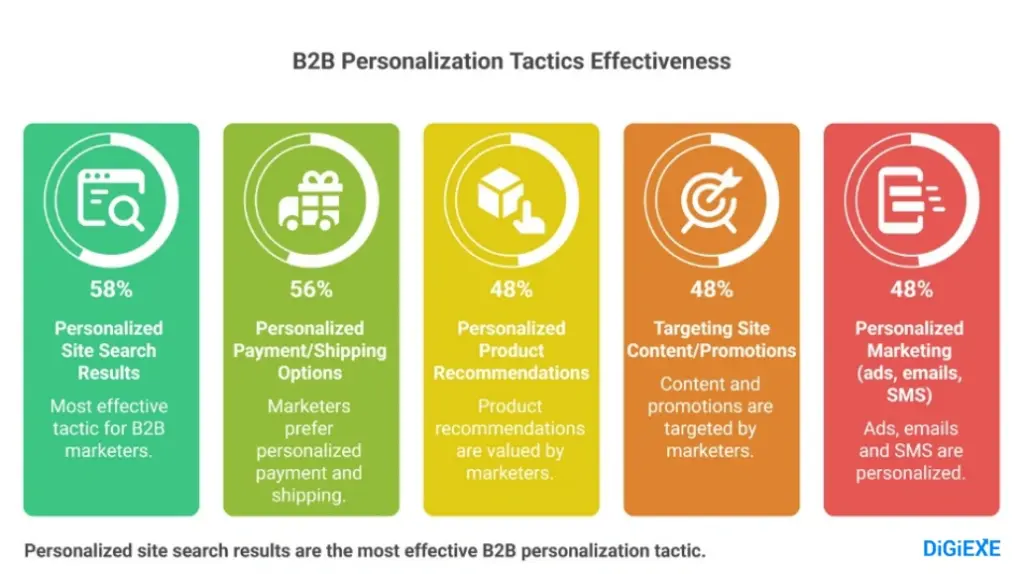
The premier tactic, personalizing site search results, succeeds for 58 percent, followed by tailored payment options at 56 percent and product recommendations at 48 percent. Targeting content to segments matches this at 48 percent, alongside multichannel marketing.
Commerce firms invest 63 percent in user experience improvements, though 40 percent cite personalization as a major challenge.
These statistics guide B2B professionals to prioritize search customization, enhancing lead qualification and deal closures. Individuals in sales roles can adopt similar tactics, personalizing outreach to mirror client behaviors for stronger rapport.
Consider this table outlining top B2B personalization tactics:
| Tactic | Percentage |
| Personalized site search results | 58% |
| Personalized payment/shipping | 56% |
| Personalized product recommendations | 48% |
| Targeting content/promotions | 48% |
| Personalized multichannel marketing | 48% |
By focusing on these, B2B users elevate efficiency, turning data into professional advantages.
Also read about: Google Ads Statistics
Personalized Marketing Statistics
Leading marketers, at 90 percent, deem personalization essential for profitability, as it propels sales and turnover.
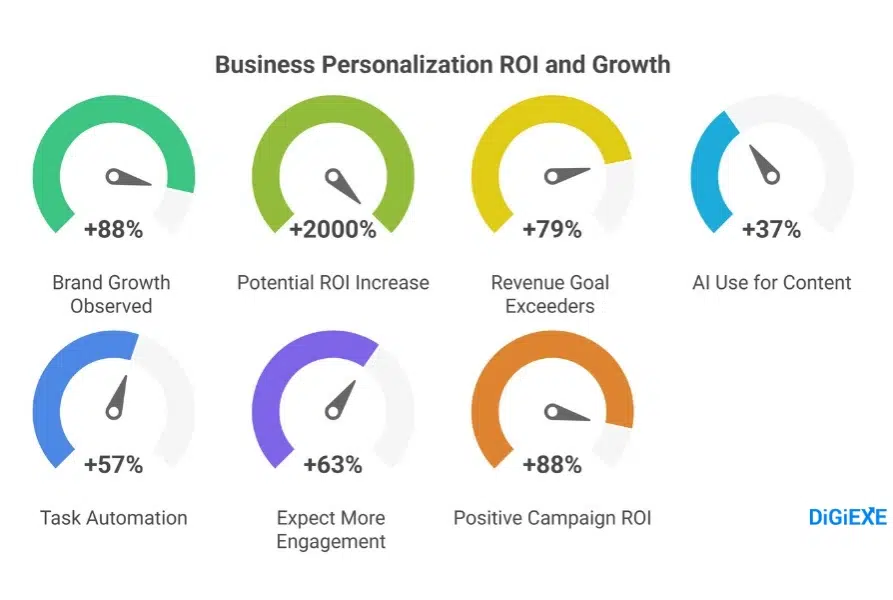
Retail businesses invest 79 percent in tools, while 88 percent aim to elevate customer experiences through it. Content serves as the primary vehicle for 62 percent, with 60 percent claiming extensive digital personalization.
Top applications include product recommendations and predictive service, driving relevance.
Eighty-nine percent of businesses invest overall, blending creativity with data for impact.
Marketers in the US, at 88 percent, observe brand growth from efforts, potentially amplifying ROI by 2000 percent—$20 returns per dollar for advanced users, or 500 to 800 percent for others.
Seventy-nine percent exceeding revenue goals credit personalization, yielding 5 to 15 percent uplifts. Positive ROI emerges for 88 percent in campaigns.
For readers, this means crafting marketing plans around content personalization, like segmenting newsletters to boost opens and clicks, fostering personal brand growth.
Consumer Personalization Statistics: Building Loyalty Through Relevance
Consumers favor personalized brands 76 percent of the time, with 78 percent recommending them for repeat business. Sixty-six percent expect needs understanding, impacting 70 percent loyalty.
Impersonal experiences frustrate 71 percent, repelling 42 percent and causing 63 percent loss. Ninety percent of US customers find it appealing, strengthening relationships for 98 percent of eCommerce firms—yet $756 billion lost globally in 2021 from shortfalls.
Engagement rises 72 percent with personalized messages, though 41 percent find unsolicited texts intrusive. Apology emails charm 41 percent, and 84 percent buy from human-like brands.
Ninety percent share data for discounts. Readers can demand such tailoring, using preference settings to curate feeds and offers that align with lifestyles.
The following table summarizes consumer responses:
| Response Type | Percentage |
| Preference for personalized brands | 76% |
| Expectation of needs understanding | 66% |
| Frustration with impersonal | 71% |
| Likelihood to engage messages | 72% |
| Willingness to share for discounts | 90% |
These empower users to seek value-driven interactions.
Email Personalization Statistics: Crafting Messages That Convert
Brands, at 96 percent, seek email strategy enhancements. Millennials, 70 percent, find irrelevance frustrating. Twenty percent of retail uses demographic tailoring, and 50 percent view email as top personalization.
Personalized subjects lift opens 26 percent, with 55 percent favoring targeted offers. Click-throughs improve for 75 percent, driving sixfold transactions. Fifty-two percent ignore non-personalized emails, and CTAs convert 202 percent better.
Readers benefit by segmenting personal inboxes, unsubscribing from generics to focus on tailored promotions that save time and reveal deals.
Advertising Personalization: Targeting with Transparency
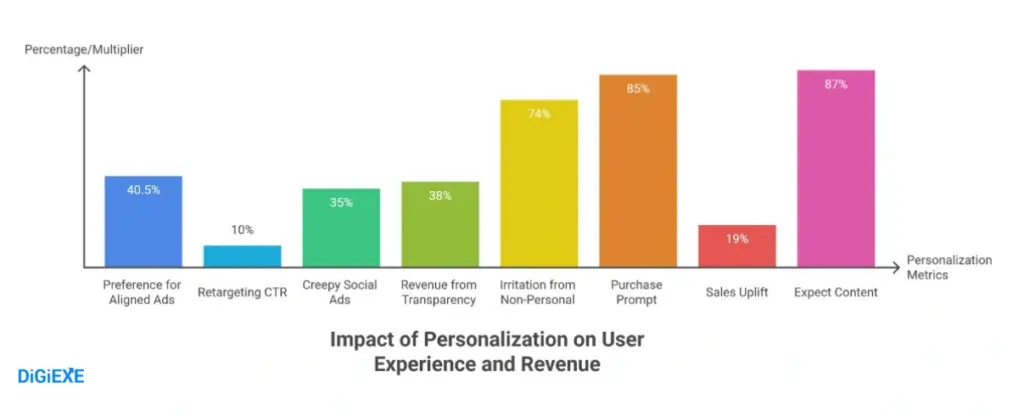
Consumers prefer interest-aligned ads 40.5 percent, trading data for relevance. Retargeting yields 10 times CTR over displays, though 35 percent deem social retargeting creepy.
Transparency boosts revenue 38 percent, with acceptance up 19 percent. Ninety-six percent in media personalize.
Businesses gain by auditing ad preferences, ensuring alignments that enhance discovery without overwhelm.
Website Personalization Statistics: Enhancing User Journeys
Seventy-four percent irritate over non-personalized sites, with 83 percent lower responses from poor content.
Customized homepages prompt 85 percent purchases, uplifting sales 19 percent. Professionals, 87 percent, note expectations for tailored content.
Users can enable cookies selectively for better site adaptations, streamlining research or shopping.
E-Commerce Personalization: From Cart to Conversion
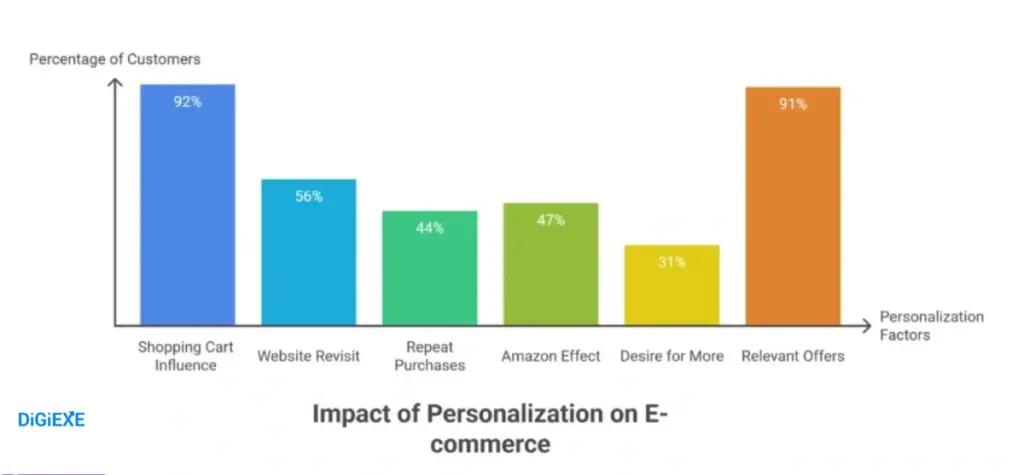
Custom recommendations influence 92 percent in carts, with 56 percent revisiting sites.
Forty-four percent repurchase post-good experiences, 47 percent switching to Amazon otherwise. Thirty-one percent desire more, and 91 percent shop relevant offers.
Shoppers apply by setting profiles for suggestions, reducing decision fatigue.
The table below highlights eCommerce impacts:
| Impact Area | Percentage |
| Influenced by cart recommendations | 92% |
| Revisit with personalization | 56% |
| Repurchase likelihood | 44% |
| Switch without it | 47% |
| Shop relevant offers | 91% |
Benefits of Personalization: Efficiency, Engagement, and Relationships
Personalization increases marketing spend efficiency 30 percent, advancing relationships for 98 percent of marketers. Visitor engagement tops benefits at 55 percent.
Individuals leverage for curated content, enhancing learning or wellness.
The Future of Personalization: AI, Ethics, and Hyper-Relevance
Over 66 percent of American companies plan increased investments, favoring first-party data 61 percent. Marketers, 58.1 percent, need more consumer info, with 83 percent sharing for experiences.
AI drives 95 percent interactions, with 92 percent using it for growth. Leaders, 60 percent, see acquisition gains, 47 percent accuracy, 44 percent speed and retention.
Trends forecast AI at scale, zero-party data, emotional intelligence, ethics, and predictive campaigns. By 2028, 20 percent of apps use adaptive AI.
Challenges in Personalization: Navigating Privacy and Relevance
Consumers see unwanted recommendations 58 percent, disliking unshared data use 28 percent. Marketers, 39 percent, blame data lacks.
Solutions involve transparent opt-ins, balancing benefits.
Latest Insights from Quora and Reddit: User Questions and Emerging Trends
Discussions on Quora and Reddit pulse with 2025 queries, like “How can AI-driven personalization enhance customer experience?” where users praise predictive intent and hyper-relevant content via chatbots.
On Reddit’s r/DigitalMarketing, threads query “What marketing strategies drive results in 2025?” emphasizing super-personalized emails that double conversions when timely.
Quora users ask “What tools lead AI transformation?” highlighting hyper-personalization at scale with platforms like Klaviyo AI. Reddit’s r/Design spotlights eCommerce trends, noting AI for dynamic pricing reduces churn.
Questions like “Best practices for email in 2025?” stress mobile optimization and segmentation.
Emerging from r/agency: volume-based cold emails fade, favoring custom value hooks. r/OdysseyBookClub discusses AI in self-improvement apps, adapting to emotional states per Deloitte 2025.
These conversations reveal authenticity’s rise, blending AI with human touch for trust, and niche focus for small brands.
Users seek ethical frameworks to avoid “creepy” feels, with 68 percent of Gen Z using AI tools per McKinsey. Reddit warns against over-reliance on trends without strategy, advocating data-backed personalization for micro-communities.
How Personalization Maximizes Results: From Revenue to Loyalty
Advanced personalization makes brands 48 percent more likely to exceed revenue, 71 percent for loyalty, 67 percent for frequency. It trims waste, deepens engagement, speeds decisions.
Readers track personal metrics, like app adaptations for productivity.
FAQs About Personalization Statistics
1. How does AI-driven personalization benefit small businesses in 2025?
AI boosts small businesses by automating personalized recommendations, increasing conversions by 202%, and cutting costs, enabling loyalty-building without large teams.
2. What challenges do consumers face with personalization, and how can they overcome them?
Consumers face irrelevant recommendations (58%) and privacy concerns (28%). They can adjust preferences and opt into transparent data programs for exclusive perks.
3. Why is email personalization crucial for marketing success this year?
Email personalization increases open rates by 26% and transactions sixfold, helping brands drive immediate actions and long-term engagement with higher click-throughs.
4. How can individuals use website personalization for personal growth?
Website personalization on learning platforms adapts to preferences, boosting session effectiveness by 85%, helping users grow skills in areas like wellness and career.
5. What future trends in personalization should readers prepare for?
Prepare for emotional AI, real-time sentiment-based personalization, and zero-party data, which will shape predictive, privacy-conscious experiences by 2028.
Also Read:
- DeepSeek AI Statistics
- Microsoft Teams Statistics
- Voice Search Statistics
- ChatGPT Statistics
- Google Ads Statistics
Conclusion: Embrace Personalization for a Tailored Tomorrow
Personalization thrives in 2025, with 59 percent easier discoveries and 80 percent purchase boosts. AI powers 95 percent interactions, yet 96 percent retailers challenge execution.
Over 987 million engage daily, markets to $12 billion. Invest now for loyalty and growth.
