
Software as a Service (SaaS) has become a fundamental driver of modern business operations.
In today’s fast-paced digital world, SaaS provides businesses with the ability to access powerful software solutions without the burden of installation, maintenance, and high upfront costs.
In 2025, SaaS continues to redefine business operations across industries, enabling companies to automate processes, improve productivity, and scale with ease.
This guide dives into key SaaS statistics, offering market insights, adoption trends, and practical strategies for businesses to harness SaaS for growth and efficiency.
Global SaaS Market Growth
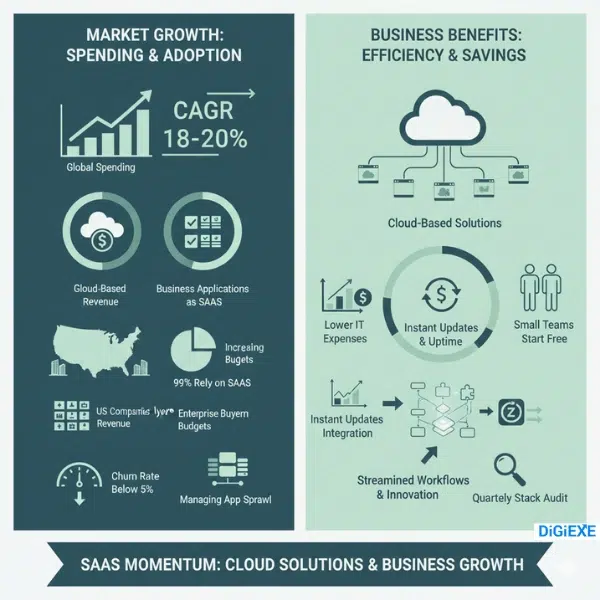
The global SaaS market is experiencing explosive growth, with projections showing it will reach $299.07 billion in 2025, slightly down from $317.55 billion in 2024.
However, this growth trajectory remains strong, with the market expected to grow to $793.1 billion by 2029. SaaS has become a critical tool for businesses worldwide, and its widespread adoption is driving this market expansion.
SaaS Industry Growth Rate
- Compound Annual Growth Rate (CAGR): 18.4% (2023–2032)
- SaaS Market Size (2025): $299.07 billion
- SaaS Market Size (2024): $317.55 billion
- SaaS Market Size (2023): $273.55 billion
The significant expansion of the SaaS market reflects its growing importance as companies increasingly turn to cloud-based software solutions to enhance their agility and competitiveness.
Also read about: SaaS SEO Guide 2025
SaaS Adoption Rates and Industry Demand

SaaS adoption continues to rise across industries, with 85% of all business applications now operating on SaaS platforms.
This widespread adoption is further boosted by industries such as healthcare, retail, and e-commerce, which are projected to see rapid SaaS growth.
SaaS Adoption by Industry
- Healthcare: 20% annual growth
- Retail/E-commerce: 23.6% CAGR, expected to reach $138.9 billion by 2027
- BFSI (Banking, Financial Services, and Insurance): 19.2% CAGR, expected to reach $130.7 billion by 2027
These trends show how sectors like retail and healthcare are embracing SaaS to streamline operations, improve customer service, and maintain compliance.
Key SaaS Statistics for 2025
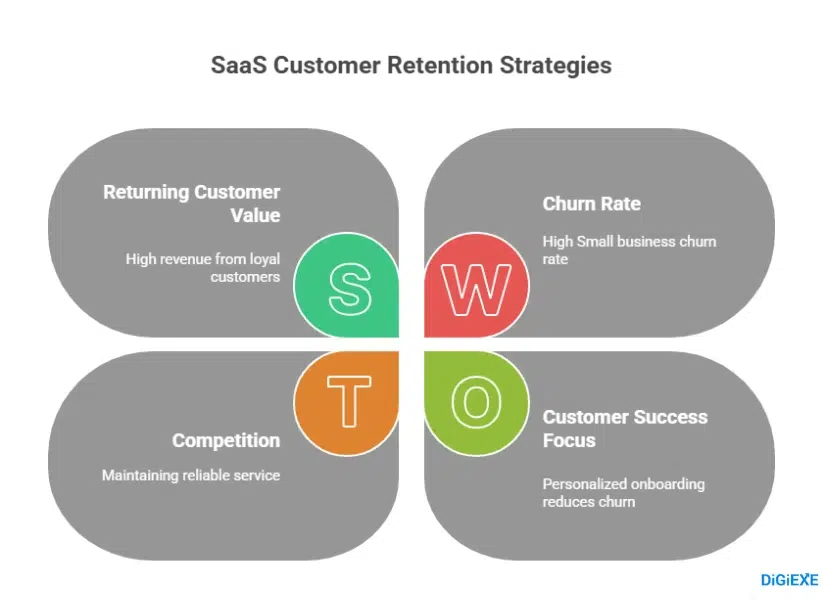
Several key statistics highlight the importance of SaaS in business today. For example:
- 99% of businesses deploy at least one SaaS application.
- Small businesses lead with 78% SaaS adoption, benefiting from the low cost and high ROI of these tools.
- Large organizations use an average of 447 SaaS apps per business, reflecting the need for robust management and integration platforms.
- The average spend per employee on SaaS reached $92.19 in 2024, expected to rise as remote work tools continue to expand.
Also read about: 6+ Popular Software as a Service (SaaS) Examples
SaaS Market Evolution: Historical Growth and Future Projections
Looking at the historical trajectory of the SaaS market, we can see consistent growth over recent years:
| Year | Market Size (USD Billion) | Growth Rate (%) |
| 2020 | 178 | – |
| 2021 | 197 | 10.7% |
| 2022 | 217 | 10.2% |
| 2023 | 273.55 | 26.1% |
| 2024 | 317.55 | 16.1% |
This data reveals a 500% expansion in the SaaS industry over the past seven years, with consistent annual growth.
The Rise of AI in SaaS
AI is transforming SaaS, with 95% of SaaS applications incorporating AI to power features like automation, predictive analytics, and customer personalization.
The AI SaaS market alone is expected to reach $101.73 billion by 2025, growing at a 39.4% CAGR. AI technologies help businesses automate workflows, improve decision-making, and enhance customer experiences.
Impact of AI on SaaS
- 70% of companies now monetize AI features, streamlining tasks and enhancing decision-making.
- 51% of SaaS applications use generative AI to create content, predict trends, and automate processes.
AI adoption is a critical growth area for SaaS, helping companies enhance efficiency and customer satisfaction.
SaaS Pricing Models and Subscription Trends
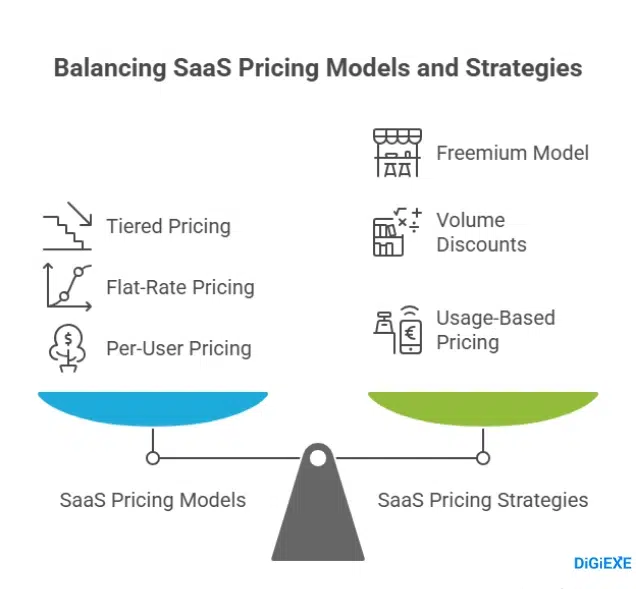
Pricing models for SaaS solutions continue to evolve. In 2025, the following models dominate:
- Per-user pricing (54%) is favored for its simplicity and transparency.
- Usage-based pricing (38%) is growing in popularity for its fairness, aligning costs with value.
- Tiered and flat-rate pricing remain prevalent, providing options based on the scale of usage.
SaaS Subscription Growth
With inflation at 8.7% and subscriptions rising 9% year-over-year, businesses are expected to refine their pricing strategies to remain competitive.
Many SaaS businesses are experimenting with freemium models and tiered pricing to lower entry barriers and increase conversion rates.
Also read about: Most Searched Things on Google Statistics
SaaS Security Challenges and Solutions
Security is a top concern for SaaS users, as 55% of organizations have faced security incidents in the past two years. With rising data breaches and increased risks related to AI tools, businesses must adopt robust security measures, including:
- Multi-factor authentication and regular security audits.
- Centralized security teams and better monitoring to avoid data leaks and breaches.
Many companies are also focusing on compliance and data protection through dedicated teams to ensure their SaaS solutions meet the highest security standards.
Regional SaaS Market Insights
SaaS adoption varies across regions, with North America, Europe, and Asia-Pacific leading the charge.
Key projections for the global SaaS market in 2025 include:
| Region | No. of SaaS Companies | Projected 2025 Revenue (USD Billion) |
| United States | 9,100 | 221.50 |
| United Kingdom | 1,500 | 25 |
| Canada | 992 | 15 |
| Germany | 840 | 16.3 (EUR) |
| India | 711 | 9.22 |
| China | 443 | 37.98 |
North America remains the dominant player, contributing 46% of the global SaaS market share.
However, emerging markets like India and China are also witnessing rapid growth, with India’s SaaS market projected to reach $9.22 billion by 2025.
Marketing and Sales Strategies for SaaS
SaaS companies invest heavily in marketing and sales efforts to fuel growth. B2B SaaS cycles average 69 days, with 15% of budgets allocated to marketing. Tactics that drive SaaS marketing success include:
- Email marketing (84%)
- Social ads (75%)
- Content marketing (69%)
Moreover, blogs generate 67% more leads, helping businesses scale organically through content and SEO strategies.
The Future of SaaS: Trends to Watch
Several key trends are shaping the future of SaaS:
- AI and automation will continue to dominate, with SaaS companies investing heavily in AI-powered tools for efficiency.
- Low-code/no-code platforms will triple in usage, empowering non-technical teams to develop and deploy SaaS applications.
- Micro-SaaS solutions, targeting niche markets with $1K-$30K MRR, will grow in popularity.
FAQs About SaaS Statistics
1. What is the projected growth rate for the SaaS market in 2025?
The SaaS market is projected to grow at a 18.4% CAGR through 2032, reaching $299.07 billion in 2025.
2. How can small businesses benefit from adopting SaaS in 2025?
Small businesses can streamline operations and cut costs with SaaS, enabling fast ROI and scalable solutions.
3. What role does AI play in the future of SaaS?
AI is a major driver in SaaS, powering 95% of applications and contributing to the $101.73 billion AI SaaS market by 2025.
4. How can I manage SaaS sprawl and security risks in my organization?
Regular audits and centralized security systems help reduce SaaS sprawl and mitigate risks, ensuring compliance and data protection.
5. What pricing models should I consider for my SaaS product in 2025?
Consider per-user pricing or usage-based models to align costs with customer needs, while exploring freemium options for organic growth.
Also Read:
- DeepSeek AI Statistics
- Chatbot Statistics
- Google Ads Statistics
- Voice Search Statistics
- Gemini Users Statistics
Conclusion: Embrace the SaaS Revolution
SaaS statistics for 2025 show that the industry is thriving, with global market projections reaching $299 billion.
As AI continues to drive innovation and adoption accelerates across industries, businesses that embrace SaaS will gain a competitive edge.
Whether you’re a small business looking for cost-effective solutions or a large enterprise seeking scalable tools, SaaS provides the flexibility, innovation, and efficiency required to thrive in the digital era.
By adopting these insights and strategies, businesses can unlock explosive growth and stay ahead of the curve in an ever-evolving market.
