

Email marketing remains one of the most effective digital strategies in 2025, delivering unmatched ROI—between $36 and $50 for every $1 spent.
Retail and e-commerce often hit $45, thanks to email’s direct, personalized messaging that builds trust and drives conversions.
With over 4.48 billion daily users sending 361.6 billion emails, the channel’s reach is vast. Nearly 99% of users check their inboxes daily, offering endless touchpoints for brands.
This guide explores the latest email marketing statistics for 2025, from global usage trends to the rise of AI and zero-party data.
Whether you’re focused on retention or lead nurturing, these insights will help you boost open rates, drive clicks, and maximize ROI.
Platforms like Quora and Reddit also offer real-world tips on avoiding spam filters and improving personalization.
With email projected to generate $13.69 billion this year and drive 58% of total marketing revenue, it remains a critical tool for sustainable growth.
Global Email Usage and Market Growth in 2026
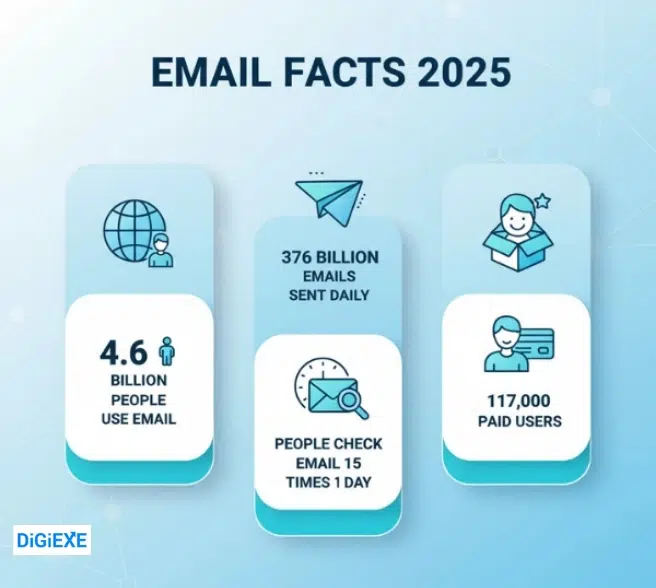
Email’s global reach expands relentlessly, providing marketers with a vast audience primed for engagement.
In 2025, an estimated 4.48 billion people actively use email, a figure that climbs from 4.37 billion in 2023 and edges toward 4.6 billion by year’s end.
This growth reflects email’s evolution from a basic communication tool into an indispensable part of daily life and commerce.
Projections indicate that by 2027, the user base will swell to 4.85 billion, driven by increasing internet penetration and the rise of mobile access. Businesses tap into this by segmenting lists based on user behavior, ensuring messages resonate and prompt action.
The sheer scale of email traffic amplifies its marketing power. Every second, more than 3.13 million emails zip across networks, culminating in over 376 billion daily exchanges.
This torrent includes everything from casual notes to high-stakes promotions, but marketers who focus on quality over quantity reap the rewards.
For instance, 63% of companies prioritize customer engagement emails, which build rapport and encourage repeat interactions.
As a result, email marketing’s market value surges; experts forecast it will hit $36.3 billion by 2033, growing at a compound annual rate of 11.7% from $14.8 billion in 2025.
To visualize this trajectory, consider the following table, which outlines worldwide email users by year. These numbers, sourced from reliable analyses, help you benchmark your list growth against global trends and set ambitious targets for expansion.
| Year | Number of Email Users Worldwide |
| 2023 | 4.37 billion |
| 2024 | 4.48 billion |
| 2025* | 4.60 billion |
| 2026* | 4.73 billion |
| 2027* | 4.85 billion |
Source: Statista
*-projected numbers
Similarly, email marketing revenue paints a picture of explosive potential. Starting from $7.5 billion in 2020, the industry now generates $13.69 billion in 2025, with forecasts pushing it to $17.9 billion by 2027.
This 13.3% CAGR arises from email’s high ROI and adaptability to trends like AI personalization.
For your business, this means investing in email now positions you for scalable profits.
Start by auditing your subscriber list to ensure it mirrors these growth patterns—aim to add 10-15% more subscribers quarterly through opt-in forms on your website.
By aligning with global expansion, you not only reach more people but also capitalize on the 78% of marketers who integrate email into multichannel strategies for amplified impact.
Daily volumes tell another compelling story. By 2027, emails will exceed 408 billion per day, up from 376 billion in 2024. Gmail dominates with 1.8 billion users, holding a 26.72% share of clients, while Apple leads overall at 51.52%.
These providers influence deliverability, so test your campaigns across platforms to maintain high inbox placement rates.
Businesses that do this see sustained growth, as email’s role in content distribution—chosen by 79% of B2B marketers—fuels lead nurturing and sales pipelines.
Also read about: Email Copywriting Tips for Attracting Customer Reviews 2025
ROI and Performance: Why Email Delivers Unmatched Returns
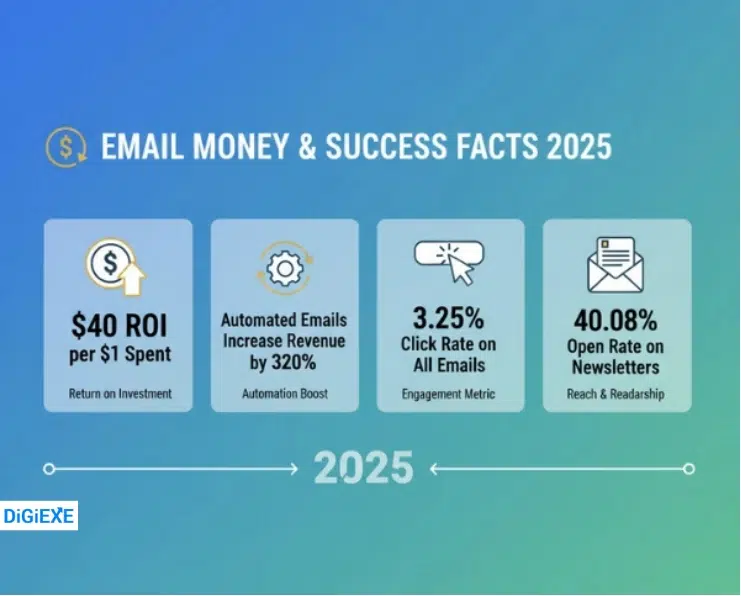
No discussion of email marketing statistics for 2025 omits its stellar ROI, which consistently outpaces competitors. Marketers earn an average of $36 for every $1 spent, with ranges stretching to $40 or even $50 in optimized scenarios.
Retail, e-commerce, and consumer goods sectors lead with $45 returns, thanks to targeted promotions that convert browsers into buyers.
This efficiency makes email 40 times more effective than social media for acquiring customers, a fact that 80% of marketers affirm by prioritizing it over platforms like Facebook or Twitter.
Performance metrics reinforce this dominance. Email campaigns yield a 3600% ROI overall, far surpassing other channels. Nearly half of companies report returns between 10:1 and 50:1, and those sending daily emails achieve click-through rates above 5%.
To leverage this, track your ROI using formulas like (Revenue from Email – Cost of Campaign) / Cost of Campaign x 100. For example, if a $500 campaign generates $18,000 in sales, your ROI hits 3500%—a benchmark many achieve through automation.
The table below illustrates email marketing revenue growth, highlighting why forward-thinking businesses allocate budgets here. Use it to justify investments to stakeholders, showing how projections align with your fiscal goals.
| Year | Email Marketing Revenue |
| 2020 | $7.5 billion |
| 2021 | $8.49 billion |
| 2022 | $9.62 billion |
| 2023 | $10.89 billion |
| 2024 | $12.33 billion |
| 2025* | $13.69 billion |
| 2026* | $15.81 billion |
| 2027* | $17.9 billion |
Source: eMarketer
*-projected numbers
Automation plays a pivotal role, boosting qualified leads by 451% for nurturing efforts. Companies dedicating over 15% of budgets to email report open rates of 20-40%, with 33% hitting 20-30%.
For your benefit, implement tools like drip sequences for abandoned carts, which recover 60% of lost sales. This not only pads revenue but also strengthens retention—80% of professionals credit email for keeping customers coming back.
Also read about: Benefits of Digital Marketing
Engagement and Open Rates: Crafting Emails That Captivate
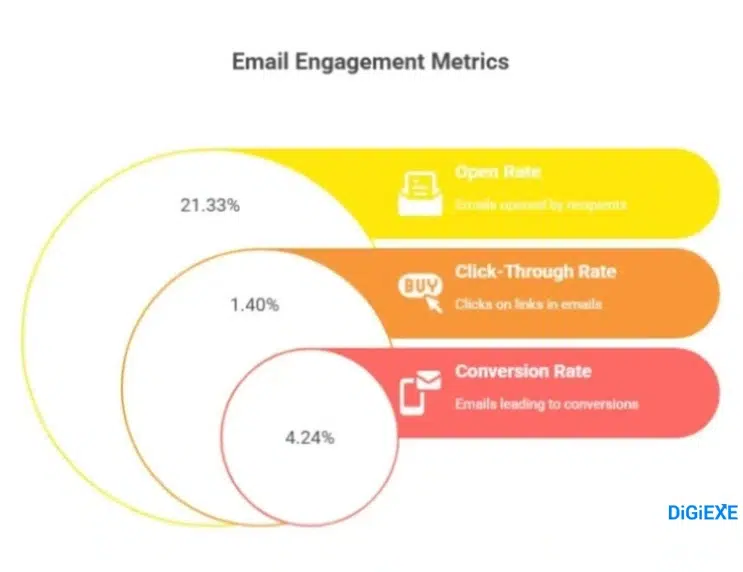
Engagement defines email’s success, and 2025 statistics reveal benchmarks that guide high-performing campaigns. The average open rate stands at 21.33% across industries, though ecommerce edges higher at 29.8% and government emails peak at 28.77%.
A solid target ranges from 17% to 28%, but you can surpass this by personalizing subject lines, which lift opens by 50%.
Marketing and advertising emails average 17.38%, yet videos embedded within boost click rates by 300%, turning passive readers into active engagers.
Click rates average 1.40%, with faith-based organizations leading at 2.46%. Over 60% of users click links in promotional emails, signaling strong intent when relevance shines.
Bounce rates hover at 2%, a low figure that underscores clean list hygiene—remove inactives quarterly to maintain deliverability. Welcome emails excel here, achieving 68.6% opens and four times the engagement of others, making them ideal for onboarding.
To apply this, A/B test subject lines like “Unlock Your Exclusive Discount” versus generic ones; the personalized version often doubles response. Businesses that do see 23% higher click-to-open ratios in B2B contexts, proving engagement’s direct link to revenue—59% of B2B marketers name email their top generator.
Personalization: The Key to Deeper Connections and Higher Conversions
Personalization transforms standard emails into tailored conversations, driving 2025’s most effective campaigns. Personalized messages secure 29% open rates and 41% click-through rates, with 27% higher unique clicks and 11% better opens overall. They deliver six times higher transaction rates and a median 122% ROI, as 75% of marketers attest to elevated clicks from dynamic content like user-specific recommendations.
Fifty-four percent of marketers personalize based on behavior, location, or history, while 65% favor dynamic tactics. Yet, 52% of consumers switch brands if emails feel impersonal, emphasizing relevance. Targeted efforts account for 58% of revenue, so segment lists by past purchases to suggest upsells— this tactic influences 59% of buying decisions.
In practice, use merge tags for names and AI for product suggestions; Quora users frequently ask how to scale this without overwhelming teams, recommending tools like Klaviyo for seamless integration. On Reddit’s r/EmailMarketing, threads highlight zero-party data—preferences users voluntarily share—as a 2025 must-have for GDPR compliance, boosting trust and opens by 15-20%.
The impact shines in numbers: Brands personalizing see 71% higher automation success. Start small by adding “Hi [Name]” and evolve to behavioral triggers, watching conversions climb.
User Behavior and Daily Habits: Timing Your Reach Perfectly
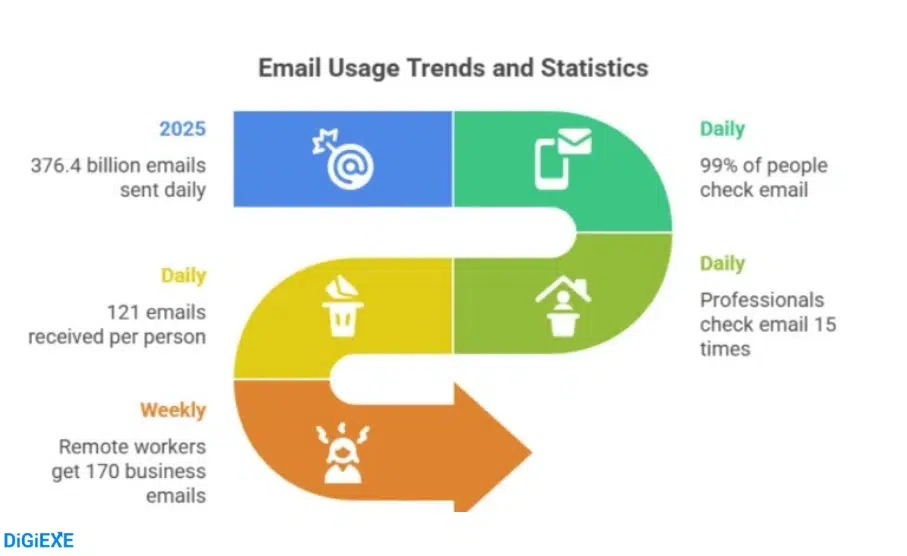
Users interact with email habitually, offering marketers windows of peak attention. Ninety-nine percent check inboxes daily, with professionals averaging 15 views and heavy users spending 8.8 hours weekly.
Fifty-eight percent consult email before social media or news, and consumers dedicate 10 seconds per brand message—enough time for a compelling hook.
Individuals receive 121 emails daily, remote workers 170 weekly for business. Eighty-six percent maintain multiple accounts, averaging 1.75 per person, so cross-platform consistency matters. Gmail users hoard over 17,000 messages, signaling tolerance for value-packed sends.
Leverage this by sending 9 a.m. to 3 p.m. on Tuesdays through Thursdays, when opens peak.
Twenty-two percent of marketers dispatch 2-3 emails daily, 21% one per day, and 12% weekly—match your frequency to audience tolerance via analytics.
Reddit discussions in r/marketing reveal users craving “value-first” content, like tips over hard sells, reducing unsubscribes by 30%.
Mobile Optimization: Meeting Users Where They Scroll
Mobility reshapes email in 2025, with 47% accessing via apps and 81% preferring smartphones for opens and replies. Twenty-one percent favor tablets, and 1.7 billion use mobiles versus 0.9 billion desktops.
Three in five check on the go, yet 42.3% delete non-responsive designs—optimize to gain 15% more unique mobile clicks.
Sixty-four percent of web traffic is mobile, and U.S. smartphone users near 327.54 million by 2029.
Thirty-five percent of professionals respond via phone, so ensure thumb-friendly buttons and fast loads. Litmus reports 47% test renders across devices; adopt this to avoid 80% of experts prioritizing mobile tools.
For benefits, redesign templates with single-column layouts and alt-text images. Quora queries on “mobile email pitfalls” stress AMP for emails, enabling interactive elements like polls that lift engagement 25%.
AI’s Role: Automating Smarter, More Effective Campaigns
AI revolutionizes email in 2025, with 51% of marketers deeming it superior to traditional methods. Forty-three percent use generative AI for creation, 95% finding it effective, and 57% of large firms (500+ employees) deploy it for personalization—yielding 41% revenue gains and 13.44% CTR boosts. Forty-seven percent apply it to retargeting.
By 2026, 89% expect AI to handle 75% of operations, from segmentation to drafting. Nine in 10 marketers desire this shift, easing content burdens—30% cite creation as their top skill need.
On Reddit’s r/AIinMarketing, users share how tools like Hostinger Reach generate full campaigns from prompts, slashing design time by 80% for non-experts.
Implement AI by starting with subject line generators; track how it elevates your 35.63% average open rate toward 40%.
B2B Email Mastery: Nurturing Leads for Long-Term Wins
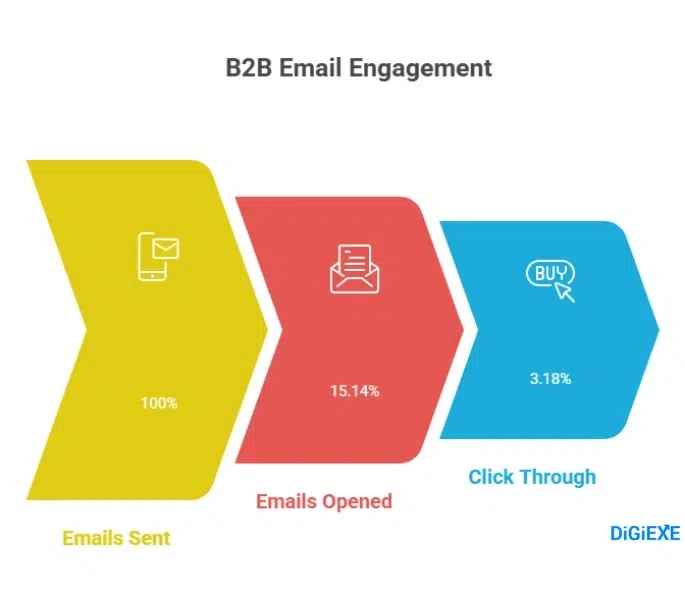
B2B thrives on email, with 81% of marketers favoring newsletters as their top method and 77% integrating them strategically.
Opens average 15.14%, clicks 3.18%, and CTR 21%—23% higher click-to-open than B2C. Sixty-four percent personalize with dynamic content, 93% distribute via email, and 59% credit it for revenue.
Thirty-one percent use newsletters for lead nurturing, with 71% sending them in 2024. To benefit, automate sequences for 451% more qualified prospects; Quora threads on B2B fatigue suggest capping at biweekly sends.
B2C Dynamics: Driving Impulse and Loyalty
B2C emails shine in immediacy, with 72% using software for distribution and 87% automating growth. Fifty percent buy monthly from emails, 91% welcome promotional ones, and 34% act on discoveries.
Opens average 19.7%, with 60% recovering abandoned carts via personalization.
Eighty percent boost retention, and 42.3% subscribe for discounts—1 in 3 purchases from lists. Reddit users in r/ecommerce rave about interactive emails, like quizzes, spiking conversions 20%.
Empowering Small Businesses: Acquisition and Retention Simplified
Sixty-four percent of small businesses use email, 81% for acquisition, 80% retention, and 89% lead gen.
Automation yields 451% prospect growth. Start with free tools like Mailchimp to segment and track, mirroring big-league ROI.
Optimal Send Times and Frequencies: Science-Backed Scheduling
Forty percent send weekly, basing times on benchmarks (40%), data (35%), or AI (31%). Daily sends hit 5%+ CTR; tailor to industry—daily for publishers, biweekly standard.
Emerging Trends: Insights from Quora and Reddit
Communities buzz with 2025 innovations. Quora users query interactive emails’ rise, noting 25% engagement lifts via polls/carousels.
Reddit’s r/EmailMarketing debates privacy, pushing zero-party data for 15% trust gains amid CCPA scrutiny. Users also hail blockchain for verification, reducing spam by 40%—integrate via tools like Validity to future-proof.
FAQs About Email Statistics
1. How can small businesses start email marketing effectively in 2025?
Small businesses can begin by building a clean subscriber list through website opt-ins and offering value like exclusive tips, then use free tools to send personalized weekly newsletters that focus on retention and acquisition for quick ROI gains.
2. What role does AI play in improving email open rates?
AI enhances open rates by generating dynamic subject lines and content tailored to user behavior, with marketers reporting up to 13.44% higher clicks and 41% revenue increases when implementing these features across campaigns.
3. Why is mobile optimization crucial for email success?
Mobile optimization ensures emails load swiftly on smartphones, where 81% of users open them, preventing 42.3% deletions from poor designs and boosting unique clicks by 15% through responsive layouts.
4. How does personalization influence customer purchases?
Personalization sways 59% of consumers toward purchases by delivering relevant recommendations, achieving 29% open rates and six times higher transactions compared to generic sends.
5. What are the best practices for email frequency to avoid unsubscribes?
Marketers should send 2-3 emails weekly on Tuesdays through Thursdays between 9 a.m. and 3 p.m., monitoring engagement data to adjust and incorporate value-driven content that reduces fatigue.
Also Read:
- LinkedIn Statistics
- Semrush Statistics
- Instagram Statistics
- X (Twitter) Statistics
- Google Searches Statistics
Conclusion: Harness Email’s Power for 2026 Success
In 2025, email marketing solidifies its position as the undisputed champion of digital strategies, empowering businesses of all sizes to achieve extraordinary returns—averaging $36 to $50 for every dollar invested—while reaching over 4.59 billion users worldwide who check their inboxes daily with unwavering habits.
By embracing personalization that drives 29% open rates and 41% clicks, mobile optimization capturing 81% of smartphone opens, AI enhancements boosting revenue by 41%, and timely sends on peak days like Tuesdays through Thursdays, marketers unlock 58% of total revenue through targeted campaigns that influence 59% of purchases and foster lasting loyalty.
As the industry surges toward $13.69 billion in revenue this year and beyond, with emerging trends like zero-party data and interactive elements discussed fervently on Quora and Reddit, email transcends mere communication to become a dynamic growth engine—proving that strategic, value-driven inbox connections not only outperform social media by 40 times in acquisitions but also deliver sustainable success for those who act on these proven statistics today.
