

Remote work has reshaped the modern workplace in profound ways, offering professionals unprecedented freedom to balance career ambitions with personal lives.
In 2026, more than 32.6 million Americans embrace fully remote roles, representing about 22% of the total workforce, while hybrid arrangements dominate for another 52% of remote-capable employees.
This surge reflects a lasting shift that began during the pandemic but has since matured into a strategic choice for companies and individuals alike.
Employers now recognize that flexible setups not only attract top talent but also drive productivity and retention.
If you seek ways to harness remote work for your benefit – whether by negotiating better terms, enhancing your output, or launching a location-independent career, this detailed exploration of remote work statistics equips you with actionable insights.
You will discover how to leverage these trends to secure higher-paying opportunities, reduce burnout, and build a fulfilling professional path.
The Explosive Growth of Remote Work
Companies worldwide actively expand remote options to tap into global talent pools, and the data underscores this momentum.
As of November 2025, remote job postings have stabilized after a brief 4% dip in Q3, yet they remain three times higher than pre-2020 levels.
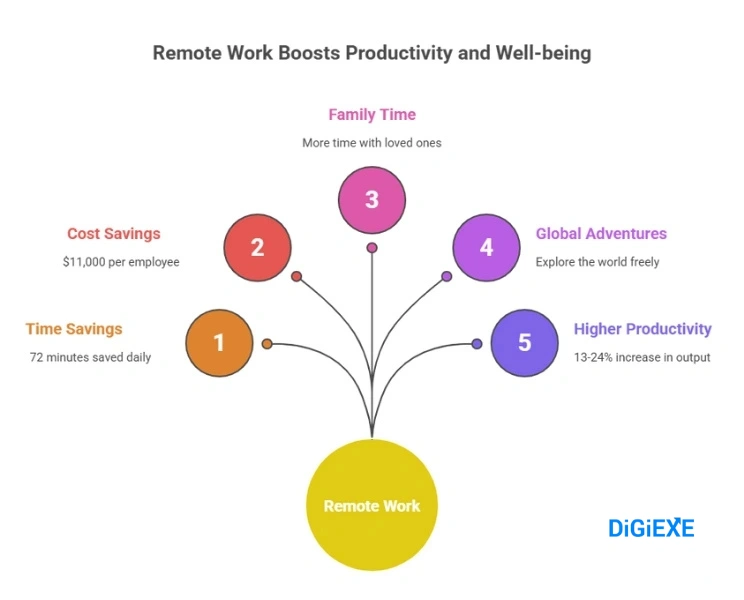
This growth stems from proven benefits like cost savings and employee satisfaction, which encourage businesses to prioritize flexibility over rigid office mandates.
Experts predict that by the end of 2025, remote work will encompass 30% of the global workforce, up from 25% in 2022.
In the United States, the telework rate hovers steadily between 17.9% and 23.8% since late 2022, with 34.6 million employed individuals teleworking in August alone.
These figures highlight how remote work has evolved from a pandemic necessity into a cornerstone of economic resilience.
You can use this trend to your advantage by targeting industries with high remote adoption.
For instance, update your resume to emphasize skills in virtual collaboration tools like Zoom or Slack, and apply to roles in booming sectors such as technology or finance.
This positions you as a forward-thinking candidate ready to contribute immediately in a distributed environment.
The following table illustrates the year-over-year growth in remote and hybrid job postings in the U.S., based on recent labor market analyses.
| Year | Remote Job Postings (% of Total) | Hybrid Job Postings (% of Total) | Total Flexible Roles (% of Total) |
| 2023 (Q2) | 10% | 15% | 25% |
| 2024 (Q2) | 12% | 20% | 32% |
| 2025 (Q3) | 12% | 24% | 36% |
This data reveals a clear trajectory: flexible arrangements now account for over one-third of new opportunities, empowering you to negotiate terms that align with your lifestyle.
Also read about: Stay At Home Dad Jobs- A Complete Review & Guide 2026
How Many People Work Remotely?
Professionals everywhere flock to remote setups for their inherent advantages, and the numbers tell a compelling story.
Globally, 48% of the workforce engages in some form of remote or hybrid work in 2025, a dramatic rise from just 20% in 2020.
This expansion reflects widespread adoption across continents, with North America, the UK, and Australia leading at over 40% remote participation rates.
In the U.S., 22.8% of employees—equating to 36.07 million people—work remotely at least partially as of March 2025. Fully remote roles claim 26% of remote-capable positions, while hybrid models cover 52%.
These statistics demonstrate how remote work sustains momentum despite economic fluctuations, allowing workers to save an average of 72 minutes daily on commutes.
To benefit personally, consider relocating to lower-cost areas without sacrificing income. Many remote workers report earning 9.7% more annually than in-office peers, averaging $8,600 extra per year.
Target companies offering location-agnostic pay to maximize this gain, and use platforms like FlexJobs to filter for roles that match your expertise.
The table below compares remote work prevalence across key regions in 2025.
| Region | % of Workforce Remote/Hybrid | Average Remote Days per Week | Key Driver of Adoption |
| North America | 45% | 2.5 | Talent access and productivity |
| Europe | 38% | 2.2 | Right-to-disconnect laws |
| Asia | 25% | 1.8 | Cost savings for employers |
| Australia/UK | 42% | 2.4 | Employee retention focus |
These insights guide you toward regions with supportive policies, enhancing your remote career prospects.
Remote Work by Demographics
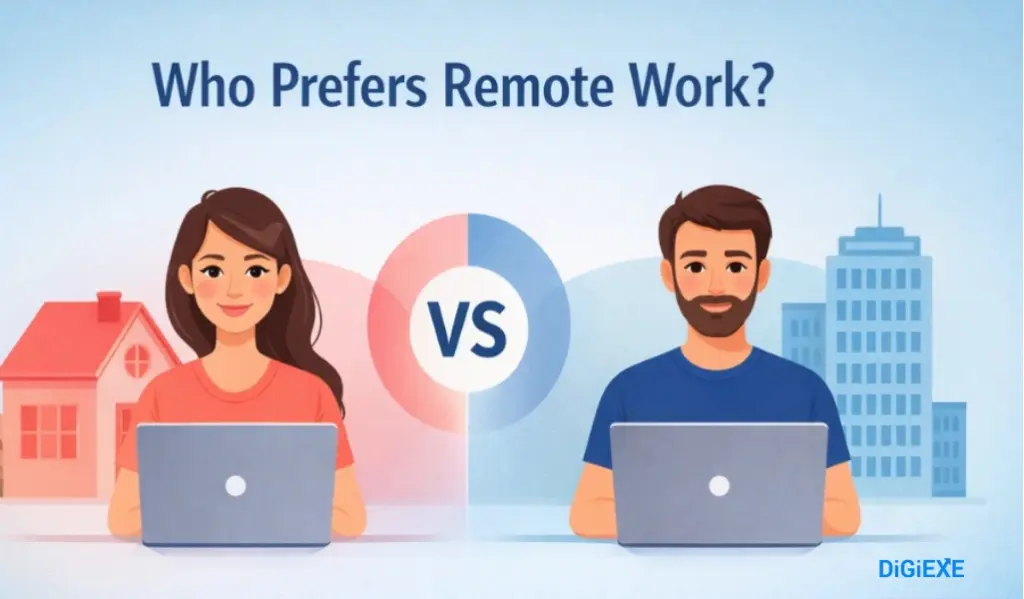
Demographic shifts reveal who thrives in remote environments, and understanding them helps you advocate for arrangements that suit your needs.
Women with children express the strongest desire for remote work, averaging 2.66 days per week, slightly higher than women without children. Men show similar preferences regardless of parental status, underscoring gender parity in adoption rates.
Age plays a pivotal role too: millennials (ages 26-41) lead with 41% preferring full remote setups, followed closely by Gen X (42-57) at 40%. Gen Z (18-25) lags at 27%, often prioritizing in-person networking for early career growth.
Education amplifies opportunities—45% of advanced-degree holders work remotely full-time, compared to 29% with high school diplomas.
You can leverage this by highlighting family-friendly aspects in interviews, such as your ability to manage childcare while meeting deadlines.
If you fall into a high-preference group like millennials, emphasize how remote work boosts your focus and output, backed by data showing 77% of part-time remote workers report higher productivity.
Gender and age preferences further illuminate these patterns in the table below.
| Demographic Group | % Preferring Remote Work | % in Hybrid Roles | Benefit Highlighted by Group |
| Women (Overall) | 46% | 34% | Reduced anxiety (34% report) |
| Men (Overall) | 39% | 37% | Higher earnings potential |
| Millennials (26-41) | 41% | 35% | Flexibility for side pursuits |
| Gen Z (18-25) | 27% | 28% | Mentorship via virtual tools |
Align your job search with these trends to find roles that enhance your well-being and career trajectory.
Remote Work by Industry and Occupation
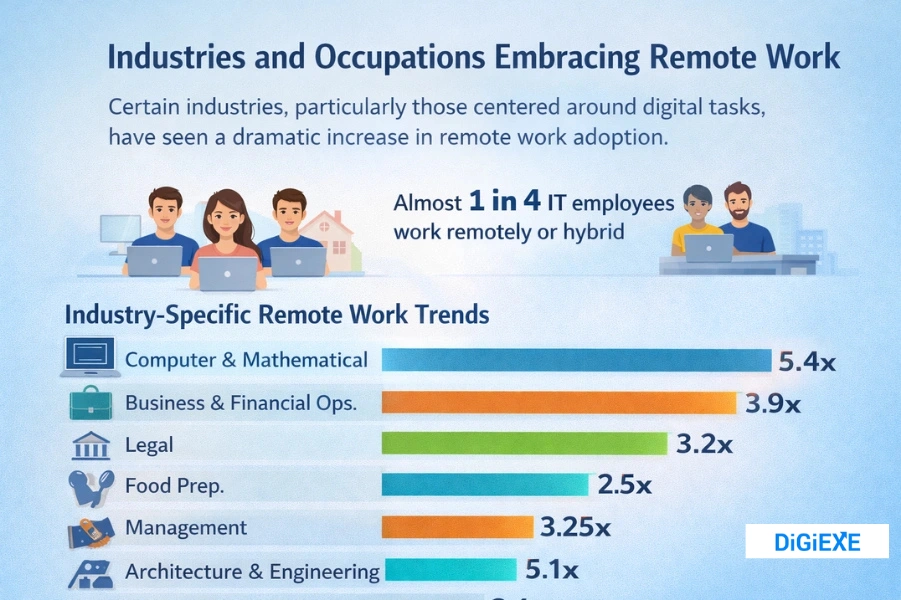
Certain sectors pioneer remote integration, creating fertile ground for skilled professionals.
Technology, information, and media lead with 41.2% of LinkedIn job listings offering remote options, followed by education at 29%.
Computer and mathematical occupations saw a 5.4-fold increase in remote roles since 2019, while business and financial operations grew 3.9 times.
These industries value laptop-based tasks, enabling seamless virtual execution. In Q3 2025, senior-level roles boast the highest flexibility: 30% hybrid and 15% fully remote, compared to 18% hybrid for entry-level positions.
This hierarchy rewards experience, so mid-career professionals can command premium remote gigs.
To capitalize, upskill in high-demand areas like data analysis or project management, where remote postings surged.
Reddit users in r/RemoteJobs note that cybersecurity and software development roles remain resilient amid RTO pushes, with tips focusing on building GitHub portfolios for visibility.
Quora threads echo this, advising beginners to ask interviewers about tool stacks like AWS to demonstrate remote readiness.
The table outlines top industries for remote opportunities in 2025.
| Industry | % Remote Job Listings | Growth Since 2019 | Tip for Job Seekers |
| Technology/Information/Media | 41.2% | 4x | Showcase AI tool proficiency |
| Education | 29.0% | 3x | Highlight virtual teaching demos |
| Administrative/Support Services | 27.4% | 2.5x | Emphasize time-zone management |
| Professional Services | 26.5% | 3.2x | Network on LinkedIn for leads |
Pursue these fields to access roles that align with your strengths and lifestyle.
Productivity Insights: Why Remote Workers Outperform
Debates on remote productivity rage on, but evidence tilts positively. Remote workers average 10% higher output than office-based peers, per Stanford studies, with 77% of part-timers reporting equal or greater efficiency.
A BLS analysis links a 1% rise in remote share to 0.09% productivity growth, attributing gains to fewer interruptions—remote pros reclaim 62 hours yearly.
Yet challenges persist: 69% experience burnout from blurred boundaries.
Counter this by adopting Quora-recommended routines like dedicated workspaces and “focus blocks,” which Reddit’s r/remotework community praises for sustaining momentum.
Hybrid models shine brightest, with 54% engagement rates versus 48% for fully remote.
You boost your value by tracking metrics—share weekly wins in stand-ups to prove impact. Employers save $11,000 per employee annually on overhead, so position yourself as a cost-effective asset.
Compare productivity perceptions across setups in this table.
| Work Arrangement | % Reporting Higher Productivity | Common Boost Factor | Challenge to Address |
| Fully Remote | 77% | No commute (72 min saved) | Isolation (35% affected) |
| Hybrid | 80% | Balanced collaboration | Scheduling conflicts (28%) |
| In-Office | 65% | Spontaneous ideation | Distractions (47%) |
Implement these strategies to excel and negotiate raises based on results.
Employee Preferences and Satisfaction
Workers overwhelmingly favor remote options, with 98% desiring at least part-time arrangements—up from 97% in 2022. Half prefer hybrid, a quarter fully remote, and just 19% in-office.

This preference stems from flexibility: 22% cite time autonomy as the top perk, 19% location freedom.
Satisfaction soars—68% report very positive experiences, crediting reduced burnout (36%) and better mental health (33%). Remote earners outpace office counterparts by $8,600 yearly, especially office managers (31.7% premium).
On Reddit’s r/digitalnomad, users discuss “quiet quitting Fridays,” where remote pros log off early, reclaiming 90 minutes weekly for well-being.
Quora tips include asking managers about update cadences to foster trust. Use this to your benefit: in interviews, inquire about flexibility’s role in retention, signaling alignment with company values.
Key preferences appear in the table below.
| Preference Factor | % of Workers Ranking It Top | How to Leverage It Personally |
| Time Flexibility | 22% | Schedule deep work during peaks |
| Location Independence | 19% | Relocate for lower living costs |
| No Commute Savings | 12% | Invest saved time in upskilling |
| Financial Benefits | 11% | Negotiate remote pay parity |
Embrace these to craft a satisfying, high-earning remote career.
Health and Well-Being Benefits
Remote work nurtures holistic health, with 34% of employees noting reduced anxiety and depression.
Sleep improves for 32%, exercise rises for 30%, and overall physical health betters for 28%. These gains arise from customizable routines, allowing healthier meals (35%) and burnout relief (36%).
Parents, especially mothers, benefit immensely—women with children seek 2.66 remote days weekly for family harmony. Yet, 1 in 3 struggles with homebound isolation.
Combat this with Reddit-suggested virtual coffee chats or Quora’s emphasis on boundary-setting rituals like end-of-day walks.
For your benefit, integrate wellness into routines: use saved commute time for yoga, tracking improvements to justify remote needs. Companies offering hybrid see 33% lower quit rates, per studies, so seek those prioritizing employee health.
Health impacts summarize in the table.
| Health Aspect | % Reporting Improvement | Practical Tip for Implementation |
| Reduced Burnout | 36% | Set “no-email” evenings |
| Less Anxiety/Depression | 34% | Daily mindfulness apps |
| Better Sleep | 32% | Consistent wake-up routines |
| Increased Exercise | 30% | Home gym setups |
Prioritize these for sustained energy and longevity in your career.
Challenges of Remote Work: Navigating Burnout and Isolation
Despite perks, hurdles demand proactive solutions.
69% face burnout from overwork, 53% struggle with colleague connections, and 47% battle home distractions. Loneliness affects 35%, exacerbated by 28% difficulty disconnecting.
Reddit’s r/RemoteJobHunters highlights 2025’s tougher market—applications tripled, yet persistence pays via tailored outreach.
Quora users advise role-specific prep, like cybersecurity pros demoing secure setups. Only 4.1% of firms mandate in-office minimums, per Census data, easing negotiations.
Address these by joining online communities for camaraderie and using tools like Trello for focus. This resilience turns challenges into strengths, making you indispensable.
Common challenges detail in the table.
| Challenge | % Affected | Strategy to Overcome |
| Burnout/Overwork | 69% | Weekly workload check-ins |
| Connection Difficulties | 53% | Scheduled video team huddles |
| Home Distractions | 47% | Dedicated workspace rituals |
| Isolation | 35% | Virtual social events |
Master these to thrive amid obstacles.
Future Trends: Hybrid Dominance and AI’s Role by 2030
Hybrid emerges as the 2030 standard, blending remote freedom with office synergy. Demand surges 30% by decade’s end, fueled by Gen Z’s cravings for flexibility.
AI shapes this: tools automate admin, freeing 20% more creative time, per Deloitte.
In 2025, 35-40% remote on Thursdays/Fridays signals “quiet weekends,” boosting retention. Reddit debates RTO’s demise, with stats showing 27% full in-office by year-end—far from reversal.
Prepare by learning AI prompts for efficiency; Quora envisions AI-powered virtual assistants resolving 70% of queries. This future favors adapters—position yourself as an AI-savvy remote expert for enduring success.
Trends forecast in the table.
| Trend | Projected 2030 Impact | Preparation Tip |
| Hybrid Dominance | 60% workforce | Build hybrid collaboration skills |
| AI Integration | 20% time savings | Master tools like ChatGPT |
| Gen Z Demand | 30% rise | Offer mentorship in applications |
| Quiet Quitting Fridays | 90 min weekly gain | Advocate outcome-based metrics |
Anticipate these for a competitive edge.
FAQs About Remote Work Statistics
1. How many Americans work remotely?
Approximately 32.6 million Americans work fully remotely in 2025, representing 22% of the workforce, while another 52% engage in hybrid arrangements that include remote days.
2. Does remote work improve productivity according to 2025 data?
Yes, remote workers report 10% higher productivity on average in 2025, with 77% of part-time remote employees achieving equal or greater output than their in-office counterparts due to fewer distractions and customizable routines.
3. What challenges do remote workers face most in 2026?
The most common challenges include burnout affecting 69% of remote employees and difficulties connecting with colleagues reported by 53%, often stemming from blurred work-life boundaries and isolation in home setups.
4. How can beginners land a remote job in 2026?
Beginners succeed by tailoring resumes to highlight virtual tools proficiency, networking on LinkedIn, and preparing for interviews with questions about team communication, as remote postings remain strong at 12% of new jobs despite market competition.
5. What future trends will shape remote work by 2030?
By 2030, hybrid models will dominate 60% of the workforce with a 30% demand increase, driven by Gen Z preferences and AI integrations that save 20% of work time through automation and enhanced collaboration.
Also Read:
- TikTok Users Statistics
- Facebook Users Statistics
- Mobile Marketing Statistics
- Link Building Statistics
- Personalization Statistics
Conclusion
Remote work statistics illuminate a vibrant, flexible future where 32 million Americans and billions globally redefine success on their terms.
From 48% global adoption to 10% productivity lifts, the data affirms that remote setups deliver tangible wins in earnings, health, and satisfaction.
Challenges like burnout persist, but with strategies drawn from real-user insights on Reddit and Quora—such as boundary rituals and AI tools—you transform hurdles into opportunities.
Whether you negotiate hybrid perks, upskill for tech roles, or embrace location independence, remote work empowers you to craft a career that fuels joy and growth.
As hybrid models solidify and AI amplifies efficiency, the message rings clear: flexibility is not a perk—it’s your pathway to thriving. Dive into these trends today, and step confidently into a work life that truly serves you.
