
In 2025, meetings have become both essential and a productivity drain, with employees spending 11.3 to 12 hours a week—31% of their workweek—in meetings.
U.S. businesses lose $259 billion annually due to unproductive sessions. This marks a shift from pre-pandemic times when meetings took up just 15% of work hours.
The rise of hybrid and remote work has tripled meeting volumes since 2020, and ad-hoc calls now make up 57% of all meetings.
Tuesdays are the busiest day, leaving professionals exhausted by endless video calls. This guide compiles insights from sources like Microsoft, Asana, and Reddit to provide actionable tips for reducing meeting overload and reclaiming time for more meaningful work.
The Explosive Growth of Meetings
Meetings have multiplied at an astonishing rate since the world went remote in 2020. Microsoft reports that the total number of meetings per person has tripled, while the average weekly meeting time jumped from roughly 6–8 hours pre-pandemic to 11.3–12 hours today.

In larger enterprises, executives now dedicate 19–23 hours per week—nearly three full workdays—to meetings, compared to just 10–12 hours for individual contributors.
This surge reflects the ease of clicking “Join” from anywhere, but it also creates what Microsoft calls “the most overloaded hour of the day” around 11 a.m., when meetings, chats, and notifications peak simultaneously.
For many professionals, the calendar feels relentless. Forty-six percent attend three or more meetings daily, and salespeople often exceed five hours.
Remote workers face 50% more meetings than their in-office counterparts, while hybrid employees fall somewhere in between.
On Reddit’s r/productivity and r/antiwork in November 2025, users frequently share screenshots of calendars blocked solid from 9 a.m. to 4 p.m., with one viral post titled “My 2025 calendar looks like Tetris on expert mode—help!” receiving over 12,000 upvotes and hundreds of comments recommending “no-meeting Wednesdays.”
| Role/Level | Average Weekly Meeting Hours (2025) | % of Workweek in Meetings |
| Individual Contributor | 8–10 hours | 20–25% |
| Manager | 16 hours | 40% |
| Executive/VP | 19–23 hours | 48–58% |
| Sales Professional | 20+ hours | 50%+ |
| Enterprise Employee | 15+ hours | 38%+ |
These meeting statistics 2025 show that the higher you climb, the less time you actually have to do the work you were promoted to lead.
Also read about: 5 Best WebinarJam Alternatives & Competitors😎
When and How Often We Meet
Tuesdays remain the undisputed champion of meeting days, hosting 23% of all weekly meetings, while Fridays drop to just 16%.
Most sessions cluster between 9–11 a.m. and 1–3 p.m.—exactly the windows when many knowledge workers report their highest energy for deep thinking.
Microsoft’s 2025 data reveals that by 11 a.m., collaboration overload reaches its peak, leaving afternoons fragmented and after-hours work inevitable.
Ad-hoc meetings now dominate: 57% happen without a formal calendar invite, and one in ten scheduled meetings gets booked only minutes before starting.
Global teams add another layer of complexity—one-third of all meetings now span multiple time zones, driving a 35% rise in cross-time-zone calls since 2021 and a 16% increase in meetings after 8 p.m.
| Day of Week | Share of Weekly Meetings | Typical Sentiment (Reddit/Quora 2025) |
| Monday | 18% | “Dreaded recap day” |
| Tuesday | 23% | “Meeting apocalypse” |
| Wednesday | 21% | “Still recovering from Tuesday” |
| Thursday | 22% | “Trying to finish strong” |
| Friday | 16% | “Half-day illusion” |
Professionals on Quora in late 2025 frequently ask, “Is Tuesday really the worst day for meetings in 2025?” The consensus: yes, and many now protect Wednesdays with company-wide “no internal meeting” policies that have become a top-requested perk.
Also read about: Remote Work Statistics 2026
Virtual, Hybrid, and In-Person Meetings: What Actually Happens in 2025
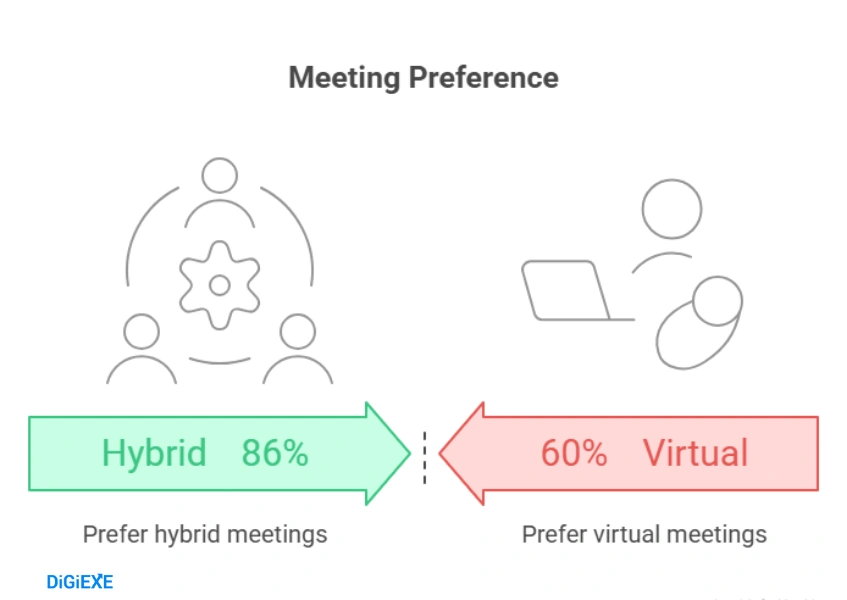
Hybrid remains king. Eighty-six percent of meetings include at least one remote participant, making fully in-person gatherings rare (only 14%).
Yet when stakes are high—major decisions, onboarding, or team-building—67% of professionals still prefer face-to-face. Gen Z leans heavily virtual (56% preference), while Boomers and Gen X favor in-person (61%).
Tech issues continue to plague sessions: 72% of workers lose time weekly to audio glitches, frozen video, or login problems.
Only 15% of meeting rooms are properly equipped for hybrid, leading to the infamous “Can you hear me now?” dance that wastes an average of 75 seconds per meeting.
| Meeting Format | Prevalence 2025 | Productivity Perception |
| Fully In-Person | 14% | Highest for big decisions |
| Hybrid (mixed) | 86% | Most common, most frustrating |
| Fully Virtual | ~60% of total | Convenient but fatiguing |
Reddit threads in r/hybridwork routinely crown hybrid the “worst of both worlds” when rooms lack proper cameras and microphones, yet companies keep defaulting to it because “everyone is used to Zoom now.”
Also read about: Zoom User Statistics 2026
The Massive Cost of Meetings: $259 Billion Wasted Annually
Poorly run meetings don’t just annoy people—they cost real money. U.S. businesses lose approximately $259 billion each year on unproductive meetings, with individual employee meeting time valued at roughly $29,000 annually (excluding scheduling overhead).
Forty-three percent of workers spend three or more hours per week just coordinating meetings, and 35–45% of all meetings are deemed unnecessary.
When you multiply average salaries by the 11.3–12 hours spent weekly, the math becomes sobering fast. A mid-level manager earning $100,000 effectively “spends” $31,000–$35,000 per year simply attending meetings.
| Country | Annual Cost of Unproductive Meetings |
| United States | $259 billion |
| United Kingdom | £50 billion |
| France | ~€180 billion (estimated) |
These meeting statistics 2025 explain why “meeting bankruptcy” declarations—where teams cancel all recurring meetings and re-add only the essential ones—have become a viral trend on LinkedIn and Reddit this year.
Productivity Killers: Why 35–45% of Meetings Fail
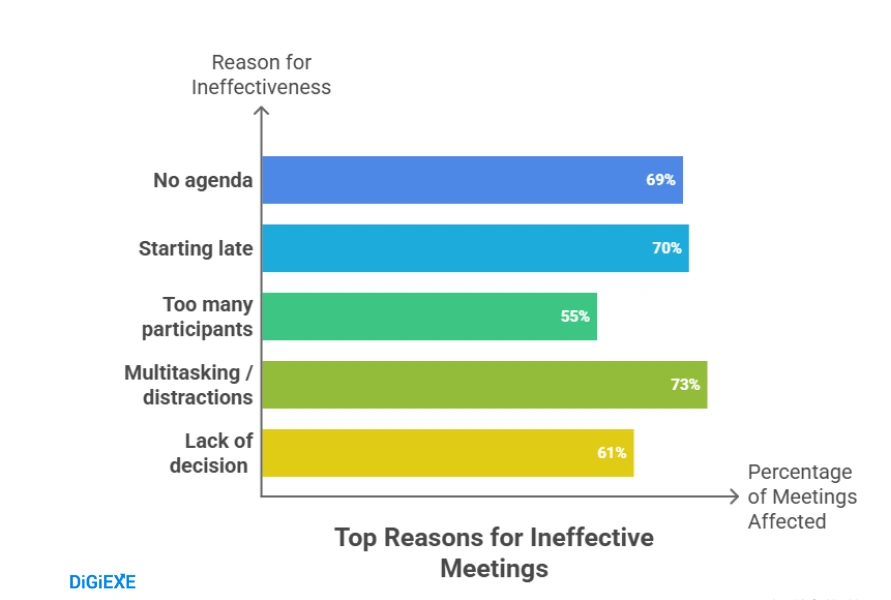
Only 37% of meetings use a written agenda—the single factor most correlated with perceived success. Another 37% end without a clear decision.
Executives label 67% of meetings as failures, while 73% of attendees multitask (60% of Gen Z do it “always” or “very often”). Attention spans collapse after 30 minutes in 52% of sessions, and 96% of people stop paying full attention after 50 minutes.
The top annoyances remain unchanged: starting late (70%), no agenda (69%), off-topic rambling (64%), and too many irrelevant attendees.
| Factor That Makes Meetings Unproductive | % Citing It |
| No clear agenda | 69% |
| Starting late | 70% |
| Too many participants | 55% |
| Multitasking / distractions | 73% |
| Lack of decision or action items | 61% |
On Quora, the question “What’s the #1 meeting mistake companies still make in 2025?” overwhelmingly points to “inviting everyone ‘just in case’ instead of only decision-makers.”
What Actually Makes Meetings Worthwhile
When done right, meetings accelerate work: 55–68% of professionals say good meetings enhance productivity and move projects forward. The magic ingredients remain simple yet rare:
- Clear purpose and agenda sent in advance (cited by 72%)
- Right attendees only (35% say fewer people = better meeting)
- Timeboxed to 25–30 minutes when possible (45% of meetings are now 30 minutes—the sweet spot)
- Explicit action items and owners before ending
Companies that train employees on hybrid facilitation see 49% higher satisfaction, and those adopting AI notetakers (like Notta, Otter, or Fireflies) report 80% reduction in post-meeting admin time.
| Element Present | % Rating Meeting Productive |
| Clear agenda | 83% |
| Under 8 participants | 79% |
| Ends with action items | 81% |
| 30 minutes or less | 76% |
Fresh Insights from Reddit and Quora Users
Real-world sentiment confirms the data. The top-voted post on r/productivity this month reads: “I cut my recurring meetings by 60% in 2025 and my output doubled—anyone else?” (18k upvotes).
Users share tactics like “async standups via Loom + Notion” and “default 25-minute invites instead of 30.”
On Quora, the trending question “Are no-meeting days still effective in 2025?” garners hundreds of replies praising Wednesday or Friday focus blocks, with many reporting 20–30% productivity gains and dramatically lower burnout.
Another hot topic: AI meeting assistants. Thousands of users now swear by tools that auto-join calls, transcribe in real time, and generate summaries + action items in seconds. “It’s the closest thing we have to making meetings optional,” one Redditor wrote.
Practical Ways to Take Back Your Time Starting This Week
Apply these proven tactics drawn from the latest meeting statistics 2025:
- Default every new meeting to 25 minutes instead of 30—Flowtrace data shows completion rates soar.
- Make agenda + desired outcome mandatory fields in calendar invites.
- Institute one recurring-meeting-free day per week (Wednesday is most popular).
- Replace status updates with async video or written updates—cuts meeting volume 30–50%.
- Use AI transcription and summarization tools to eliminate manual notetaking and follow-up emails.
Teams that adopted even two of these habits report 4–6 hours reclaimed per person per week.
FAQs About Meeting Statistics
1. How much time do employees spend in meetings in 2025, and how can they reduce it?
Employees spend 11.3–12 hours per week (31% of their workweek) in meetings. To cut this down, set invites to 25 minutes, require agendas, use async updates, and block one no-meeting day per week to reclaim 4–6 hours.
2. What percentage of meetings are unproductive in 2025, and why?
35%–45% of meetings are unproductive due to lack of agendas (69%), late starts, too many irrelevant participants, and no clear action items, causing multitasking and disengagement after 30 minutes.
3. Are hybrid meetings still dominant in 2025, and how can teams improve them?
Yes, 86% of meetings are hybrid in 2025. Teams can improve by using proper AV equipment, calling on remote participants first, using collaborative agendas, and appointing a facilitator to balance airtime.
4. What do Reddit and Quora discussions reveal about meeting culture in late 2025?
Discussions highlight “meeting bankruptcy” (cancelling recurring meetings), the rise of AI notetakers for auto-generating summaries, and a preference for no-meeting days on Wednesdays or Fridays, leading to productivity gains and reduced burnout.
5. How much do unproductive meetings cost businesses, and how can they reduce that cost?
Unproductive meetings cost U.S. businesses $259 billion annually. The fastest way to lower costs is to require clear agendas and desired outcomes in advance—this can boost perceived productivity by 40–50%.
Also Read:
- Android Usage Statistics
- Coupon Statistics
- Email Marketing Statistics
- Online Advertising Statistics
- Podcast Statistics
Conclusion
The meeting statistics 2025 paint a clear picture: we are meeting more than ever—11.3–12 hours per week on average, often poorly—and it costs us hundreds of billions in lost productivity while fragmenting focus and fueling burnout.
Yet the same data reveals a path forward. When meetings have purpose, the right people, tight timing, and clear outcomes, they become powerful accelerators rather than drains.
Hybrid work is here to stay, but endless video calls are not inevitable. By embracing shorter defaults, ruthless agendas, async alternatives, and smart AI tools, individuals and organizations can transform meetings from the #1 time thief into the collaboration superpower they were always meant to be.
Start with one small change this week—shorten your next recurring meeting by five minutes and add an agenda—and watch the ripple effect begin.
