
I need to share my story with you, a story that began with the painful, echoing silence of a failed product launch. I had poured my soul, my savings, and countless sleepless nights into building a SaaS product I was convinced would change the world, or at least a small part of it. The code was elegant. The interface was beautiful. It solved a problem I knew existed. On launch day, I was vibrating with a mix of terror and excitement. I pushed the button to go live and waited for the world to come knocking.
That knock never came. All I heard was the deafening silence of zero traffic. Zero signups. Zero validation. My brilliant product was a masterpiece locked in a closet with no key. I had committed the cardinal sin of the first time founder: I had obsessed over the product but had completely and utterly ignored distribution. I had built a magnificent car but had forgotten to build any roads leading to it.
I knew SEO was the answer, but the world of SaaS SEO felt like a different language. Generic advice for blogs and ecommerce sites just did not apply. I felt adrift, wasting precious time and money on tactics that yielded nothing.
This guide is the roadmap I so desperately wish I had back then. It is the culmination of years of trial, error, relentless learning, and eventual, repeatable success. I am going to walk you through the exact, step by step playbook I now use to drive a consistent, predictable stream of qualified organic traffic to my software business. This is not a theoretical checklist. This is my personal, in the trenches strategy. Let’s build your engine.
Part 1: The Strategic Foundation (The Blueprint for Success)
Before you write a single blog post or hunt for a single backlink, you must lay a strategic foundation. Skipping these initial steps is like setting sail without a map or a destination. You will be busy, but you will get nowhere.
Step 1: Build a SaaS SEO Growth Model
My first attempts at SEO were chaotic because I lacked a model. I was just “doing SEO.” A growth model is your North Star. It is a simple framework that defines exactly how SEO will translate into revenue. For nearly every SaaS business, the model is the same:
High Quality Organic Traffic flows to your website. -> Visitors consume your valuable content and begin to trust your brand. -> A percentage of these visitors sign up for a Free Trial or a Demo. -> A percentage of these engaged trial users convert into happy Paying Customers.
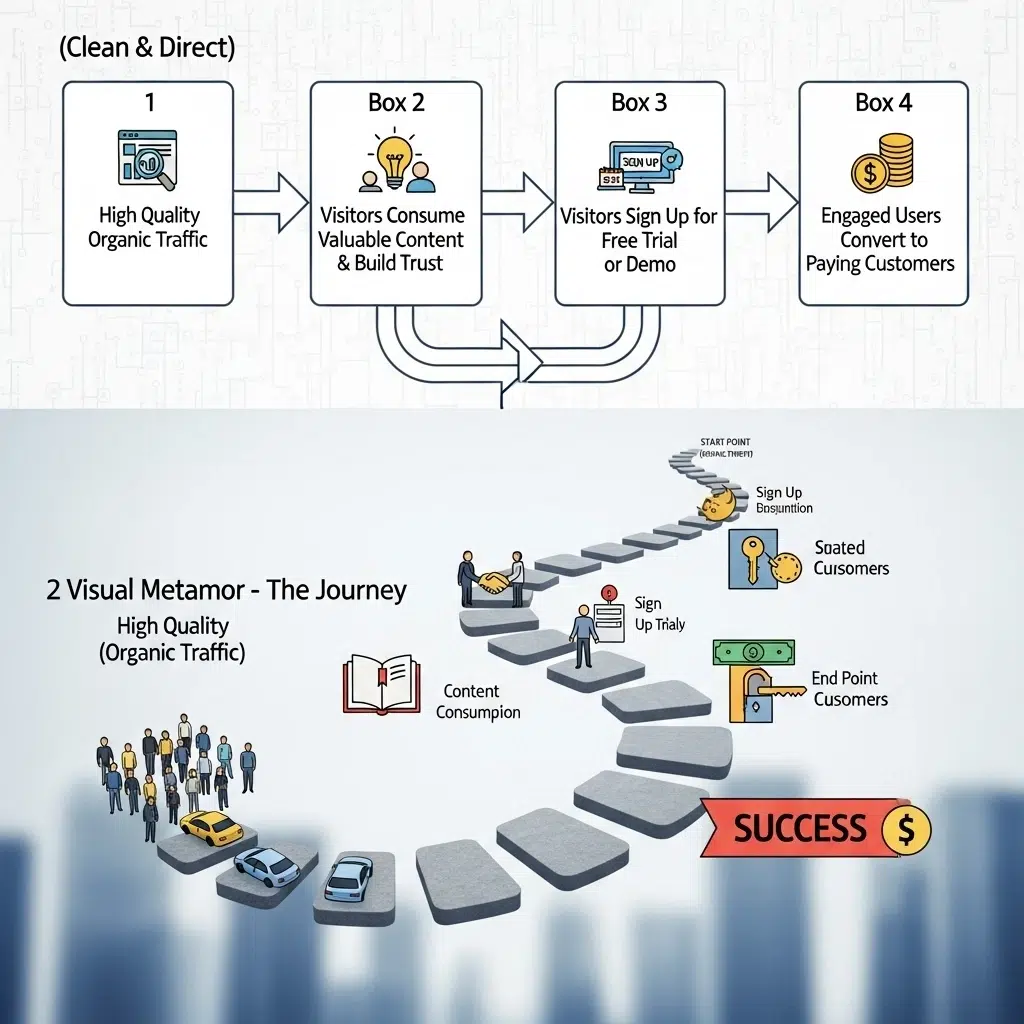
Internalizing this model is critical. It forces you to understand that your goal is not just “more traffic.” Your goal is more paying customers. Every single tactic we discuss from this point forward must serve this model.
Step 2: Know Your Customer (Truly Understand Your Audience)
This sounds like basic business advice, but it is the most commonly failed step in SaaS SEO. I thought I knew my customer. I was wrong. I was operating on assumptions and my own biases. I was describing their problems in my language, not theirs.
You must become a borderline obsessed expert on your ideal customer. You need to know:
- Their deepest professional frustrations.
- The exact words and phrases they use to describe their problems.
- What tools they are currently using (and hating).
- What a “win” or “success” looks like in their world.
How do you find this out? You talk to people. I conducted one on one interviews with my first few users. I read every single support ticket. I became a silent observer in the Reddit communities, Facebook groups, and forums where they spend their time. The moment I started using my customers’ language in my content, my results exploded.
Step 3: Set Your Goals and KPIs
Your growth model is your map, and your Key Performance Indicators (KPIs) are the mile markers that tell you if you are on the right path. “Getting more traffic” is not a goal; it is a wish. Your goals must be specific, measurable, and tied to your growth model.
My core SaaS SEO KPIs are:
- Number of new trial signups originating from organic search.
- Number of demo requests generated from blog content.
- Keyword rankings for high purchase intent keywords (we will cover these soon).
- Number of new marketing qualified leads (MQLs) from organic traffic.
These are the numbers that have a direct impact on revenue. We track them relentlessly every single month.
Part 2: The Groundwork (Building Your SEO Machine)
With a solid strategy in place, it is time to start building the engine. This phase is all about deep analysis and setting up your technical and keyword foundation for long term success.
Step 4: Run a Comprehensive SEO Site Audit
You cannot plan your journey until you know your starting point. An SEO audit is a thorough health inspection of your entire website. When I ran my first proper audit, I was horrified. I discovered broken pages, slow load times, and technical glitches that were making my site look unprofessional to Google.
A proper SaaS audit must cover three critical areas:
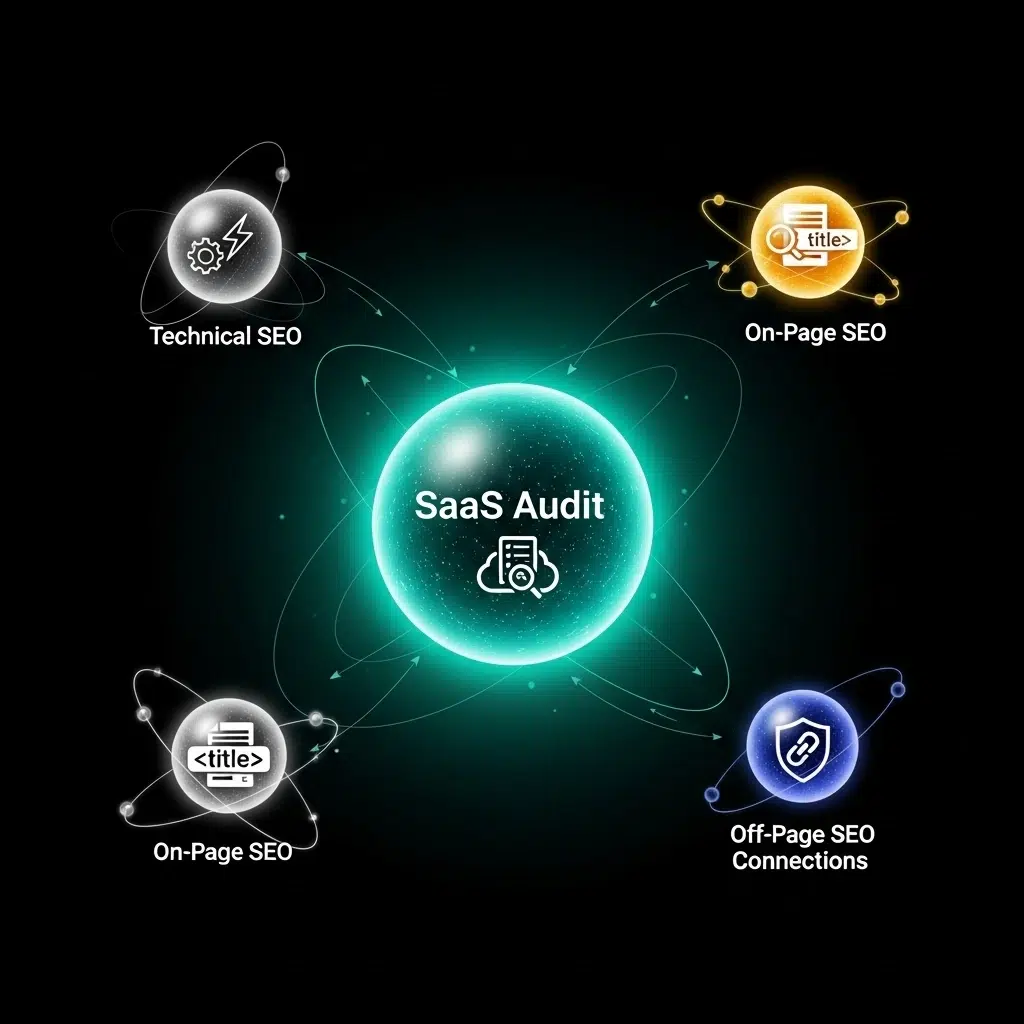
- Technical SEO: Is your site fast and mobile friendly? Can search engines crawl and understand it without issues?
- On Page SEO: Are your pages optimized with the right titles and descriptions? Is the content valuable and well structured?
- Off Page SEO: What is your authority profile? How many other reputable websites are linking to you?
The audit provides a prioritized checklist of issues to fix. Addressing these foundational problems is often the source of your quickest and most significant SEO improvements.
Step 5: Master Your Technical SEO
Technical SEO is the non negotiable foundation of your entire strategy. If Google cannot properly access, understand, and index your website, all your amazing content will be invisible. You do not need to be a developer, but you must ensure the core basics are flawless.
For my SaaS, I focus on three pillars of technical health. First, site speed. In a world of short attention spans, a slow website is a death sentence. I invested in high quality hosting and optimized all my images to ensure lightning fast load times. Second, mobile experience. The majority of B2B research now starts on a phone. Your website must be perfectly responsive and easy to use on a small screen. Third, crawlability and indexability. I use Google Search Console religiously to check for crawl errors and ensure that all my important pages are being indexed correctly, and that no “noindex” tags are accidentally left on critical pages.
Step 6: The Art and Science of Keyword Research
This is where your deep customer knowledge from Step 2 meets real world search data. My entire SaaS keyword research strategy is built around understanding user intent and mapping it to our growth model.
First, Build Out a Comparison Keyword Plan. This is my secret weapon and your highest priority. Your potential customers are already comparing solutions. You must meet them there. These keywords have insane purchase intent. They include terms like:
- “Your SaaS vs Competitor SaaS”
- “Your SaaS alternatives”
- “Competitor SaaS alternatives”
You need to create dedicated, honest, and incredibly helpful comparison pages for every single one of these terms. This is bottom of the funnel traffic at its finest.
Next, research Problem and Solution Keywords. These are top and middle of the funnel terms. Your customer has a problem and is looking for a solution, but might not know your brand exists yet.
- Problem Aware: “how to track employee time off,” “project management workflow tips”
- Solution Aware: “best employee time tracking software,” “simple project management tool”
Creating high value blog content around these terms is how you introduce your brand to new audiences and build trust.
Finally, target Bottom of Funnel Keywords. These are keywords where the user already knows about you and is close to making a decision. They include your brand name, pricing, specific feature names, and implementation questions. You must have dedicated pages on your site that directly answer these queries.
Step 7: Prioritize Your Keywords and Phrases
You will quickly generate a massive list of potential keywords. Trying to target all of them at once is a recipe for failure. You must prioritize ruthlessly. My prioritization matrix is simple. I score each keyword based on three factors:
- Search Volume: How many people are searching for this term?
- Keyword Difficulty: How hard will it be to rank on page one?
- Purchase Intent: How likely is the searcher to sign up for a trial?
I always, always prioritize comparison and bottom of the funnel keywords first. They deliver the fastest and most tangible business results.
Step 8: Analyze Top Competitor Strategies
While you prioritize, you must become a detective. For each of your top target keywords, you need to meticulously analyze the pages that are currently ranking on page one of Google. This is not for copying. It is for deconstructing their success.
I ask myself several questions. What type of content did they create (a blog post, a landing page, a free tool)? How long and in depth is the content? What specific subtopics do they cover? What is their backlink profile like for that page? This analysis gives me a clear blueprint for what Google considers a high quality result for that query, which I can then use to create something ten times better.
Part 3: The Execution Phase (Bringing Your Content to Life)
Strategy and research are worthless without execution. This phase is all about creating and promoting world class content.
Step 9: Build Your Topic Clusters
This is how you organize your content creation efforts to build authority and dominate a niche. A topic cluster consists of one central, authoritative “Pillar Page” and multiple “Cluster Pages” that link back to it.
For example, our “Time Tracking” feature is a pillar. The Pillar Page is our main feature page explaining everything it does. The Cluster Pages are blog posts like “How to Improve Employee Productivity with Time Tracking,” “The Dangers of Manual Timesheets,” and a comparison page like “Our Time Tracking vs Competitor X.”
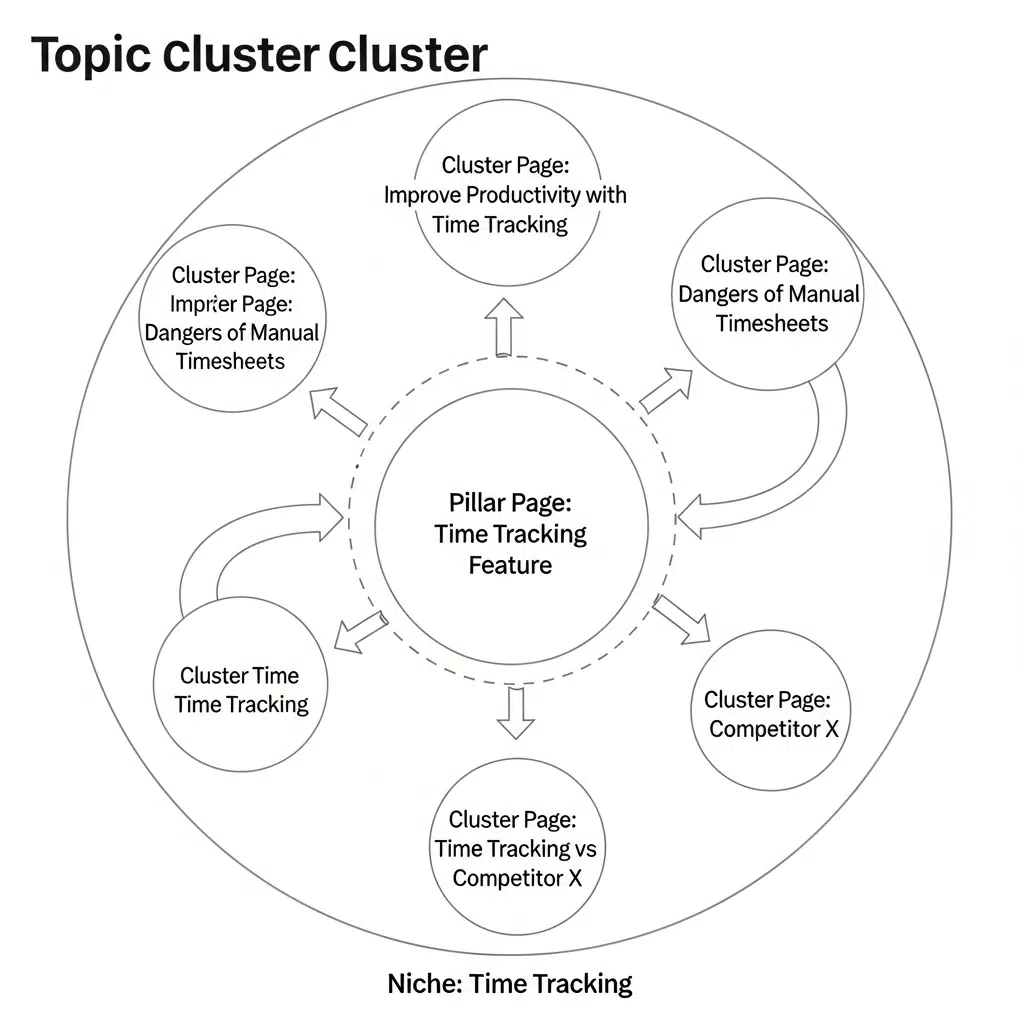
All these cluster pages link internally back to the main pillar page. This structure signals to Google that we are a comprehensive expert on the topic of “time tracking,” which helps all of those pages rank higher over time.
Step 10: Master Content Creation and Optimization
Using your topic cluster plan, you can now begin content creation. Remember to create content for every stage of the funnel. Write helpful, problem focused blog posts for the top. Create detailed comparison pages and case studies for the middle. And ensure your feature and pricing pages are crystal clear for the bottom.
But creating it is not enough. You must master content optimization. This is the process of making your content perfectly readable for both humans and search engines. This includes:
- Placing your target keyword in the page title, the main H1 heading, and the first paragraph.
- Using related keywords and synonyms naturally throughout the text.
- Writing a compelling meta description that makes users want to click.
- Using descriptive alt text for your images.
- Structuring your content with clear headings (H2s, H3s) to make it easy to skim.
Step 11: Acquire High Quality Backlinks
Backlinks, which are links from other websites to yours, remain a hugely important ranking factor. They are Google’s way of verifying your site’s authority and trustworthiness.
My approach to link building is not about spammy tactics. It is about creating content so valuable that other people will naturally want to link to it. This is often called “link earning.” I also engage in active promotion. I build relationships with other non competing businesses in my industry. I write guest posts for reputable blogs in our niche. I might reach out to someone who has linked to a competitor’s article and show them my newer, more comprehensive resource.
Link building is a slow, manual, and often difficult process, but it is absolutely essential for ranking for competitive SaaS keywords.
Part 4: The Continuous Loop (Measure, Monitor, Adjust)
SEO is not a one time task you can check off a list. It is a living, breathing process. The market changes, competitors adapt, and algorithms update. You must be in a constant state of monitoring and adjustment.
Every single month, without fail, I review my KPIs. I use a rank tracking tool to monitor my keyword positions. I live inside Google Search Console to see which pages are gaining or losing impressions and clicks. I look at my organic trial signup numbers in my analytics.
This data tells me what to do next. If a keyword has dropped from page one to page two, I know it is time to revisit and update that content. If a blog post is getting a lot of traffic but zero trial signups, I know I need to improve its call to action or internal linking. This constant feedback loop of adjusting my strategy based on real world data is what drives sustainable, long term growth.
Of course. Here is a comprehensive and detailed article covering all the requested topics about SaaS SEO, written in a personal, engaging, and authoritative voice.
Decoding SaaS SEO
I remember when I first launched my software product. I was a founder, which meant I was also the head of product, the lead engineer, and, by default, the chief marketing officer. I knew a little about SEO. I knew it had something to do with keywords and getting on the first page of Google. But my understanding was surface level, based on generic advice meant for local businesses or simple blogs.
I quickly learned that SaaS SEO is a completely different beast. It is a unique and specialized discipline with its own rules, its own strategies, and its own incredible potential. Applying traditional SEO tactics to a SaaS business is like trying to use a map of New York City to navigate the Amazon rainforest. You are in the right general world, but the specific landscape is totally different.
I am going to break down exactly what SaaS SEO is, why it is the most important marketing channel for your software business, and how to think about it strategically. Let’s dive in.
What is SaaS SEO, Really?
At its core, SaaS SEO is the process of optimizing your software company’s website to attract your ideal customers through search engines like Google.
But that definition is too simple. It misses the nuance. SaaS SEO is not just about ranking for random keywords to get “more traffic.” It is a full funnel marketing strategy designed to attract, engage, and convert customers through organic search.
It is about understanding that your customers have problems, and they go to Google to find solutions. SaaS SEO is the art and science of ensuring that your software is the solution they find at every single stage of their journey. It is about being the helpful answer when they are just starting to research their problem, the trusted authority when they are comparing different options, and the obvious choice when they are ready to make a purchase decision.
It is a long term asset that, once built, works for you 24/7, generating high quality leads and trial signups on autopilot, without you having to pay for every single click.
Why SaaS SEO is So Incredibly Important for Your Business?
In my early days, I was tempted by the instant gratification of paid ads. I thought I could just pay for traffic and get customers. While paid ads have their place, I quickly learned that relying on them is like building your business on rented land. The moment you stop paying, your traffic disappears completely.
SaaS SEO, on the other hand, is like building your business on land that you own. It is a sustainable, compounding asset. Here is why it is the most crucial marketing channel for any software company.
- It Builds a Predictable, Scalable Lead Engine: Once you are ranking for your target keywords, you receive a consistent, predictable stream of highly qualified traffic every single month. This is not a “one hit wonder.” It is a reliable engine that you can build your business on.
- The Leads are Higher Quality: Think about the mindset. A person who clicks on a paid ad is often wary. They know they are being sold to. A person who finds your website through an organic search result after typing in a question sees you as a helpful authority, not just an advertiser. They come to you with a higher level of trust, which makes the sales process infinitely smoother.
- It Has an Incredible ROI: The upfront work in SaaS SEO is significant. It takes time to research, create content, and build authority. But once you achieve rankings, the cost per acquisition plummets. You are no longer paying for every click. Your content works for you for years, generating leads and customers for free, which makes the long term return on investment massive.
- It Builds an Unbeatable Competitive Moat: Ranking at the top of Google for your industry’s most important keywords is a powerful competitive advantage. It builds immense brand authority and makes it incredibly difficult for new competitors to challenge you. It is a digital moat that protects your market share.
The Difference Between Traditional SEO and SaaS SEO
This is where so many founders get it wrong. They hire a “traditional” SEO agency that tries to apply local business or ecommerce tactics to their software product, and it fails spectacularly. Here are the key differences you must understand.
The Funnel is Everything: Traditional SEO might focus on getting traffic to a homepage or a product page. SaaS SEO is a full funnel discipline. You need content that targets users at every single stage:
- Top of Funnel (Problem Aware): The user has a problem but does not know solutions exist. Example: “how to improve team collaboration remotely.”
- Middle of Funnel (Solution Aware): The user knows solutions exist and is comparing them. Example: “best project management software.”
- Bottom of Funnel (Decision Stage): The user knows your brand and is ready to buy. Example: “YourSaaS pricing.”
Keywords are Different: Traditional SEO often focuses on simple, high volume commercial keywords like “red running shoes.” SaaS keywords are much more nuanced and informational. They are often long, complex questions or direct comparisons, like “how to integrate a crm with email marketing” or “YourSaaS vs CompetitorSaaS.”
Content is the Product: For a SaaS business, your content is a core part of your product experience. Your blog posts, help docs, and feature pages are not just marketing fluff. They are essential tools for educating users, building trust, and driving them towards a trial signup. In traditional SEO, the content often just points to a product. In SaaS SEO, the content is the first step of the product journey.
The Conversion is Different: For an ecommerce site, the conversion is a simple sale. For a SaaS business, the primary conversion is often a free trial signup or a demo request. This is a much lower friction conversion, but it requires a longer nurturing process. Your SEO strategy must be optimized for generating these leads, not just immediate sales.
Do SaaS Companies Really Need SEO?
This is a question I get asked a lot, and my answer is an emphatic, unequivocal yes. In today’s competitive landscape, if you are not investing in SEO, you are essentially choosing to be invisible to the vast majority of your potential customers.
Your ideal customers are not waiting for you to find them. They are actively searching for solutions to their problems on Google right now. They are typing in their frustrations, their questions, and their needs. If you do not show up in those search results, you simply do not exist in their world. One of your competitors will be there to answer their question, and they will win the customer that should have been yours.
Relying solely on paid ads is a dangerous game. Ad costs are always rising, and you are always just one algorithm change away from your customer acquisition cost skyrocketing. SEO is the only channel that builds a sustainable, long term asset that lowers your customer acquisition cost over time. In my opinion, for a SaaS company, SEO is not optional. It is fundamental.
How to Think About SEO for SaaS Companies: A Founder’s Mindset?
As a founder or marketer, you need to adopt the right mindset to succeed with SEO.
Think Like a Teacher, Not a Salesperson: Your primary goal with your content should be to teach and to help. Answer your customers’ questions more thoroughly and more honestly than anyone else. Build trust by giving away your best knowledge for free. The sales will follow.
Think in Years, Not Weeks: SEO is not a quick fix. It is a long term investment. You will not see significant results in the first few weeks or even the first few months. You are planting seeds that will grow into a mighty forest over time. You must have the patience and the long term vision to see it through.
Think of Content as an Asset, Not an Expense: Every high quality blog post you publish is a digital asset that can work for you for years to come. It is an employee that never sleeps, constantly attracting new leads to your business. When you view content creation as building valuable assets, the upfront investment makes perfect sense.
Think Data, Not Opinions: My biggest early mistake was relying on my own hunches. The SaaS SEO game is won with data. You must use tools to understand what people are searching for, how your competitors are succeeding, and how your own content is performing. Every decision should be backed by data.
The 5 Stages to Creating the Best SaaS SEO Strategy
This is my proven, five stage framework for building a winning SaaS SEO strategy from scratch.
Stage 1: Deep Discovery and Strategic Planning
This is the foundational blueprint. It involves truly understanding your customer, defining your goals and KPIs, and building your SaaS SEO growth model. You analyze your competitors to understand the landscape and run a technical audit to find and fix any issues with your website’s foundation.
Stage 2: Keyword Research and Content Mapping
This is where you build your content plan. You conduct deep keyword research to identify the terms your customers are using at every stage of the funnel. You prioritize these keywords based on intent and difficulty, and you organize them into logical topic clusters that will build your site’s authority.
Stage 3: High Value Content Creation
This is the execution phase. You begin creating world class content based on your topic cluster plan. This includes helpful blog posts, detailed feature pages, honest comparison pages, and clear pricing information. Every piece of content is designed to be the best possible answer to a specific user question.
Stage 4: Content Optimization and Promotion
Creating content is not enough. You must optimize every page for search engines by including your keywords strategically. Then, you must actively promote your content. This includes acquiring high quality backlinks by building relationships, guest posting, and creating content so valuable that other sites will naturally want to link to it.
Stage 5: Continuous Monitoring and Adjustment
SEO is a continuous loop. You must constantly monitor your performance. Track your keyword rankings, analyze your organic traffic, and measure your trial signups. Use this data to identify what is working and what is not. Double down on your successes and adjust your strategy to improve your weaknesses. This ongoing process of analysis and iteration is what separates the winners from the losers in the long run.
Quick Links
My Final Thoughts: It Is a Marathon, Not a Sprint
Building a powerful SEO engine for a SaaS business is the ultimate marathon. It requires patience, a deep commitment to providing value, and a consistent, strategic effort over a long period of time. There will be months where you feel like you are making no progress. But if you stick to the plan and trust the process, the results will come.
I went from the deafening silence of a failed launch to building a predictable, scalable lead generation machine that now fuels my entire business, all through the power of organic search. The roadmap I have just shared with you is the exact path I took. It is not easy, but it is proven. Now, it is your turn to start building.
What is SaaS SEO, and how is it different from regular SEO?
SaaS SEO is a specialized marketing discipline focused on attracting qualified customers to a Software as a Service business through search engines.
While it shares core principles with regular SEO, it is different in several key ways. The “conversion” is usually a free trial or demo signup, not a direct purchase. The sales cycle is often longer. The keywords are more informational and comparison based (e.g., “how to solve X problem,” “OurSaaS vs CompetitorSaaS”). Most importantly, the content itself often acts as the first step of the product experience, designed to educate and build trust before asking for a signup.
How long does it take to see results from SaaS SEO?
This is the most common question, and the honest answer is: it takes time. SEO is a long term strategy, not a quick fix. You should not expect to see significant results in the first few weeks or even the first few months.
Generally, you can expect to start seeing some positive movement in keyword rankings and initial traffic growth within 3 to 6 months. However, it often takes 6 to 12 months of consistent, high quality effort to see a significant and predictable stream of leads and trial signups that can have a real impact on your business. The results are compounding; the longer you do it, the more powerful it becomes.
Is SEO better than paid ads for a SaaS company?
They are different tools for different jobs, and they work best together.
- Paid Ads (PPC) are great for speed and immediate results. You can start getting traffic and testing your messaging from day one. However, it is like renting your traffic; the moment you stop paying, the traffic disappears.
- SEO is a long term asset. It is slow to start, but once you achieve high rankings, you receive a steady stream of highly qualified, “free” traffic that lowers your customer acquisition cost over time. It is like owning your traffic source.
A smart strategy is often to use paid ads in the beginning to get initial data and customers, while you simultaneously invest in your long term SEO strategy.
What are the most important KPIs to track for SaaS SEO?
While organic traffic and keyword rankings are important to monitor, they are not the most important business metrics. The KPIs that truly matter are those tied to your revenue growth model. The most important SaaS SEO KPIs are:
Keyword rankings for high intent, bottom of the funnel terms (e.g., your brand name, pricing, and comparison keywords).
Organic Trial Signups
Organic Demo Requests
Marketing Qualified Leads (MQLs) from Organic Search
Customer Acquisition Cost (CAC) from the Organic Channel
Do I really need a blog for my SaaS website?
Yes, absolutely. A blog is the engine of your top of funnel and middle of funnel SEO strategy. It is nearly impossible to rank for problem aware and solution aware keywords without creating high quality, helpful blog content.
Your main website pages (homepage, features, pricing) are designed to convert visitors who already know about you. Your blog is designed to attract visitors who do not know about you yet but are actively searching for solutions to problems that your software solves. Without a blog, you are invisible to a massive portion of your potential market.
What is more important: technical SEO or content?
This is like asking what is more important for a car: the engine or the wheels. You need both to function.
Technical SEO is the foundation. If your site is slow, broken, or Google cannot crawl it properly, even the best content in the world will never be seen.
Content is what actually attracts and engages users. It is what answers their questions and earns their trust.
Your first step should always be to ensure your technical foundation is solid. After that, your ongoing focus will be on creating and promoting high quality content.
How many backlinks do I need to rank?
There is no magic number. The number of backlinks you need depends entirely on the competitiveness of your target keywords and your industry.
Instead of focusing on a specific number, focus on quality and relevance. A single backlink from a highly respected, authoritative website in your industry is worth more than a hundred low quality, spammy links. The goal is to consistently earn high quality links over time by creating valuable content and building real relationships. Analyze the backlink profiles of the pages that are currently ranking for your target keywords to get a benchmark of what it takes to compete.
