
In 2025, the average person worldwide spends 6 hours and 45 minutes staring at screens every single day — almost half of all waking hours.
Understanding these average screen time statistics 2025 gives you the power to stop feeling guilty and start making smart, intentional choices that boost your energy, focus, health, and relationships.
This guide combines the latest global data with real strategies shared daily on Reddit and Quora so you can turn numbers into real-life wins.
Global Average Screen Time: The Big Picture in [Year]
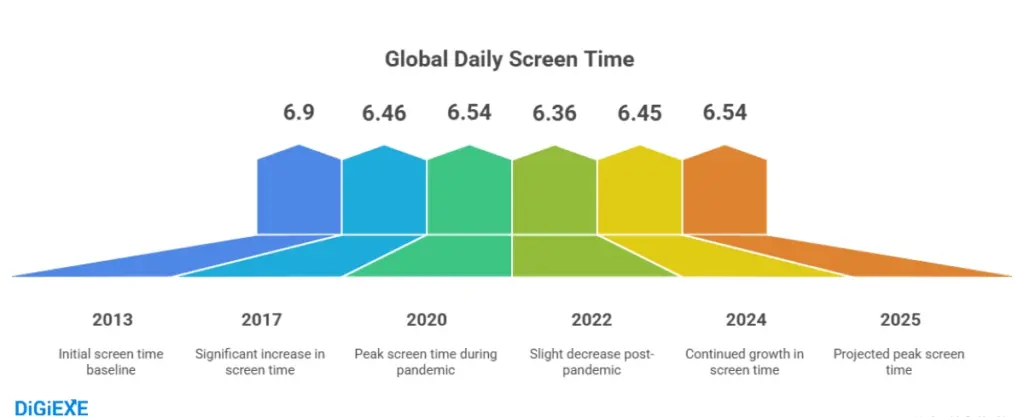
People around the world now average 6 hours and 45 minutes of daily screen time, with a projected rise to 6 hours and 54 minutes by the end of 2025.
That equals more than 47 hours per week — the same as a full-time job spent on phones, laptops, tablets, and TVs.
| Quarter/Year | Global Average Screen Time | Change from Previous Period |
| Q3 2013 | 6 hours 9 minutes | – |
| Q3 2020 (pandemic peak) | 6 hours 54 minutes | +4.2% |
| Q3 2024 | 6 hours 45 minutes | +1.25% |
| Q3 2025 (projected) | 6 hours 54 minutes | +2.22% |
Also read about: Android Usage Statistics
Average Screen Time in the United States
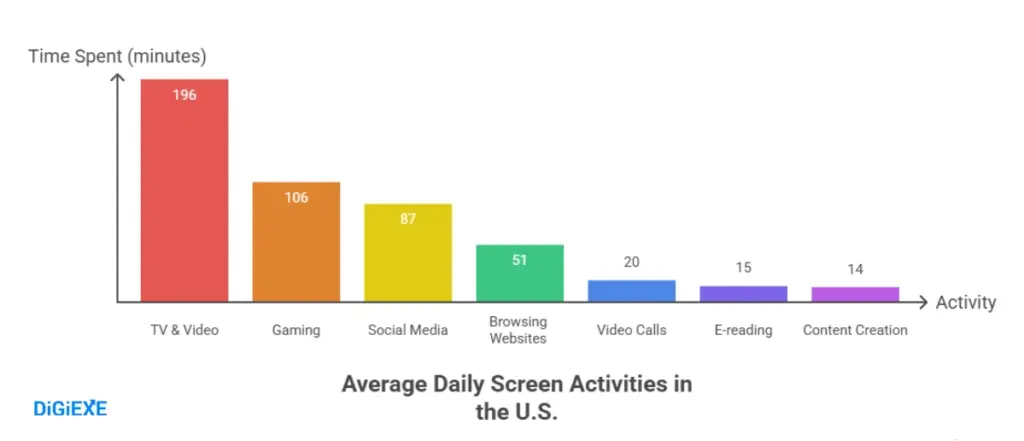
U.S. adults currently average 7 hours and 2 minutes per day — slightly above the global figure — and the number has stayed remarkably stable since 2021.
| Activity (U.S. Adults) | Daily Average Time |
| Watching TV & videos | 3 hours 16 minutes |
| Gaming | 1 hour 46 minutes |
| Social media | 1 hour 27 minutes |
| General web browsing | 51 minutes |
| Video chatting | 20 minutes |
| Everything else | 29 minutes |
Screen Time Breakdown by Age and Generation in 2025
Younger people lead the pack, and the gap between generations has never been wider.
| Generation / Age Group | Average Daily Screen Time |
| Gen Z (13–28) | 9 hours |
| Millennials (29–44) | 6 hours 42 minutes |
| Gen X (45–60) | 4 hours 10 minutes |
| Baby Boomers (61+) | 3 hours 31 minutes |
| Females 16–24 | 7 hours 32 minutes |
| Males 16–24 | 7 hours 7 minutes |
| Ages 55–64 | ~5 hours 15 minutes |
Children and Teen Screen Time – The Most Concerning Numbers of 2025
- 41% of U.S. teens (13–18) now exceed 8 hours of entertainment screen time daily
- Average for ages 8–12: 5 hours 33 minutes (up 49 minutes since 2019)
- TikTok alone takes 1 hour 53 minutes from American kids every day
| Age Group | Average Entertainment Screen Time | % Over 8 Hours Daily |
| 0–2 years | 1 hour 3 minutes | – |
| 5–8 years | 3 hours 28 minutes | – |
| 8–12 years | 5 hours 33 minutes | 20% |
| 13–18 years | 8 hours 39 minutes | 41% |
Also read about: iPhone Users Statistics
Which Countries Spend the Most (and Least) Time on Screens?
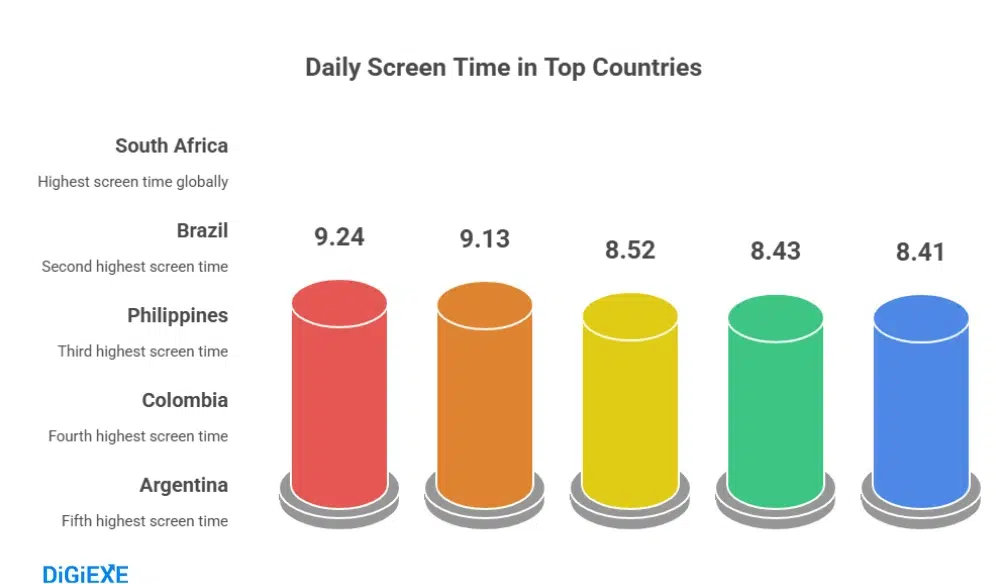
South Africa tops the global list at 9 hours and 24 minutes daily, while Japan sits at the very bottom.
| Rank | Country | Average Daily Screen Time |
| 1 | South Africa | 9 hours 24 minutes |
| 2 | Brazil | 9 hours 13 minutes |
| 3 | Philippines | 8 hours 52 minutes |
| … | United States | 7 hours 3 minutes |
| Last | Japan | 4 hours 9 minutes |
Mobile vs Desktop vs Streaming – Where the Hours Actually Go
- Smartphones: 53% of all screen time (global average 4 hours 37 minutes)
- Top U.S. streaming platforms in 2025: Hulu (2h10m) → Netflix (1h50m) → Prime Video (1h37m)
Social Media Screen Time – The Habit That Keeps Growing
The world now spends an average of 2 hours and 31 minutes per day on social platforms — exactly the recommended maximum for all recreational screen time.
| Year | Global Daily Social Media Time |
| 2015 | 1 hour 51 minutes |
| 2020 | 2 hours 25 minutes |
| 2025 | 2 hours 31 minutes |
Health Risks Linked to High Screen Time (Backed by 2025 Research)
- Obesity risk: 23% higher
- Type 2 diabetes risk: 15% higher
- 87% of children already exceed the official 2-hour recreational limit
- 32% of adults say screens noticeably change their mood and behavior
Fresh 2025 Insights from Reddit and Quora Users
- r/productivity and r/digitalminimalism members are hitting under 4 hours daily using grayscale mode + Opal blockers
- Parents on r/Parenting report the “3-3-3 rule” (no screens 3 hours before bed, first 3 hours of the day, and during the 3 family meals) works wonders
- Quora threads confirm remote workers who separate “work screens” from “fun screens” on different devices cut total time by 2–3 hours without losing output
- Gen Z posters openly admit 9+ hours but say switching to e-ink tablets and dumbphones for weekends drops them to 5–6 hours and “feels like getting time back”
Practical Strategies That Actually Work in 2025
You do not need superhuman willpower. These proven tactics from real people in 2025 deliver results:
- Track for one week with built-in phone tools → most people instantly shave 60–90 minutes just from awareness
- Set app limits at 30–45 minutes for TikTok/Instagram → Reddit users report zero regret and sharper focus
- Charge phones outside the bedroom → Quora parents and professionals unanimously call this the single biggest sleep upgrade
- Use “Focus Mode” schedules that auto-block social apps during your peak productive hours
- Replace one doom-scroll session with a 20-minute walk → thousands of r/GetDisciplined members say this alone cuts average screen time by 60+ minutes
FAQs About Screen Time Statistics
1. Is 7 hours of screen time per day bad in 2025?
Seven hours is the U.S. average. It’s fine if most time is work or learning, but heavy scrolling harms sleep, mood, and focus.
2. How can I reduce my teen’s screen time without fights?
Replace screens with fun offline activities and set rules together. Shared screen reports work better than strict bans.
3. What is a healthy screen time goal for adults in 2025?
Aim for under 6 hours total per day, with no more than 2 hours on social media or entertainment.
4. Do experts still recommend only 2 hours of recreational screen time?
Yes. Health groups still advise limiting non-work screen time to 2 hours daily for better sleep and mental health.
5. Will screen time keep rising after 2025?
Growth is slowing. Many people are cutting back using wellness tools, simpler phones, and digital minimalism habits.
Also Read:
- TikTok Users Statistics
- Facebook Users Statistics
- SaaS Statistics
- Infographics Statistics
- Gemini Users Statistics
Conclusion
The average screen time statistics 2025 show we are more connected than ever, yet the same numbers prove that small, deliberate changes create massive freedom.
Whether you currently sit at 9 hours like most Gen Z users or closer to the global 6 hours and 45 minutes, you now hold the exact benchmarks, community-tested tools, and motivation to design a digital life that serves you instead of stealing from you.
Start with one tiny habit today — track your time, set one honest limit, or charge your phone across the room tonight — and watch how quickly balance, energy, and joy return.
Source: Exploding Topics, Statista
