
Startups are the engines of innovation, constantly reshaping industries and driving economic growth.
In 2025, the global startup ecosystem is experiencing a surge in activity, providing entrepreneurs with exceptional opportunities.
Whether you’re considering launching your own business or already immersed in the world of startups, this guide, packed with the latest startup statistics for 2025, will help you navigate the ever-changing landscape and unlock the secrets to startup success.
The Global Startup Surge: Numbers You Need to Know

Every day, countless new ventures are launched, fueled by passion and groundbreaking ideas.
The world is witnessing an unprecedented boom in entrepreneurship, as more individuals embrace the challenge of creating their own businesses.
Here are some key statistics that shed light on the magnitude of this global phenomenon.
A World Full of Startups
There are currently over 150 million startups operating across the globe. This staggering number illustrates the sheer volume of innovation happening at any given moment.
These startups are not just creating new products and services but are reshaping entire industries.
Daily Launches
On average, 137,000 new startups emerge every day, underscoring the constant influx of fresh ideas and entrepreneurial energy. The global startup ecosystem is buzzing with activity, making 2025 a year of immense possibilities for those who take the leap.
The Powerhouses: Leading Countries in Startup Activity
The United States is the clear leader in startup activity, with 1.14 million startups. This highlights the country’s strong entrepreneurial culture and its role as a global innovation hub.
India, on the other hand, has rapidly grown into a startup powerhouse, with 493,000 startups.
The entrepreneurial landscape in India is expanding at an exponential rate, offering significant opportunities for those looking to tap into one of the world’s most vibrant startup ecosystems.
Global Startup Breakdown by Country (2025):
| Country | Number of Startups (2025) |
| United States | 1,148,296 |
| India | 493,000 |
| United Kingdom | 368,665 |
| Canada | 180,147 |
| Germany | 139,516 |
| China | 102,231 |
| Australia | 98,747 |
| France | 77,973 |
| Italy | 55,558 |
| Singapore | 42,599 |
This table illustrates the distribution of startups worldwide, helping entrepreneurs identify potential markets and competitive landscapes.
These numbers highlight key regions for launching a startup, offering valuable insights into where the most dynamic entrepreneurial ecosystems are thriving.
Also read about: Startup to Success 2025: How Our Digital Marketing Agency Can Help?
The Reality of Startup Failure: What You Can Learn
While the scale of global startup activity is inspiring, it’s important to acknowledge the harsh reality that most startups face significant challenges.
The road to success is rarely smooth, and understanding the common pitfalls can help aspiring founders navigate the entrepreneurial journey with greater resilience.
The High Failure Rate of Startups
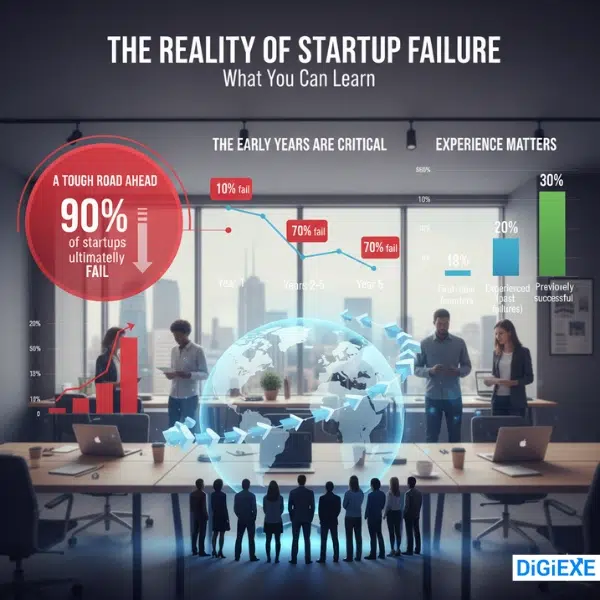
An astonishing 90% of startups ultimately fail. This sobering statistic reveals just how tough it is to establish and sustain a successful business.
Despite the relentless energy that drives new ventures, many don’t survive long enough to realize their full potential.
The Early Years Are Critical
The initial years of a startup are crucial for survival. 10% of startups fail within their first year, highlighting how important the early stages are for establishing a solid foundation.
Between the second and fifth years, 70% of startups close their doors. This period represents a significant challenge, as the company needs to prove its value and gain traction in a competitive market.
Experience Matters
Entrepreneurship is not just about having a great idea—it’s also about execution. First-time founders have an 18% success rate, while those who have experienced previous failures see a slightly higher success rate of 20%.
Founders with a previously successful startup experience a significantly higher 30% success rate.
This highlights the importance of learning from past failures and using that experience to improve future ventures.
Startup Failure and Success Rates by Country:
| Country | Startup Failure Rate (2025) | Startup Success Rate (2025) |
| The USA | 80% | 20% |
| Canada | 80% | 20% |
| The UK | 70% | 30% |
| France | 80% | 20% |
| Germany | 75% | 25% |
| Switzerland | 65% | 35% |
| Estonia | 75% | 25% |
| South Africa | 86% | 14% |
| Hong Kong | 70% | 30% |
| Singapore | 70% | 30% |
| Australia | 75% | 25% |
This table shows the varying startup failure rates across different countries, highlighting how local conditions such as funding availability, infrastructure, and market conditions can impact a startup’s chance of success.
Also read about: How to Choose Best Digital Marketing Agency in India?
Why Startups Fail: Understanding the Pitfalls
Understanding why startups fail is just as important as understanding how to succeed. By identifying common causes of failure, you can proactively address these challenges in your own venture.
Common Reasons for Startup Failure
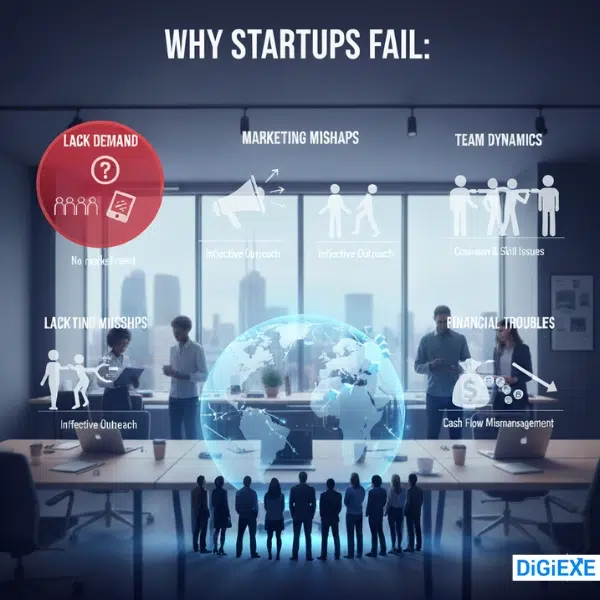
- Lack of Demand: 34% of startups fail because they create products or services with no market demand. This reinforces the need for rigorous market research before launching a product.
- Marketing Problems: 22% of startups struggle due to ineffective marketing strategies. Even the best product will fail if it doesn’t reach the right audience.
- Team Problems: 18% of startups fail because of internal team issues, underscoring the importance of building a strong, cohesive team with complementary skills.
- Financial Troubles: 16% of startups collapse due to poor financial management, making it clear that sound financial planning and cash flow management are crucial for long-term success.
Failure Breakdown by Reason:
| Failure Reason | Percentage (2025) |
| Lack of Product Demand | 34% |
| Marketing Problems | 22% |
| Team Problems | 18% |
| Financial Problems | 16% |
| Technical Problems | 6% |
| Legal Problems | 2% |
| Operational Problems | 2% |
This breakdown helps identify the common reasons for failure, offering valuable lessons for new founders.
The Elusive Unicorn: Reaching Billion-Dollar Valuations
While most startups face steep challenges, a select few achieve extraordinary success, becoming “unicorns”—companies valued at over $1 billion.
A Rare Breed
Less than 1% of startups ever reach unicorn status, making these companies truly exceptional. However, the global unicorn landscape is growing rapidly, with over 1,400 unicorn startups across 48 countries. Since 2018, more than 250 new unicorns have emerged each year, culminating in a surge of 787 unicorns in 2021.
The Unicorn Powerhouses
The United States dominates the unicorn scene, with a staggering 1,720 unicorn startups. China follows with 438 unicorns. Other countries with significant unicorn numbers include the United Kingdom (183), India (117), and Germany (72).
Top Unicorn Startups and Their Valuations
| Company | Valuation (2025) |
| SpaceX | $350 billion |
| ByteDance | $330 billion |
| OpenAI | $300 billion |
| ANT Group | $150 billion |
| Reliance Retail | $100 billion |
| Shein | $66 billion |
| Stripe | $65 billion |
| Databricks | $62 billion |
| Reliance Jio | $58 billion |
| xAI | $50 billion |
These unicorns exemplify the massive growth and disruption happening within their respective industries, leading the way in terms of innovation and valuation.
The Cost of Starting Up: Financial Realities
Understanding the financial realities of launching a business is key to planning your startup’s success.
Average Initial Investment
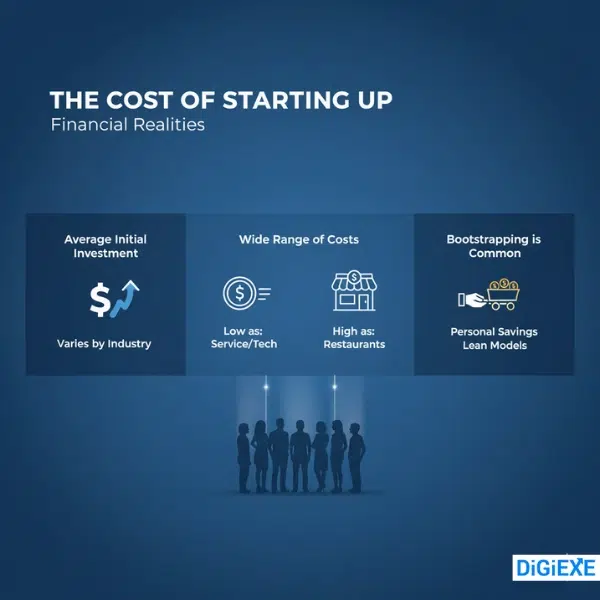
The average cost to launch a startup in its first year is around $40,000. However, this figure varies significantly across industries. Some businesses can be started with as little as $5,000, while others, like restaurants, may require $400,000 or more.
Startup Funding Sources
- Bootstrapping: Nearly 58% of small business owners start their ventures with less than $25,000, and a third begin with under $5,000. This shows a strong trend of entrepreneurs using personal savings and lean startup models to get their businesses off the ground.
Startup Costs by Industry:
| Industry | Average Cost to Start (2025) |
| Food and Restaurants | $375,000 |
| Construction | $37,390 |
| Retail | $39,210 |
| Arts | $32,960 |
| Entertainment | $12,272 |
These figures demonstrate the range of startup costs across industries, helping entrepreneurs plan their financial strategy accordingly.
Startup Funding: Fueling Growth and Innovation
Access to capital is often a critical factor in scaling a startup. The availability of funding is a major determinant of a company’s ability to grow and succeed.
Venture Capital Funding Surge
Global venture funding saw a significant rebound in Q2 2025, reaching $91 billion, an 11% year-over-year increase, signaling renewed investor confidence.
AI Takes the Lead
Artificial intelligence (AI) startups are attracting a significant share of venture funding. In Q2 2025, AI companies secured nearly $19 billion, representing 28% of all venture capital funding during that period.
Regional Funding Dynamics
- North America dominates, claiming 70% of global funding in the first half of 2025, with $145 billion flowing into startups in the U.S. and Canada.
- M&A activity is also booming, with over $100 billion in startup acquisitions in H1 2025, a 155% increase year-over-year, largely driven by demand in AI infrastructure and cybersecurity.
Beyond Venture Capital
Only 0.05% of startups receive venture capital funding. The majority of businesses rely on personal savings (77%), bank loans, friends and family, and credit cards for initial capital.
The Gender Funding Gap
In 2022, male founders received $156.2 billion in venture capital, while female founders received only $28.1 billion.
This highlights a persistent gender funding gap, with women-founded companies receiving only 2.1% of the total venture capital invested in U.S. startups in 2023.
Founder Demographics: Who Are the Innovators?

Understanding the demographics of startup founders provides insights into the entrepreneurial landscape.
Experience Trumps Youth
The average age of a startup founder is 42 years old. Founders over 40 account for 59% of all startup founders, showing that experience plays a major role in entrepreneurial success.
Interestingly, 60-year-old founders are more likely to succeed than 30-year-old founders, challenging the notion that younger entrepreneurs have an edge.
Gender Distribution Among Founders
- 64.3% of founders are male.
- 35.7% of founders are female, a significant increase from 17.64% in 2020.
Racial Diversity Among Founders
- 62.8% of founders are white.
- 16.9% of founders are Hispanic or Latino.
- 10.8% of founders are Black or African American.
This data underscores the importance of continued efforts to foster greater racial and gender diversity in the startup ecosystem.
Educational Background
- 71% of startup founders hold a bachelor’s degree.
- 16% have a master’s degree.
While education is a strong foundation, it is ultimately experience and industry knowledge that drive startup success.
Industry-Specific Startup Performance: Where Do You Stand?
Different industries present unique challenges and opportunities for startups. Understanding these variations can help you choose the right market.
Highest Failure Rates
The Information Technology (IT) industry has the highest failure rate, with 63% of startups failing. Other sectors with high failure rates include Transportation and Utilities (55%) and Retail (53%).
Startup Failure Rates by Industry:
| Industry | Failure Rate (2025) |
| Information Technology | 63% |
| Transportation and Utilities | 55% |
| Retail | 53% |
| Construction | 53% |
| Manufacturing | 51% |
| Mining | 49% |
| Wholesale | 46% |
| Services | 45% |
| Agriculture | 44% |
| Education and Health | 44% |
Fintech Startups: The Future of Finance
The Fintech sector is growing rapidly, with 30,000 fintech startups globally. The U.S. leads with 242 fintech unicorns, showcasing its dominance in this space.
FAQs About Startup Statistics
1. What are the most common reasons why startups fail, and how can I avoid them?
Common reasons include lack of demand (34%), poor marketing (22%), team issues (18%), and financial mismanagement (16%). Conduct market research, build a strong team, and manage finances carefully.
2. How can I increase my chances of success as a first-time founder?
Learn from mentors, validate your market, and focus on strong financial planning. Experience boosts success, so keep learning and iterating.
3. How much capital do I need to start a business in 2025?
Starting a business typically costs around $40,000, but it can range from $5,000 to $400,000 depending on the industry. Most startups rely on personal savings.
4. Which industries have the highest and lowest startup failure rates?
IT has the highest failure rate at 63%, followed by transportation (55%). Sectors like finance, education, and agriculture have lower failure rates (42-44%).
5. What are the key emerging trends in the startup ecosystem for 2025?
AI integration, sustainable business models, remote work, and founder mental health are key trends for 2025.
Also Read:
- Social Media Statistics
- Twitch Statistics
- Google Searches Statistics
- LinkedIn Statistics
- Instagram Statistics
Conclusion: Startup Ecosystem of [Year]
The startup ecosystem in 2025 is vibrant, filled with both tremendous opportunities and significant challenges. With over 150 million startups worldwide, the spirit of innovation has never been stronger.
However, the high failure rate of 90% highlights the difficulties that entrepreneurs face. Understanding the reasons behind failure, such as lack of product demand, poor marketing, and financial mismanagement, is crucial for avoiding these pitfalls.
Despite these challenges, the surge in venture funding—particularly in sectors like AI—signals that there are vast opportunities for innovation.
By leveraging the startup statistics for 2025, understanding the dynamics of different industries, and addressing emerging trends like AI and sustainability, entrepreneurs can position themselves for success.
While the startup journey is difficult, with careful planning, resilience, and a clear vision, you can significantly increase your chances of not just surviving but thriving in this exciting and ever-evolving landscape.
