
In 2025, Zoom continues to be the leading platform for video conferencing, powering millions of daily virtual meetings, from business discussions to family catch-ups.
The platform has evolved over the years, becoming an indispensable tool for professionals, students, and families.
With over 300 million daily active users, Zoom holds a commanding 55.91% share of the global video conferencing market.
This article delves into the latest Zoom user statistics for 2025, offering insights into the platform’s growth, revenue, regional adoption, and more.
Additionally, we explore how Zoom is optimizing connections through innovative features like AI companions, secure meetings, and enhanced collaboration tools.
Explosive User Growth and Engagement
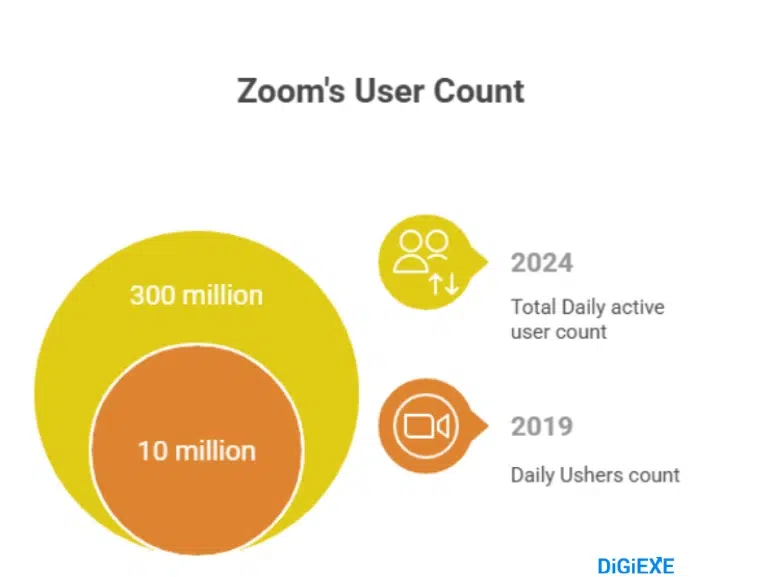
Zoom’s growth trajectory since its rise during the pandemic has been nothing short of impressive.
In 2025, the platform reports 300 million daily active users, a significant jump from the 10 million users in 2019.
This rapid growth is primarily attributed to the continued popularity of remote work, hybrid work setups, and the global shift toward digital communication.
The platform processes 3.5 trillion annual meeting minutes in 2025, up from 3.3 trillion in 2024.
The average Zoom meeting session lasts 45 minutes, with users engaging in everything from business meetings to casual catch-ups.
Families use Zoom to stay connected with relatives across the globe, while businesses host global webinars and training sessions.
The ease of use, combined with its robust functionality, ensures that Zoom remains a go-to tool for virtual collaboration.
Also read about: Slack Statistics
Steady Participation and Engagement
Despite fierce competition from platforms like Microsoft Teams and Google Meet, Zoom maintains its dominance.
In Q1 2025, the platform saw a steady surge of over 300 million daily active users, with 89% of employees reporting increased connections through video calls compared to pre-pandemic levels.
This trend is expected to continue as businesses, educational institutions, and individuals increasingly rely on Zoom for seamless virtual interactions.
Zoom also offers one-click joins for meetings, which help reduce drop-offs by 15%. Features like these make Zoom a favorite for both business and personal meetings, ensuring smooth participation even for large calls.
Revenue Growth and Financial Stability
Zoom’s financial performance in 2025 is equally impressive. The company reported a $4.66 billion revenue in 2024, marking a 3% increase from the previous year.
With a solid growth trajectory, Zoom is projected to reach $4.8 billion in revenue in 2025, driven by expanded enterprise adoption and new AI-driven features.
Zoom generates substantial revenue through subscriptions. As of 2025, 9.8 million subscribers contribute significantly to the company’s earnings.
The majority of Zoom’s revenue comes from mid-sized businesses with 10 or more employees, representing about 64% of the total revenue.
Enterprise customers also account for a significant portion of revenue, with 2,278 large clients contributing over $100,000 annually each.
Zoom offers different pricing plans, ranging from free basic accounts to Pro ($14.99 per month) and Enterprise packages ($199.90 per month), with tiered options to accommodate everything from small teams to large enterprises.
Also read about: Microsoft Teams Statistics
Global Market Share and Competitive Landscape
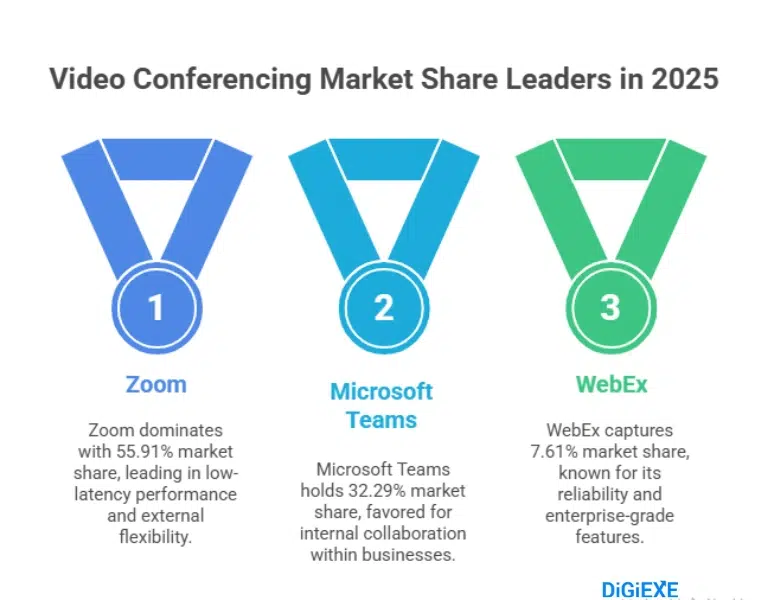
In 2025, Zoom continues to hold a 55.91% market share in the video conferencing sector, dwarfing its competitors, such as Microsoft Teams (32.29%), WebEx (7.61%), and Google Meet (5.52%).
Zoom’s market share dominance is bolstered by its superior low-latency performance (under 150 milliseconds), which is highly valued by users across industries, including education, healthcare, and finance.
One of the reasons for Zoom’s success is its adaptability. While Microsoft Teams is favored for internal collaboration within businesses, Zoom’s external flexibility makes it the go-to solution for cross-company meetings, global webinars, and virtual events.
In fact, 90,000 schools use Zoom to host virtual classes, with features like breakout rooms and screen sharing significantly enhancing the learning experience.
Zoom also benefits from being user-friendly, which is crucial for attracting a broad audience, from individual users to large enterprises.
The platform’s ability to seamlessly integrate with other tools like Google Calendar, Outlook, and Slack makes it a versatile choice for businesses and casual users alike.
Also read about: Social Media Statistics
Features Driving Zoom’s Success
Several features set Zoom apart from its competitors. AI companions have been one of the most notable innovations, experiencing a 68% quarter-over-quarter growth in 2025.
These AI-driven tools help users analyze meetings for insights, improving productivity by up to 41.7%.
For business users, this translates into more efficient coaching and decision-making, while individual users benefit from automated meeting summaries, cutting review time in half.
Zoom also excels with its breakout rooms, which enable participants to engage in smaller discussions during larger meetings.
Teachers use this feature to facilitate group work, and businesses use it to conduct focused brainstorming sessions or training programs.
In 2025, Zoom’s continued investment in security features like end-to-end encryption ensures that users feel safe during sensitive discussions.
This security focus has helped Zoom become a trusted platform for government agencies, large corporations, and nonprofit organizations.
Business and Enterprise Adoption
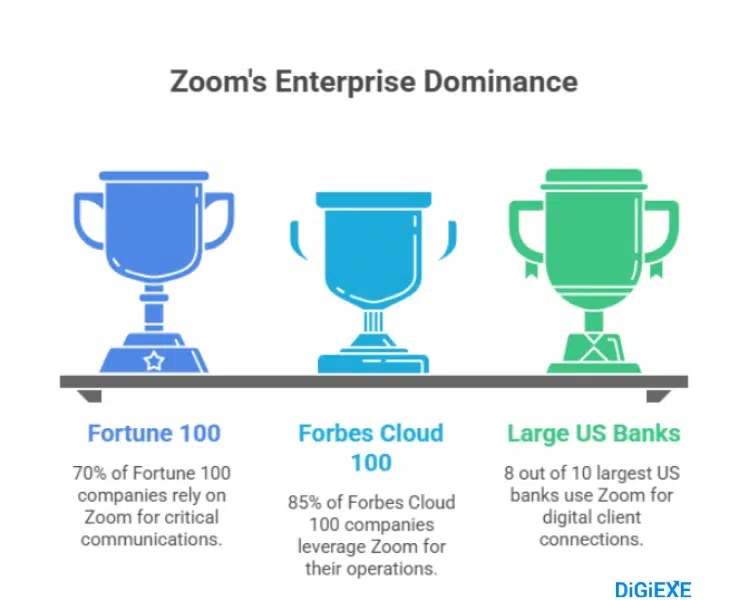
Zoom’s widespread adoption is particularly strong in the business sector. The platform serves 504,900 business customers in 2025, including a staggering 70% of Fortune 100 companies.
These businesses rely on Zoom for a variety of purposes, from client calls and webinars to team collaborations and training sessions.
Zoom facilitates 45 billion webinar minutes annually, underscoring its importance as a tool for knowledge sharing and global communication.
In 2025, large businesses continue to use Zoom’s Enterprise plans to host large-scale meetings with up to 500 participants.
Smaller companies often opt for the Pro plan, which allows for unlimited 40-minute meetings with up to 100 participants.
These flexible pricing plans ensure that Zoom can cater to organizations of all sizes.
Download Trends and Regional Penetration
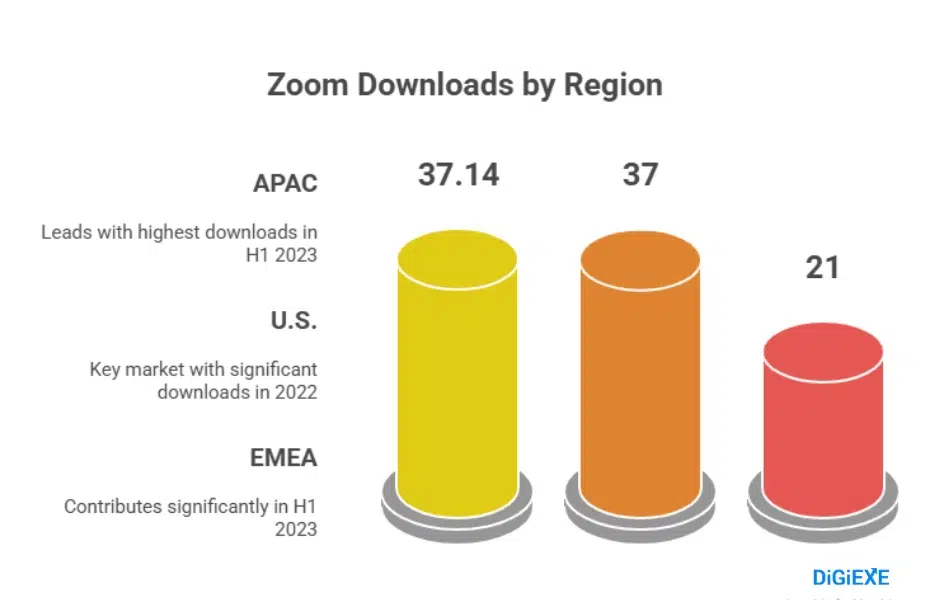
Zoom’s popularity is not limited to one region. In 2025, APAC (Asia-Pacific) continues to lead with the highest number of downloads, accounting for 37.14 million in H1 2023.
The U.S. follows closely with 37 million downloads in 2022, making it a key market for the platform.
Europe, the Middle East, and Africa (EMEA) also contribute significantly, with 21 million downloads in the first half of 2023.
This regional penetration reflects Zoom’s global reach. In emerging markets, such as India and Brazil, Zoom’s adoption is skyrocketing.
As these regions continue to digitize and embrace remote work, Zoom’s versatility and affordability make it the preferred choice for virtual communication.
Meeting and Webinar Minute Trends
Zoom continues to lead in the meeting and webinar minutes category, processing 3.5 trillion annual meeting minutes in 2025, with a strong focus on webinars.
45 billion webinar minutes are recorded each year, driven by the increasing demand for online learning, corporate training, and virtual conferences.
In 2025, Zoom continues to be favored by educators and businesses alike for hosting events that attract large audiences.
The platform’s interactive features, such as polling and Q&A sessions, boost engagement by up to 20%, making it ideal for virtual events where user interaction is key.
Employee and Corporate Diversity
Zoom prides itself on its diverse workforce, with 53.4% white and 22.4% Asian employees contributing to the company’s innovation.
With 8,484 employees as of 2024, Zoom’s diverse team drives continuous updates, including new features and security enhancements.
The company has also focused on improving its employee engagement, fostering an inclusive work environment that reflects its global user base.
Zoom’s Financial Outlook for 2025
Zoom’s financial outlook for 2025 is bright. The platform is projected to earn $4.8 billion in revenue, driven by both enterprise subscriptions and AI-driven features.
The platform’s AI Companion, which helps analyze meeting dynamics and provides insights, has gained significant traction, with 68% growth in quarter-over-quarter adoption.
Additionally, Zoom’s push into the hybrid work and education sectors has solidified its position as a critical player in the video conferencing market.
Maximizing Zoom for Personal and Professional Use
Zoom offers numerous ways to improve both personal and professional communication.
For individuals, the platform’s free tier is great for casual meetings, while the Pro plan is perfect for hosting extended calls with up to 100 participants.
Features like breakout rooms, screen sharing, and virtual backgrounds enhance the experience and make meetings more engaging.
For businesses, leveraging AI insights, breakout rooms, and real-time collaboration tools boosts productivity, reduces meeting times, and improves decision-making.
Additionally, using polls, Q&A sessions, and whiteboarding during webinars or meetings can increase engagement and make virtual sessions more interactive.
FAQs About Zoom Statistics
1. How many daily active users does Zoom have in 2025?
Zoom surpasses 300 million daily active users in 2025, providing seamless communication for businesses, students, and families alike.
2. What is Zoom’s market share in video conferencing for 2025?
Zoom holds 55.91% of the global video conferencing market, maintaining a strong lead over competitors like Microsoft Teams and Google Meet.
3. How has Zoom’s revenue grown in recent years?
Zoom’s revenue grew to $4.66 billion in 2024 and is projected to reach $4.8 billion in 2025, driven by enterprise subscriptions and AI features.
4. How can individuals benefit from Zoom in 2025?
Individuals can use Zoom’s free tier for casual meetings and Pro for hosting larger calls with up to 100 participants. Features like AI Companion, breakout rooms, and polling can help enhance communication.
5. What are some of the most popular features of Zoom in 2025?
Popular features include AI Companion, breakout rooms, screen sharing, and virtual backgrounds, all of which make Zoom an engaging and efficient platform for personal and professional use.
Also Read:
- Mobile Internet Traffic Statistics
- Grok AI Statistics
- Google Chrome Statistics
- Android Usage Statistics
- Mobile Marketing Statistics
Final Thoughts
In 2025, Zoom remains the leader in video conferencing, with a massive user base, innovative features, and solid financial growth.
Whether it’s for business meetings, remote learning, or family gatherings, Zoom continues to be a vital tool that connects people worldwide.
With its focus on security, ease of use, and continuous innovation, Zoom is poised to maintain its dominance in the video conferencing market for years to come.
Source: Business Insider, Business of Apps
