
Businesses worldwide actively embrace artificial intelligence to streamline recruitment processes in 2025.
Companies integrate AI tools to source candidates faster, reduce costs, and make smarter hiring decisions.
The global AI recruitment market reaches impressive heights, and recruiters report significant time savings. However, candidates express concerns about bias and lack of human touch.
This comprehensive guide combines worldwide data, adoption trends, benefits, challenges, and emerging insights from platforms like Quora and Reddit.
Readers discover how AI transforms hiring and learn practical ways to leverage these tools for their organizations’ success.
Statistics reveal that 87 percent of companies now use AI in recruitment, while the market grows at a compound annual growth rate (CAGR) of 6.78 percent from 2023 to 2030.
AI Recruitment Statistics: Global Market Size and Growth Projections
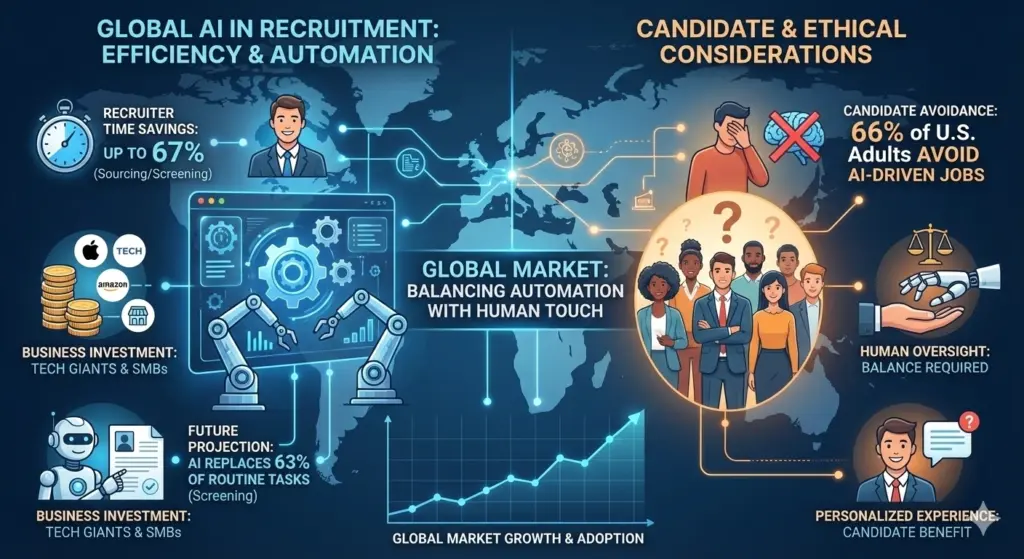
Organizations implement AI to handle high-volume applications efficiently. Recruiters save up to 67 percent of their time on sourcing and screening.
Small and medium businesses allocate budgets to AI-powered tools, and tech giants invest heavily in advanced software.
Candidates benefit from personalized experiences, but 66 percent of U.S. adults avoid jobs with AI-driven decisions.
Future projections show AI replacing routine tasks like candidate screening in 63 percent of cases.
Companies balance automation with human oversight to achieve optimal results. This article explores market sizes, regional differences, recruiter opinions, and innovative applications discussed in online communities.
The AI recruitment landscape evolves rapidly. Enterprises in North America lead with 40 percent cost reductions in HR processes. Europe follows closely at 36 percent.
Asia-Pacific regions adopt AI for remote hiring, especially post-pandemic. High-volume sectors like retail and healthcare use AI interviewers to process thousands of applicants daily.
Accuracy improves as AI assesses technical skills with 90 percent precision. Soft skills evaluation advances through sentiment analysis. Cheating prevention features ensure integrity in remote assessments.
Challenges persist, including algorithmic bias affecting 67 percent of implementations at some point. Companies mitigate risks through diverse training data and regular audits.
Innovative users on Quora share success stories of integrating AI with virtual reality for immersive interviews. Reddit threads highlight open-source AI tools that small businesses customize for niche hiring.
These community insights add fresh perspectives to traditional statistics. Organizations apply AI not just for entry-level roles but also for executive searches with hybrid models.
Data shows 14 percent higher interview pass rates for AI-selected candidates. Revenue per employee increases by 4 percent on average.
Budget allocations rise, with 35.5 percent of small and medium businesses investing in AI recruitment solutions.
| Year | Market Size (in Million USD) |
| 2020 | 380.6 |
| 2021 | 470.3 |
| 2022 | 540.4 |
| 2023 | 661.56 |
| 2030 | 1119.8 |
This table illustrates the steady growth of the AI recruitment industry. Companies project the enterprise sector to reach 275.2 million USD by 2030.
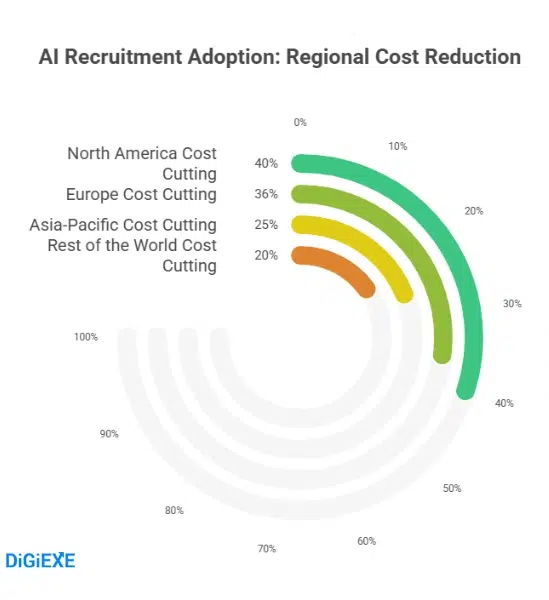
IT and telecommunications follow at 132.9 million USD, while education hits 130 million USD. Regional cost cuttings vary significantly.
| Region | Cost Cutting Percentage |
| North America | 40 |
| Europe | 36 |
| Asia-Pacific | 25 |
| Rest of World | 20 |
North America generates 206.4 million USD in revenue in 2022, projected to 323.2 billion USD by 2030.
Note the billion figure reflects broader HR AI impacts, but recruitment-specific contributions remain substantial.
Recruiters actively discuss these figures on Reddit, where HR professionals share case studies of 30 percent per-hire savings.
Also read about: Perplexity AI Statistics
Worldwide Adoption Rates and Industry Breakdown

Adoption rates soar globally. Eighty-eight percent of organizations integrate AI into hiring, up from previous years. Forty-five percent deploy AI interviewers for scaling screenings.
Tech industries lead with 75 percent adoption. Healthcare achieves 65 percent, and finance reaches 70 percent.
Regional variations show North America at 82 percent, Europe at 65 percent, and Asia-Pacific at 60 percent.
High-volume hiring benefits immensely, with 80 percent of companies reporting reduced screening time.
Recruiters voice positive opinions. Seventy-nine percent believe AI will handle hiring and firing decisions soon. Sixty-eight percent agree it removes biases.
Forty-four percent cite time savings as the primary reason for implementation. Forty-one percent value insights provided, and 39 percent note job simplification.
However, 35 percent worry about excluding unique candidates. Twenty-six percent fear AI could disrupt the HR industry. Mixed views emerge from Quora questions, where recruiters ask about ethical AI use in diverse hiring.
Companies invest aggressively. Seventy-three percent plan recruitment automation. AI investments total 142.3 billion USD, a 54 percent increase from 2022.
Ninety-nine percent of Fortune 500 firms use AI methods. Sixty-five percent of recruiters implement them. Twenty-four percent focus on talent acquisition.
Eighty-nine percent of HR professionals see improvements in application processes. Industries span marketing, healthcare, education, and retail.
Also read about: Latest AI Statistics
Key Benefits Driving AI Implementation
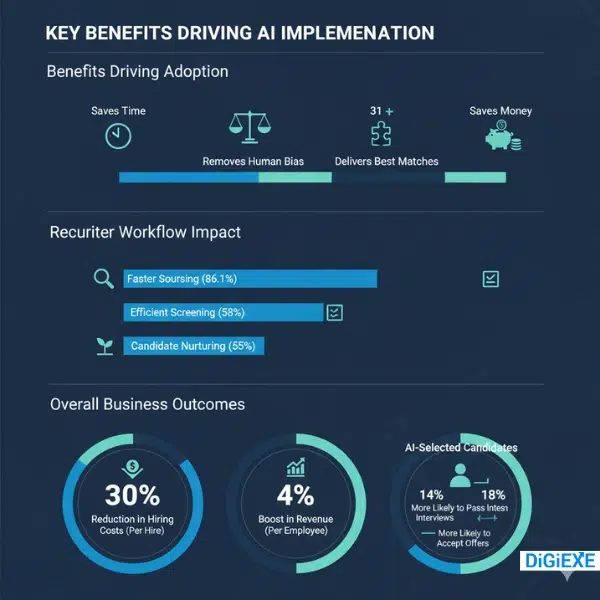
Benefits drive adoption. AI-selected candidates pass interviews 14 percent more often and accept offers 18 percent higher. Sixty-seven percent of decision-makers highlight time savings.
Forty-three percent note bias removal. Thirty-one percent appreciate best matches, and 30 percent enjoy cost savings.
| Benefit | Share of Respondents (Percentage) |
| Saves Time | 67 |
| Removes Human Bias | 43 |
| Delivers Best Matches | 31 |
| Saves Money | 30 |
Eighty-six point one percent of recruiters confirm faster processes. Fifty-eight percent find sourcing most useful.
Fifty-six percent value screening, and 55 percent nurture candidates effectively.
Overall, AI reduces hiring costs by 30 percent per hire and boosts revenue per employee by 4 percent.
Also read about: DeepSeek AI Statistics
Challenges and Candidate Concerns
Challenges temper enthusiasm. Seventy-one percent of U.S. adults oppose AI for final decisions. Sixty-six percent avoid AI-involved jobs due to perceived lack of personal touch.
Fifteen percent believe AI treats applications unequally. Twenty-three percent doubt qualification identification.
Forty-four percent question potential recognition in non-fitting candidates. Forty-three percent worry about coworker fit.
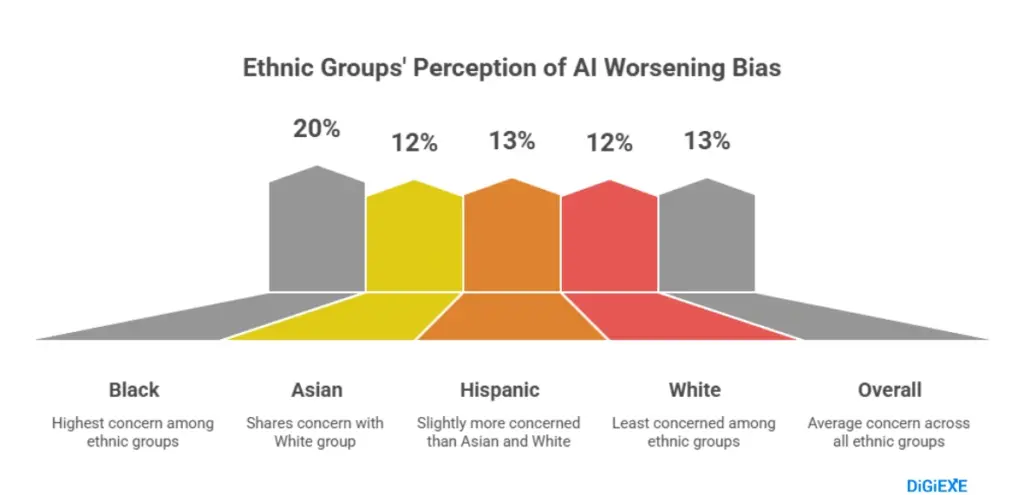
Bias concerns persist. Thirty-seven percent of American adults view racial or ethnic bias as significant. Thirteen percent think AI worsens it, with 20 percent of Black adults agreeing.
| Ethnicity | Share Believing AI Worsens Bias (Percentage) |
| Black | 20 |
| Asian | 12 |
| Hispanic | 13 |
| White | 12 |
| Overall | 13 |
Only 31 percent allow AI final hires, but 75 percent accept with human involvement. Current state shows 68.1 percent increase in AI tool usage from 2023 to 2024.
Sixty percent of organizations manage talent with AI. Thirty percent use it for campaigns. Over 100 startups develop HR AI tools.
Future Trends and Predictions
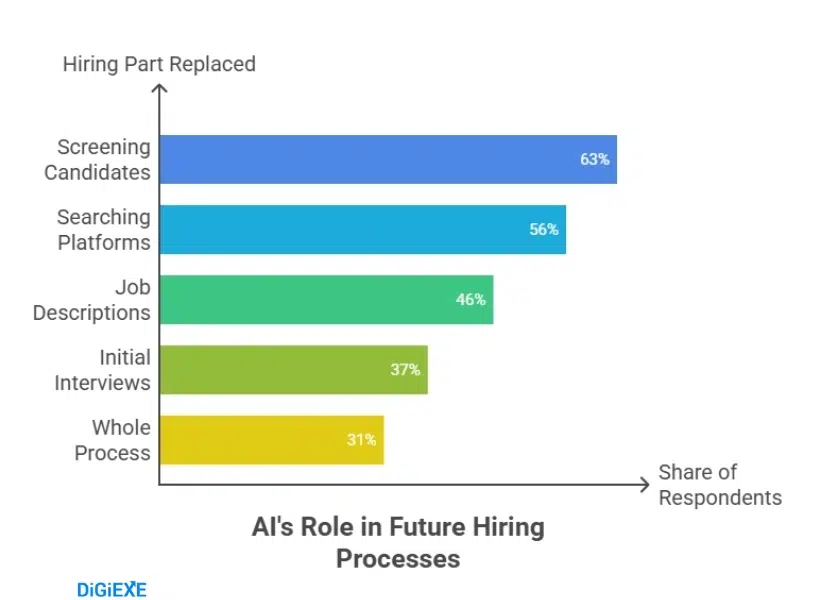
Future outlook remains bright. Thirty-five point five percent of small and medium businesses budget for AI tools. Sixty-three percent expect AI to replace screening.
Fifty-six percent anticipate platform searches. Forty-six percent predict job description creation. Thirty-seven percent foresee initial interviews.
Thirty-one percent believe full takeover, but 15 percent say human elements persist.
| Hiring Part Replaced | Share of Respondents (Percentage) |
| Screening Candidates | 63 |
| Searching Platforms | 56 |
| Job Descriptions | 46 |
| Initial Interviews | 37 |
| Whole Process | 31 |
HR executives adopt variably. Forty-four percent use AI for recruiting. Twenty-nine percent fully implement solutions.
Payroll sees 44 percent full implementation. Performance management reaches 34 percent.
| HR Area | Not Using (Percentage) | Starting (Percentage) | Fully Implemented (Percentage) |
| Employee Records | 22 | 41 | 37 |
| Payroll/Benefits | 23 | 33 | 44 |
| Recruitment/Hiring | 27 | 44 | 29 |
| Performance Management | 28 | 38 | 34 |
| Onboarding | 31 | 42 | 27 |
Tech companies invest 60 percent in AI software. Ninety-one percent target sourcing tools. Eighty-six percent focus on branding.
Dangers include 21 percent overlooking unique qualities. Eighteen percent cite algorithmic bias.
Sixteen percent worry about manipulation or developer oversights. Fourteen percent note dropouts from discomfort.
| Danger | Share of Respondents (Percentage) |
| Overlooking Unique Qualities | 21 |
| Algorithmic Bias | 18 |
| Manipulation | 16 |
| Developer Oversights | 16 |
| Discomfort Dropouts | 14 |
FAQs About AI Recruitment Statistics
1. What is the current global market size for AI in recruitment as of 2025?
The AI recruitment industry was valued at $661.56 million in 2023 and is projected to grow to $1.12 billion by 2030 at a 6.78% CAGR.
2. How much time do recruiters save by using AI in the hiring process?
AI reduces time-to-hire by 50-60% for half of companies, with 86.1% of recruiters reporting faster processes.
3. What are the primary benefits of implementing AI recruitment tools for businesses?
AI tools reduce hiring costs by 30%, improve interview pass rates by 14%, and help eliminate bias while enhancing candidate matching.
4. What concerns do candidates have about AI in recruitment, and how common are they?
66% of U.S. adults avoid AI-involved jobs, with concerns over bias (37%) and lack of personal touch being prevalent.
5. How can small businesses start using AI recruitment tools effectively in 2025?
Small businesses can start with affordable software for sourcing and screening, train staff, and focus on high-volume roles to reduce HR costs by 40%.
Also Read:
- Gmail Statistics
- TikTok Users Statistics
- Android Usage Statistics
- Mobile Marketing Statistics
- Link Building Statistics
Conclusion:
AI is revolutionizing recruitment in 2025, offering businesses faster, more efficient, and cost-effective hiring processes.
With AI handling high-volume tasks like sourcing, screening, and interviewing, companies save time and reduce costs, while also improving candidate matching and removing bias.
However, concerns about bias and the loss of a personal touch remain, especially among candidates.
Despite these challenges, AI tools are becoming mainstream, with most companies planning to expand their use in the coming years.
For small businesses, integrating AI tools is an effective way to streamline HR processes and save costs.
The future of AI in recruitment is promising, and as the technology evolves, so will its potential to transform the hiring landscape.
Source: Market Research Future, Statista.
