

I like Coursera because it strikes the perfect balance between academic depth, real-world relevance, and everyday accessibility. I love that I can learn from top-tier institutions like Yale, Stanford, and Google without ever setting foot in a classroom.
- Courses from top universities and companies
- Wide range of topics and skill levels
- Certificates add credibility to your resume
- Learn at your own pace, anywhere
- Great app experience
- Peer reviews can be hit or miss
- Some older courses need refreshing
- Pricing can be confusing if you’re not on Coursera Plus
Price: $9/Month
You’ve hit that career wall, haven’t you? Resume gathering dust, skills from last year feeling obsolete, endless LinkedIn scrolls turning up zilch. Or maybe you’re that side-hustler burning midnight oil, dreaming of turning a hobby into real income, but drowning in free YouTube rabbit holes that lead nowhere. I get it, I’ve been there, staring at a screen at 2 AM, wondering if any course out there will actually move the needle. That’s when Coursera Review first hooked me. Not the hype, but the quiet promise of learning from Yale profs or Google pros without quitting your day job.
In this Coursera Review, we’ll walk through my real journey- frustrations, wins, the courses that stuck. Updated for 2026, with fresh pricing and features pulled straight from the source. If you’re skeptical (like I was), stick around. By the end, you’ll know if it’s your ticket out of the rut.
What Is Coursera?
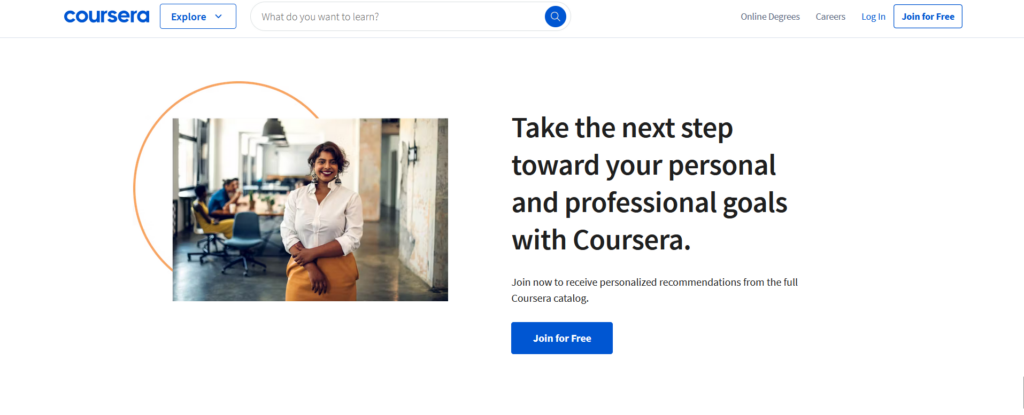
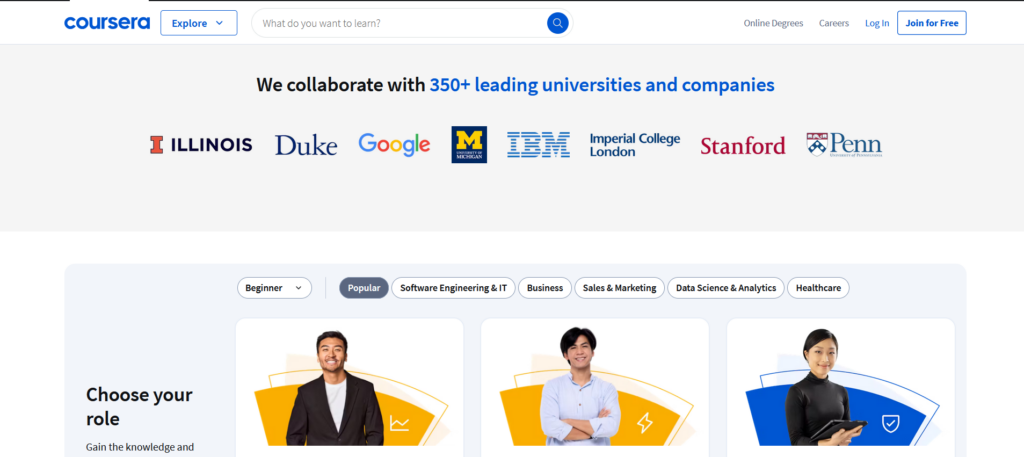
Coursera is one of the world’s largest online learning platforms. Launched in 2012 by two Stanford professors, it partners with top universities and companies (think Yale, Google, IBM, Stanford) to offer:
- 🎓 Online courses
- 📜 Professional certificates
- 🎯 Career-focused learning paths
- 🧑🎓 Full degree programs
You can either audit many courses for free or pay for access to graded assignments, certificates, and specializations.
Founded in 2012 by Stanford professors, Coursera connects learners with institutions like Yale, Google, IBM, and the University of Michigan to provide education that is both academically rigorous and career-relevant.
Whether you want to pick up a new skill, explore a subject out of curiosity, or earn a credential to boost your resume, Coursera makes it possible to learn from anywhere, at your own pace.
With both free and paid options, it caters to casual learners, professionals, and career switchers alike.
Coursera’s Offerings:
1. Coursera provides courses in diverse fields such as:
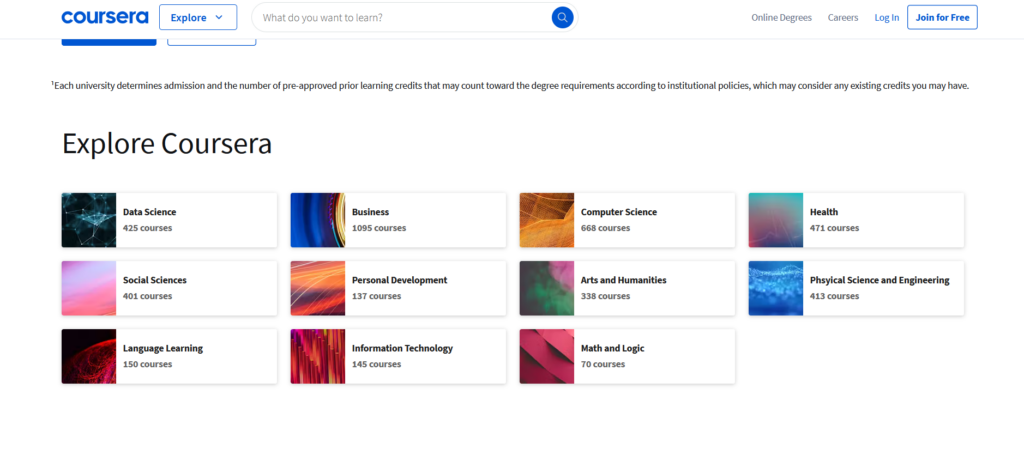
- Technology: Data Science, Machine Learning, AI (including GenAI strategies), Software Development, UX Design, Cybersecurity.
- Business: Marketing, Content Creation (e.g., for TikTok, YouTube, Instagram), Leadership, Finance.
- Health: Public Health, Healthcare Management.
- Social Sciences: Psychology, Economics.
- Personal Development: Career Skills, Communication, Creativity.
- Arts and Humanities: History, Music, Writing.
- Science and Engineering: Mathematics, Physics, Environmental Science.
Courses range from beginner to advanced levels, with options for free courses, guided projects, specializations, and professional certificates.
2. Degrees:
- Online bachelor’s and master’s degrees from universities like the University of Illinois at Urbana-Champaign, Duke University, University of Michigan, Stanford, and others.
- Degrees may allow credit for prior learning, depending on university policies.
3. Certificates:
- Professional Certificates from industry leaders like Google, IBM, and Microsoft in areas like IT, cloud computing, and data analytics.
- Specializations, which are series of courses focused on specific skills (e.g., Digital Marketing, Machine Learning).
- Free and Paid Options:
- Many courses are free to audit, with paid options for certificates.
- Coursera Plus: A subscription offering access to 10,000+ programs, with a promotional discount of $200 off mentioned in the document (valid until June 30, though the exact year isn’t specified in the document; check the website for current offers).
- Learning Formats:
- Flexible, self-paced online learning with videos, quizzes, and hands-on labs.
- Programs designed for individuals, teams (Coursera for Teams), and businesses, with AI-enhanced tools and credentials.
- Key Partners:
- Universities: Stanford, University of Pennsylvania, Imperial College London, etc.
- Companies: Google, IBM, L’Oréal, Procter & Gamble, Reliance Industries, etc.
How to Explore All Courses:
Since listing every course is not feasible, you can browse the full catalog directly on Coursera’s website:
- Use the search bar or browse by category (e.g., Data Science, Business, Computer Science).
- Filter by course type (e.g., free, paid, certificate, degree), level (beginner, intermediate, advanced), or partner (e.g., Google, Stanford).
- Sign up for a free account to receive personalized recommendations based on your interests and goals.
Additional Notes:
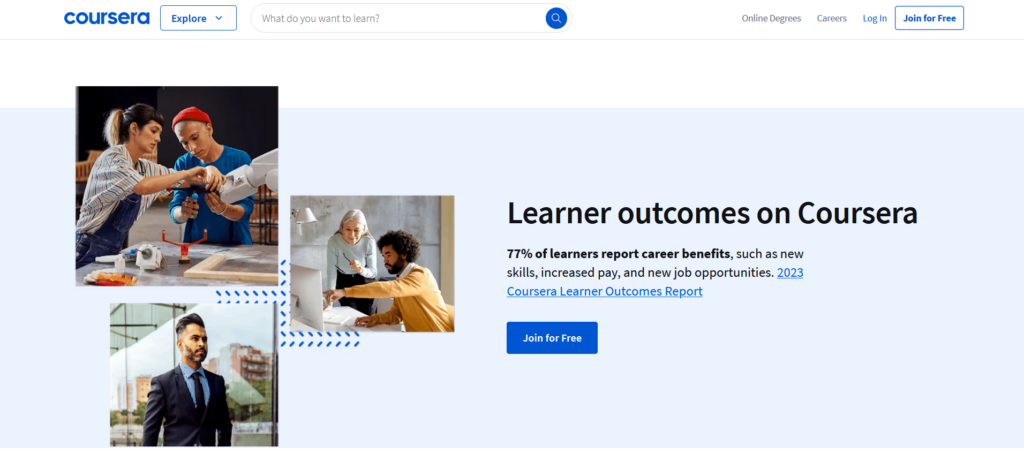
- The document highlights learner outcomes, with 77% of learners reporting career benefits like new skills, increased pay, or job opportunities (2023 Coursera Learner Outcomes Report).
- Testimonials emphasize flexibility for working professionals and practical, hands-on learning experiences.
- For business training, Coursera for Teams and enterprise solutions are available for upskilling teams.
Specializations and Guided Projects
Specializations are like mini-degrees, and I loved how my digital marketing one built skills step-by-step across multiple courses. It took three months, but the structure kept me focused.
Guided projects, such as building a basic website, were great for hands-on practice, although some felt too brief to delve deeper. I’d highlight these for readers who want structured or practical learning.
Pricing and Subscription Options: Coursera Review
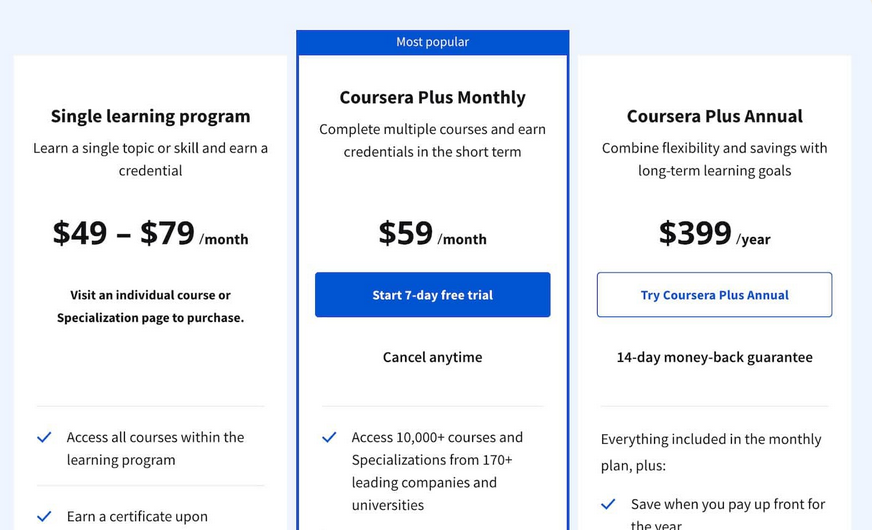
There are two types of subscriptions to Coursera Plus:
- Monthly – $59/month. Starts with a 7-day free trial.
- Annual – $399/year. Comes with a 14-day money-back guarantee.
Both memberships can be cancelled at any time. Prices for monthly subscriptions may vary based on promotions. Learners in India currently only have access to the monthly subscription option.
Coursera Plus: Is It Worth It?
Yes, if you’re a lifelong learner or building a new career.
With Coursera Plus, I completed multiple professional certificates and specializations without paying for each course. I also loved how it removed the mental friction of deciding, “Should I pay for this course?”
You get:
- Unlimited certificates
- Full access to premium content
- Flexibility to pause, start, or skip around
Coursera Refund Policy:
Coursera’s refund policy, as outlined on their Help Center, allows learners to request a refund under specific conditions.
For most paid courses, specializations, and Coursera Plus subscriptions, a full refund is available if requested within 14 days of the purchase date or subscription start date, provided the course or specialization has not been completed and no certificate has been earned.
Refunds are not available for degree programs, MasterTrack certificates, or certain other programs, though specific refund terms may vary by program and are detailed at the time of enrollment.
To request a refund, learners must submit a request through their Coursera account or contact Coursera Support, and the refund is typically processed to the original payment method within 5–10 business days.
However, this may vary depending on the payment provider. Refunds are not granted for free courses, courses completed before the refund request, or if the 14-day period has expired, except in cases where regional laws provide additional refund rights.
For subscriptions like Coursera Plus, canceling within the 14-day window stops further billing and refunds any unused portion of the subscription fee, but access to content ends upon cancellation.
Learners should review the specific refund terms displayed during enrollment for any exceptions or additional conditions.
Coursera Review: Core Features
🎓 University & Industry-Certified Courses
Coursera partners with world-renowned universities like Yale, Stanford, and the University of London, as well as top tech companies such as Google, IBM, and Meta. This means learners can access high-quality, credible content created by leading experts in their fields.
📚 Multiple Learning Formats
Coursera offers a variety of learning paths to suit different goals. You can take individual courses, pursue multi-course specializations, earn professional certificates, complete guided projects, or even enroll in full online degree programs at the undergraduate or graduate level.
📜 Recognized Certifications
Upon completing paid courses or specializations, you receive a shareable certificate that can be added to your resume or LinkedIn profile. These certificates carry real value, especially those from well-known institutions and corporate partners.
🕒 Self-Paced Learning
Courses on Coursera are designed to be flexible. You can start when you’re ready and learn at your own pace, making it easy to fit education around your job, family, or other commitments.
📱 Mobile Learning
The Coursera mobile app allows you to learn anywhere, anytime. You can download videos for offline use, complete quizzes, and even submit assignments directly from your smartphone or tablet.
📊 Skill-Based Curriculum
Many Coursera programs are aligned with in-demand skills like data analytics, coding, business strategy, and digital marketing. Courses often include real-world projects and assessments to help you apply what you’ve learned immediately.
💬 Community & Peer Interaction
Each course includes access to discussion forums where you can engage with fellow learners, ask questions, and participate in peer reviews, adding a social dimension to your online learning experience.
💳 Flexible Pricing Options
Coursera offers free auditing for most courses, pay-per-course options, and the Coursera Plus subscription for unlimited access to thousands of courses and certificates. Financial aid is also available for many programs.
Who Coursera Is Best For
Coursera is ideal for:
- 🎓 Students supplementing college learning
- 👨💼 Professionals switching careers or upskilling
- 👩🎨 Creatives & freelancers looking to expand skills
- 📈 Entrepreneurs learning business, marketing, and tech
- 💙 Curious minds who love to learn
Pros & Cons: Coursera Review
Pros
- Many courses can be audited for free (no certificate, but full content access).
- Many programs focus on practical, job-ready skills.
- Great value for serious learners with unlimited course access under one subscription.
- From tech and business to arts, health, and personal development.
- Learn at your own pace, pause, resume, or schedule learning around your life.
- Courses created by prestigious universities and global companies (like Yale, Stanford, Google, and IBM).
Cons
- Some Courses Are Outdated, especially in fast-evolving fields like tech and marketing.
- Discussion forums can be inactive or unmoderated.
Why I Like Coursera
There are a lot of online learning platforms out there, but Coursera stands out to me, and not just because of the big-name universities or shiny certificates.
I like Coursera because it strikes the perfect balance between academic depth, real-world relevance, and everyday accessibility.
I love that I can learn from top-tier institutions like Yale, Stanford, and Google without ever setting foot in a classroom. The video lectures are high quality, the materials are thoughtfully structured, and I can go at my own pace.
And then there’s the flexibility. Whether I’m on my laptop at home or using the mobile app on the go, learning fits into my schedule.
However, the fact that Coursera is practical rather than only “head knowledge” is what really sticks with me. I’ve completed courses on data analytics, which I immediately applied to my freelancing employment.
I gained more clients by earning marketing certificates. Even soft-skill classes, such as the Science of Well-Being, provided me with useful tools.
Career Impact: Does Coursera Help You Get a Job?
Short answer: Yes, but with effort.
Completing a course or certificate on Coursera won’t guarantee you a job, but it can absolutely open doors.
In my case:
- I added my certificates to LinkedIn and my resume ✅
- Got interviews in data-related roles 🎯
- Used the course projects in my freelance portfolio 🧳
Courses from recognized institutions carry real weight, especially those from Google, IBM, or leading universities. I’ve even had recruiters ask me about what I learned in a particular specialization.
Coursera Platform Experience
What I Love About Coursera
- The Course Variety Is Mind-Blowing
- Flexibility That Fits My Life
- High-Quality Content and Instructors
- Specializations and Guided Projects
- Certificates That Add Value
- The Mobile App Keeps Me Learning on the Go
- Community and Peer Interaction
What I Don’t Love About Coursera
- Free vs Paid Confusion
- Peer-Graded Assignments Can Be Hit-or-Miss
- Limited Access After Course Completion
- Technical Glitches and Navigation Hiccups
- Some Courses Feel Overwhelming
FAQs About Coursera Review
Are Coursera certificates recognized by employers?
Yes, many Coursera certificates are recognized and respected, especially those from well-known universities and companies like Google, IBM, Meta, Yale, and Stanford.
Can Coursera help me get a job?
It can be helpful to apply what you learn. Coursera provides job-relevant skills and certificates that you can use to stand out in applications. Some programs even include career support, projects, and interview prep, particularly Google Career Certificates.
Can I access Coursera on my phone?
Yes! Coursera has a highly rated mobile app for iOS and Android, which lets you download videos, complete assignments, and learn on the go, even offline.
How long do Coursera courses take?
Courses typically range from 4 to 12 hours of content, but learning is self-paced. Some specializations or professional certificates may take 1–6 months, depending on your speed.
Can I get a refund from Coursera?
Yes, Coursera offers a 14-day refund policy for most paid individual courses and subscriptions. Coursera Plus has the same refund window if you haven’t completed a course yet.
How’s the mobile app for learning?
It’s decent for watching lectures or listening offline, which I did during commutes. But for quizzes or assignments, it’s frustrating, with small buttons and weird formatting. I’d stick to a laptop for serious work.
What if I don’t finish a course?
No big deal. I dropped a couple of courses when life got busy, and there’s no penalty. You can always pick up where you left off or start fresh. Just set realistic goals to avoid burnout.
Is the content up-to-date?
Mostly, but it varies. My Python course was spot-on with current tools, but a marketing course had outdated references. Check course reviews for recency before enrolling.
How do I stay motivated to finish?
I struggled with this. Setting small goals, like finishing one module a week, helped. The platform’s progress tracker and discussion forums kept me accountable, but picking courses I was excited about made the biggest difference.
Why choose this platform for online learning?
For me, it’s the variety and credibility. With thousands of courses from top universities and companies, I always find something relevant to my goals, whether it’s tech or personal growth. The certificates carry weight with employers, and I love that I can learn at my own pace. It’s not perfect, but the quality and flexibility keep me coming back.
How long does it take to complete a course?
It depends. Most courses I took were 4-8 weeks, with 3-5 hours of work per week. Self-paced courses let you speed up or slow down, but I found setting a consistent schedule helped me finish faster.
Quick Links
Final Verdict on Coursera Review: Is It Worth It in 2026?
You’ve scrolled this far ’cause that rut stings- the job hunt ghosts, skills stale, side gig stalled. Coursera Review truth: It’s your quiet weapon. Not hype. Real access to Stanford brains, Google tools, Yale wisdom, all on your couch.
It provides access to top-notch education from any location in the world, with thousands of courses offered by renowned universities and business titans like Google, IBM, and Yale.
While expensive solutions, such as Coursera Plus or specific certifications, offer genuine value to the resume or LinkedIn profile, free auditing makes it available to all students.
Overall, Coursera offers a consistently excellent learning experience, while some courses may feel outdated or have varying levels of engagement.
