

Slack has become a central tool for workplace communication. The latest Slack statistics for 2025 show just how vital it is for teams worldwide.
Whether you are a small business owner, a manager of a remote team, or someone looking to optimize your communication, understanding Slack’s role can help you streamline your workflow and boost productivity.
With millions of daily users and billions of messages exchanged, Slack is revolutionizing how businesses operate, helping teams collaborate more efficiently.
This article takes a close look at Slack’s growth, revenue trends, and features in 2025, offering actionable insights that can help you take advantage of its capabilities.
By leveraging these statistics, you can optimize your workflow, improve team culture, and stay ahead in the fast-paced hybrid work environment.
Slack Statistics : The Meteoric Rise of Slack Users
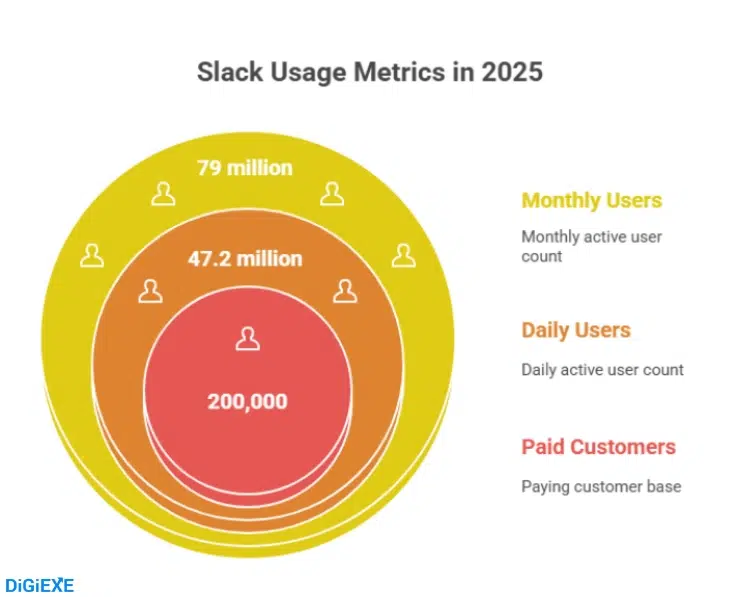
Slack now has 47.2 million daily active users and 79 million monthly active users in 2025. This is a significant leap from just 8.7 million daily users in 2019.
As businesses and organizations embrace hybrid and remote work, Slack has seen adoption across a wide range of industries.
With 750,000 organizations using Slack, including 77% of Fortune 100 companies, it has become the go-to platform for communication.
For individuals, joining the right channels and utilizing Slack’s features, like searchable archives and app integrations, can help streamline communication and keep track of important messages.
As users continue to grow, Slack’s ability to provide an intuitive platform for remote work, file sharing, and team communication makes it indispensable.
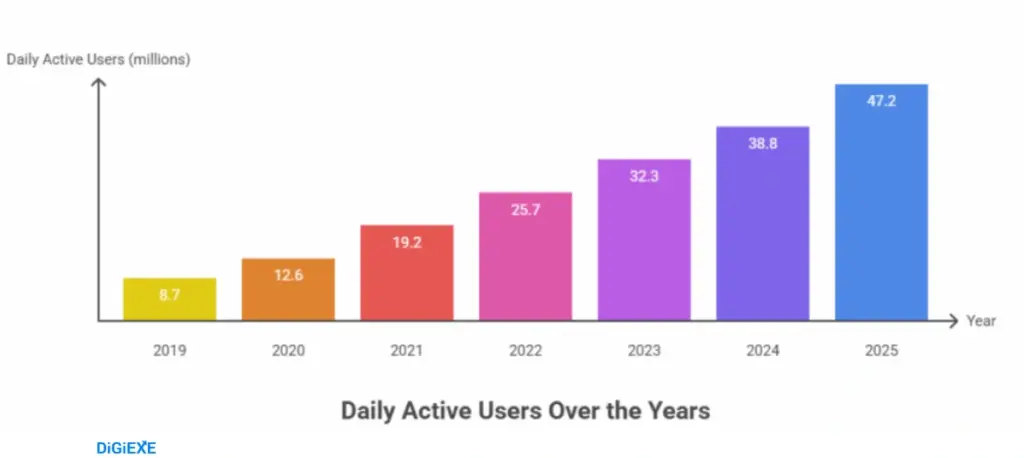
User Growth Over Time
| Year | Daily Active Users (in Millions) | Monthly Active Users (in Millions) |
|---|---|---|
| 2019 | 8.7 | 14.6 |
| 2020 | 12.6 | 21.0 |
| 2021 | 19.2 | 32.2 |
| 2022 | 25.7 | 43.1 |
| 2023 | 32.3 | 54.1 |
| 2024 | 38.8 | 65.0 |
| 2025 | 47.2 | 79.0 |
These numbers show how quickly Slack’s user base has expanded, driven by its easy integration with other apps like Google Drive, which cuts coordination time by 30%.
Also read about: Social Media Statistics
Revenue Growth
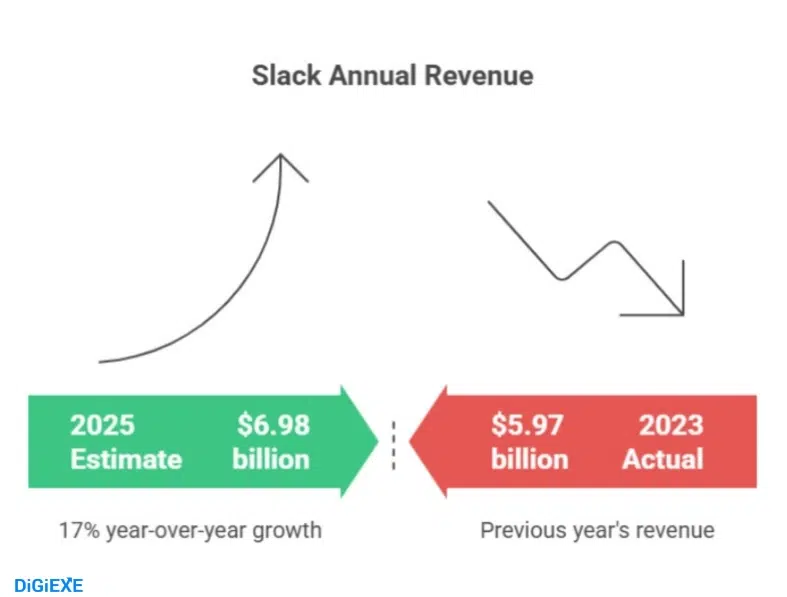
In 2025, Slack’s revenue reaches an estimated $6.98 billion, a 17% increase from 2023.
This growth is a result of Slack’s acquisition by Salesforce and its consistent improvement of paid features like unlimited message history.
With more than 200,000 customers, businesses are increasingly relying on Slack to enhance communication and improve workflows.
Slack’s revenue growth is driven by its ability to integrate with over 2,400 apps, such as Zoom and Trello, making it an essential tool for project management and collaboration.
These integrations reduce app-switching by 25%, helping teams stay focused and productive.
Revenue Growth Over Time
| Fiscal Year | Revenue (in Millions) |
|---|---|
| 2013 | 12 |
| 2014 | 30 |
| 2015 | 100 |
| 2016 | 200 |
| 2017 | 221 |
| 2018 | 400.6 |
| 2019 | 630.4 |
| 2020 | 902.6 |
| 2021 | 3,324 |
| 2022 | 4,509 |
| 2023 | 5,967 |
| 2025 | 6,980 |
Organizational Adoption
In 2025, more than 750,000 organizations use Slack, a 200% increase from earlier years.
This includes large companies like IBM and Amazon, but also many small teams, with 63,035 users from businesses earning $1–10 million annually. Slack’s flexibility and scalability make it ideal for both large enterprises and small startups.
Slack’s adoption has been particularly strong in industries like IT (13%), software (12%), and marketing (7%). Retail teams, for example, are using Slack to coordinate inventory and reduce delays by 15%.
Teams also leverage Slack for sensitive projects by creating private channels that maintain security while fostering collaboration.
Growth in Organizational Adoption
| Year | Number of Organizations | Paid Customers |
|---|---|---|
| 2014 | 30,000 | 50,000 |
| 2015 | 60,000 | 60,000 |
| 2016 | 200,000 | 88,000 |
| 2017 | 330,000 | 112,000 |
| 2018 | 450,000 | 156,000 |
| 2019 | 640,000 | 169,000 |
| 2020 | 750,000 | 200,000 |
Also read about: WhatsApp Users Statistics
Usage Dynamics: How Slack Improves Team Productivity

Slack users spend an average of 90 minutes daily on the platform, performing 5 billion actions weekly.
In 2025, teams report 47% productivity boosts, with some organizations seeing up to 40% increases.
By streamlining communication, reducing the need for meetings, and cutting down on emails, Slack helps teams focus on deep work.
Slack also helps businesses reduce meeting time by 27% and email usage by 32%, giving employees more time to complete tasks and engage in creative problem-solving.
This is particularly valuable for remote teams, where quick decision-making and transparency are essential.
Productivity Impact
| Productivity Increase | Number of Organizations |
|---|---|
| Over 100% | 33 |
| 100%–80% | 58 |
| 80%–60% | 129 |
| 60%–40% | 292 |
| 40%–20% | 515 |
Also read about: Telegram Statistics
Slack’s Market Position: Standing Strong in 2026
Slack holds an 18% market share in 2025, trailing behind Microsoft Teams, which leads with a 53% share.
Despite this, Slack’s extensive app integrations, open API, and user-friendly interface continue to make it a top choice for many teams.
Its ability to streamline communication and automate tasks makes it a valuable tool for businesses and individuals alike.
Slack’s $6.98 billion in revenue and 18% market share reflect its solid position in the market, helping teams collaborate effectively and efficiently.
Market Share Comparison: Slack vs. Teams
| Parameter | Microsoft Teams | Slack |
|---|---|---|
| Monthly Users | 320 million | 79 million |
| Market Share | 53% | 18% |
| Revenue | $8 billion+ | $6.98 billion |
Global Reach and Demographics
Slack operates in over 150 countries, with the U.S. leading the way with 36.11% of traffic.
In 2025, Slack’s user demographics show a balanced split between male (51.64%) and female (48.36%) users, with the largest age group being 25–34 years old.
This diversity makes Slack an inclusive platform, suitable for a wide range of users across different regions and industries.
User Demographics
| Age Group | Share of Users |
|---|---|
| 18–24 years | 15.25% |
| 25–34 years | 33.29% |
| 35–44 years | 20.54% |
| 45–54 years | 14.62% |
| 55–64 years | 9.62% |
| 65+ years | 6.68% |
Maximizing Slack: Practical Tips
- Set Do-Not-Disturb Hours: Focus on important tasks and reduce notifications by 40%.
- Integrate Apps: Use tools like Notion and Asana within Slack to keep all your work in one place.
- AI Bots for Automation: Use Slack’s AI bots to handle repetitive tasks, saving you 15 minutes a day.
FAQs About Slack Statistics
1. How do Slack statistics 2025’s 47% productivity boost help small business owners?
Slack’s 47% productivity boost allows small business owners to streamline operations, reduce emails by 32%, and make quicker decisions, saving time and resources.
2. What benefits do remote workers gain from Slack’s 91% remote work improvement rate in 2025?
Slack enables remote workers to collaborate in real-time, ensuring efficient updates and reducing feelings of isolation, making remote work more effective.
3. Why should teams focus on Slack’s 2,400+ app integrations?
Slack’s 2,400+ app integrations streamline workflows by connecting tools like Google Drive and Zoom directly in channels, saving time and increasing efficiency.
4. How can managers optimize team culture using Slack’s 2025 insights?
Managers can use Slack’s AI-driven bots for onboarding and status updates to reduce interruptions and enhance team culture, leading to a more inclusive work environment.
5. Why does Slack’s 18% market share in 2025 matter?
Slack’s 18% market share reflects its robustness as a collaboration tool, offering more app integrations and flexibility compared to competitors like Microsoft Teams.
Also Read:
- Gmail Statistics
- TikTok Users Statistics
- Facebook Users Statistics
- Android Usage Statistics
- Mobile Marketing Statistics
Conclusion: Slack’s 2025 Dominance Empowers Your Success
Slack’s continued growth, strong revenue, and increasing user base make it a powerful tool for teams of all sizes.
By leveraging Slack’s capabilities, businesses and individuals can improve collaboration, increase productivity, and create a more efficient and effective work environment.
Source: Business of Apps, Statista.
