

In 2026, misinformation is more widespread than ever, with 62% of all online content being unreliable or false.
This shocking figure, reported by the Central Statistics Office and Statista, highlights the magnitude of the problem.
As digital news and social media shape our daily interactions, it’s crucial to understand how fake news spreads, its effects on society, and the tools available to help combat it.
This guide dives into fake news statistics for 2026, focusing on how misinformation impacts us, offers global insights, and provides strategies to help you spot, verify, and share only the truth.
By being aware of how misinformation operates, you can protect yourself and make better decisions in your personal and professional life.
The Alarming Scale of Fake News

Fake news has become a dominant force in the digital landscape, and the scale is worrying. According to the Central Statistics Office, in 2026, 62% of all online content is false.
This includes social media posts, articles, videos, and advertisements. The sheer volume of misinformation is staggering, and it’s impacting how we perceive the world.
- AI-Generated Content: A major driver of this problem is AI-generated content. The FBI reports that 93% of all synthetic videos shared on social media are deepfakes. These videos are altered or completely fabricated, making it even harder to differentiate fact from fiction.
- Spread of Misinformation: Misinformation spreads at an alarming rate. Research from MIT shows that false information travels ten times faster than the truth online. This rapid spread makes it more difficult to detect and counter fake news in real-time.
- Economic and Social Impact: Fake news costs the global economy around $78 billion annually, with significant losses in stock markets, financial sectors, and public health misinformation.
Key Statistics on Fake News in 2026
Here’s a quick look at some of the most important statistics about fake news:
| Metric | Global Statistic | U.S. Specific Insight |
|---|---|---|
| Percentage of Online Content False | 62% | 53% of daily exposure |
| Global Exposure to Fake News | 86% | 80% lifetime exposure |
| Deepfake Videos on Social Media | 93% | 67% encounter rate on Facebook |
| Spread Speed (Fake vs. True) | 10x faster | 40% of shared content is false |
| Economic Losses (Annual) | $78 billion | $259 billion in the U.S. |
The Global Spread of Fake News
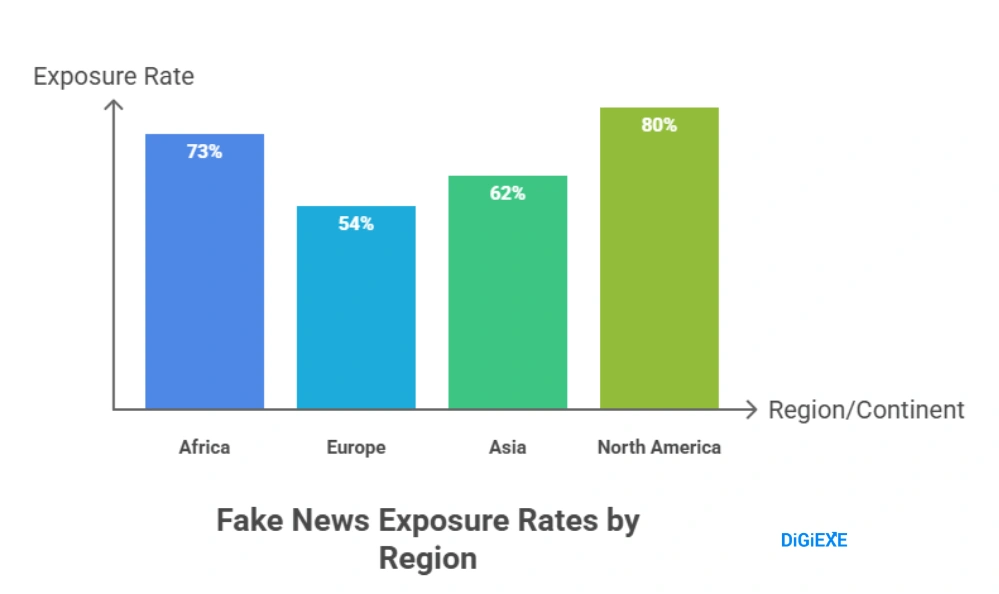
The reach of fake news isn’t limited to a few regions; it affects citizens worldwide. According to Ipsos, 86% of people globally report being exposed to fake news at least once. However, exposure rates vary by region, and the impact of fake news is felt more in certain areas:
- Africa: 73% of people in Africa report seeing fake news frequently, largely due to the rise of social media as a primary news source.
- Europe: Exposure in Europe averages 54%, but countries like France are particularly affected due to political instability and fake news around elections.
- Asia: Asia is seeing an increase, especially in countries like Brazil, where 62% of citizens admit to believing fake news at some point.
Social media is the primary culprit in spreading misinformation. 67% of U.S. citizens report encountering fake news on Facebook, while 40% of shared content globally is false, according to Statista.
Regional Breakdown of Fake News Exposure
| Region/Continent | Exposure Rate | Top Concern | Protection Tip |
|---|---|---|---|
| Africa | 73% | Health misinformation | Use WhatsApp community notes |
| Europe | 54% | Political deepfakes | Use EU Digital Services Act tools |
| Asia | 62% | Election interference | Cross-check with Reuters |
| North America | 80% (U.S.) | Social media shares | Use browser extensions like NewsGuard |
These regional insights allow us to customize our approach to combating misinformation. For example, in Asia, particularly in countries like Brazil, election-related fake news is a huge concern, making it vital to cross-check sources.
U.S. Landscape: 80% of Adults Consume Fake News in 2026
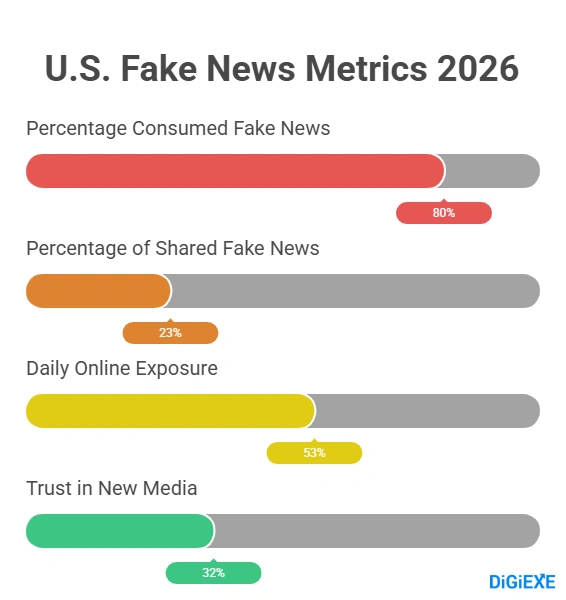
In the U.S., 80% of adults have encountered fake news, with 53% encountering it daily.
The situation is particularly concerning during election seasons, when 32% of U.S. adults report regularly seeing fake political news.
The spread of fake news is deeply linked to political divides. According to Pew Research, 64% of people say fake news causes confusion, with a notable difference in political affiliation-Republicans report seeing more pandemic-related hoaxes than Democrats.
U.S. Fake News Metrics
| Metric | Statistic | Demographic Split |
|---|---|---|
| Percentage Consumed Fake News | 80% | Youth (85%), Seniors (70%) |
| Percentage of Shared Fake News | 23% | Men (20%), Women (26%) |
| Daily Online Exposure | 53% | Under 30 (60%) |
| Trust in New Media | 32% | Republicans (25%), Democrats (38%) |
These statistics provide insight into how different age groups and political leanings experience fake news. Young people, in particular, are more likely to encounter and believe fake stories, which makes media literacy education crucial.
The Role of Social Media in Fake News Distribution
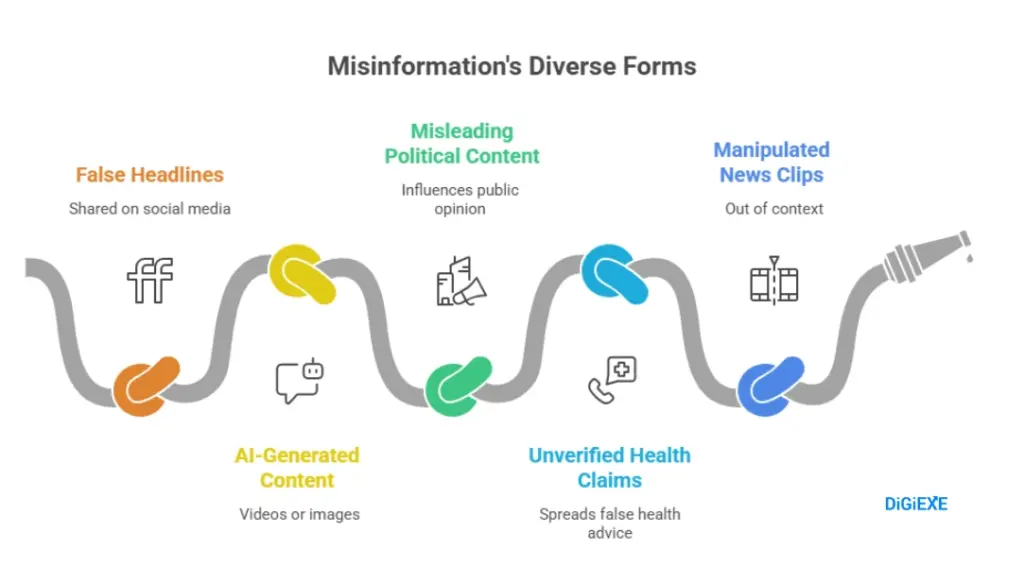
Social media platforms are at the forefront of spreading misinformation. In 2026, 40% of content shared on social media is false, according to Statista.
The FBI reports that 93% of social media videos are altered through AI tools like deepfakes. Facebook and Twitter are the most common platforms for encountering fake news.
- Facebook: 67% of U.S. users report seeing fake content on the platform. A significant portion of this is political misinformation and health-related hoaxes.
- Twitter: 42% of links clicked on Twitter lead to fake websites, showing how easily misinformation spreads through links.
- Instagram: Although it’s primarily a visual platform, 40% of shared content on Instagram is also false.
To combat this, users are advised to follow verified accounts, engage with fact-checking apps, and report misleading content.
Fake News Exposure on Popular Platforms
| Platform | Fake Content Share (%) | U.S. Encounter Rate | Mitigation Tips |
|---|---|---|---|
| 67% | 67% | Follow verified accounts | |
| 42% (to fake sites) | 52% | Use community notes feature | |
| 40% (shared) | 55% | Check hashtags against fact-checking sites |
By being more discerning on these platforms and using available tools, users can significantly reduce their exposure to misinformation.
Political and Democratic Impact
Fake news poses a significant threat to democracy. 59% of people globally believe that misinformation is a major issue, with the impact being especially noticeable during election seasons.
In Europe and the U.S., people are increasingly dissatisfied with their democratic systems, citing fake news as one of the top reasons for this decline.
- U.S. Elections: 32% of U.S. adults report seeing fake political news regularly, and deepfakes are particularly influential, with 16% of undecided voters swayed by fake videos.
- Global Impact: In countries like Poland, fake news related to extremism is a major concern, and it is leading to increased polarization. In the UK, 64% of citizens view fake news as a significant threat to democracy.
Economic Toll: $78 Billion in Global Losses from Fake News in 2026
The economic toll of fake news is staggering. $78 billion is lost annually due to misinformation, with major losses in various sectors:
- Stock Market Losses: $39 billion is lost in the stock market due to fake news and misinformation about companies and investments.
- Health Misinformation: $9 billion is lost due to health-related misinformation, including false cures and misleading health tips.
Businesses can take proactive measures by verifying claims, auditing marketing campaigns, and using fact-checking tools to avoid these losses.
| Sector | Annual Loss ($ Billion) |
|---|---|
| Stock Market | 39 |
| Financial Misinformation | 17 |
| Reputation Damage | 9.54 |
| Public Health | 9 |
AI and Deepfakes
AI technology, particularly deepfakes, has made it easier for fake news to spread.
93% of social media videos are altered using AI, which can make people appear to say or do things they never did. This has a profound impact on elections and public opinion.
By using reverse image search tools and AI detectors, users can quickly spot deepfakes and avoid being misled.
How to Combat Fake News: Tools and Strategies for 2026
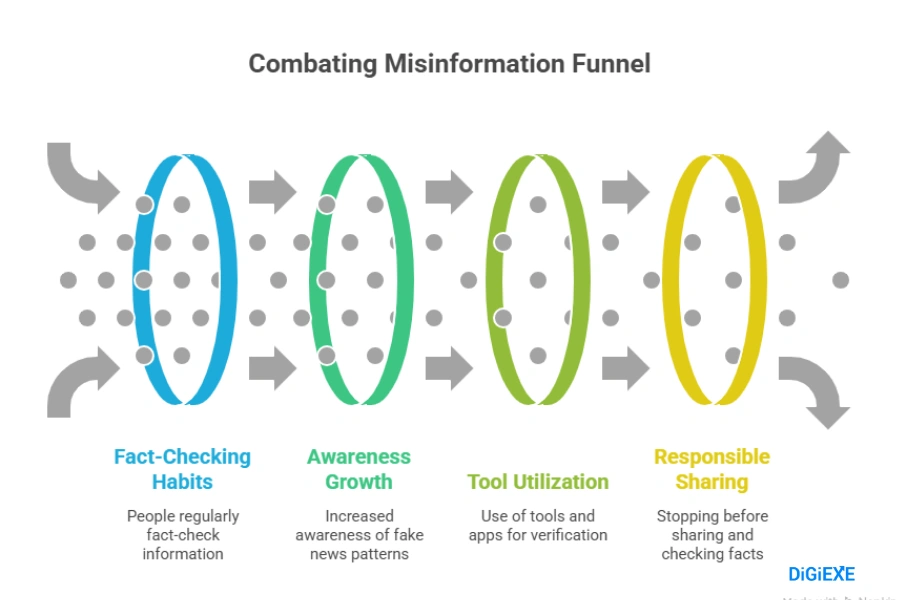
To protect yourself and your community from fake news, here are some tools and strategies you can use:
- Fact-Checking Tools: Use platforms like Snopes, FactCheck.org, and NewsGuard to verify information before sharing.
- Browser Extensions: Extensions like NewsGuard can block fake content and help you browse with more confidence.
- Social Media Strategies: Follow verified journalists and engage with fact-checking communities like X’s Community Notes.
By using these tools regularly, you can significantly reduce your exposure to fake news and help others do the same.
FAQs About Fake News Statistics
1. What percentage of online content is fake in 2026, and how can individuals protect themselves from it?
In 2026, 62% of online content is false. Individuals can protect themselves by using fact-checking tools like Snopes, browser extensions like NewsGuard, and cross-checking sources before sharing.
2. How does fake news impact democracy in 2026, based on global surveys?
Fake news threatens democracy, with 59% of global citizens seeing it as a significant issue. It erodes trust in government and fuels political polarization, which can be reduced through civic education and regulations.
3. What role does social media play in spreading fake news in 2026, and what steps can users take to mitigate it?
Social media spreads 40% of false content globally. Users can mitigate this by following verified accounts, using community notes, and reporting suspicious content, helping reduce misinformation.
4. How much does fake news cost the global economy in 2026, and how can businesses benefit from awareness?
Fake news costs the global economy $78 billion annually. Businesses can protect themselves by verifying information, auditing campaigns, and using fact-checking tools to avoid costly mistakes.
5. What do recent discussions on Reddit and Quora reveal about fake news trends in late 2025 and early 2026?
Discussions highlight the role of AI, especially deepfakes, in spreading fake news. Solutions include civic education and using detection tools to combat misinformation, especially during elections.
Also Read:
- eLearning Statistics
- Google Chrome Statistics
- Global Crypto Adoption Statistics
- Disney Plus Statistics
- Content Marketing Statistics
Conclusion
Fake news is an ever-growing challenge, and its effects on society, democracy, and the economy are profound.
However, by staying informed and using the right tools, you can protect yourself from misinformation.
Remember to fact-check, use trusted platforms, and educate those around you to foster a more informed and resilient community.
