Technical SEO Audit Services That Find What Holds Your Site Back
Our technical SEO audit services check how Google crawls, renders and indexes your site, then turn the findings into a short, ranked list of fixes. You get developer-ready tickets, not a 300-page tool export nobody reads.
Good content cannot rank if Google cannot reach it
Many sites publish good pages that never rank. The cause is often technical: pages blocked by robots.txt, wrong canonical tags, redirect chains, slow templates or JavaScript that Google does not render.
These problems are hard to spot from the front end. The site looks fine to you, but Google sees broken signals, wastes its crawl budget and leaves key pages out of the index.
Common signs of technical SEO problems
- Traffic dropped after a redesign, migration or plugin change.
- Search Console shows many pages as “Crawled, currently not indexed”.
- New pages take weeks to appear in Google.
- Mobile pages fail Core Web Vitals.


A technical SEO audit that ends in fixes
Running a crawler is easy. Knowing which of its 400 warnings matter is the hard part. Our technical SEO audit combines a full crawl with your Search Console data and a manual review of your main page templates.
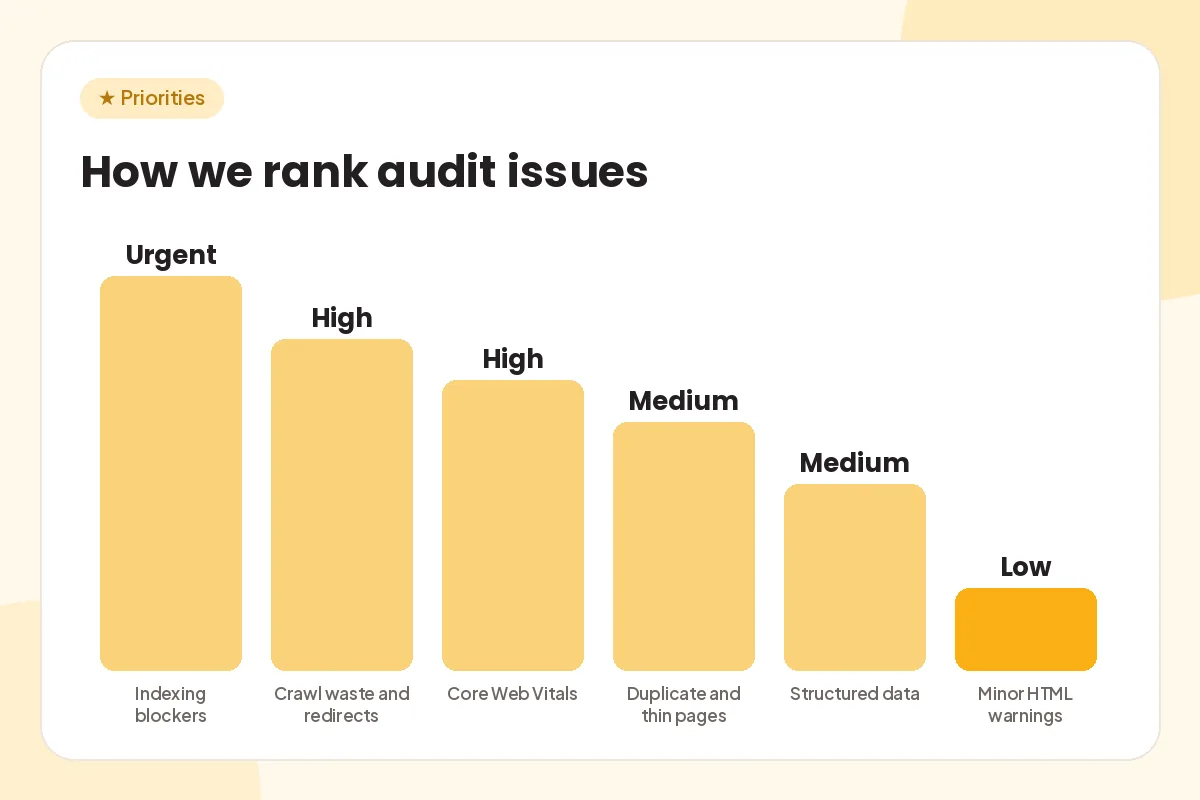
We rank every issue by its effect on crawling, indexing and rankings, and by how much effort it takes to fix. The top of the list is what your developers should do first.
Each issue comes with the affected URLs, why it matters and the exact steps to fix it.
What our technical SEO audit covers
Every audit covers the areas below. Larger plans go deeper.
Crawlability
Indexing
Core Web Vitals
Mobile and rendering
Redirects and status codes
Structured data and security
Our technical SEO audit checklist
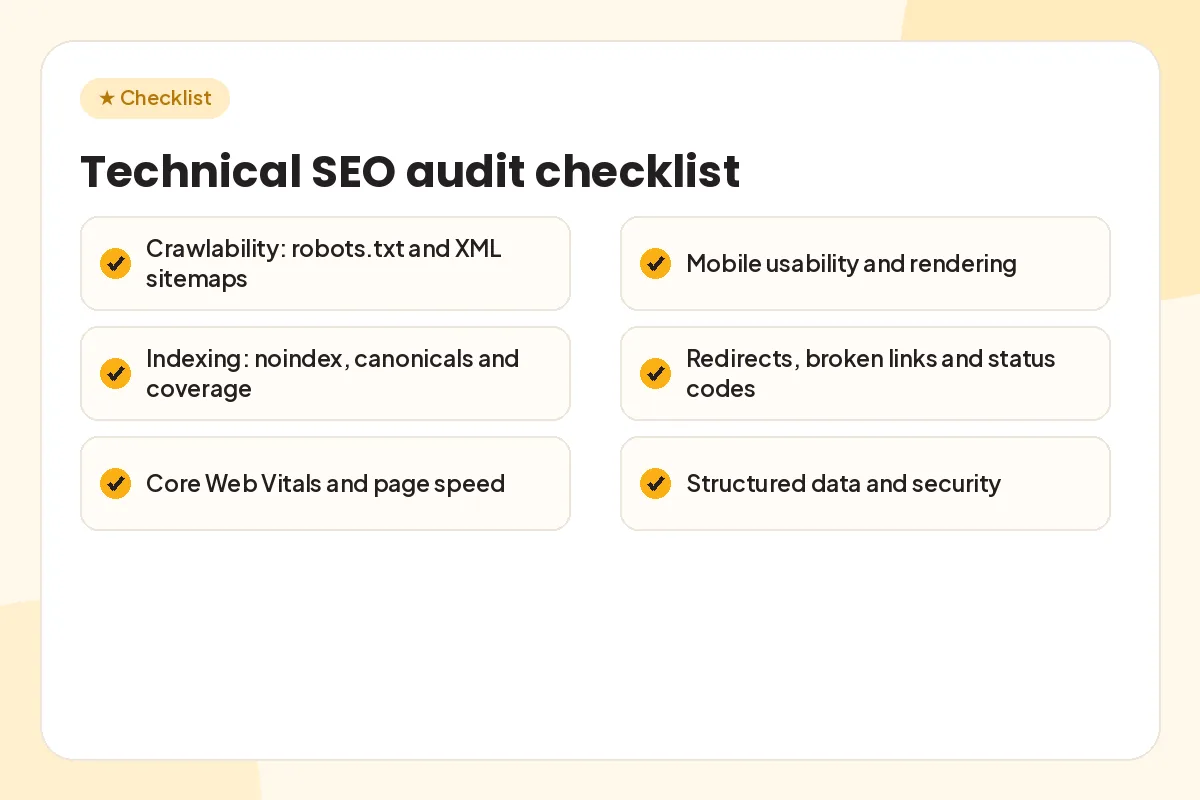
This is the core of the checklist we run on every site. The order matters: if Google cannot crawl or index a page, speed and schema make no difference.
- Crawl access. Can Googlebot reach every page you want ranked, and is it kept away from pages you do not?
- Index signals. Do canonicals, noindex tags and sitemaps all point to the same preferred URLs?
- Site structure. Are key pages within three clicks of the homepage, with descriptive internal links?
- Rendering. Does the content Google renders match what users see?
- Speed. Which templates fail Core Web Vitals on mobile, and why?
- Duplicates. Are thin, duplicate or near-duplicate pages splitting your rankings?
- Structured data. Is schema valid, and does it match what is on the page?
- International. For multi-country sites, are hreflang tags correct?

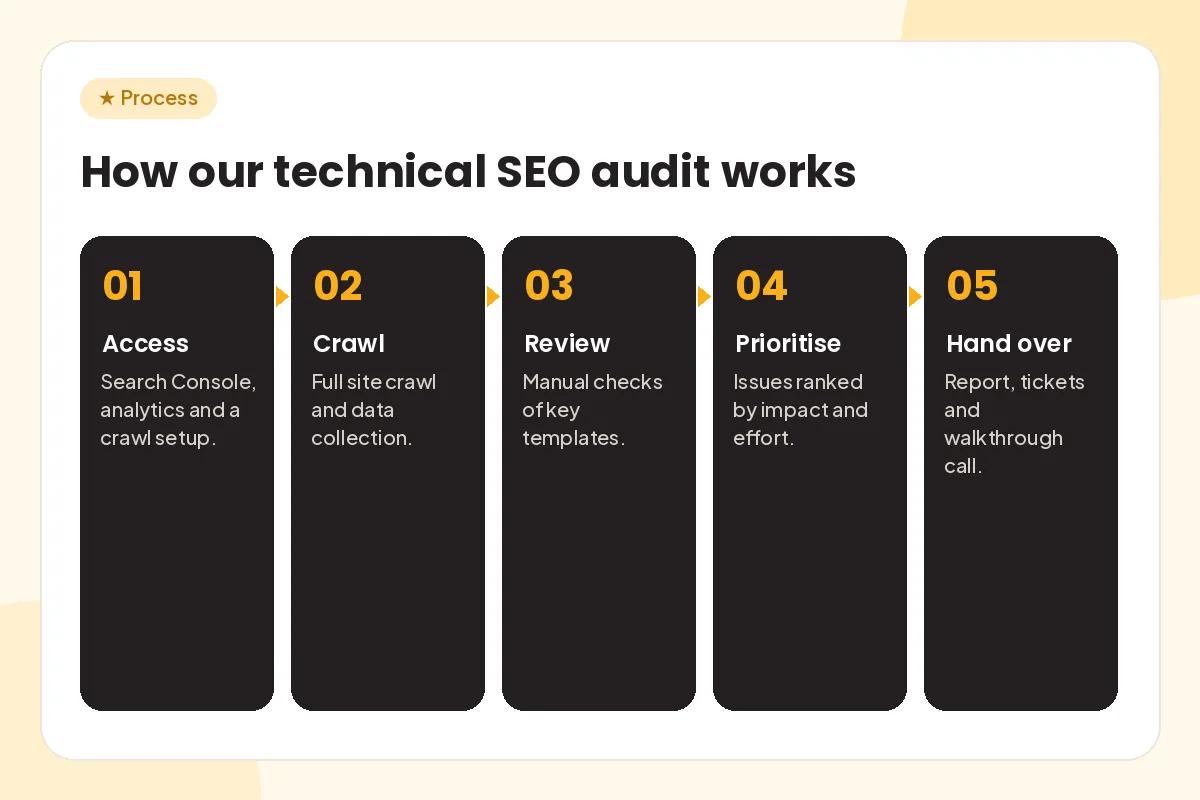
How our technical SEO audit works
Access
Crawl
Review
Prioritise
Hand over

How we decide what to fix first
Not every warning deserves a developer’s time. A missing alt attribute on one image is not as urgent as a canonical tag that points every product page to the homepage.
We score each issue on how many pages it affects, how close it is to blocking crawling or indexing and how much traffic those pages bring or could bring. Then we weigh it against the effort to fix it.
The result is a short list of high-impact fixes at the top of the report, and a longer list of lower-priority clean-up below it.
Technical SEO audit plans and prices
The price of a technical SEO audit depends mainly on site size and platform. A 50 page WordPress site is a smaller job than a 50,000 URL store on a custom stack. These plans cover the common sizes.
Basic
- Full technical site crawl (up to 250 pages)
- Crawlability and indexation audit (robots.txt, XML sitemaps)
- Core Web Vitals and PageSpeed analysis
- Mobile-friendliness and responsiveness check
- Broken links and redirect chain report
- Prioritized fix recommendations document
Standard
- Everything in Basic
- Deep crawl (up to 1,000 pages)
- HTTPS, security and canonical tag audit
- Structured data / schema markup review
- Duplicate and thin content analysis
- Log file analysis for crawl budget
- Competitor technical SEO benchmarking
- 30-day email support
Corporate
- Everything in Standard
- Unlimited page crawl and monthly re-audit
- JavaScript rendering and hreflang (international SEO) audit
- Hands-on implementation of priority fixes
- Custom performance dashboard and monthly reporting
- Dedicated technical SEO account manager
- Quarterly strategy and roadmap call
- Priority support (SLA-backed)
Prices are in USD. Need the fixes done too? Our technical SEO consultant service handles implementation.
What you receive after the audit
- An executive summary with the five issues that matter most.
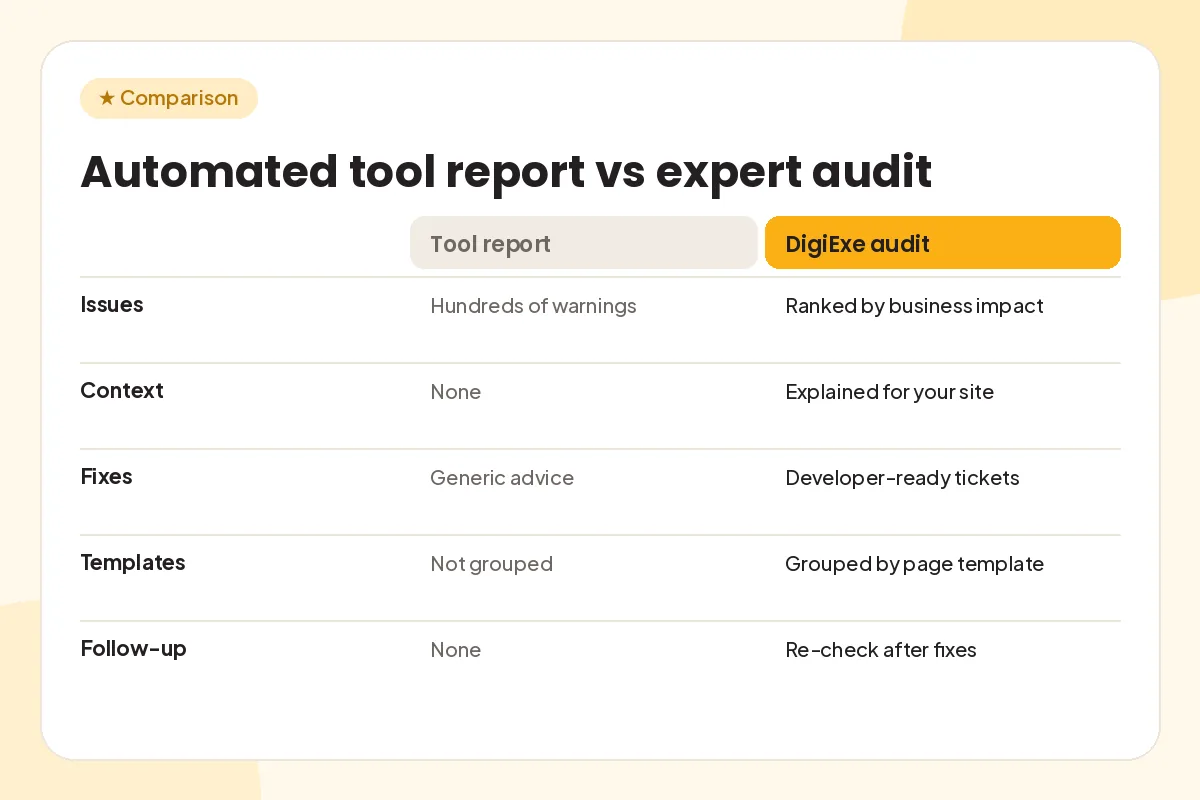
- A full issue list with affected URLs, grouped by page template.
- Developer-ready tickets with clear steps to fix each issue.
- A Core Web Vitals report with templates ranked by impact.
- A walkthrough call to explain the findings to your team.
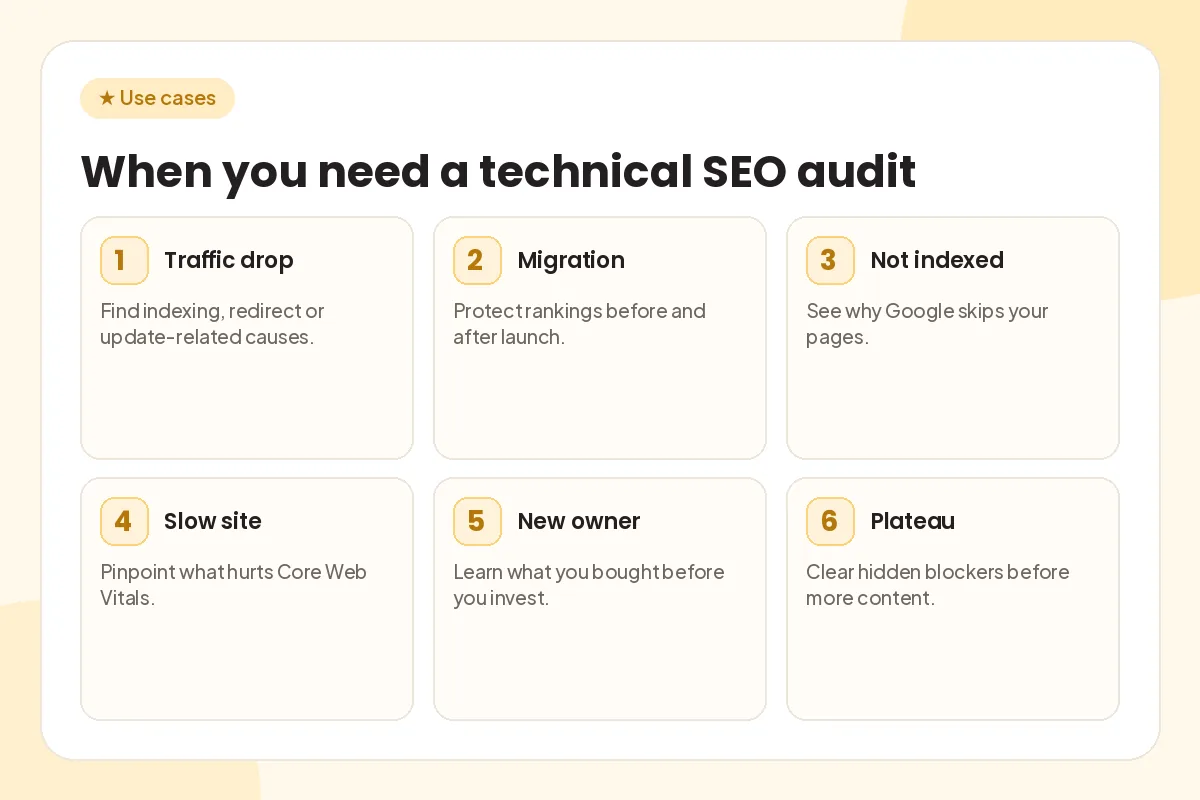
| Situation | Why an audit helps |
|---|---|
| Traffic dropped suddenly | Finds indexing, redirect or update-related causes |
| Site migration or redesign | Prevents lost rankings before and after launch |
| Pages not getting indexed | Shows why Google skips them |
| Slow site | Pinpoints what hurts Core Web Vitals |
Why tool reports are not enough
Automated tools are useful, and we use them: Screaming Frog, Google Search Console, PageSpeed Insights, Lighthouse and Semrush. But a tool cannot tell you whether a noindex tag is a mistake or a choice, or whether a page with “thin content” is actually your best-selling product.
That judgment is what you pay for in an audit. We check each finding against how your business works, so the report tells you what to change and what to leave alone.
If your traffic fell after a Google update, a technical audit is the first step of our penalty and recovery work.

Issues we find most often in technical SEO audits
Every site is different, but some problems come up again and again. If any of these sound familiar, an audit will likely pay for itself.
- Redirect chains. Old URLs that redirect two or three times before reaching the final page, wasting crawl budget and link value.
- Index bloat. Tag pages, filters, search results and thin archives indexed alongside your real content.
- Canonical conflicts. Canonical tags, sitemaps and internal links pointing to different versions of the same page.
- Orphan pages. Important pages with no internal links pointing to them, so Google rarely finds them.
- Heavy templates. Page builders, sliders and third-party scripts that push mobile LCP well past 2.5 seconds.
- Broken schema. Structured data with errors, or markup that does not match what is on the page.
Why choose DigiExe for your technical SEO audit
Short claims you can check.
1,400+ clients in 28 countries
Founder-led
Tested on our own sites
Fixes, not just findings
Technical fixes behind real growth
Technical clean-up was the first step on every site in our published SEO case studies. These numbers come from Google Search Console.
Services that follow a technical SEO audit
An audit shows what to fix. These services help you fix it and grow.

Jitendra has run technical SEO on his own sites, including BloggersIdeas since 2013, and reviews the audit checklist our team uses on client sites.
Jitendra started BloggersIdeas in 2013, runs AffiliateBooster and SchemaNinja, and wrote the international bestseller Inside A Hustler's Brain (20,000+ copies). He has spoken at Affiliate Summit, Affiliate World, DMSS and TES, and works from New Delhi.
Last updated:
Technical SEO audit services: FAQs
What is log file analysis and do I need it?
Log file analysis reviews your server logs to see exactly which pages Googlebot crawls, how often and what errors it meets. It shows crawl budget wasted on filters, redirects or old URLs. Small sites rarely need it, but large stores and sites with thousands of pages often find big wins there.
What is included in a technical SEO audit?
A technical SEO audit checks crawlability, indexing, site speed and Core Web Vitals, mobile usability, JavaScript rendering, site structure, internal links, redirects, structured data and security. We deliver the findings as a ranked list of fixes with affected URLs, so your team knows what to change first and why it matters.
How long does a technical SEO audit take?
Most audits take 5 to 10 working days from the day we get access. Very large sites, or audits that include log file analysis, can take up to three weeks. We give you a delivery date before we start, and we flag any urgent problem, such as a site-wide noindex tag, the same day we find it.
How much do technical SEO audit services cost?
Our technical SEO audit plans are $1,299 for Basic, $1,599 for Standard and $1,999 for Corporate, all in US dollars. The right plan depends on the size of your site and how deep the review needs to go. The pricing table on this page lists what each plan includes.
How often should I run a technical SEO audit?
Run a full audit once or twice a year, plus a check before and after any redesign, migration or platform change. Large sites that publish or change pages every day benefit from monthly monitoring, which is why our Corporate plan includes a monthly re-audit and reporting on top of the first audit.
Do you fix the issues you find?
We can. The audit report is yours to use with any developer, and the tickets are written so they can act on them. If you want our team to make the changes, our Corporate plan includes hands-on implementation of priority fixes, and our technical SEO consultant service covers larger fix projects.
Which tools do you use?
We use Screaming Frog, Google Search Console, PageSpeed Insights, Lighthouse and Semrush, plus log file analysers on larger plans. Tools collect the data, but every audit also includes a manual review of your key page templates, because tools cannot judge intent, business value or whether a warning is actually a problem.
Will an audit improve my rankings by itself?
No. The audit shows what is holding your site back, and rankings improve once the fixes are live and Google recrawls the pages. Sites with serious indexing or crawl problems often see changes within weeks of fixing them. Sites with minor issues gain less, and need content and links too.
What access do you need?
We need read access to Google Search Console and your analytics, and the site address. For log file analysis we need server logs from your host. We do not need admin access to your website for the audit itself, which keeps the work safe and keeps your site in your control.
What is the difference between a technical audit and a full SEO audit?
A technical SEO audit looks at how search engines crawl, render and index your site. A full SEO audit also covers content quality, keywords and backlinks. If you are unsure where your problem lies, start with our free SEO audit, which gives a quick overview before you commit to a deeper review.
Can you audit a site before a migration?
Yes, and it is one of the best times to do it. We record your current URLs, rankings and redirects, plan the new redirect map and check the new site on staging before launch. After launch we crawl again to catch broken redirects or lost pages before they cost you traffic.
Find out what is holding your site back
Pick an audit plan or send us your site. We will confirm the right scope and a delivery date.
Brands We Have Worked With
A few of the businesses that have trusted DigiExe and our founder with their marketing.


What our clients say about DigiExe