
AI-powered SEO, GEO & growth marketing since 2014

★ Offshore developers

Hire an Offshore Web Developer and Designer from India

Hire a skilled offshore web developer or designer from DigiExe for WordPress, Shopify, PHP, Laravel and JavaScript work. Choose full time, part time or hourly. Every developer signs an NDA, the code belongs to you and our team backs each hire with quality checks and cover.

DigiExe at a glance
1,400+
Clients served
28
Countries
20,000+
Copies sold of Inside A Hustler's Brain, by our founder
Led by founder Jitendra Vaswani, New Delhi
★ The problem

Why hiring web developers is so hard

Good web developers are expensive and slow to hire. A local search can take weeks of job posts, interviews and tests, and the right person may still say no. Once hired, you also pay for equipment, software, benefits and office space.

Freelance marketplaces look like a shortcut, but quality varies a lot. You spend hours screening profiles, and if your freelancer gets busy or disappears, the work stops and you start again.

Many businesses just need reliable developers who know their stack, work during agreed hours and stay for the long run.

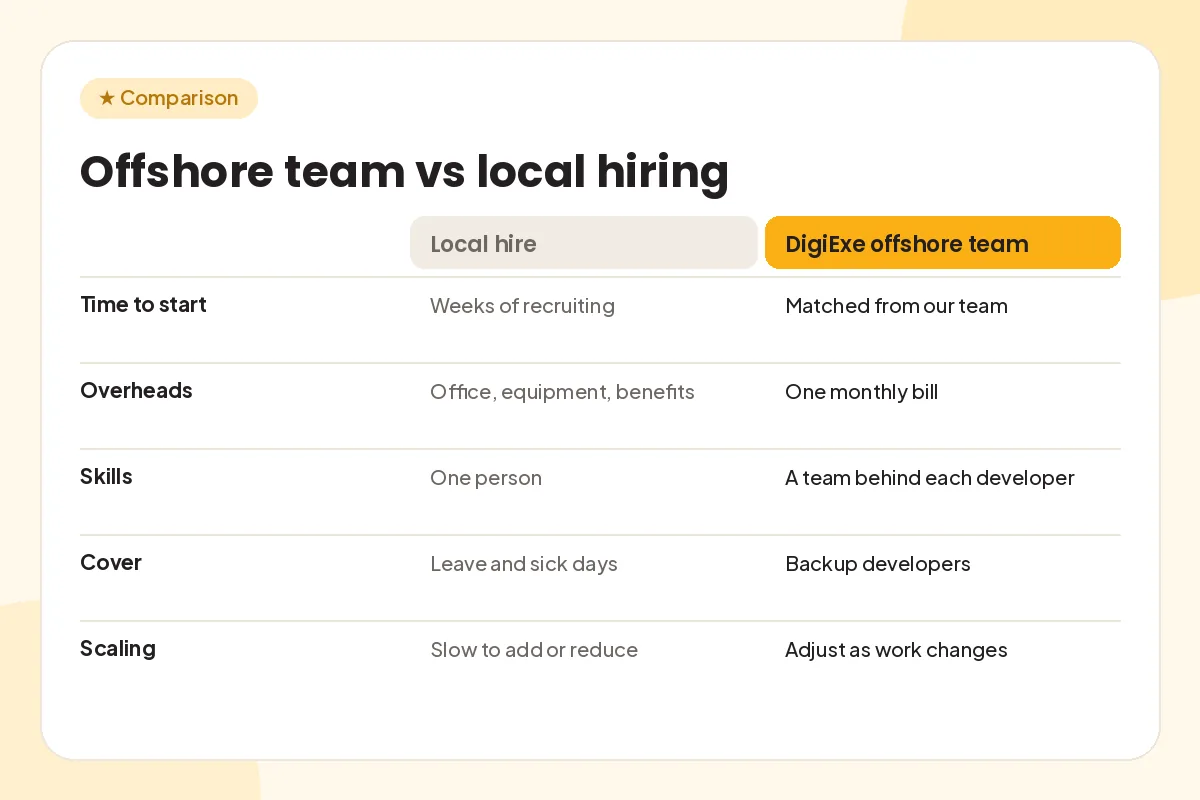
Comparison of an offshore web team and local hiring
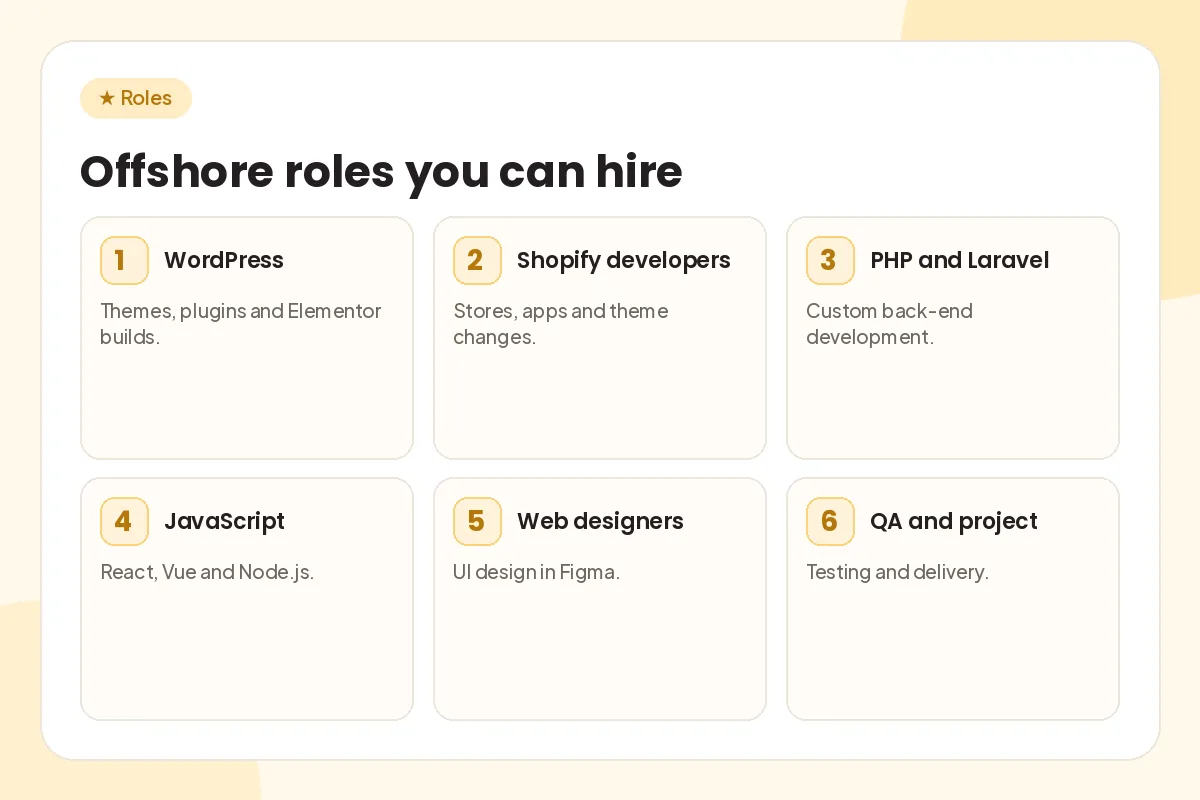
Offshore web roles you can hire from DigiExe, from WordPress developers to QA testers
★ Our solution

Offshore web developers backed by a team

DigiExe gives you an offshore web developer or designer who works on your projects, under your direction, as part of your team. You choose the person after an interview, and you set the priorities.

Behind every hire is our team in India. Senior developers review code, project managers help with planning, and if your developer is away, someone else can step in. You get the focus of a dedicated hire with the safety of an agency.

Every developer signs an NDA, all intellectual property created during the work belongs to you, and you pay one simple bill with no extra costs for equipment or software.

★ Who you can hire

Offshore web developers and designers you can hire

Hire one specialist or build a small team.

WordPress developers

Custom themes, plugins, Elementor builds, speed fixes and WooCommerce.

Shopify developers

Store builds, theme changes, apps and speed work.

PHP and Laravel developers

Custom back ends, APIs, portals and dashboards.

JavaScript developers

React, Vue and Node.js for fast, interactive front ends.

Web designers

UI design in Figma, design systems and landing pages.

QA and project managers

Testing, planning and delivery support for larger projects.
★ Hiring models

Full time, part time or hourly

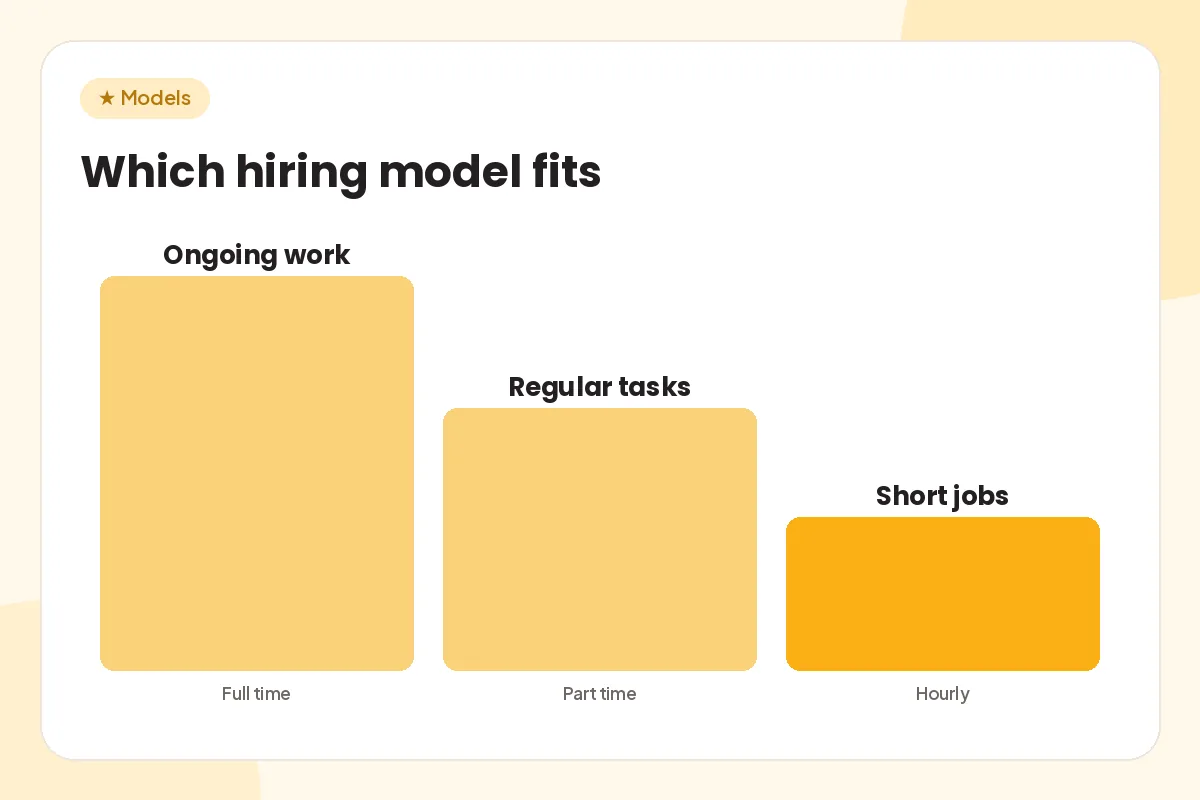
Pick the model that matches how much work you have. You can change it later as your needs grow or shrink.

ModelBest for
Full timeOngoing development, product work and large sites
Part timeRegular smaller tasks, updates and support
HourlyShort or one-off work, fixes and small features

Full-time developers work only on your projects. Part-time and hourly developers set aside agreed hours for you each week. Tell us about your work and we will suggest the right model and send a quote.

Full time, part time and hourly offshore hiring models and what each fits
★ Comparison

Offshore team vs local hiring

Local hiring makes sense when you need someone in the room every day. For most web work, an offshore web developer gives you more for the same budget.

  • Faster start. We match you from our existing team instead of running a long recruitment process.
  • Lower overheads. No office, equipment, software or benefits to pay for.
  • Wider skills. Your developer can ask our designers, SEO specialists and senior developers for help.
  • Cover. Holidays and sick days do not stop your project.
  • Flexibility. Move between full time, part time and hourly as your workload changes.

The trade-off is distance. Clear tasks, agreed overlap hours and regular updates close most of that gap, and we help you set them up from day one.

★ How it works

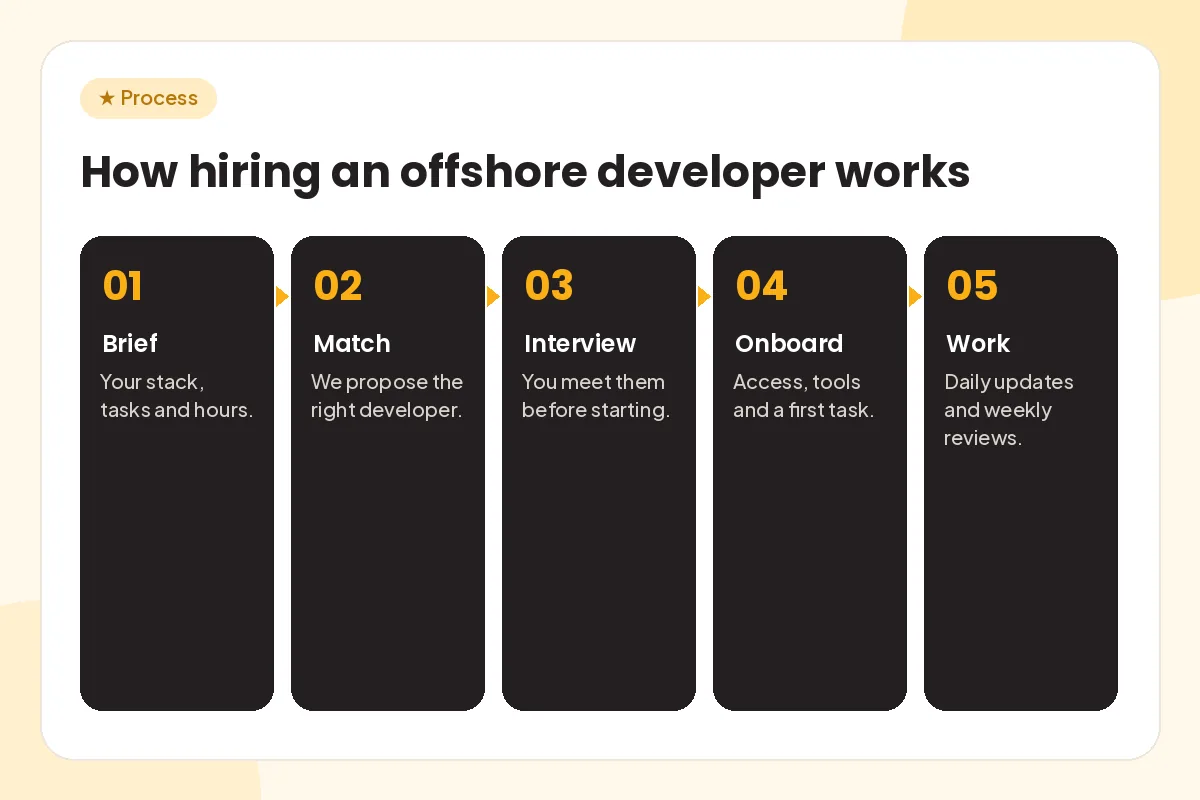
How to hire an offshore web developer from DigiExe

01

Brief

Tell us your tech stack, the work you need done and the hours you want covered.
02

Match

We propose a developer or designer whose skills and experience fit your work.
03

Interview

You meet the developer on a video call and ask any questions before you decide.
04

Onboard

We set up access, tools and communication, and start with a small first task.
05

Work and review

Daily updates, weekly reviews and support from our team throughout.
Five step process to hire an offshore web developer
★ Process detail

What the first weeks look like

A good start sets the tone for the whole engagement. In the first week we agree on how you will work together: which tools you use, who gives the developer tasks, when the daily overlap hours are and what “done” means for each task.

We usually begin with a small, real task. It shows you how the developer works and lets them learn your code and standards without pressure. From there, the workload grows to match the plan.

In the first month, our project manager checks in with you regularly. If something is not working, such as communication style or a skill gap, we fix it early, including a change of developer if needed.

★ Communication

Time zones and communication

Our team works from India. For clients in the USA, the UK, Europe and Australia, that means part of the developer’s day overlaps with yours and part happens while you sleep. Used well, that is an advantage: you hand over tasks in the evening and review finished work in the morning.

We agree on overlap hours at the start, so you always have time for calls and quick questions. Most clients use Slack or Microsoft Teams for daily chat, a task board such as Jira, Trello or Asana for work and short video calls for planning and reviews.

Your developer sends a short update at the end of each day: what was done, what is next and anything blocking progress.

★ Security

How we protect your code, data and IP

Handing code and logins to a team on another continent needs trust. We earn it with clear rules.

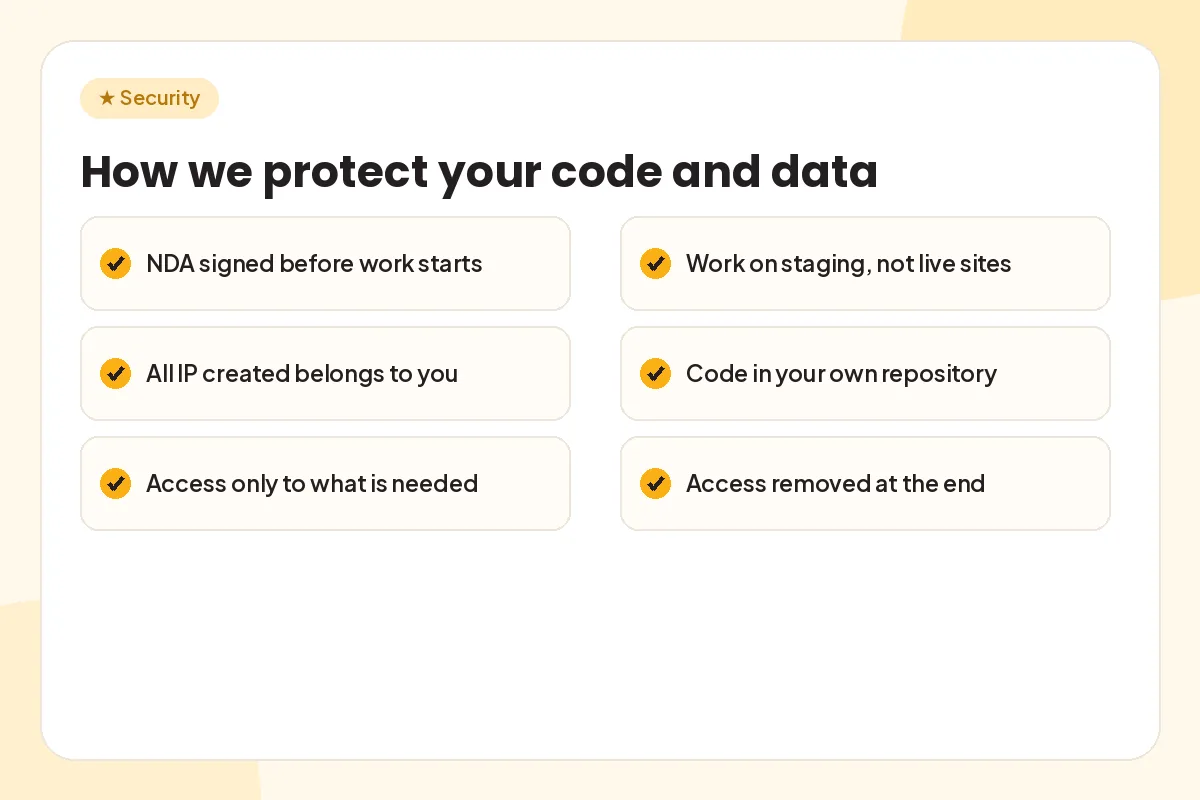
  • Every developer signs a non-disclosure agreement before work starts.
  • All intellectual property created during the work belongs to you.
  • Developers get access only to the systems they need, with their own accounts.
  • Work happens on staging sites and in your own code repository.
  • When the engagement ends, all access is removed and the code stays with you.
How DigiExe protects code and data with NDAs, IP ownership and access control
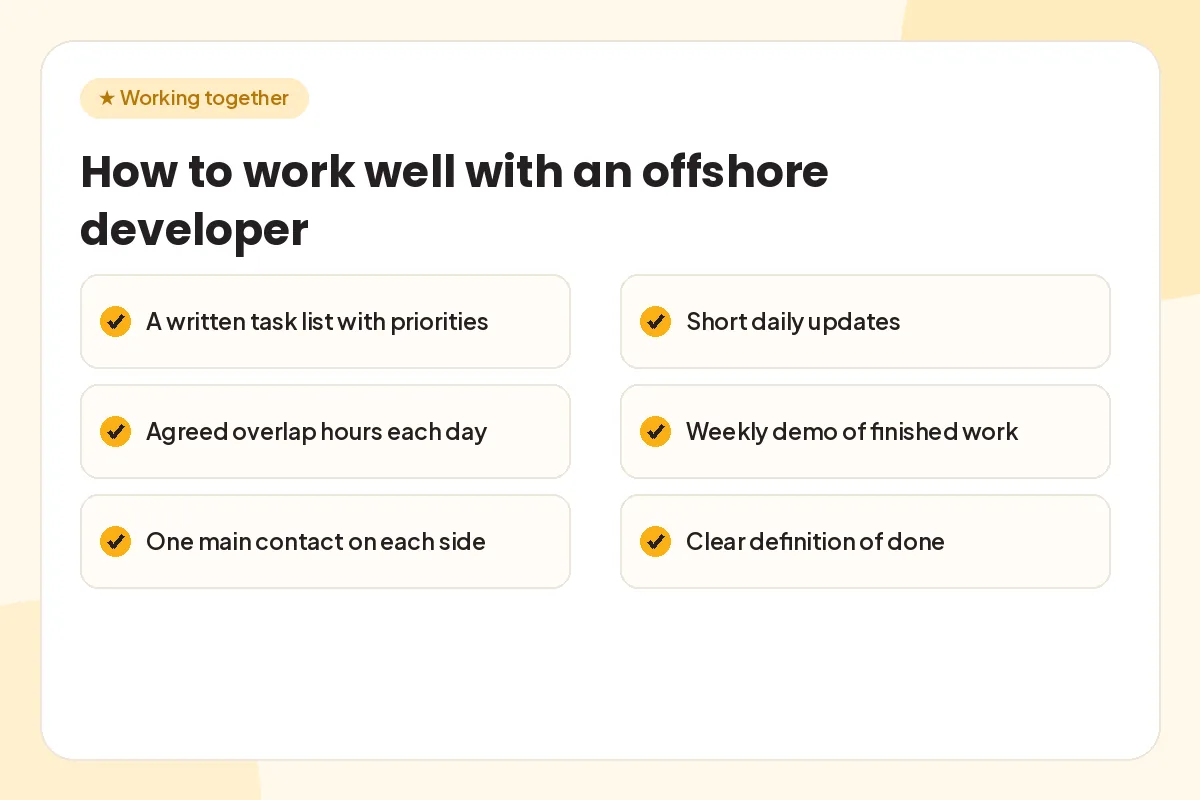
Checklist for working well with an offshore web developer
★ Working well

How to get the most from an offshore developer

The businesses that get the best results from offshore developers treat them like part of the team. A few habits make a big difference.

  1. Write tasks down. A short written brief beats a long call. Include the goal, examples and what done looks like.
  2. Set priorities. A ranked task list stops your developer guessing what matters most.
  3. Use overlap hours. Keep calls and quick questions to the agreed hours.
  4. Review often. A weekly demo of finished work catches problems early.
  5. Give feedback. Clear, honest feedback in the first weeks pays off for months.
★ Quality

How we keep quality high

Your developer does not work alone. Senior developers on our team review code for larger tasks, check that WordPress and coding standards are followed and help with tricky problems.

We test on staging before anything goes live, use version control for every change and keep notes on what was built. If your project needs SEO, design or content help, our in-house specialists are a message away, so you do not need to hire more people.

★ Roles

Which role do you need?

Your needRole to hire
Ongoing updates and fixes on a WordPress sitePart-time WordPress developer
A new custom theme or pluginFull-time WordPress developer for the project
A Shopify store with frequent changesShopify developer, part time or full time
A web app, portal or dashboardLaravel or JavaScript developer, plus QA
Landing pages and design updatesWeb designer, part time or hourly
A larger build with several peopleA small team with a project manager

Not sure? Describe the work and we will suggest a setup.

★ When not to offshore

When offshore hiring is not the right fit

Offshore developers are not the answer to every problem. If you have no clear tasks yet, no one to give feedback or a project that needs someone on site every day, you may be better off with a fixed-price project or a local hire.

For a new website with a clear scope, our web development services or website design services may suit you better, because we manage the whole project for a fixed price. For ongoing care of an existing site, our website maintenance services are often simpler.

★ Models compared

Offshore vs nearshore vs onshore development

There are three ways to hire remote developers, and each has a place. Onshore means hiring in your own country. Nearshore means hiring in a nearby country with a similar time zone. Offshore means hiring further away, often in India, Eastern Europe or South East Asia.

ModelMain strengthMain trade-off
OnshoreSame time zone and cultureHighest cost and hardest to hire
NearshoreClose time zone, lower costSmaller talent pool
OffshoreLarge talent pool, best valueFewer shared hours, needs clear process

For most web work, such as WordPress builds, Shopify stores, landing pages and ongoing updates, offshore gives the best balance of skill and budget. The time difference matters less than people expect once tasks are written down and overlap hours are agreed.

★ Cost

What affects the cost of an offshore web developer

Offshore rates vary a lot from one provider to another, so it helps to know what drives the price before you compare quotes.

  • Experience. A senior developer who can plan architecture costs more than a junior who follows instructions, but often finishes faster.
  • Tech stack. Common skills such as WordPress cost less than rarer ones such as complex React apps or headless builds.
  • Hiring model. Full-time developers usually cost less per hour than part-time or hourly work, because the commitment is longer.
  • Support around the developer. Code reviews, project management and cover add value that a solo freelancer does not offer.
  • Hidden costs. With some providers, software, equipment or management are billed on top. With us, you pay one bill.

The cheapest hourly rate is rarely the cheapest project. Rework, missed deadlines and bugs found after launch cost far more than a fair rate for good work. Send us your requirements and we will send a clear quote.

★ Skills

Skills to look for in an offshore web developer

Technical skill is only part of what makes a remote developer good to work with. When you interview anyone, look for these.

Technical skills

  • Strong knowledge of your main platform, such as WordPress, Shopify or Laravel.
  • Clean, readable code that follows the platform’s standards.
  • Experience with version control, staging sites and safe deployments.
  • An understanding of speed, security and basic SEO.

Working skills

  • Clear written English, because most communication happens in writing.
  • The habit of asking questions early instead of guessing.
  • Honest updates, including when something is late or blocked.
  • Ownership of the result, not just the task.
★ Red flags

Red flags when hiring offshore developers

Most offshore hiring problems can be spotted early. Be careful if a provider or developer shows any of these signs.

  1. No interview. You should always meet the person who will work on your project.
  2. Vague ownership terms. If the contract does not say the code is yours, ask before you sign.
  3. Work on the live site. Changes made straight on a live site cause broken pages and lost sales.
  4. No updates. Silence for days usually means a problem nobody wants to mention.
  5. Promises that sound too good. Very low prices with very fast deadlines rarely end well.
  6. Shared logins. Each developer should have their own accounts, so access can be removed cleanly.
★ Onboarding

Onboarding checklist for your offshore developer

A well-prepared first week saves weeks of confusion later. Before your developer starts, have these ready, or let our project manager help you prepare them.

  • Accounts for your chat tool, task board and code repository.
  • Access to a staging site, never only the live site.
  • A short overview of the project, its users and its goals.
  • Your coding standards, design files and brand guidelines.
  • A ranked list of the first tasks, starting with a small one.
  • The agreed overlap hours and the name of the main contact on your side.

With these in place, most developers are productive on real tasks within the first days.

★ For agencies

Offshore developers for agencies

Many of our offshore developers work with digital agencies that need extra hands without hiring. Your developer can work under your brand, join your client calls if you want, and follow your processes and tools.

The same rules apply: an NDA before work starts, IP that belongs to you or your client and access removed at the end. If you also resell SEO, our white label SEO services work the same way, so you can offer a full service under your own name.

★ Designers

Hiring an offshore web designer

A good offshore web designer can design landing pages, website layouts, design systems and UI for web apps in Figma, then work closely with developers to make sure the build matches the design.

Design work needs more back and forth than development, so we suggest a few habits: share examples of sites you like, agree on brand colours and fonts first and review designs on a short call rather than by email. Our designers can also turn your Figma, XD or PSD files into working WordPress or HTML pages.

★ Writing tasks

How to write a task your offshore developer can finish

Most delays with remote developers come from unclear tasks. A good task answers four questions: what should change, why it matters, what it should look like and how you will know it is done.

A weak task

“Fix the contact page.”

A strong task

“On the contact page, the form does not send emails since last week’s plugin update. Please find the cause on staging, fix it and confirm a test email reaches the sales inbox. The form should keep the same fields and design. Done means three test submissions arrive and the fix is live.”

The second task takes a minute longer to write and saves a day of back and forth.

★ Mistakes

Common mistakes businesses make with offshore developers

  • Hiring for price alone. The lowest rate often means slower work, more bugs and more of your own time spent managing.
  • No single point of contact. When five people send tasks, the developer cannot tell what matters most.
  • Skipping the first small task. A small paid task is the best test of fit before a big project.
  • Waiting too long to give feedback. Small issues in week one become habits by month three.
  • Treating the developer as a ticket machine. Developers who understand the business goal make better decisions on their own.
★ Measuring

How to measure your offshore developer's work

Hours worked tell you little. Measure outcomes instead. Simple measures that work for most web teams:

MeasureWhat it shows
Tasks finished per weekSteady output and good planning
Bugs found after releaseQuality of testing
Time from task to first questionEngagement and understanding
Missed deadlines and whyHonesty and estimation skill
Page speed and uptimeCare for the live site

Review these every few weeks with your developer and our project manager, and agree on what to improve.

★ Scaling

From one developer to a small team

Many clients start with one part-time developer and grow from there. As the workload rises, you can move that developer to full time, then add a designer, a second developer or a QA tester.

When a team grows past two or three people, a project manager becomes useful. They plan sprints, keep the task board tidy and make sure everyone works on the right priorities, which frees you to focus on the business. Growing slowly, one role at a time, keeps quality high and costs predictable.

★ Example setups

Example setups for different businesses

Every business uses offshore developers a little differently. These example setups show how the hiring models fit common needs. They are illustrations, not client stories.

A service business with a WordPress site

A part-time WordPress developer handles updates, new landing pages, form changes and speed fixes a few days a week. The owner sends tasks through a shared board and reviews work every Friday.

An online store growing fast

A full-time Shopify or WooCommerce developer works on new features, apps and page speed, with a designer brought in part time for new collection pages and campaigns.

A SaaS company building a product

Two full-time JavaScript and Laravel developers, a QA tester and a project manager work in two-week sprints, with a demo at the end of each one.

A digital agency

A full-time developer and a part-time designer work under the agency’s brand on several client sites, following the agency’s process and tools.

★ SEO

Developers who understand SEO

A developer who does not understand SEO can undo months of ranking work with one change: a wrong canonical tag, a blocked folder in robots.txt or a redesign without redirects. Our developers work next to our SEO team, so they know what to check before they ship a change.

If search traffic matters to your business, ask your developer to run a quick check after every release: pages still indexable, titles and headings unchanged unless planned, redirects in place and page speed no worse than before.

★ Contracts

What a good offshore contract covers

Before any work starts, make sure the agreement covers the basics. A clear contract protects both sides and avoids awkward conversations later.

  • The developer’s role, hiring model and agreed working hours.
  • How tasks are assigned and how progress is reported.
  • Confidentiality, with an NDA signed by the developer.
  • Ownership of all code, designs and content created for you.
  • How access is managed during and after the engagement.
  • How changes to the team or the hours are agreed.
★ Why DigiExe

Why hire offshore developers from DigiExe

Short claims you can check.

1,400+ clients in 28 countries

We have worked with businesses of every size across 28 countries.

Founder-led from New Delhi

Jitendra Vaswani runs BloggersIdeas, AffiliateBooster and SchemaNinja with teams in India.

NDA and IP protection

Every developer signs an NDA, and the IP they create belongs to you.

A team behind each hire

Code reviews, cover and specialist help from our in-house team.
★ Results

Built by the same team that grew our own sites

Our developers and SEO specialists work on our own sites as well as client projects. These numbers come from Google Search Console.

122K
Clicks for Gizmobase in 12 months
111K
Clicks for Affiliatebay in 16 months
90K
Clicks for Idblogging in 8 months
28
Countries served
★ First week

What your first week with an offshore developer looks like

A good start saves weeks later. On day one, your developer gets access to your code, tools and task board, and we agree on working hours, update times and how you want to review work.

During the first few days, the developer sets up a local copy of your project, reads the existing code and picks a small, low-risk task to finish. This shows you their code quality and communication early, before bigger work begins.

By the end of the first week, you should have a short written summary of what they found in the codebase, a plan for the next sprint and a clear routine for daily updates. If anything feels wrong, tell us early so we can adjust.

★ Related services

Related development services

Prefer a managed project? These services handle everything for you.

Jitendra Vaswani, founder of DigiExe
Written and reviewed by
Jitendra Vaswani, Founder of DigiExe

Jitendra has built and run remote teams for his own businesses, including BloggersIdeas, AffiliateBooster and SchemaNinja, from New Delhi. He reviews how we match and support offshore developers.

Jitendra started BloggersIdeas in 2013, runs AffiliateBooster and SchemaNinja, and wrote the international bestseller Inside A Hustler's Brain (20,000+ copies). He has spoken at Affiliate Summit, Affiliate World, DMSS and TES, and works from New Delhi.

Last updated:

★ FAQs

Offshore web developer: FAQs

An offshore web developer is a developer based in another country who works on your website or web app remotely, usually for a lower total cost than a local hire. With DigiExe, your offshore developer works from India on your projects, follows your priorities and is backed by our in-house team for code reviews and cover.

Our developers and designers work from India, where DigiExe is based. Founder Jitendra Vaswani runs the business from New Delhi. We work with clients across 28 countries, including the USA, the UK, Australia and Canada, and agree on overlap hours with each client so there is always time for calls.

Yes. We agree on overlap hours at the start, so you have time each day for calls, quick questions and reviews. Outside those hours your developer keeps working on agreed tasks, which means you can hand over work in your evening and review finished work the next morning.

Most clients use Slack or Microsoft Teams for daily chat, a task board such as Jira, Trello or Asana for work and short video calls for planning and reviews. Your developer sends a short daily update on what was done, what is next and anything that is blocking progress.

You do. Every developer signs a non-disclosure agreement before work starts, and all intellectual property created during the work belongs to you. Code lives in your own repository and on your own servers. When the engagement ends, we remove all access and hand over any notes.

Yes. We propose a developer or designer whose skills match your work, and you meet them on a video call before you decide. Ask about their experience, look at past work and check how they communicate. If the fit is not right, we suggest someone else.

You can hire a developer full time, part time or by the hour. Full time suits ongoing development and product work. Part time suits regular smaller tasks and updates. Hourly suits short or one-off jobs. You can move between models as your workload changes, and we send a quote for each.

Your project does not stop. Because every developer is part of our wider team, another developer who knows the same stack can cover urgent work during holidays or sick days. Our project manager plans cover in advance for planned leave, so deadlines are not missed.

Our offshore developers work with WordPress, WooCommerce, Elementor, Shopify, PHP, Laravel, JavaScript, React, Vue and Node.js. Our designers work in Figma. If you need a skill outside this list, tell us about the project and we will tell you honestly whether we have the right person.

Senior developers review code on larger tasks, check that standards are followed and help solve hard problems. All work is tested on staging before it goes live, and changes are tracked in version control. In the first month, our project manager checks in with you regularly to fix any issue early.

Yes, with the right rules. Developers sign an NDA, get access only to what they need through their own accounts, work on staging sites rather than live ones and lose access when the work ends. We are happy to follow any extra security policies your business already has in place.

Send us a short note about your tech stack, the work you need done and the hours you want covered. We will reply with questions, suggest a hiring model and propose a developer. After you interview them and approve the quote, we set up access and start with a first task.

Ready to hire an offshore web developer?

Tell us about your project and stack. We will propose the right developer for you to interview.

★ Trusted by brands

Brands We Have Worked With

A few of the businesses that have trusted DigiExe and our founder with their marketing.

★ Testimonials

What our clients say about DigiExe