Ecommerce SEO Services That Turn Searches Into Sales
DigiExe ecommerce SEO services help online stores rank for the searches shoppers make when they are ready to buy. We fix the technical issues that hold big catalogues back, optimise category and product pages, and build content and links, then report on orders and revenue, not just rankings.
Why many online stores depend on paid ads
Most online stores start with ads because they work fast. But costs per click keep rising, and the moment you stop paying, the traffic stops too. Stores that earn steady sales from free search traffic have lower costs per order and more room to grow.
The trouble is that stores are hard to rank. Thin category pages, copied product descriptions, thousands of filter URLs and slow mobile pages all hold them back.
- Category pages with no text and weak titles.
- Product descriptions copied from the manufacturer.
- Filters and variants creating endless duplicate pages.
- Out-of-stock pages that lead to dead ends.

Ecommerce SEO services built around revenue
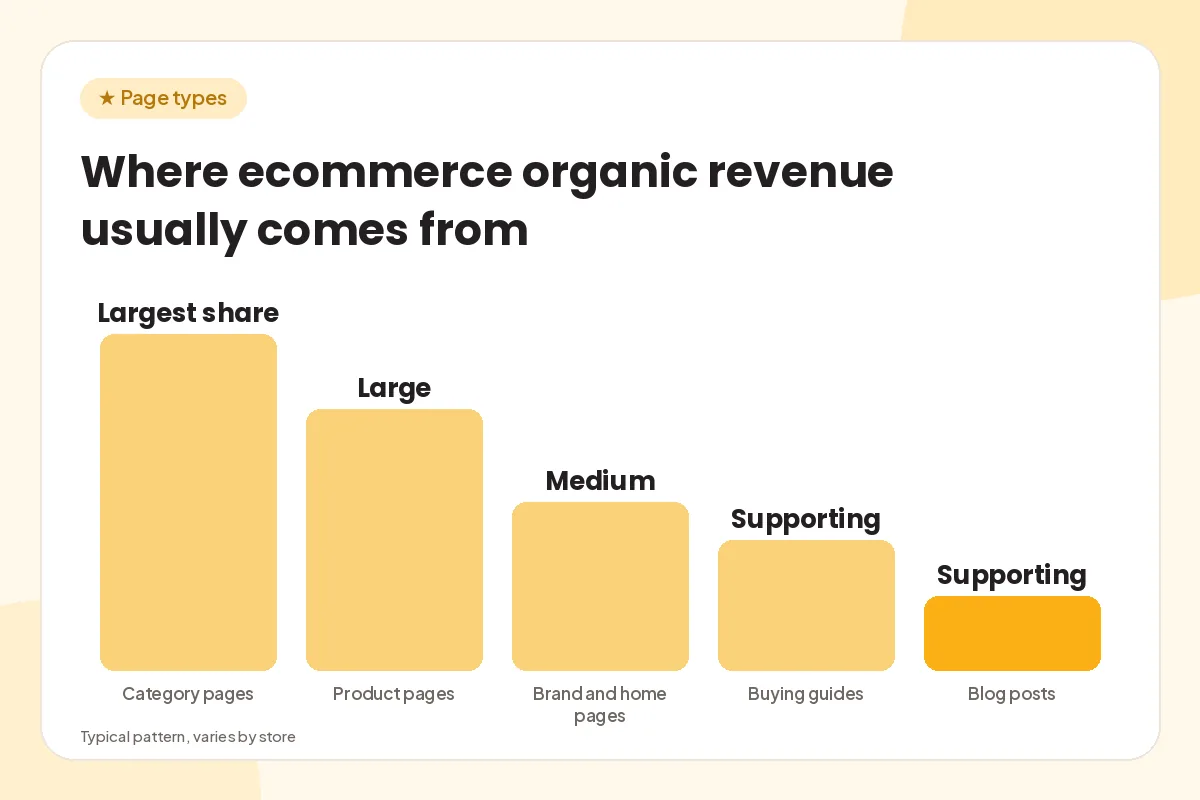
We focus on the pages that make money. In most stores, category pages earn the largest share of organic revenue, followed by product pages. We start there, fix the technical issues that stop Google crawling them well, then build content and links that lift the whole store.
Every month you get a plain report on organic orders, revenue, traffic and rankings, so you can see what SEO is worth to your business.
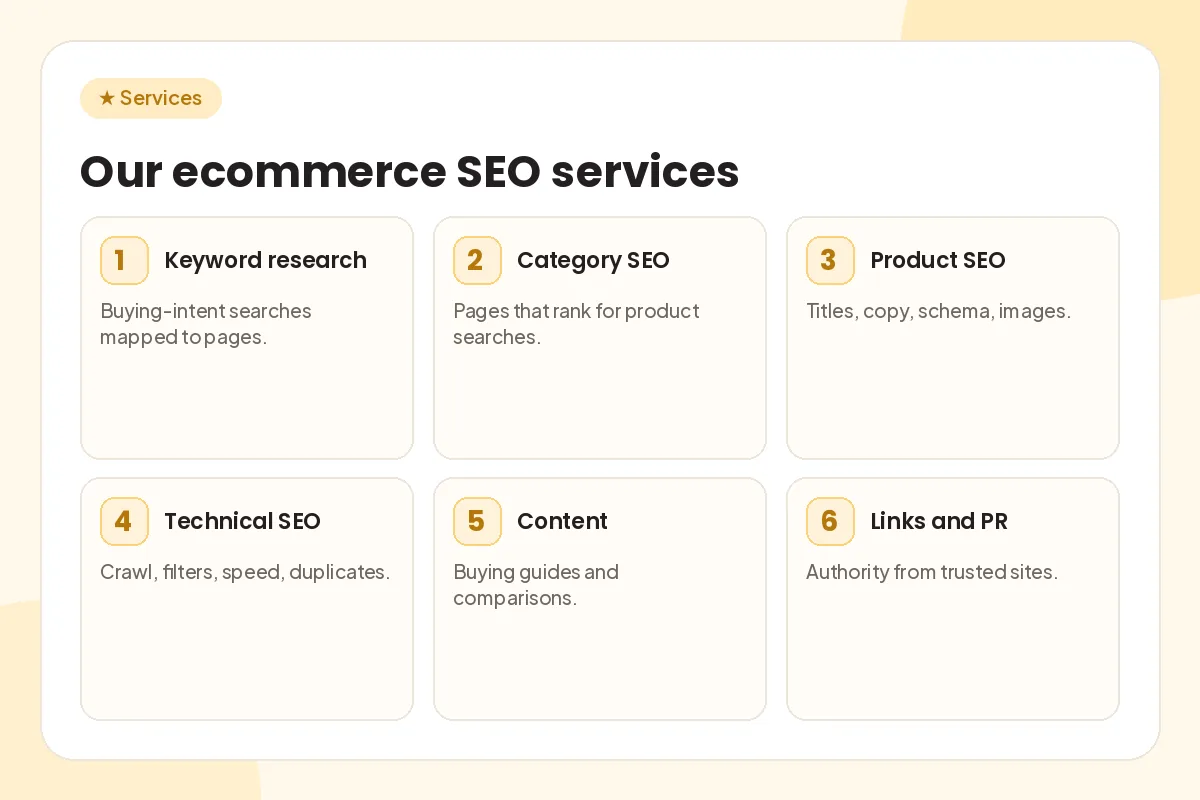
Our ecommerce SEO services
Everything an online store needs to rank and sell.
Ecommerce keyword research
Category page SEO
Product page SEO
Technical ecommerce SEO
Content and buying guides
Link building and PR
Ecommerce keyword research that finds buyers
Shoppers search in patterns. Broad terms like “running shoes” are competitive and vague. Longer terms like “women’s trail running shoes waterproof” show a clear buyer with a clear need, and they often convert far better.
| Search type | Example | Best page |
|---|---|---|
| Category | women’s trail running shoes | Category page |
| Product | Brand X Model 5 trail shoe | Product page |
| Attribute | waterproof trail running shoes | Filtered landing page |
| Comparison | Model 5 vs Model 6 | Buying guide |
| Question | how to choose trail running shoes | Guide linking to categories |
We map each important search to one page, so pages do not compete with each other.

Category pages that rank and sell
Category pages are where most shoppers land from search, so they need more than a grid of products. We write clear titles and headings around the main search, add a short intro that helps shoppers choose, and place a longer buying guide or FAQs below the products where it does not get in the way.
We also check how categories link to each other and to products. A clear structure, with main categories, subcategories and helpful filters, makes it easy for both shoppers and Google to find what they want.

Product page SEO
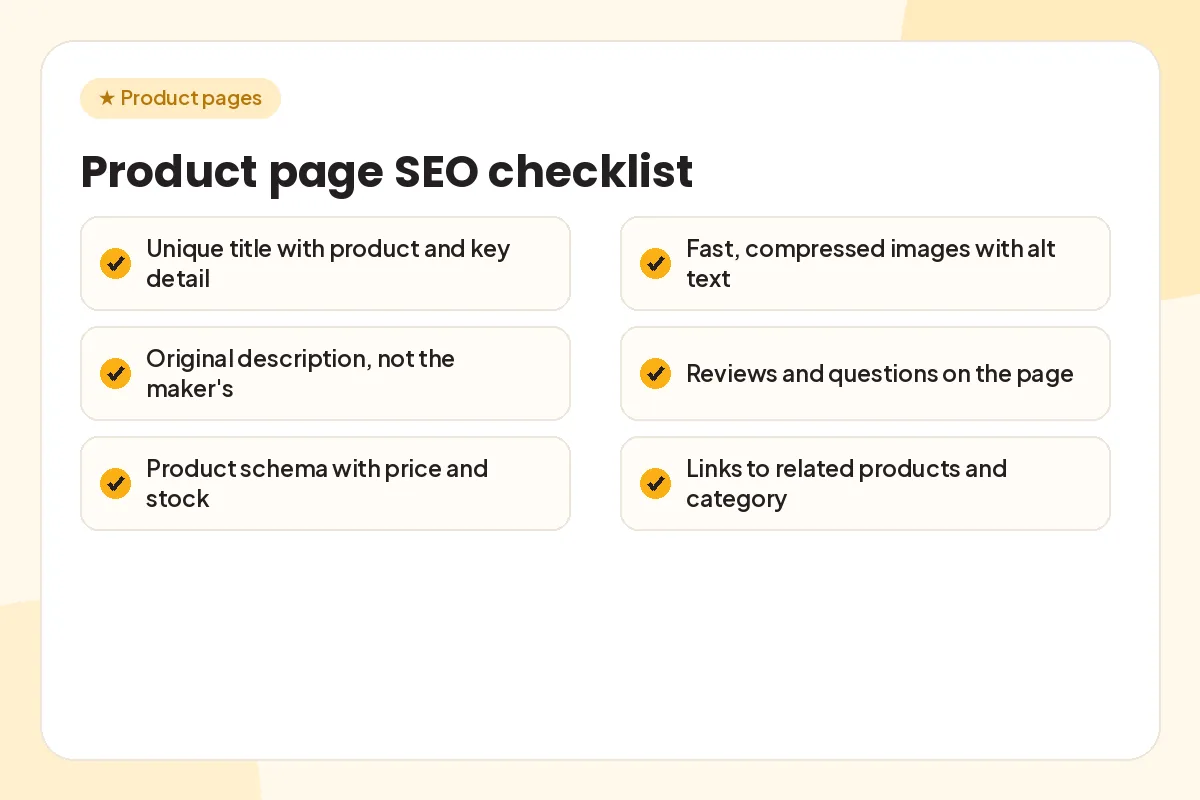
Product pages win long, specific searches and turn visitors into buyers. Many stores use the manufacturer’s description, which means the same text appears on dozens of other sites. We write or brief unique descriptions that answer the questions shoppers ask.
We also add product schema with price, stock and reviews so your products can show rich results, compress and label images, and link each product to related items and its category. For large catalogues, we create templates and rules so improvements apply across thousands of products.
Technical SEO for big catalogues
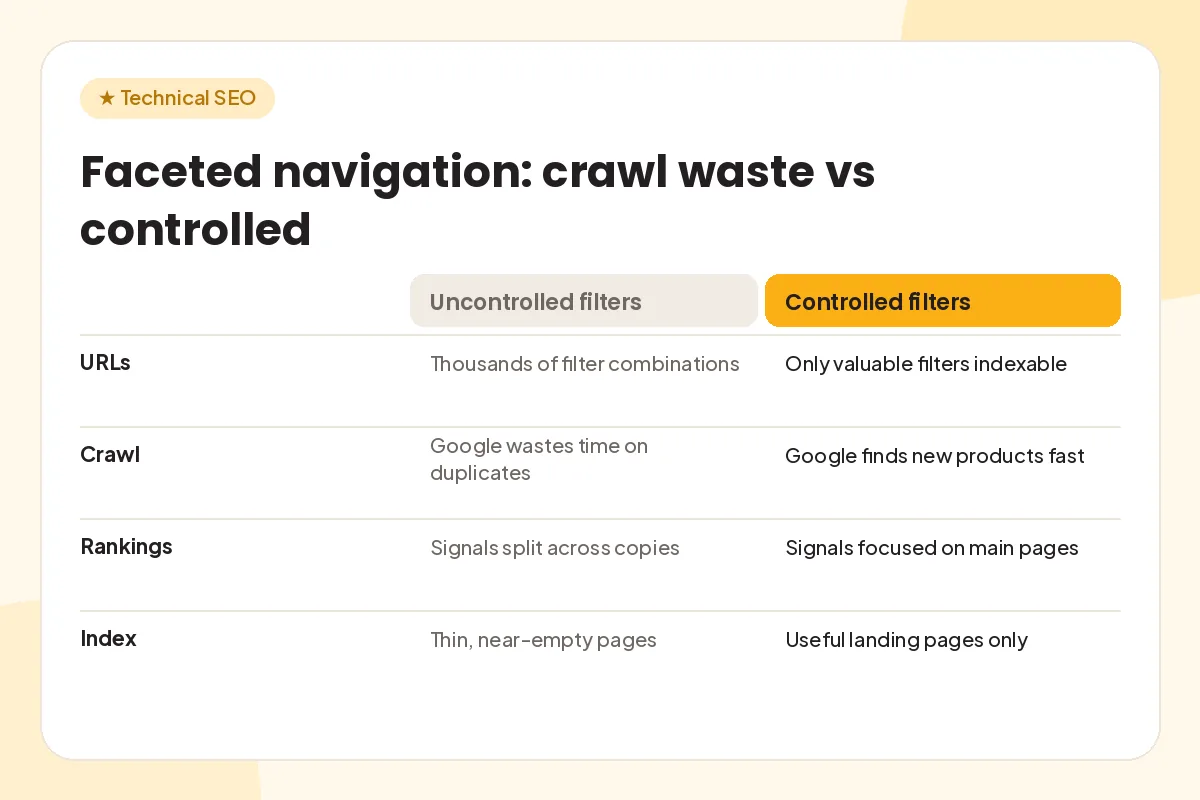
Filters and sorting options can create thousands of URLs for the same products. Google’s own guidance warns that faceted navigation can lead to overcrawling and slower discovery of new pages. We decide which filter pages deserve to be indexed, such as popular colour or brand combinations, and keep the rest out of the index.
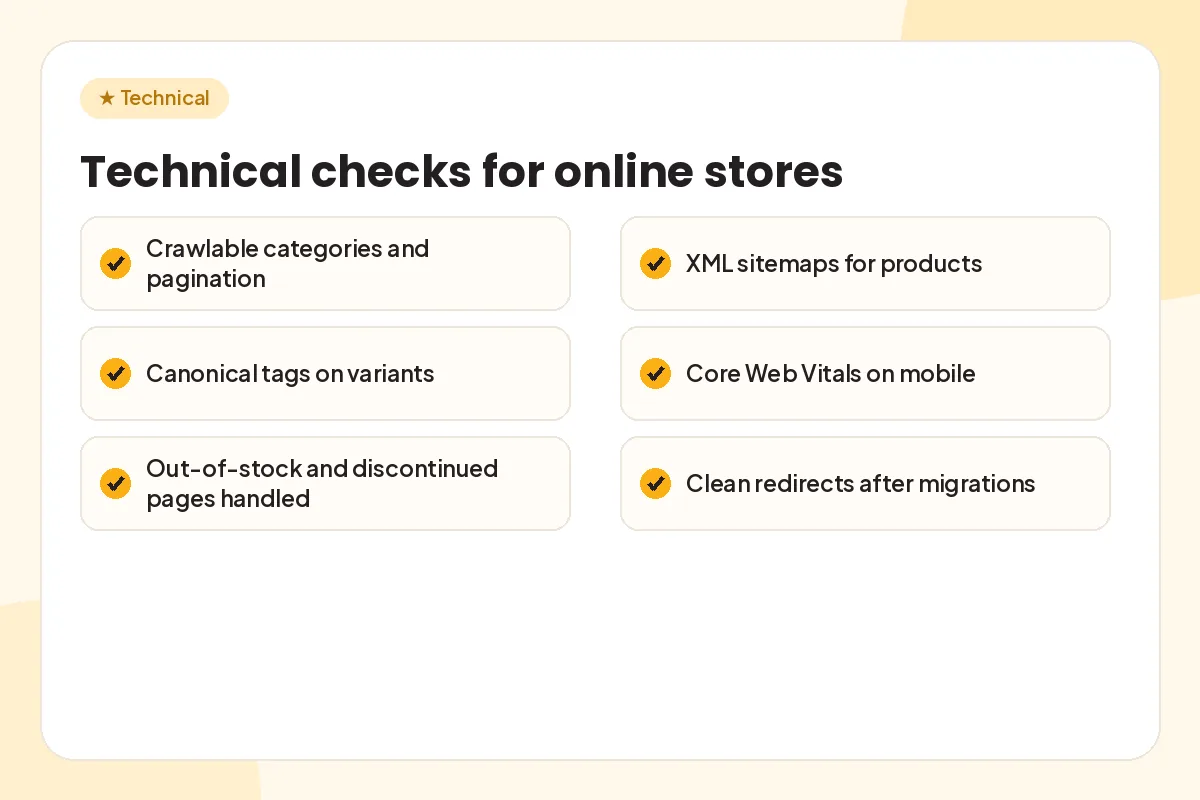
We also fix duplicate URLs from product variants, set canonical tags, clean up redirect chains, improve XML sitemaps and speed up mobile pages so they pass Core Web Vitals.

Out-of-stock and discontinued products
Removing product pages when stock runs out throws away rankings and links. Keeping dead pages live with no alternative frustrates shoppers. We set clear rules for each case.
- Temporarily out of stock: keep the page, show the restock date and suggest alternatives.
- Discontinued with a replacement: redirect to the new model.
- Discontinued with no replacement: redirect to the closest category, or keep a helpful page if it still earns traffic and links.
- Seasonal products: keep the URL year after year so it builds authority.

Our technical checklist for online stores
Every ecommerce SEO project starts with a technical audit. We crawl your store like Google does and check how categories, products, filters and pagination are found and indexed. Issues are ranked by their effect on revenue, and we work with your developers, or our own, to get fixes live.
Ecommerce platforms we work with
| Platform | Common SEO issues we fix |
|---|---|
| WooCommerce | Slow plugins, duplicate tag and attribute pages, weak schema |
| Shopify | Duplicate collection URLs, app bloat, limited URL control |
| Magento | Layered navigation crawl waste, slow pages, complex canonicals |
| BigCommerce and others | Faceted URLs, thin categories, migration issues |
See also our Shopify SEO services and Magento SEO consultant pages.
Content that brings shoppers in earlier
Not every shopper is ready to buy on their first search. Buying guides, comparisons and how-to articles reach them while they are still deciding, and they link to the right category and product pages.
Good content also earns links from other sites, which lifts your whole store. We plan topics around your best-selling categories, so every guide supports a page that makes money. Our content marketing team can write and promote it.
Structured data for products
Product schema tells Google your price, stock, brand and review rating, which can show as rich results in search and in Google Shopping’s free listings. We add Product, Offer, AggregateRating where you have real reviews, BreadcrumbList and Organization markup, and check that it matches what shoppers see on the page.
Our founder built SchemaNinja, a schema plugin for WordPress, so structured data is an area we know closely. We also review your Merchant Center feed so product data is consistent everywhere.
Getting found in AI shopping answers
Shoppers now ask AI assistants for product recommendations, and Google shows AI summaries for many product searches. These tools draw on clear product data, helpful category content, reviews and mentions on trusted sites.
The work that helps here is the same work that helps SEO: accurate structured data, useful buying guides, honest product details and a brand that other sites talk about. We include these signals in your plan.
Internal linking that lifts category pages
Internal links tell Google which pages matter most. In many stores, the home page links to a few categories, and everything else is buried several clicks deep. We plan links from the menu, breadcrumbs, related categories, product pages and guides, so authority flows to the categories and products that earn the most.
We also add links between related categories, such as “trail running shoes” and “running socks”, which helps shoppers browse and helps search engines understand your range.
Reviews and shopper questions
Real customer reviews add fresh, unique text to product pages, answer questions in the shopper’s own words and build trust. They can also show as star ratings in search results when marked up correctly.
We help you set up review requests after purchase, show reviews on product pages in a way Google can read and add a questions section for common pre-sale questions. We never add fake reviews or ratings, which break Google’s rules and can lead to penalties.
Site speed for online stores
Slow stores lose sales. Every extra second on mobile gives shoppers a reason to leave, and Core Web Vitals are part of how Google judges page experience.
The usual causes are large product images, too many apps or plugins, heavy themes and third-party scripts for reviews, chat and tracking. We measure your key templates on mobile, fix what we can directly and give your developers a clear list for the rest.
Selling in more than one country
If you sell in several countries or languages, search engines need to know which version to show to whom. We set up hreflang tags, choose the right URL structure for each market, localise category content and make sure prices and currency in schema match each version. Our international SEO service covers this in depth.
Common ecommerce SEO mistakes
- Empty category pages. A product grid with no text gives Google little to rank.
- Copied descriptions. Manufacturer text means competing with every other seller.
- Indexing every filter. Thousands of thin pages waste crawl budget.
- Deleting old products. Lost URLs mean lost rankings and links.
- Ignoring mobile speed. Most shoppers browse on phones.
- Skipping SEO in a migration. A new platform without redirects can wipe out traffic.
Your first 90 days
Month one: full technical and content audit, analytics and tracking checks, keyword mapping and the first urgent fixes.
Month two: category page optimisation for your top-earning categories, product templates, schema and crawl control.
Month three: buying guides, internal linking, the first link building work and your first full revenue report. From there, we repeat the cycle for the next set of categories.
How to choose an ecommerce SEO agency
Ask any agency how they will measure success. The answer should be orders and revenue, not only rankings. Ask which platforms they know well, how they handle filters and out-of-stock products, and who will make technical changes on your store.
Ask for examples of category page work and a sample report. Be careful with anyone who promises fixed rankings or quick results from link packages. Good ecommerce SEO builds steadily and keeps paying back, so a clear plan and honest reporting matter more than big promises.
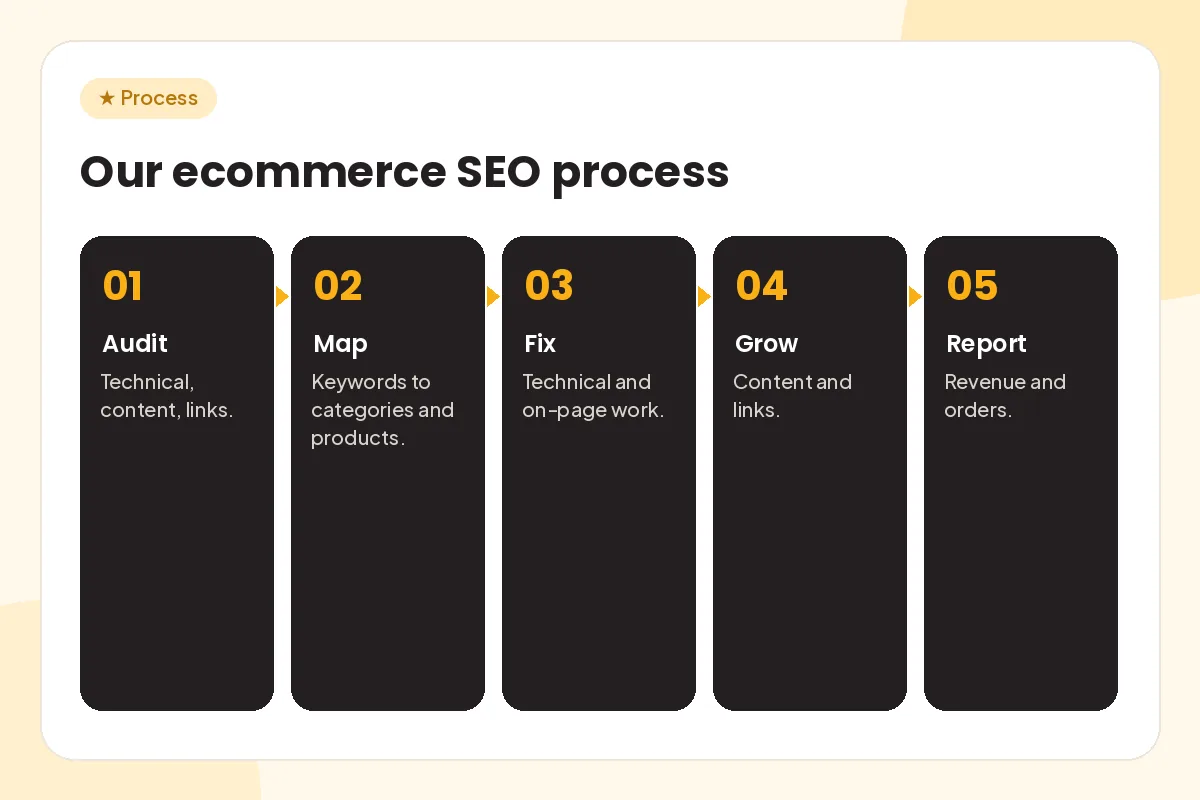
Our ecommerce SEO process
Audit
Map
Fix
Grow
Report
How we measure ecommerce SEO
- Organic revenue and orders from analytics, with ecommerce tracking checked first.
- Organic conversion rate, to make sure the traffic we bring is buying.
- Clicks and impressions for category and product pages in Search Console.
- Rankings for the buying keywords in your plan.
- Indexed pages, to confirm Google sees your products and not filter clutter.

Replatforming without losing rankings
Moving to a new platform or redesigning your store is one of the riskiest moments for SEO. URLs change, content gets lost and redirects are missed. We map every old URL to its new home, test redirects before launch, check that schema and content carry over and watch rankings closely in the weeks after. If you are planning a new store, see our ecommerce website design service.
Why choose DigiExe for ecommerce SEO services
Short claims you can check.
1,400+ clients in 28 countries
Founder-led SEO
Schema specialists
Store builders too
SEO results from our team
Our published case studies show the growth our SEO process delivers on real sites.
Stores we work with
We work with fashion and apparel, beauty and wellness, home and furniture, electronics, sports and outdoor, food and drink, auto parts and B2B supply stores. Store sizes range from small catalogues of a few dozen products to large stores with thousands of products and many filters.
Each niche brings its own search habits. Fashion shoppers search by style, colour and size, electronics buyers compare specs and models, and B2B buyers search by part numbers and bulk terms. We shape your keyword map, category structure and product content around how your shoppers actually search, rather than using one template for every store.
Services that pair with ecommerce SEO
Grow every part of your store.

Jitendra has grown his own sites through SEO since 2013 and runs SchemaNinja, a schema markup plugin for WordPress. He reviews the ecommerce SEO checklist our team uses.
Jitendra started BloggersIdeas in 2013, runs AffiliateBooster and SchemaNinja, and wrote the international bestseller Inside A Hustler's Brain (20,000+ copies). He has spoken at Affiliate Summit, Affiliate World, DMSS and TES, and works from New Delhi.
Last updated:
Ecommerce SEO services: FAQs
What are ecommerce SEO services?
Ecommerce SEO services help online stores rank higher in search results for the products they sell. The work covers keyword research, category and product page optimisation, technical fixes for issues like filters and duplicate URLs, product schema, content such as buying guides and link building, all measured by organic orders and revenue.
How is ecommerce SEO different from regular SEO?
Stores have problems most sites do not: thousands of product pages, filters that create duplicate URLs, products that go out of stock and manufacturer descriptions shared with other sites. Ecommerce SEO focuses on category and product pages, crawl control and structured data, and it is measured by revenue rather than leads alone.
How long does ecommerce SEO take to work?
Technical fixes and category page improvements can show results within a few months, especially on stores with existing traffic. Bigger gains from content and links usually build over six to twelve months. Timelines depend on your store authority, competition and how quickly fixes go live, so we set realistic goals at the start.
Which platforms do you work with?
We work with WooCommerce, Shopify, Magento and BigCommerce, as well as custom stores. Each platform has its own SEO issues, such as duplicate collection URLs on Shopify or layered navigation on Magento. Our team includes developers, so we can make technical changes directly or work alongside your own developers.
Should I write unique product descriptions?
Yes, for your most important products at least. Manufacturer descriptions appear on many other sites, so Google has little reason to rank yours. Unique descriptions that answer shopper questions help you rank and convert. For large catalogues, we prioritise the products with the most search demand and margin, then use templates for the rest.
How do you handle out-of-stock products?
It depends on the case. Temporarily out-of-stock products keep their page, with a restock date and alternatives. Discontinued products with a replacement redirect to the new model. Those with no replacement usually redirect to the closest category. This keeps rankings and links while giving shoppers a useful next step.
What is faceted navigation and why does it matter?
Faceted navigation is the set of filters shoppers use, such as size, colour and price. Each filter combination can create a new URL, which can mean thousands of near-duplicate pages. Without control, Google wastes time crawling them. We decide which filtered pages are worth indexing and keep the rest out of the index.
How much do ecommerce SEO services cost?
Cost depends on the size of your store, the competition in your market and how much content and link building you need. Our general SEO packages start at a fixed monthly price, and larger stores get a custom plan. After a free store audit, we send a clear proposal with the scope and monthly cost.
Will SEO help my Google Shopping results?
It helps. Free product listings in Google Shopping use your Merchant Center feed and the data on your product pages. Accurate product schema, consistent prices and stock, good images and clear titles help both organic search and Shopping. We review your feed and product data as part of the work.
Can you help with a store migration?
Yes. We map every old URL to its new page, test redirects before launch, check that content and schema carry over and monitor rankings after the move. Planning SEO into a migration from the start is far easier than fixing lost rankings afterwards, so talk to us before you set a launch date.
Do you report on revenue?
Yes. We check that ecommerce tracking in Google Analytics is set up correctly, then report each month on organic revenue, orders and conversion rate, alongside traffic and rankings. That way you can see the return on your SEO spend, not just whether rankings moved, and we can focus effort where it pays.
Grow sales from search, not just ads
Request a free store audit. We will show you what is holding your store back and where the quickest wins are.
Brands We Have Worked With
A few of the businesses that have trusted DigiExe and our founder with their marketing.


What our clients say about DigiExe