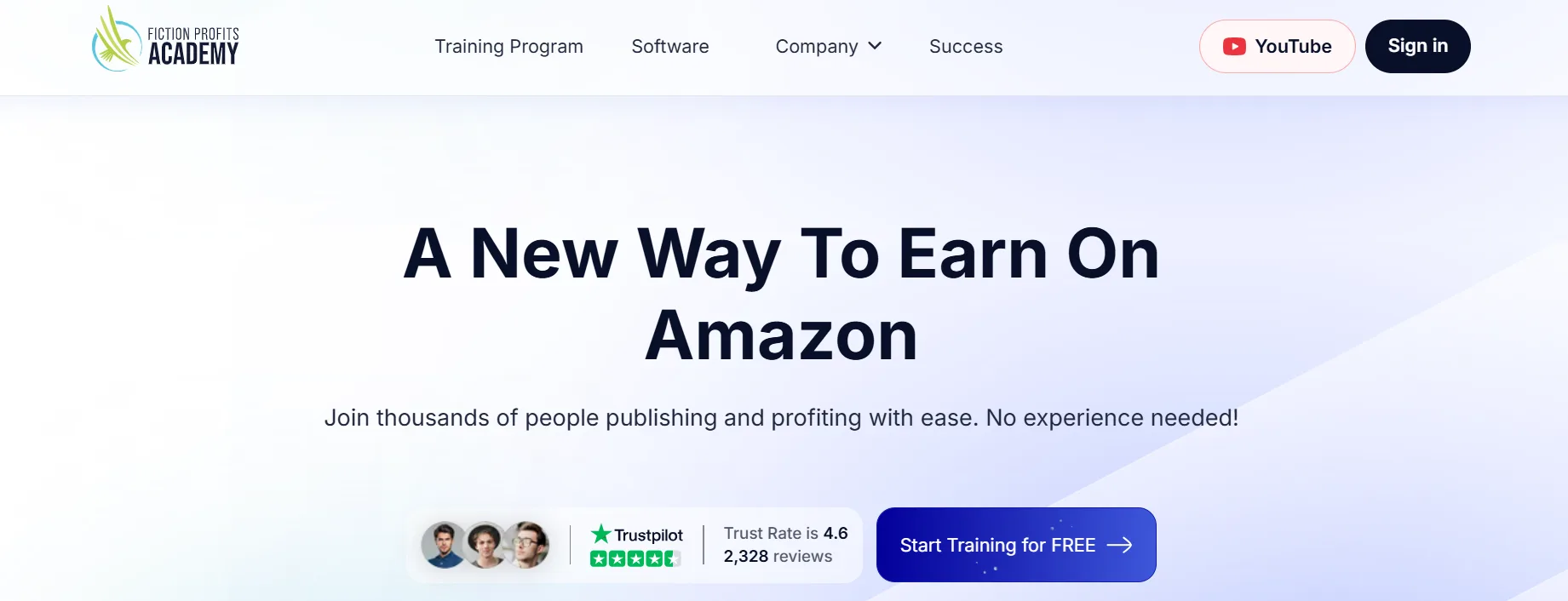
There’s a moment every person who stumbles onto Fiction Profits Academy experiences. It usually happens somewhere between 30 and 45 seconds into their sales video, when a calm voice explains that you can publish fiction books on Amazon and earn royalties — without writing a single word yourself. Your brain immediately fires off two competing reactions. The first one says this actually sounds interesting. The second one says I’ve heard this kind of thing before.
I stayed with both those reactions for three full weeks. I went to their website, went through their FAQ section line by line, read every piece of their blog I could access, watched their YouTube channel which now has 11,300+ subscribers and 78 videos including fresh content published just weeks ago in 2026, dug through their Trustpilot profile, their Better Business Bureau listing, Reddit threads, and independent video reviews. I looked for the good stuff, the bad stuff, and the stuff that sits uncomfortably in the middle.
What follows is everything I found — organized the way I wish someone had organized it for me before I started.
The Backstory: Where Did This Program Actually Come From?
Fiction Profits Academy was born in 2015 — not last year, not during the AI boom, not as a trend-chasing venture. Karla Marie, the founder, started it after spending years building her own fiction publishing business on Amazon’s Kindle Direct Publishing platform. By the time she created FPA, she had personally written and published more than 60 fiction novels, critiqued thousands of manuscripts, and built herself a six-figure income from royalties alone.
That foundation matters enormously. Too many online courses get created by people who figured something out for six months and immediately started selling knowledge they barely have. Karla Marie spent years in the trenches first.
She knows what a compelling romance blurb looks like. She knows which cover styles move readers to click. She knows why some pen name brands grow loyal audiences and others disappear after two books. She built the program around what actually worked in her career, not around what sounds good in a webinar.
Her co-founder, Roy Lewis, started as an FPA student. He applied the system, published over 200 books, landed more than 50 titles in Amazon’s Top 100 bestseller charts, and earned $2.3 million in verified royalties. He now runs the program alongside Karla. That’s the kind of story that’s either completely fabricated or completely compelling. Given that it’s supported by verifiable platform data and third-party media coverage, it falls firmly in the second category.
December 2025: The Milestone Report That Changed My View
In early December 2025, Fiction Profits Academy published an official performance report through major press outlets including USA Today and Knox News. This wasn’t a marketing email or a Facebook post — it was a formal press release with specific, auditable numbers. Here’s what it said.
FPA now holds a 4.7-star rating on Trustpilot based on more than 2,800 verified consumer reviews, with the majority of those reviews sitting in the five-star category. On the Better Business Bureau, they carry a 4.79-star rating supported by approximately 250 submitted reviews.
Both of these represent the highest scores in the company’s history, and both increased during 2025 specifically — meaning quality and student satisfaction are moving in the right direction, not declining as you’d expect from a program that peaked early and is now coasting.
More striking is this: Fiction Profits Academy grew by 33 percent in 2025 alone, which their leadership described as the largest single-year increase in the company’s nine-year history. Based on enrollment volume and program capacity, the company now positions itself as the largest U.S.-based education provider focused specifically on fiction publishing. That’s not a niche claim — that’s a market position backed by a decade of operation and verified third-party ratings.
They also announced plans for additional training modules and expanded support channels throughout 2025 and beyond, signaling that they’re reinvesting growth revenue back into the student experience rather than simply pocketing it.
The Core Idea: Why Fiction, and Why Now?
Before getting into the mechanics of the program, it’s worth understanding the market thesis that FPA is built around — because it’s actually one of the most compelling arguments I’ve come across in the online business education space.
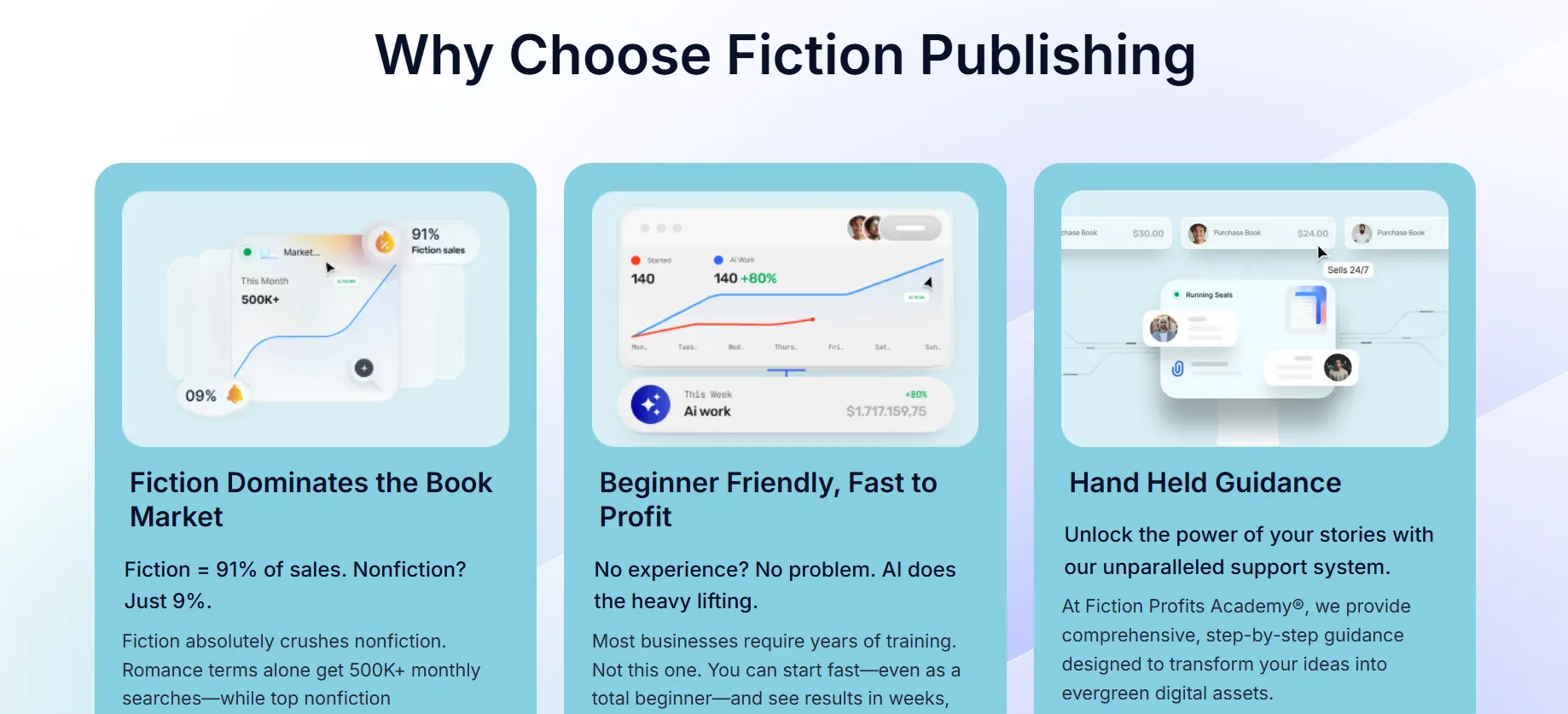
Here is the core claim: 91% of books sold on Amazon Kindle are fiction, while nonfiction accounts for just 9%. Yet most self-publishing courses teach nonfiction. They teach you to write business books, self-help guides, and how-to manuals — the smallest segment of the market — while the massive fiction market sits largely untapped by people who know how to approach it as a business rather than just a creative pursuit.
The data supports this imbalance. Romance-related search terms on Amazon generate over 500,000 monthly searches. The most popular nonfiction terms rarely crack 15,000. Readers who love romance, mystery, cozy mystery, fantasy, sci-fi, and thriller don’t just buy one book — they devour series.
They build relationships with pen name brands. They leave reviews, join author newsletters, and come back the moment a new title drops. That kind of loyal, repeat-purchase reader behavior is the engine of a sustainable publishing income.
FPA’s YouTube channel reinforces this thesis with fresh, 2026-specific content. Videos like “Ranking The BEST & WORST Amazon KDP Niches in 2026” (2,600+ views within two weeks of posting), “The Full Guide to Marketing Your Book on Amazon KDP in 2026” (16,000+ views within a month), and “These Amazon KDP Books WON’T Sell in 2026” (11,000+ views) show that the FPA team actively tracks what’s working right now, updates their guidance regularly, and isn’t recycling three-year-old advice. This is a live, evolving program — not a set of static videos recorded in 2021 and left untouched.
Inside the Program: A Module-by-Module Breakdown
When you enroll in Fiction Profits Academy, you access the course through their member portal at fpa.partners. The structure is layered and progressive, meaning each stage builds on the one before it, and coaching call access unlocks at strategic points as you advance through the material.
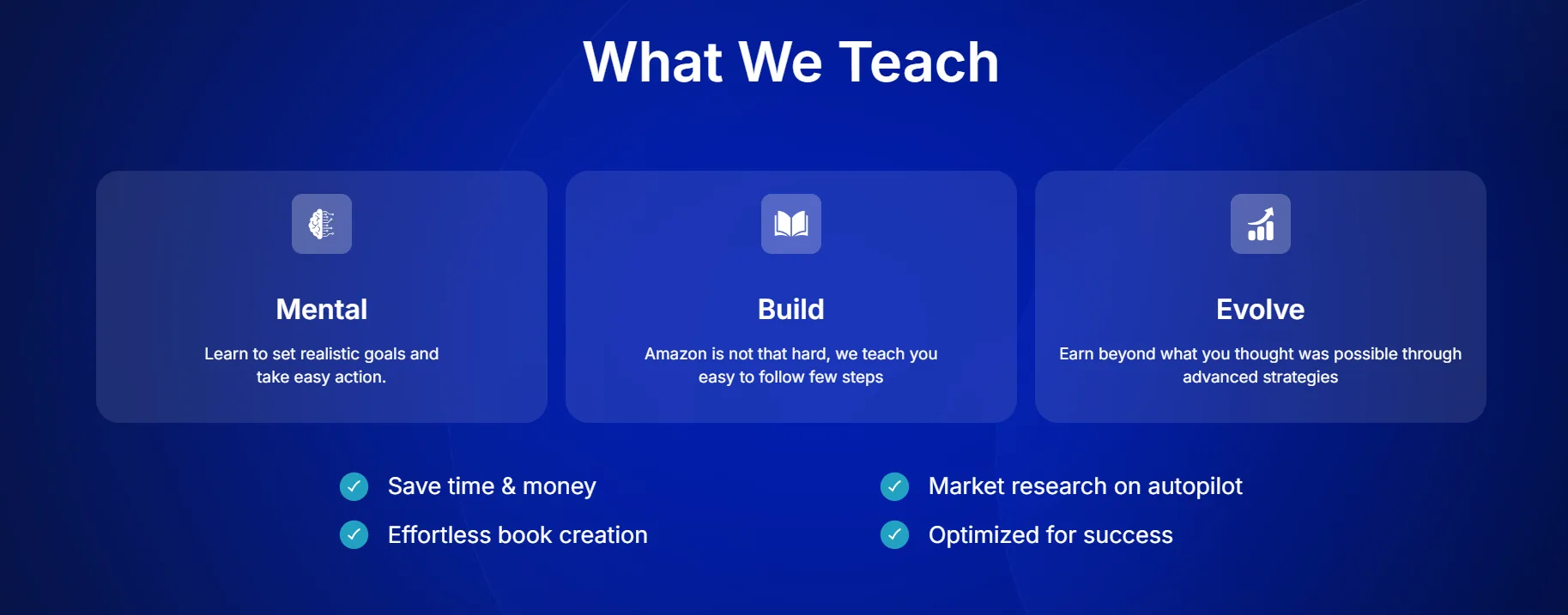
The journey begins with mindset and goal-setting — what FPA calls the “Mental” phase. This isn’t motivational filler. It’s practical clarity about what kind of publishing business you’re building, what your initial financial goals look like, and what timeline is realistic. Most people who fail in any online business fail because their expectations are wildly misaligned with reality. FPA addresses this upfront rather than letting students discover the gap six months in.
The “Build” phase is where the operational learning happens. You learn how Amazon KDP actually works — the royalty structures, the metadata systems, the category and keyword selection that determines whether your book gets discovered.
You learn how to research profitable fiction niches by studying what’s already working in the top 100 bestseller charts. You learn how to select “tropes” — the recurring narrative patterns that readers in specific genres actively seek out — and how to build book titles and subtitles that signal exactly what kind of story a potential reader is about to get.
One of the most distinctive elements of FPA’s curriculum is how seriously they treat the book blurb. Most publishing courses treat blurb writing as a secondary task — something you dash off after the book is done. FPA treats it as one of the most critical sales skills a publisher can develop. Their FAQ section makes this explicit: before any coach will review your blurb, you’re expected to have rewritten it at least 10 times using the principles from their dedicated blurb training module.
Their reasoning is sound — a blurb is essentially a direct-response advertisement. It’s the only sales copy most readers will ever read before deciding whether to buy your book. Treating it casually is like building a beautiful storefront and then leaving your sign blank.
Cover design gets similarly rigorous treatment. Students learn to research what covers are selling in their specific niche by studying current bestsellers, identify the visual cues that signal genre to readers, and commission designs that compete with traditionally published titles — not homemade covers that immediately signal “self-published.” FPA’s recommended budget for covers ranges from $20 to $50 in the early stages, scaling up as revenue grows.
The ghostwriting process is central to the program’s accessibility. Students use Upwork as the primary platform for hiring fiction writers, and FPA lists vetted ghostwriting companies in Module 2. The cost structure they recommend: at the beginner stage, shorter books of 10,000 to 30,000 words cost approximately $100 to $300 at around $0.01 per word.
Intermediate-stage books of 30,000 to 50,000 words typically run $300 to $500. Advanced-stage publishers investing in premium writers may spend $400 to $800 per book, but by that point their royalties should be funding those costs.
The “Evolve” phase covers scaling — Facebook advertising, email list building, newsletter swaps with other authors, box set strategy, outsourcing business operations to virtual assistants, and eventually building a full team around your pen name brand.
FPA is explicit that successful students earn between $10,000 and $100,000+ per month from a single pen name before they even consider building a second one. The message is clear: depth before breadth.
The Coaching Structure: Five Days a Week, Every Week
This is where Fiction Profits Academy genuinely separates itself from the majority of online courses that dump a folder of pre-recorded videos in your lap and call it mentorship.
FPA runs live group coaching calls five days a week. These sessions are where real questions get real answers in real time. You can bring your cover concept, your blurb draft, your niche research, your Facebook ad results — anything that’s blocking your progress — and get feedback from experienced coaches who are active publishers themselves. All calls are recorded and kept accessible for approximately 30 days, so catching up after a missed session is simple.
Beyond group calls, students unlock one-on-one coaching calls at four specific milestones: after selecting their tropes and titles, after rewriting their blurb 10 times, after their cover is designed, and when they begin running Facebook ads. These aren’t bonus calls that only premium members get — they’re built into the standard program as strategic checkpoints designed to catch the most common and costly mistakes before they happen.
New students start with a Success Call — a personal welcome session with a high-performance coach who creates a custom publishing plan and helps set realistic goals for the first 60 to 90 days. This kind of intentional onboarding is genuinely rare. Most programs let you figure out your starting point alone.
Support between calls happens through a private Facebook community group that coaches actively monitor and participate in. The program’s FAQ section confirms a 30-minute or less response time for direct support messages during business hours (Monday through Friday, 8am to 6pm Eastern). Email support at [email protected] operates on the same timeline.
One frequently overlooked bonus: every new FPA member receives an additional membership for a friend or family member. For couples or business partners who want to build this together, that’s a significant added value.
The AI Playground and Proprietary Tools: What’s New in 2025–2026
If you looked at Fiction Profits Academy even two years ago, the AI integration you see now didn’t exist in its current form. The program has evolved substantially.
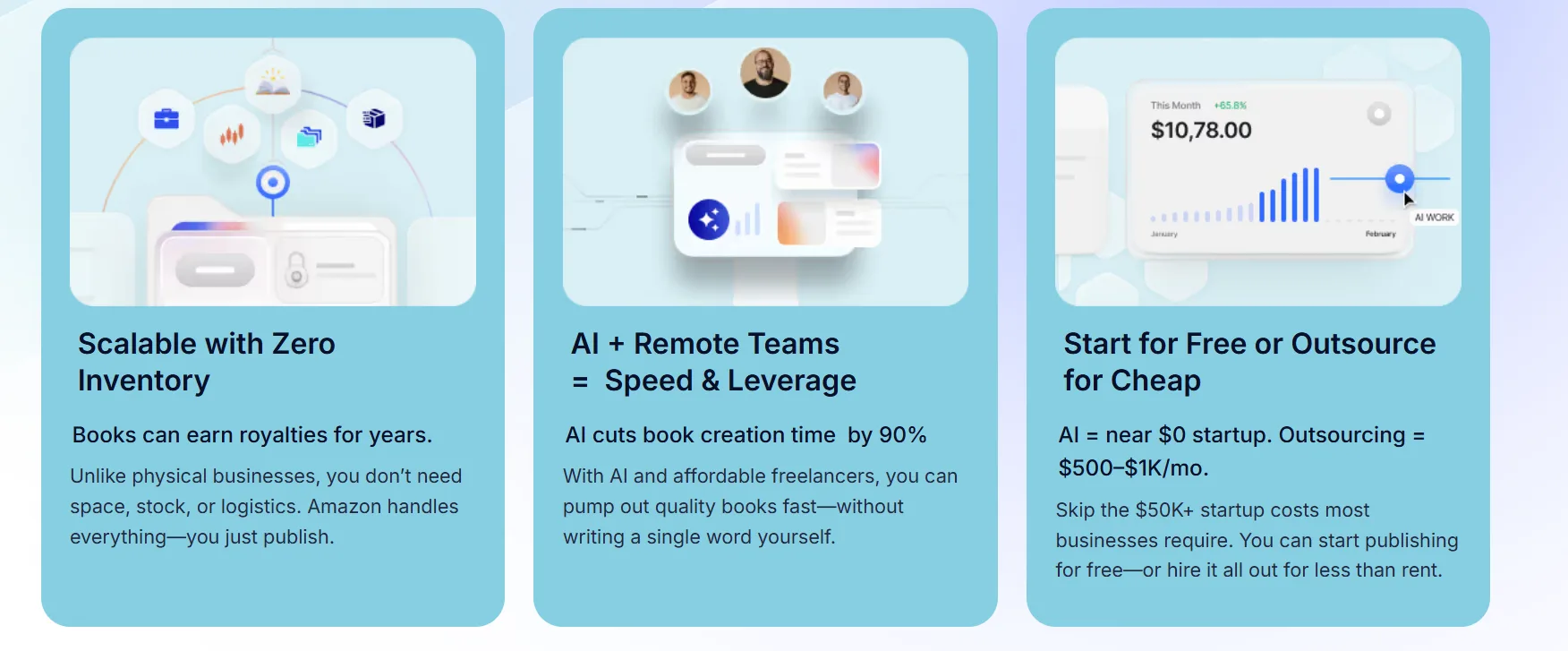
FPA now features proprietary AI software that their website describes as capable of cutting book creation time by up to 90%. This includes tools for market research automation, plot development support, manuscript formatting assistance, and content generation — all used responsibly within Amazon’s current disclosure requirements.
This is a critical point that several independent YouTube reviewers have flagged, and it’s one FPA addresses directly in their training: Amazon requires disclosure when AI assists in book creation. Students who ignore this policy risk account suspension or book removal.
FPA builds compliance into their curriculum rather than leaving students to discover the rules on their own after they’ve already violated them.
Their YouTube channel’s 2026 content reflects this AI-integrated approach throughout. Recent videos specifically address what’s working on KDP right now, which niches are growing versus saturating, and how to use AI tools responsibly to produce quality fiction that readers actually enjoy.
The channel doesn’t present AI as a magic shortcut — it presents AI as a production tool that still requires human judgment, strategic thinking, and quality control to use effectively.
The Partnership Model: How FPA Makes Money, and Why That Matters
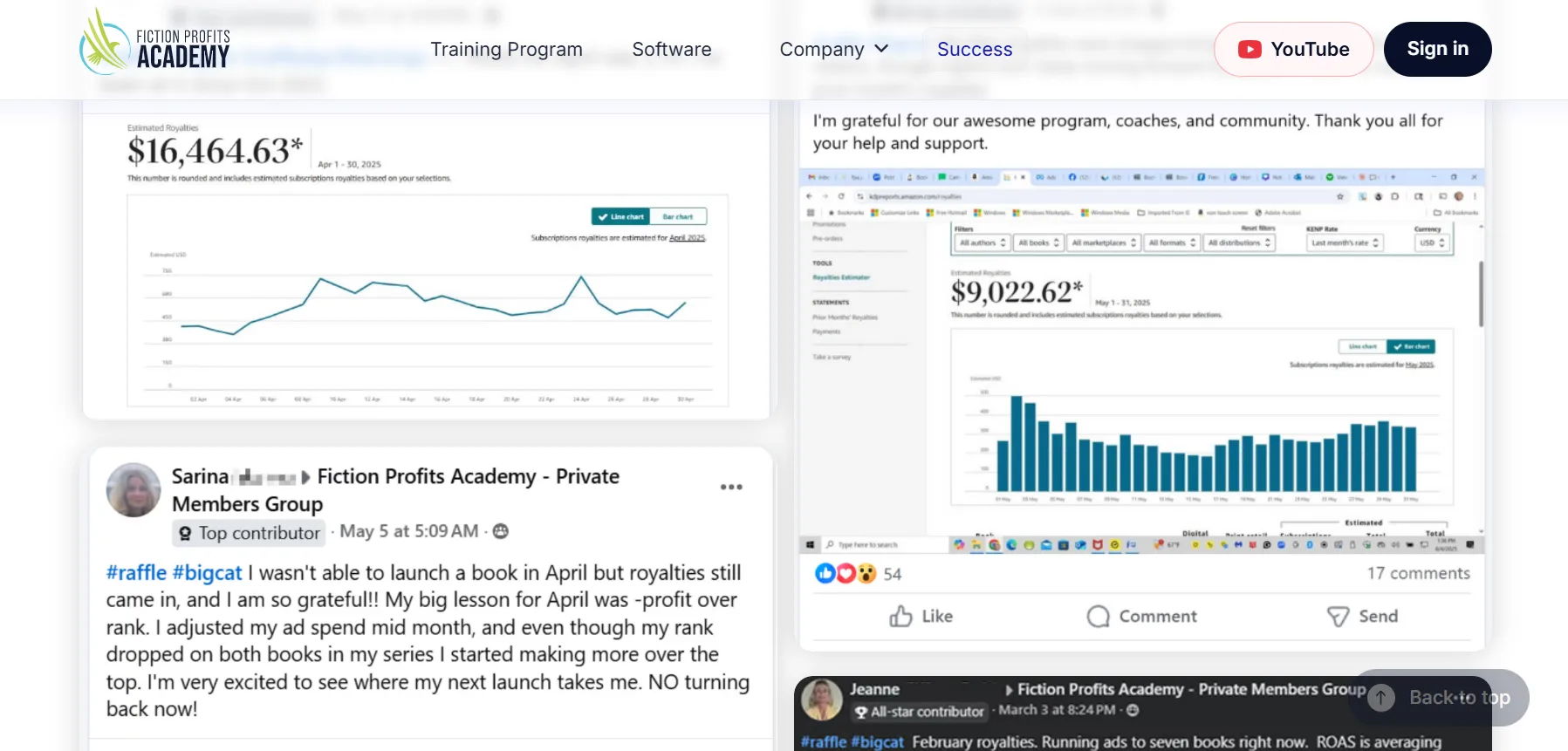
Fiction Profits Academy uses what they call a partnership model — instead of just taking your tuition fee and wishing you well, FPA earns 5% of your Kindle royalties during the first year. This is either a concerning arrangement or a brilliant alignment of incentives, depending on how you look at it.
I land firmly on the “aligned incentives” interpretation, for a simple reason: if you don’t publish books, and those books don’t sell, FPA earns nothing from the royalty share. The only way they benefit from that arrangement is if their students actually succeed.
That means every coaching call, every piece of curriculum, every support response exists in a context where FPA has a direct financial reason to make sure you follow through and get results.
Compare this to the typical online course model, where the company profits entirely from your enrollment regardless of whether you ever finish the course, publish a single book, or earn a dollar. The royalty-share model isn’t perfect — 5% of your first year’s earnings is money you won’t keep — but the incentive structure it creates is meaningfully better than a flat-fee program with no accountability for outcomes.
What Real Students Say: Patterns from Hundreds of Verified Reviews
Across Trustpilot, the BBB, and FPA’s own blog, several consistent themes emerge from student feedback that are worth understanding specifically.
The coaches most frequently mentioned by name are Daniel and Tara. Daniel appears repeatedly in reviews for his depth of knowledge in genre-specific niches — one reviewer specifically praised his understanding of cozy mystery conventions and his ability to explain what draws readers to specific subgenres. Tara appears in multiple reviews for her patience, follow-through, and willingness to support students through the same questions multiple times without frustration.
Kristen Wilsey wrote in April 2025 that she was “so relieved” to have found FPA and that coaches are “willing to help no matter the amount of times you have reached out regarding the same questions.” Daniela Soqui described a full journey of support — from niche selection to trope research to launch strategy review — all handled by a single coach who followed up consistently.
Juanita Albin described Daniel helping her get “unstuck with technical challenges” and called the combination of group calls, recordings, lessons, and resources “absolutely invaluable.”
These aren’t testimonials picked selectively from one good week. They come from a pool of 3,197+ verified Trustpilot reviews and roughly 250 BBB reviews, the vast majority of which fall in the four-to-five star range. The sheer volume of consistent, specific, third-party verified feedback is difficult to dismiss.
What Critics Say: The Real Concerns Worth Taking Seriously
Independent YouTube reviewers and Reddit communities raise several concerns that deserve honest engagement rather than dismissal.
The most substantive criticism comes from people who point out that publishing fiction on KDP is not passive income in the traditional sense. You need to publish consistently — ideally one book per month, according to FPA’s own FAQ. You need to invest in ghostwriting, cover design, and marketing for every title.
You need to monitor Amazon’s evolving AI policies, respond to reader feedback, manage ghostwriter relationships, and stay current with what’s working in your genre. This is a business. It has ongoing operational demands. Anyone who joins expecting to press a button and collect royalties while they sleep is going to be genuinely disappointed.
The $2,000 enrollment cost is also a real barrier. If you’re already financially stretched, adding ghostwriting costs of $100 to $500 per book per month on top of a $2,000 program fee is a genuine stretch. FPA is transparent about these ongoing costs — they lay them out clearly in their FAQ rather than hiding them in fine print — but the transparency doesn’t make the dollars easier to find. You need to go into this with a realistic budget for at least 6 to 12 months of operations, not just the enrollment fee.
The question of Amazon KDP market saturation comes up frequently in Reddit discussions. FPA’s response — that the Kindle market is so large that their entire student base couldn’t meaningfully saturate it — is reasonable, but the more nuanced truth is that specific niches can and do get competitive.
Students who pick broadly popular categories without finding a specific angle or subgenre position face tougher odds than those who do proper niche research. The curriculum addresses this, but students who rush past the research phase will face harder results.
Finally, the timeline reality: FPA’s own materials state that results typically emerge between 6 and 12 months of consistent effort. Some students take longer. Anyone who goes in expecting to recoup their $2,000 investment in 30 days will be disappointed.
The Reddit thread from a student who bought a $2,000 KDP course and stalled out within a month illustrates this clearly — not because the system was broken, but because their expectations were misaligned with reality from day one.
The Refund Policy: Six Months, With One Important Condition
FPA offers a six-month, 100% money-back guarantee — one of the most generous refund windows in the online education space. For context, most programs offer 30 days, and some offer nothing at all. Six months gives you enough time to go through the material, implement the steps, work with coaches, and make a genuine assessment of whether the system is working for you.
The important condition to understand: FPA strongly advises against filing a bank dispute or credit card chargeback if you want a refund. Their FAQ explains this in unusual detail — bank disputes can take 3 to 6 months to resolve, often don’t succeed, and create bureaucratic headaches for everyone involved.
Their recommendation is to contact [email protected]directly, explain your circumstances, and let them work out a solution with you. They report a 30-minute response time during business hours, which means you’re not waiting days to hear back.
The Unlimited Plan carries no refund option, which is worth knowing before choosing that tier.
Licensing and Legal Clarity: What You Can and Cannot Do
For anyone concerned about the legal standing of the business model, FPA’s FAQ lays out the rules clearly. You operate one KDP account — Amazon prohibits multiple accounts per person, and violating this risks permanent suspension. You can, however, run unlimited pen names within a single account. FPA recommends building one pen name to at least $10,000 monthly revenue before adding a second, because splitting your focus too early typically slows growth for both.
Books must disclose AI involvement per Amazon’s current terms of service. Books cannot be listed on Kindle if they’re AI-generated without disclosure. Books cannot be sold on Kindle if they’re PLR (private label rights) content.
Series books with cliffhanger endings are generally discouraged for beginners because most readers prefer standalone novels, particularly in romance. Box sets are covered in the curriculum, with the guidance that a single book should not appear in multiple box sets simultaneously, as this can trigger Amazon’s duplicate content policies.
These aren’t obscure rules buried in dense legal language — FPA teaches them explicitly because violating any of them can result in account suspension, which ends your publishing business entirely.
Who Thrives Here, and Who Doesn’t?
Based on everything I found across the program’s materials, verified reviews, YouTube content, and community discussions, the pattern of who succeeds and who struggles is pretty clear.
Students who thrive in FPA share several traits: they show up consistently for coaching calls, they implement each module step before moving to the next, they treat the investment in ghostwriting and cover design as a business expense rather than an optional extra, they have realistic six-to-twelve month timelines in their head before they start, and they genuinely enjoy the process of learning how readers think and what makes fiction sell.
These are people who find the creative and commercial blend of fiction publishing genuinely engaging.
Students who struggle tend to buy the program with a “fast money” mindset, skip the research-heavy early modules to get to publishing quickly, underpay for ghostwriters to cut costs and end up with content that won’t convert readers, disengage from coaching after the first few weeks, and lose momentum when their first book doesn’t immediately hit the top 100. The system doesn’t fail them — they fail to use the system.
The honest question you need to answer before enrolling is not “does this work?” The evidence says it does, for people who use it properly. The question is “will I use it properly?” — and only you can answer that.
they don’t pretend it is.
Quick Reference Summary
What You Need to Know | The Honest Answer |
Founded | 2015 by Karla Marie |
Students enrolled | 15,000+ worldwide |
Trustpilot rating (2025) | 4.7 stars, 2,800+ verified reviews |
BBB rating (2025) | 4.79 stars, 250+ reviews |
Year-over-year growth | 33% (largest in company history) |
Coaching | 5x/week live group calls + 1-on-1 milestone calls |
Program cost | ~$1,995 (payment plans available) |
Ongoing costs | $100–$800/book (ghostwriting + cover) |
Refund policy | 6-month money-back guarantee |
Time to results | Typically 6–12 months |
AI tools | Proprietary AI integrated with compliance training |
YouTube channel | 11,300+ subscribers, actively updated for 2026 |
Quick Links:
My Genuine Assessment After All of This Research: Fiction Profits Academy Review
Fiction Profits Academy is the real thing. That doesn’t mean it’s the right thing for everyone, but it’s a legitimately built, actively supported, transparently operated education program with a decade of track record, verifiable third-party ratings, consistent media coverage, and a growing body of student success stories that don’t require any leap of faith to believe.
The 33% year-over-year growth reported in December 2025 isn’t the growth of a company that peaked years ago and is now riding a fading reputation. It’s the growth of a program that keeps improving, keeps showing up for students, and keeps producing results in a market — fiction publishing on Amazon — that is genuinely massive and genuinely underserved by people who understand it as a business rather than just a creative endeavor.
The risks are real and worth naming clearly. You need at least $2,000 for the program and ongoing budget for production costs. You need patience for a 6-to-12 month runway to meaningful income.
You need discipline to follow the system rather than skip to what feels exciting. You need to stay current with Amazon’s evolving AI and content policies. None of these are hidden traps — FPA tells you all of them upfront. They’re just realities of building a publishing business that require honest acknowledgment.
If you’re the kind of person who can show up consistently, invest in quality, follow a proven system even when results are slow to materialize, and genuinely enjoys the world of fiction and what moves readers to buy — Fiction Profits Academy is one of the most well-constructed opportunities available for building a scalable, royalty-based income from Amazon KDP in 2026.
If you need income in 30 days or are looking for a no-effort passive income machine, this is not that. And to FPA’s credit,