

The top grade in the Future of Life Institute’s Summer 2026 index was a C+, awarded to Anthropic.
xAI, DeepSeek and Mistral all scored an F. No company earned an A or a B.
The real finding is not the low grades. It is that labs are quietly deleting promises they already made.
An independent panel just handed the world’s most powerful AI companies their report cards, and the valedictorian scraped a C+.
The scorecard
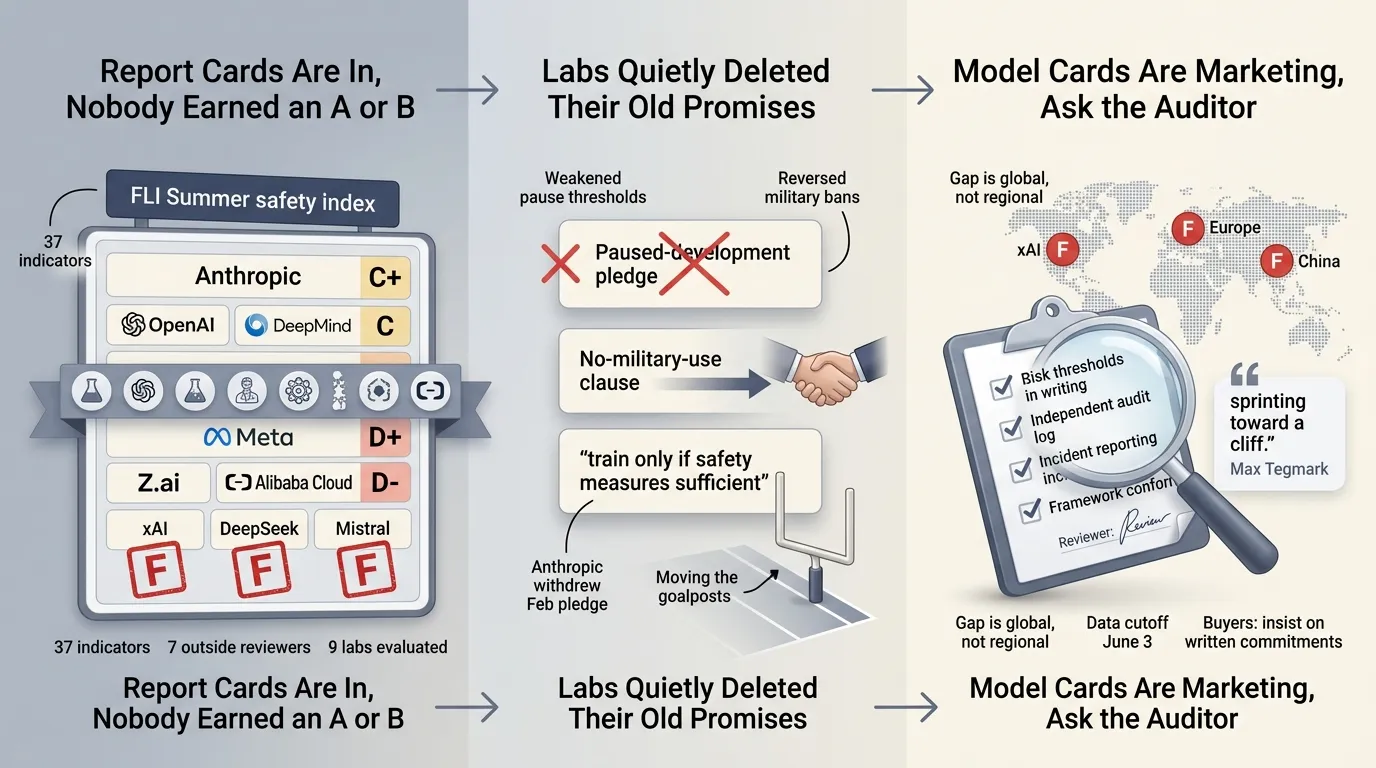
The Future of Life Institute published its Summer 2026 AI Safety Index on July 7, evaluating nine companies: Anthropic, OpenAI, Google DeepMind, Meta, Z.ai, Alibaba Cloud, xAI, DeepSeek, and Mistral.
Seven outside reviewers assigned grades across 37 indicators in six categories, covering risk assessment, current harms, safety frameworks, existential safety, governance and accountability, and transparency.
Anthropic ranked first with a C+. OpenAI and Google DeepMind each took a C. Meta earned a D+, climbing from sixth place to fourth. Z.ai and Alibaba Cloud landed at D-. xAI, DeepSeek and Mistral received an F, with xAI falling from fourth place to seventh.
Full index here:
https://futureoflife.org/ai-safety-index-summer-2026/
The part that should worry you
Grades are a headline. The backsliding is the story. The reviewers said Anthropic, OpenAI, Google DeepMind and Meta have weakened or eliminated earlier commitments to pause development if their systems approached specified danger thresholds. The panel called it moving the goalposts.
Anthropic withdrew a pledge in February not to train systems unless it could guarantee in advance that safety measures were sufficient. Reviewers said that move needs reversing.
Military policy flipped across the board too. From 2024 to 2026, companies including Anthropic, OpenAI, Google DeepMind, and Meta that previously banned military applications gradually reversed course, joining xAI and Mistral in actively seeking defense partnerships.
“AI companies are sprinting toward a cliff,” said FLI chair Max Tegmark. “Despite acknowledging the great risks of artificial superintelligence, they continue racing to build it.”
The geography kills the easy narrative. Failing grades went to one company each from the US, China, and Europe, which Tegmark says proves the gap is global, not regional. Mistral pushed back, arguing the framework does not suit open-source development, and it did not complete the survey. Five of the nine companies did.
One caveat worth printing. The index collected evidence up to June 3, 2026, so anything since is not reflected. Still, the takeaway for anyone buying frontier AI is blunt: model cards are marketing. Ask for risk thresholds, independent audits, and incident reporting in writing.
Quick Links:
