

Content marketing is now a $524 billion global industry and it gets 26% of total marketing budgets at the average organisation. The ROI case is solid — $7.65 per $1 spent on average, and 3x more leads per dollar vs companies without documented strategies. But the 2026 data also shows a growing tension: AI has flooded the web with content, and the platforms that distribute content are now filtering more aggressively than ever.
This article compiles 100+ data points from the Content Marketing Institute, HubSpot, SEMrush, Orbit Media, Ahrefs, and independent research — covering every major performance benchmark for content marketing in 2026.
Key Content Marketing Statistics 2026
Metric | Number |
Global content marketing market size (2025) | $524.73 billion |
Projected market size by 2030 | $989.84 billion at 13.53% CAGR |
Average ROI per $1 spent | $7.65 |
B2B average ROI | $3 per $1 (vs $1.80 for paid ads) |
Content marketing vs traditional marketing cost | 62% cheaper |
Leads generated vs traditional marketing | 3x more |
SEO content ROI | 702% average; compounding over 3 years |
Email marketing ROI | $42 per $1 |
B2B marketers with documented content strategy | 73% |
B2C marketers with documented content strategy | 70% |
Leads per dollar with documented strategy | 3x more than without |
Companies with blogs vs without: traffic | 55% more website traffic |
Companies with blogs vs without: leads | 67% more monthly leads |
B2B content conversion rate (blog) | 2.8x higher than paid traffic |
Marketers using AI tools for content | 81–87% |
Non-AI blog creation (2 years ago vs now) | 65% → now just 5% |
Human-edited AI content vs pure AI content | 34% better performance |
Web pages receiving zero Google traffic | 90.63% |
Long-form content (3,000+ words) vs short: traffic | 3x more |
Content incorporating statistics: AI visibility | 40% higher |
Content budget share of total marketing | 26% |
Market Size and Investment
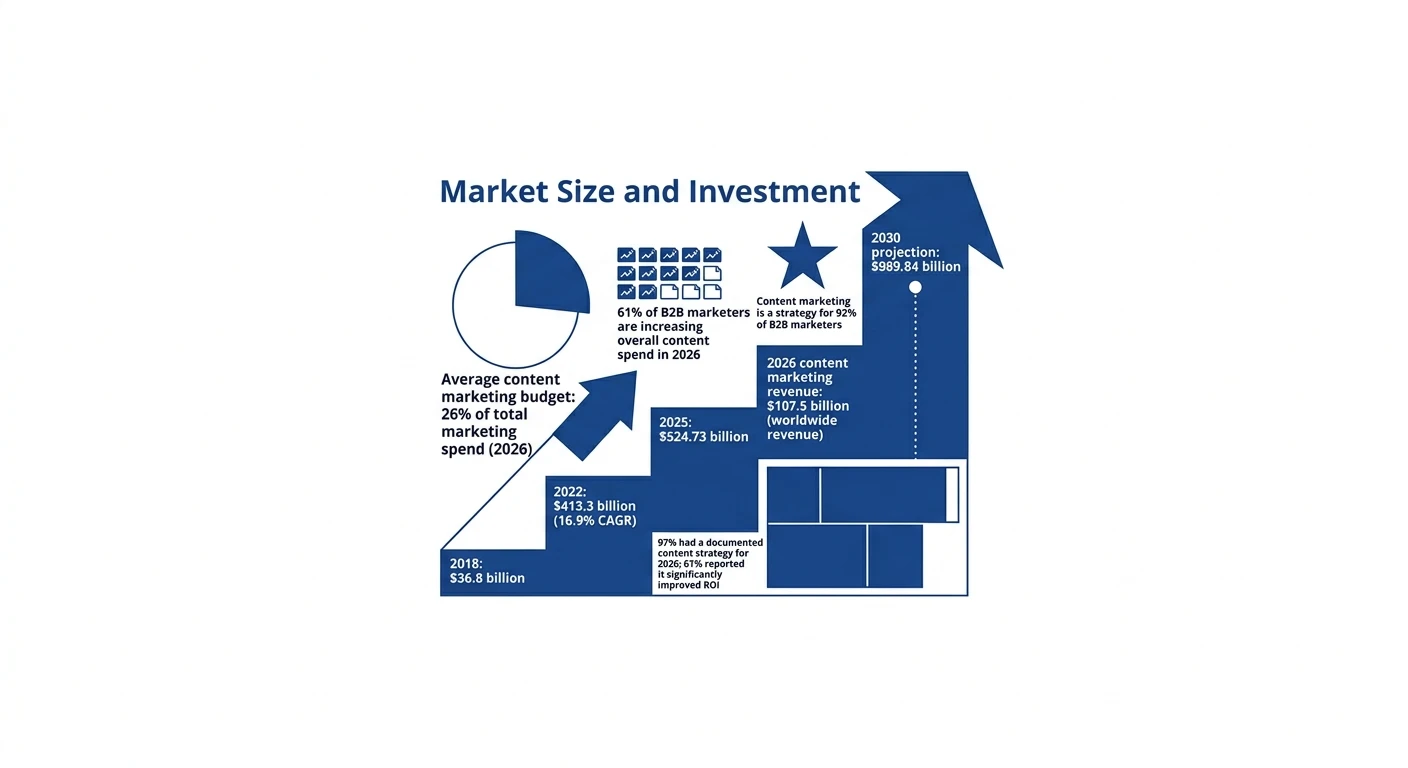
Content marketing has crossed into mainstream marketing infrastructure. It is no longer experimental.
Market trajectory:
2018: $36.8 billion
2022: $413.3 billion (16.9% CAGR)
2025: $524.73 billion
2026 content marketing revenue: $107.5 billion (worldwide revenue)
2030 projection: $989.84 billion
Budget allocation:
Average content marketing budget: 26% of total marketing spend (2026)
61% of B2B marketers are increasing overall content spend in 2026
Content marketing is a strategy for 92% of B2B marketers
97% had a documented content strategy for 2026; 61% reported it significantly improved ROI
ROI: The Numbers That Justify the Budget
Content marketing consistently outperforms alternatives on ROI — but the range is wide, and the methodology for measuring it matters.
ROI benchmarks:
Average ROI: $7.65 per $1 spent (broad content marketing)
B2B average: $3 per $1 (vs $1.80 for paid advertising)
SEO-focused content: 702% ROI on average, compounding over 3 years
Email marketing: $42 per $1 (highest ROI of any channel)
Companies reporting ROI above 700%: A minority, but SEO content’s compounding makes this achievable over 3–5 years
vs Traditional marketing:
Content marketing costs 62% less than traditional marketing
Generates 3x more leads
Organic traffic converts at 2.8x higher rates than paid traffic
The documented strategy multiplier:
Companies with documented strategies generate 3x more leads per dollar than those without
73% of B2B and 70% of B2C marketers now have documented strategies
66.5% of content marketers still struggle with resource allocation — the gap between strategic intent and operational execution is real
Blogging: Performance Data From 1,800+ Bloggers
Orbit Media’s Annual Blogging Survey 2026 (1,800+ bloggers surveyed) provides the most current benchmarks:
Traffic and leads:
Companies with active blogs have 434% more indexed pages and 97% more inbound links than non-blogging companies
Active blogs generate 55% more website traffic and 67% more monthly leads
B2B blogs produce 67% more leads per post and have a 2.1x higher conversion rate than B2C blogs (despite lower traffic volumes)
Content length:
Posts of 1,890+ words perform best for rankings and backlinks
Long-form content (3,000+ words) earns 3x more traffic than shorter pieces
Long-form earns 77% more backlinks than average-length content
Update frequency:
Content updated within the past 2 months is 28% more likely to be cited by AI systems
Refreshing existing content improves ROI by an average of 32%
Regular content audits and refresh cycles consistently outperform pure new-content strategies
AI and Content: The Adoption Wave

AI has fundamentally changed content production economics. The adoption curve is near-vertical.
AI adoption in content marketing:
Non-AI blog creation fell from 65% of marketers two years ago to just 5% today
81–87% of marketers now use AI-powered tools for content tasks (range reflects different survey methodologies)
94% of B2B marketers plan to use AI for content creation in 2026
86% of creators use generative AI (Adobe survey of 16,000+ creators)
Performance gap:
Human-edited AI content performs 34% better than pure AI output
Content that incorporates genuine expertise achieves significantly higher AI citation rates
44% of all LLM citations come from the first 30% of a piece — strong opening sections are critical for AI visibility
What AI cannot replace:
Original research and proprietary data — the highest-performing content type
First-hand experience and genuine expertise
The strategic judgment about what content to create and why
64% of marketers who publish original research report higher conversion rates and stronger organic traffic than those who do not. A single original data point is proving more valuable in 2026 than dozens of rewritten articles.
Format Performance: What Drives Results
Highest-performing content formats by ROI:
Blog posts: 22.26% share of top-5 ROI formats
Video content (short-form): Highest ROI among video types
Interactive content: 2–3x more engagement than static articles
User-generated content: 6.9x more engagement than brand content
Email newsletters: $42 ROI per $1
Video statistics:
91% of businesses use video in 2026
87% report positive ROI from video
Short-form video delivers the highest returns of all video formats
66% of marketers say videos have reduced support queries
Interactive content:
Users spend 4.5 minutes on average with interactive content like quizzes
Static articles get 1.3 minutes average engagement
Companies using interactive tools (calculators, assessments) grow 80% faster
Personalisation:
Personalised content drives 39% higher click-through rates
Segmented email campaigns generate 57% more revenue
Micro-content optimised for AI answers has grown 340% (SEMrush Sensor)
Listicles vs Other Formats: The AI Citation Advantage
One of the most actionable findings from 2026 AI citation research:
Listicles earn a 25% citation rate in AI results
How-to blogs and opinion pieces: 11% citation rate
Content incorporating statistics: 40% higher visibility in AI-generated results
Long-form content: 3x more traffic and more AI visibility
The practical implication: list-format content is not just reader-friendly — it is AI-citation-friendly. Posts structured as “X Statistics About Y” or “X Ways to Do Z” are cited at more than double the rate of narrative content on the same topics.
Distribution and Channel Mix
53% of website traffic is organic. But 90.63% of web pages receive zero traffic from Google — which means the distribution of that organic traffic is extremely concentrated among a small percentage of well-optimised content.
Channel performance in 2026:
Organic search: 53% of all website traffic
Social media: Growing but volatile (algorithm-dependent)
Email: Highest engagement per subscriber; $42 ROI per $1
Paid content amplification: Short-term, less compounding than organic
AI referral (ChatGPT, Perplexity): Growing at 527% YoY — still small but accelerating
The compounding advantage of organic: SEO ROI averages 702% and compounds over 3 years. Paid traffic delivers returns only while the spend continues. This compounding effect is the primary economic argument for investing in content over paid acquisition for most businesses.
Industry Benchmarks: B2B vs B2C
Metric | B2B | B2C |
Leads per post | 67% more than B2C | Lower but higher volume |
Conversion rate | 2.1x higher than B2C | Lower per-visit rate |
Strategy documentation | 73% | 70% |
Primary content goal | Lead generation | Brand awareness/sales |
Best channel | Email + organic search | Social + video |
Personalisation impact | High | Very high |
B2B content produces better per-visitor value despite lower overall traffic. The audience is smaller, more specific, and in a more defined buying journey — making each conversion more valuable.
FAQs
Content marketing delivers an average return of $7.65 for every $1 spent, with SEO-focused content averaging 702% ROI over three years. Email marketing leads all channels at $42 per $1, while companies with documented strategies generate 3x more leads per dollar than those without a formal plan.
Blog posts should be at least 1,890 words to compete for traffic and backlinks, with posts exceeding 3,000 words showing the strongest overall performance. Structure also matters — listicle and Q&A formats are cited by AI systems at a 25% rate compared to just 11% for traditional narrative content.
Pure AI-generated content consistently underperforms, with human-edited AI content outperforming it by 34%. While 81–87% of marketers now use AI tools, the key differentiator is layering genuine human expertise on top of AI-assisted drafts rather than publishing unedited output.
Companies that maintain active blogs generate 55% more website traffic and 67% more leads than competitors without one, largely because consistent publishing builds topical authority and captures organic search demand over time. The quality bar has risen significantly, meaning well-researched, expert-driven content now separates high-performers from the rest.
Yes — documented strategy and consistent execution matter far more than budget, with structured approaches delivering 3x more leads per dollar regardless of company size. Focusing on specific long-tail keywords, publishing in-depth Q&A or listicle formats, and combining SEO content with email marketing gives smaller teams a measurable, cost-efficient path to growth.
