

Meta has suspended Muse Image, an AI image-generation feature it rolled out days earlier across Instagram, WhatsApp and its Meta AI app, after a wave of criticism from talent agencies, safety advocates and ordinary users over how the tool handled people’s photos.
Muse Image, built by Meta Superintelligence Labs, let users generate pictures from text prompts or blend and edit existing photos. The feature that triggered the backlash allowed anyone to type the “@” symbol and tag a public Instagram account, pulling that person’s public photos directly into an AI-generated image — without ever notifying the account owner. A demo walkthrough of the tool is available on YouTube.
An Opt-Out Problem
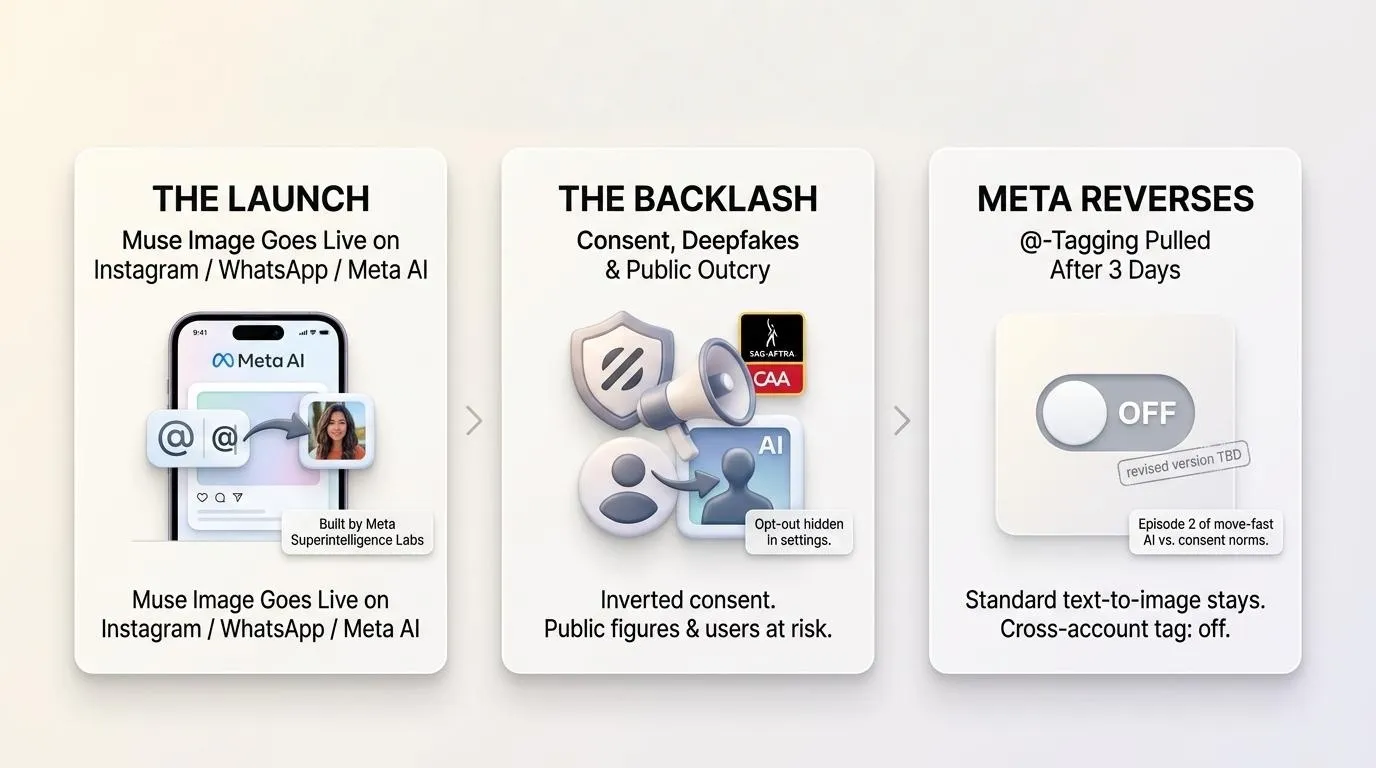
The core issue was consent. Every public Instagram account over the age of 18 was automatically included in the system by default; users had to find a buried setting to opt out if they didn’t want their images used as raw material for other people’s AI creations. Critics said that inverted the standard expected of AI tools that repurpose real people’s likenesses.
Hollywood’s SAG-AFTRA union and talent agency CAA — whose roster includes stars like Tom Hanks and Meryl Streep — raised the alarm within days of launch, arguing the feature exposed public figures and private users alike to unauthorized deepfake-style images.
The backlash spread quickly on social media, with users demonstrating how easily a stranger’s face could be lifted from a public profile and dropped into a fabricated scene.
Meta had pitched Muse Image as a showcase for its “agentic” approach to image generation — the system uses search and coding tools, self-refines its outputs, and can blend multiple photos, redecorate rooms using Marketplace furniture listings, or render legible text and working QR codes.
Meta Reverses Course
Facing mounting pressure just three days after launch, Meta pulled the account-tagging capability entirely. “We’ve heard the feedback that this feature missed the mark, so it’s no longer available,” the company said in a statement, without committing to a timeline for a revised version.
The episode marks the second time in recent months that a major platform has had to walk back an AI feature built on other people’s content without explicit permission, underscoring how quickly “move fast” AI rollouts can collide with likeness and consent norms — especially on a platform with over a billion active users.
For now, Muse Image remains available for standard text-to-image generation and personal photo editing; it’s the cross-account tagging feature specifically that has been switched off. Meta has not said whether or when a reworked, opt-in version might return.
Quick Links:
