
Semrush vs Ahrefs is the question every SEO eventually asks, usually right around the time they realize they can’t justify paying for both. This comparison is built from each tool’s actual live pricing pages and the real, measurable differences between them. After going through both platforms side by side, Semrush is the stronger overall pick for most people reading this, and I’ll show you exactly why, tier by tier and feature by feature, rather than just asserting it.
What each tool was actually built to do
Semrush and Ahrefs both started in the same lane, SEO research, but they grew in different directions from there. Semrush turned into a genuine marketing command center. Beyond SEO, it now covers PPC research, content marketing, social media management, local SEO listings, and AI search visibility tracking across platforms like ChatGPT, Gemini, and Perplexity, all under one login. Ahrefs stayed narrower, focused mainly on backlink and competitive research, with keyword research, site auditing, and content research built around that core.
That difference in scope is the whole reason Semrush wins the overall comparison. Ahrefs does one thing, backlink analysis, very well. Semrush does that same job competently while also covering everything else a modern SEO or marketing team actually needs, which is why it ends up being the more useful subscription for the vast majority of people comparing these two.
Pricing: what you’ll actually pay
Here’s where I can give you real, verified numbers rather than vague ranges. I confirmed the Semrush figures directly from their live pricing page.
Plan | Semrush (billed annually) | Ahrefs (billed monthly) | Ahrefs (billed annually) |
Entry tier | SEO Toolkit: $117.33/mo | Lite: $129/mo | ~$108/mo |
Mid tier | Starter: $165.17/mo | Standard: $249/mo | ~$208/mo |
Upper tier | Pro+: $248.17/mo | Advanced: $449/mo | ~$374/mo |
Top tier | Advanced: $455.67/mo | Enterprise: from $1,499/mo | ~$1,249/mo |
A few things worth knowing before you compare these side by side:
Semrush’s naming changed recently. The old Pro, Guru, and Business tier names have been retired in favor of SEO, Starter, Pro+, and Advanced. If you’re reading an older review that mentions “Semrush Guru,” that tier doesn’t exist under that name anymore.
Ahrefs also has a cheaper entry point below Lite, called Starter, priced at $29/mo. It’s built for a single small site with more limited data access, and it doesn’t appear alongside Lite, Standard, and Advanced in the main plan grid since Ahrefs positions it as a lighter, credit-limited option rather than a full-featured tier. If you only need to monitor one site on a tight budget, it’s worth pulling up directly on Ahrefs’ pricing page before jumping straight to Lite.
Extra seats aren’t included at either company. Ahrefs charges $40 to $100 per additional user per month depending on tier. Semrush’s per-seat costs vary similarly. Neither company prices these tools as flat-rate team subscriptions, so a 3-person team will pay meaningfully more than the sticker price on either platform.
Semrush now bundles AI Search visibility into its top three tiers by default. That’s a real recent shift. A few years ago, tracking how your brand shows up in AI Overviews or ChatGPT answers would have been a separate add-on or nonexistent. Now it’s baked into the core subscription on Semrush’s higher tiers.
At a glance, Semrush’s entry tier is meaningfully cheaper than Ahrefs’ Lite plan ($117.33 vs $129), and that gap holds roughly proportional through the mid tiers. Ahrefs becomes the more expensive option at every comparable tier, though what you get for that money differs enough that price alone shouldn’t decide this for you.
What each tier actually includes, side by side
Pricing headlines don’t tell you much without the underlying limits, so here’s what each comparable tier actually gives you, confirmed directly from both companies’ live pricing pages.
Semrush
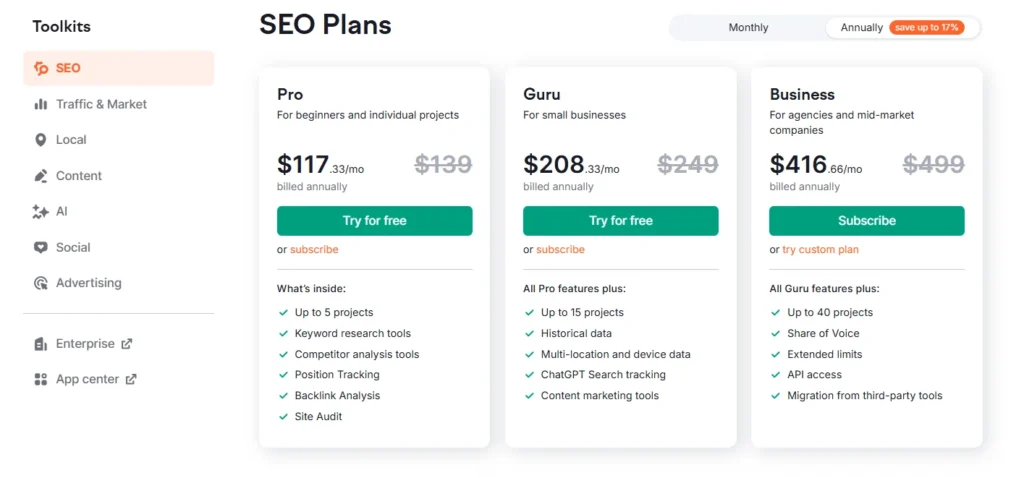
Tier | Sites to monitor | Keywords tracked daily | AI Search included? |
SEO ($117.33/mo) | 5 | 500 | No |
Starter ($165.17/mo) | 5 | 500 | Yes |
Pro+ ($248.17/mo) | 15 | 1,500 | Yes |
Advanced ($455.67/mo) | 40 | 5,000 | Yes |
Worth flagging directly: Semrush’s cheapest tier, SEO, doesn’t include AI Search tracking at all. That feature only kicks in from Starter upward. If AI visibility tracking is the reason you’re looking at Semrush, the $117.33 entry tier isn’t actually the plan you want.
Ahrefs
Tier | Projects | Historical data | Keywords tracked | AI prompts tracked | Crawl credits/mo |
Lite ($129/mo) | 5 | 6 months | 750 | 5 | 100,000 |
Standard ($249/mo) | 20 | 2 years | 2,000 | 10 | 500,000 |
Advanced ($449/mo) | 50 | 5 years | 5,000 | 20 | 1,500,000 |
The detail that matters most for AI tracking: Ahrefs now bundles AI prompt tracking into every tier, including its cheapest Lite plan. Semrush withholds the equivalent feature from its own cheapest tier. If you want AI visibility tracking at the lowest possible price point specifically, Ahrefs Lite currently gets there before Semrush SEO does, even though Semrush is cheaper overall.
Keyword research: close, but not identical
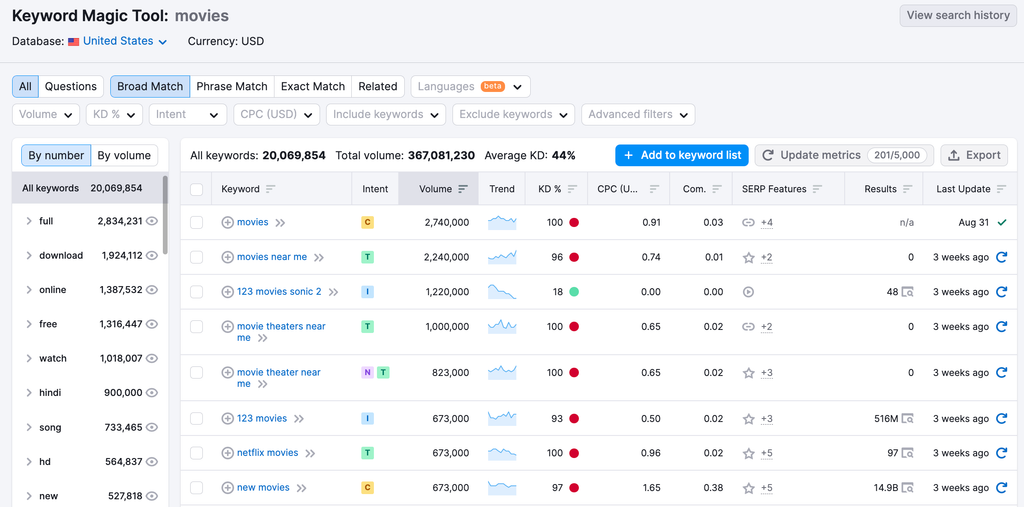
Both companies claim keyword databases in the range of 26 to 29 billion keywords, and honestly, the exact number matters less than how each of them lets you use that data. Semrush’s Keyword Magic Tool is built around generating large volumes of keyword ideas fast, with strong intent classification (informational, navigational, commercial, transactional) baked in, and it has a real edge in raw US keyword volume specifically.
Ahrefs’ Keywords Explorer leans harder on click-based metrics, meaning it tries to estimate not just how many people search a term, but how many of them actually click an organic result afterward, which matters a lot if you’re chasing keywords that trigger heavy AI Overview or featured snippet coverage that eats into click-through rates. Ahrefs also covers more search engines beyond Google, including YouTube and Amazon, which Semrush doesn’t match as directly.
If your work is mostly content planning and generating keyword ideas at volume, Semrush has the edge. If you care more about realistic traffic potential once SERP features are accounted for, Ahrefs’ approach is arguably more honest about what you’ll actually get.
Backlink analysis: this is where they genuinely diverge
This is the one category where the difference between these tools isn’t marginal. Ahrefs built its entire reputation on backlink data, and it shows. Ahrefs refreshes its backlink index every 15 to 30 minutes for active URLs. Semrush’s refresh cycle runs closer to 24 hours for most links, sometimes reported as weekly depending on the source. If your work involves catching new links fast, whether for outreach follow-up or competitor monitoring, that speed gap is real and it compounds over time.
On raw index size, the numbers flip depending on what you’re measuring. Semrush reports a larger total backlink count, around 43 trillion links, versus Ahrefs’ roughly 35 trillion. But Ahrefs reports a larger referring domain index, around 500 million domains versus Semrush’s 390 million, and referring domains matter more than raw link count for most real link-building and toxicity assessments, since one domain can host thousands of individual links that don’t each represent a distinct vote of authority.
Ahrefs’ Domain Rating (DR) score has also become the most commonly cited authority metric across the SEO industry at large, more so than Semrush’s equivalent Authority Score, which affects how useful the data is when you’re benchmarking against content or reports that already reference DR by default.
Semrush isn’t weak here by any means. Its Backlink Audit tool integrates directly with Google Search Console for disavow file management, and its toxic link scoring is more developed than what Ahrefs offers, since Ahrefs relies on DR and UR (URL Rating) rather than a dedicated toxicity score. If cleaning up a spammy link profile is your actual task, Semrush’s workflow is arguably more purpose-built for it, even if Ahrefs’ raw data is fresher.
Site audits: both strong, slightly different priorities
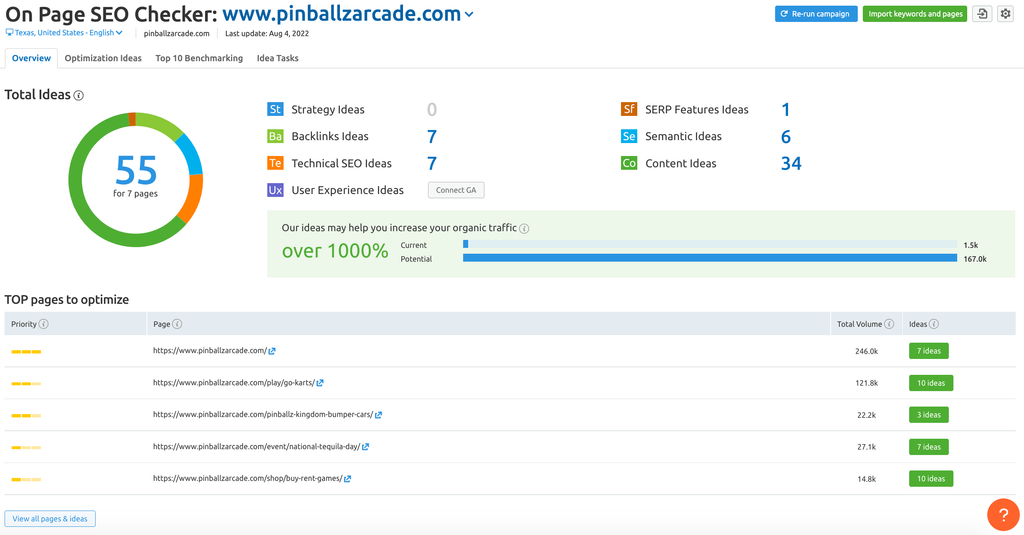
Semrush’s Site Audit tool runs somewhere around 140 individual technical checks and includes custom audit rules, historical comparison across any two audits you’ve run, and Core Web Vitals integration through Lighthouse. That depth makes it a strong fit for agencies managing multiple client sites who need consistent, comparable audit history over time.
Ahrefs’ Site Audit covers a similar range of checks, sometimes reported slightly higher at around 170, with a generally cleaner interface and faster crawl completion. It’s a genuinely pleasant tool to use day to day, even if it offers less customization for agency-specific audit rules.
Neither tool is clearly better here. It comes down to whether you value Semrush’s deeper customization and historical tracking, or Ahrefs’ speed and interface polish.
Rank tracking: Semrush pulls ahead on accuracy and locality
Semrush tracks rankings daily on the entry tier and includes local pack tracking and multi-location tracking, which matters if you’re running SEO for a business with multiple physical locations or serving local search intent. Independent testing has put Semrush’s rank-tracking accuracy against Google Search Console ground truth data at around 96%, compared to roughly 92% for Ahrefs, though these figures come from third-party testing rather than either company’s own claims, and your mileage may vary by niche and market.
Ahrefs tracks rankings weekly on its Lite plan and only moves to daily tracking once you’re on Standard or above. If daily rank tracking matters to you and you’re comparing entry-level plans specifically, that’s a meaningful gap in Ahrefs’ favor for Semrush, not against it, since Semrush includes daily tracking from its lowest tier.
Content marketing and PPC: Semrush’s biggest structural advantage
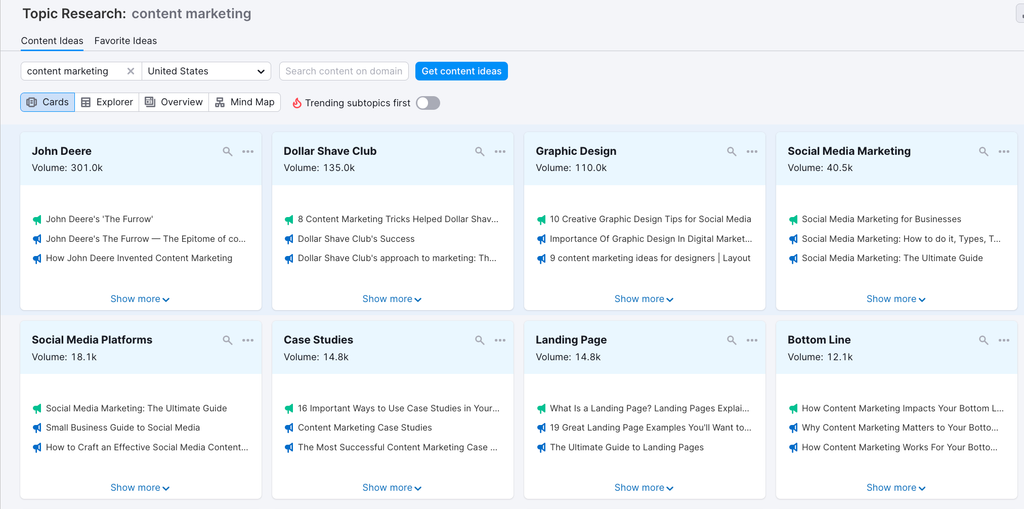
This is where Semrush’s broader positioning actually pays off rather than just adding bloat. Its Topic Research tool and SEO Writing Assistant are built specifically for content planning and on-page optimization, giving you content briefs, readability scoring, and keyword density guidance directly inside the platform. Ahrefs has a Content Explorer tool that’s genuinely useful for finding high-performing content by topic, but it doesn’t extend into actual writing assistance or brief generation the way Semrush’s suite does.
The same pattern holds for PPC. Semrush’s Advertising Toolkit lets you research competitor ad copy, estimate CPC data, and identify keyword gaps for paid campaigns. Ahrefs offers essentially nothing comparable here. If PPC research is part of your job, Ahrefs simply isn’t built for that work, and no amount of workaround changes that.
AI search visibility: the newest and fastest-moving difference
Semrush has built out genuine AI visibility tracking, bundled into three of its four tiers, Starter, Pro+, and Advanced, but notably absent from its cheapest SEO tier. Semrush now markets its full platform under the name Semrush One, positioned specifically as a single workflow for tracking visibility across both classic Google search and AI answer engines like ChatGPT, Gemini, and Perplexity at once, rather than treating AI tracking as a bolted-on extra.
Ahrefs covers this ground too, through a feature called Brand Radar, and its current pricing page shows tracked AI prompts built directly into every tier, including its cheapest Lite plan, with 5, 10, and 20 tracked prompts across Lite, Standard, and Advanced respectively, spanning ChatGPT, Google AI, Perplexity, and a couple of other assistants shown as icons on the pricing page.
The honest read is this: Semrush has the broader, more explicitly positioned AI visibility story with Semrush One as its flagship product, tracking more platforms and giving deeper reporting once you’re on it. Ahrefs includes some level of AI prompt tracking starting from its very first paid tier, while Semrush’s cheapest tier excludes the feature entirely. If you want AI visibility tracking at the lowest possible entry price specifically, Ahrefs gets you there first. If you want the deepest, most fully-featured AI tracking regardless of price, Semrush One is the bigger investment made specifically for that job. This is also the fastest-moving category in the whole comparison, so treat any snapshot of it, including this one, as temporary.
Interface and day-to-day usability
Ahrefs consistently gets credit for a cleaner, faster interface. Page loads are quicker, the data visualization is less cluttered, and there are generally fewer clicks required to get from a question to an answer. Semrush’s interface reflects its broader scope: more menus, more tools, more surface area to learn, which some users experience as powerful and others experience as cluttered.
If you’re newer to SEO tools generally, Ahrefs’ learning curve is usually described as gentler specifically because there’s less to navigate. Semrush rewards familiarity once you’ve learned where things live, but that learning period is real and worth factoring in if you’re choosing a tool for a team that isn’t already SEO-fluent.
Who should actually choose which tool
For almost everyone reading this, Semrush is the better default choice, and here’s the breakdown of why:
You run an agency managing multiple client accounts across SEO, PPC, content, and social: Semrush. The all-in-one breadth and multi-site reporting genuinely earn their keep at that scale, and you avoid stitching together three or four separate subscriptions.
You’re a solo blogger or small business handling your own SEO: Semrush. The cheaper entry tier plus built-in content tools (Topic Research, SEO Writing Assistant) get you more usable value per dollar than Ahrefs’ narrower feature set at a higher price.
You need AI search visibility tracking as a serious, ongoing deliverable: Semrush One, for the deepest and most fully-built AI tracking on the market right now, once you’re past its entry tier.
Local SEO and multi-location tracking matter to your work: Semrush, for its stronger local pack and multi-location rank tracking, included from the entry tier.
You want daily rank tracking without upgrading tiers: Semrush, since Ahrefs only offers that from its Standard plan up.
The one scenario where Ahrefs genuinely pulls ahead: if your entire job is link building and nothing else, its faster backlink refresh cycle and larger referring domain index give it a real edge for that single, narrow task. Outside of that specific use case, Semrush’s broader platform, lower entry price, and daily tracking from tier one make it the stronger overall pick.
Semrush: pros and cons
Pros
- Great value for money Cheaper entry tier at $117.33/mo versus Ahrefs' $129/mo
- Genuinely broad platform: SEO, PPC, content, social, and local SEO in one subscription
- Daily rank tracking included from the entry tier
- Broader, more explicitly-built AI visibility story via Semrush One, once you're past its entry tier
- Built-in content tools (Topic Research, SEO Writing Assistant) that Ahrefs doesn't match
Cons
- Limited free plan Interface complexity can overwhelm newer users given how many tools live inside one platform
- Backlink index refreshes slower than Ahrefs, which matters for time-sensitive link discovery
- Smaller referring domain index than Ahrefs
- The sheer breadth means you may be paying for PPC and social tools you never touch if your work is purely SEO
Ahrefs: pros and cons
Pros
- Great value for money Industry-standard backlink data with the largest referring domain index and fastest refresh cycle
- Cleaner, faster interface with a genuinely gentler learning curve
- Domain Rating (DR) is the most widely cited authority metric across the broader SEO industry
- Strong Content Explorer for finding proven, high-performing content by topic
- AI prompt tracking is included from its cheapest Lite tier, unlike Semrush's entry tier
Cons
- Limited free plan More expensive at every comparable tier
- No meaningful PPC research tools
- AI prompt tracking is capped lower per tier (5/10/20 prompts) than the deeper reporting Semrush One offers once you're past Semrush's entry tier
- Weekly rank tracking on the entry tier instead of daily
Quick Links:
Final thoughts
Semrush is the overall winner here for the vast majority of people running this comparison. It’s cheaper at every tier, it tracks rankings daily from the entry plan instead of gating that behind an upgrade, it covers content, PPC, local SEO, and social in the same subscription, and its Semrush One platform is the more ambitious, more fully-built answer to the AI search shift that’s reshaping the entire industry right now. Ahrefs remains genuinely excellent at one specific job, backlink analysis, and if that’s the only thing you do all day, it’s worth a look. For everyone else, and that’s most people reading a comparison like this, Semrush is the tool that actually covers the full scope of the work.
FAQs
Semrush, at every comparable tier. Its entry tier runs $117.33/mo annually versus Ahrefs' $129/mo, and that gap holds through the mid and upper tiers as well.
No, they're calculated differently and aren't directly interchangeable, even though both aim to represent domain authority on a similar 0-100 scale. DR is more widely referenced across the industry, which matters if you're benchmarking against reports that already cite it.
Some agencies do, using Ahrefs for backlink and link-building work while running Semrush for content, PPC, and reporting. It's a real cost to carry both, so this usually only makes sense once your budget and workload justify it.
Semrush, mainly because of the lower entry price and the built-in content tools, which reduce the number of separate subscriptions you'd otherwise need to piece together.
Semrush One covers ChatGPT, Gemini, and Perplexity alongside Google, but that's missing from its cheapest SEO tier. Ahrefs includes AI prompt tracking starting from its lowest Lite tier, so it gets you AI tracking at a lower price first, while Semrush One offers deeper tracking if budget isn't a constraint.
