Technical SEO Consultant Who Fixes the Problems, Not Just Lists Them
Hire a DigiExe technical SEO consultant to diagnose and fix crawl, indexing, speed, rendering and migration issues. We turn findings into clear tickets for your developers, check every change before it goes live, or make the changes ourselves, so technical problems stop holding your rankings back.
Audit reports that never get fixed
Many businesses already have a technical SEO audit: a long spreadsheet of errors from a crawl tool. Developers do not know which issues matter, how to fix them or how to test the fix. Months later, most items are still open and rankings have not moved.
On larger sites, the stakes are higher. A migration, a new JavaScript framework or a wrong robots rule can remove thousands of pages from Google overnight.


A technical SEO consultant who works with your developers
A technical SEO consultant finds the issues that matter, explains them in terms developers understand and makes sure the fixes ship correctly. We use crawls, Search Console data, server logs and rendering tests to diagnose problems, then rank them by impact and effort.
Each fix becomes a clear ticket with the problem, the solution, examples and how to test it. We review changes on staging before release and monitor results afterwards. If you do not have developers, we can make the changes ourselves.
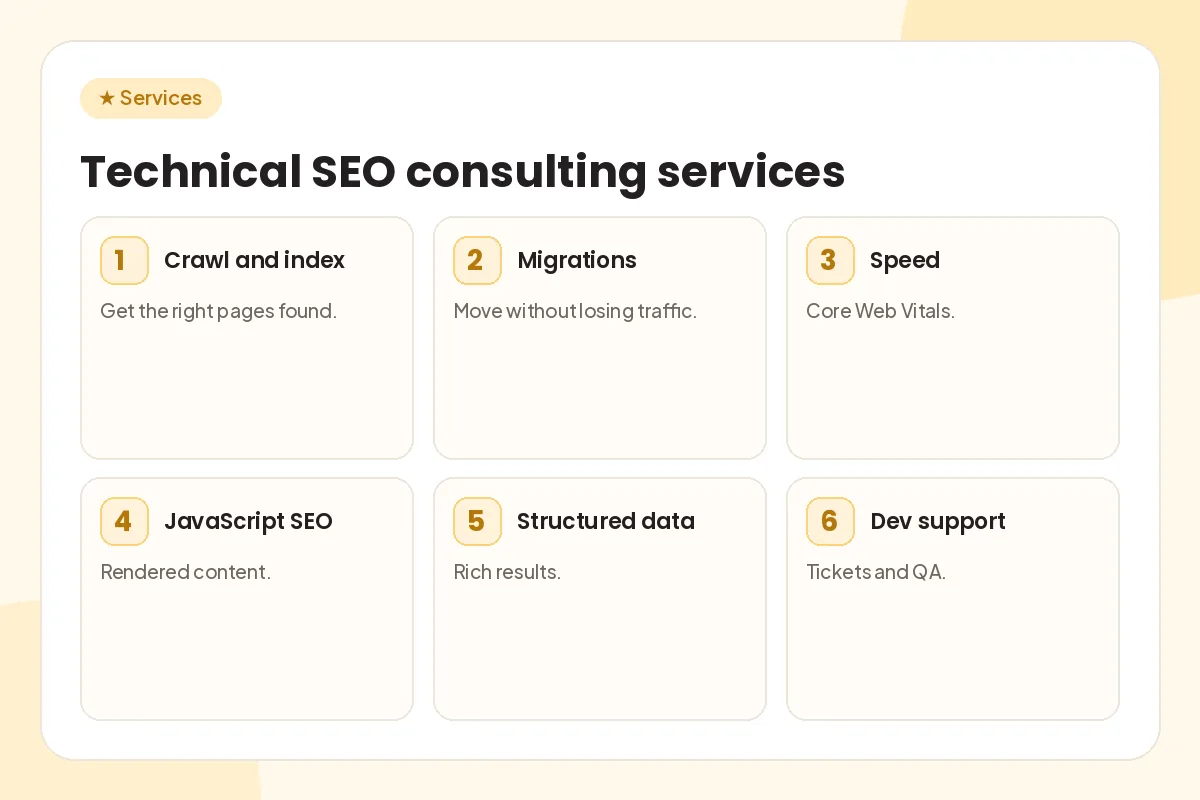
Our technical SEO consulting services
For sites where technical SEO decides results.
Crawl and indexing
Site migrations
Core Web Vitals
JavaScript SEO
Site architecture
Crawl budget and indexing problems
On large sites, Google may crawl thousands of low-value URLs, such as filters, parameters and old redirects, while important pages wait. Search Console’s Pages report often shows many pages as “Crawled, currently not indexed” or “Discovered, currently not indexed”.
We use server logs and crawl data to see where Googlebot spends its time, then fix the causes: parameter handling, faceted navigation, internal links, sitemaps, canonicals and robots rules. The aim is for Google to spend its time on pages that can rank and earn revenue.

Site migrations without losing traffic
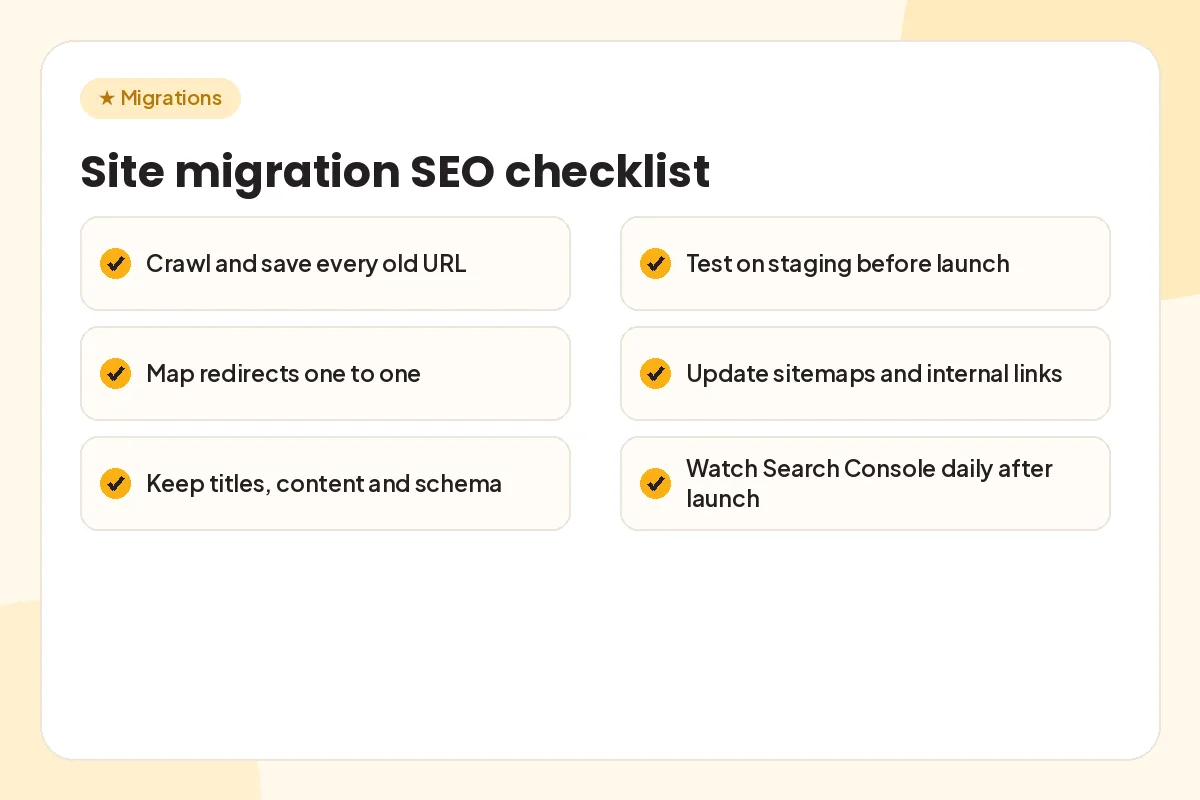
Redesigns, CMS changes, HTTPS moves, domain changes and site mergers are where most large traffic losses happen. We get involved before launch: crawling and saving every old URL, mapping redirects one to one, checking that titles, content and structured data carry over, and testing the new site on staging.
On launch day we check redirects, sitemaps and robots rules, then watch Search Console and analytics closely for the following weeks so any problem is fixed fast.
JavaScript SEO for modern websites
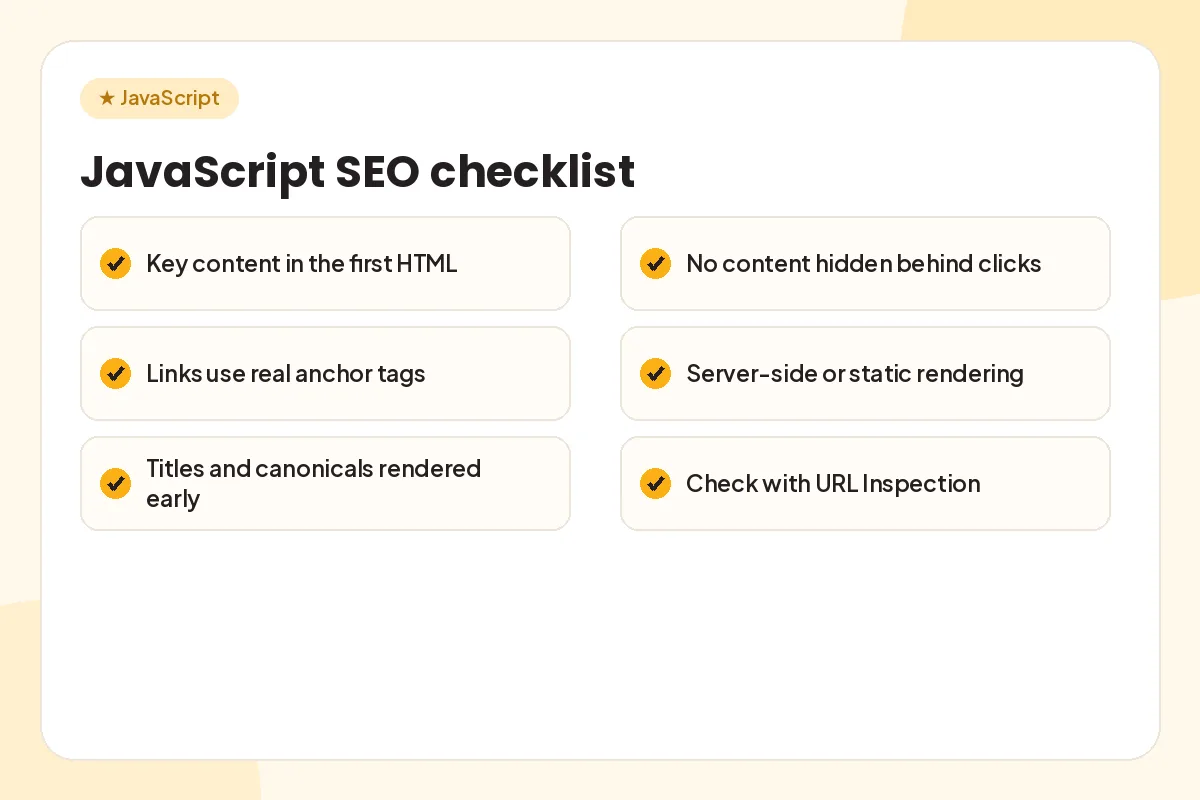
Sites built with React, Vue, Angular or headless CMS setups can look perfect to users but show little to Google if content is only rendered in the browser. Links built with click handlers instead of real anchor tags may not be followed at all.
We test what Google actually sees with the URL Inspection tool and rendering checks, then work with your developers on server-side rendering, static generation or hydration fixes. We make sure titles, canonicals, structured data, content and links are present in the first HTML response.

Core Web Vitals and page experience
Core Web Vitals measure loading (LCP), responsiveness (INP) and visual stability (CLS). We find which templates fail using Search Console and real-user data, then trace the causes: slow servers, large images, render-blocking scripts, heavy third-party tags, layout shifts from ads or fonts.
We write specific fixes for each template and measure the results in field data, not just lab scores, because field data is what Google uses.
Site architecture and internal linking
How pages link to each other tells Google which pages matter most. On large sites, important pages are often buried several clicks deep while menus link to minor pages. We review URL structure, navigation, breadcrumbs and internal links, then recommend changes that bring key pages closer to the homepage and link related pages together.
For ecommerce and listing sites, we design rules for faceted navigation so useful filtered pages can rank and the rest stay out of the index.
International and multi-language setups
Hreflang errors are among the most common technical problems on international sites. We check that every version links to the others, that codes are correct, that hreflang agrees with canonicals and that each market’s pages can be crawled and indexed. Our international SEO team can help with strategy and localisation as well.
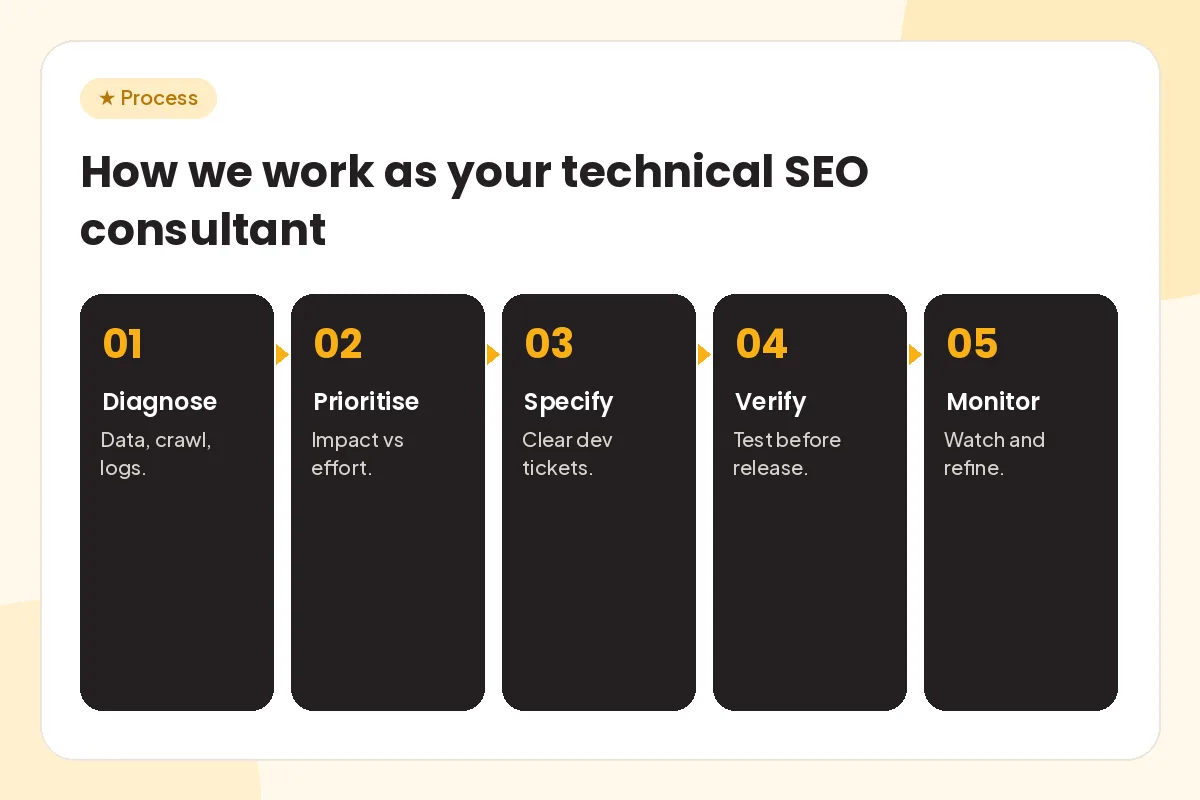
How we work as your technical SEO consultant
Diagnose
Prioritise
Specify
Verify
Monitor

Ways to work with us
Some clients need a consultant for one project, such as a migration or a JavaScript rebuild. Others want ongoing support, with a set number of hours each month for reviews, tickets and monitoring. Larger teams often add us to their sprint planning so SEO is part of every release, not an afterthought. We agree the scope and reporting at the start.
Tools and data we use
We use Google Search Console, GA4, server log files, crawlers such as Screaming Frog and Sitebulb, PageSpeed Insights and Chrome User Experience Report data, along with rendering and structured data testing tools. Tools find patterns, but people decide what matters, so every recommendation comes with the reason behind it.
Where you already pay for tools, such as an enterprise crawler or monitoring platform, we work inside them, so your team keeps access to the data after our work ends.
Why hire DigiExe as your technical SEO consultant
Short claims you can check.
1,400+ clients in 28 countries
Real recovery experience
Developer-friendly
Founder-led SEO
SEO results from our team
Technical fixes are part of every result in our published case studies.
Sites we work on
We work with ecommerce stores, SaaS companies, publishers, marketplaces, listing sites and enterprise websites on WordPress, Shopify, Magento, custom and headless platforms in the USA, India, the UK and Australia. Agencies also bring us in for complex technical projects.
Services that pair with technical SEO consulting
Build on a strong technical base.

Jitendra led the technical clean-up of BloggersIdeas after a core update drop and has worked in SEO since 2013. He reviews our technical recommendations.
Jitendra started BloggersIdeas in 2013, runs AffiliateBooster and SchemaNinja, and wrote the international bestseller Inside A Hustler's Brain (20,000+ copies). He has spoken at Affiliate Summit, Affiliate World, DMSS and TES, and works from New Delhi.
Last updated:
Technical SEO consultant: FAQs
What does a technical SEO consultant do?
A technical SEO consultant finds and fixes the technical issues that stop a website from being crawled, indexed and ranked well. That includes crawl and indexing problems, site speed, JavaScript rendering, site structure, structured data and migrations. A good consultant also works with developers to make sure fixes ship correctly.
When should I hire a technical SEO consultant?
Hire one before a site migration or redesign, when traffic drops without a clear reason, when many pages are not indexed, when moving to a JavaScript framework or when your site is large and complex. Bringing a consultant in early is usually cheaper than fixing traffic losses after launch.
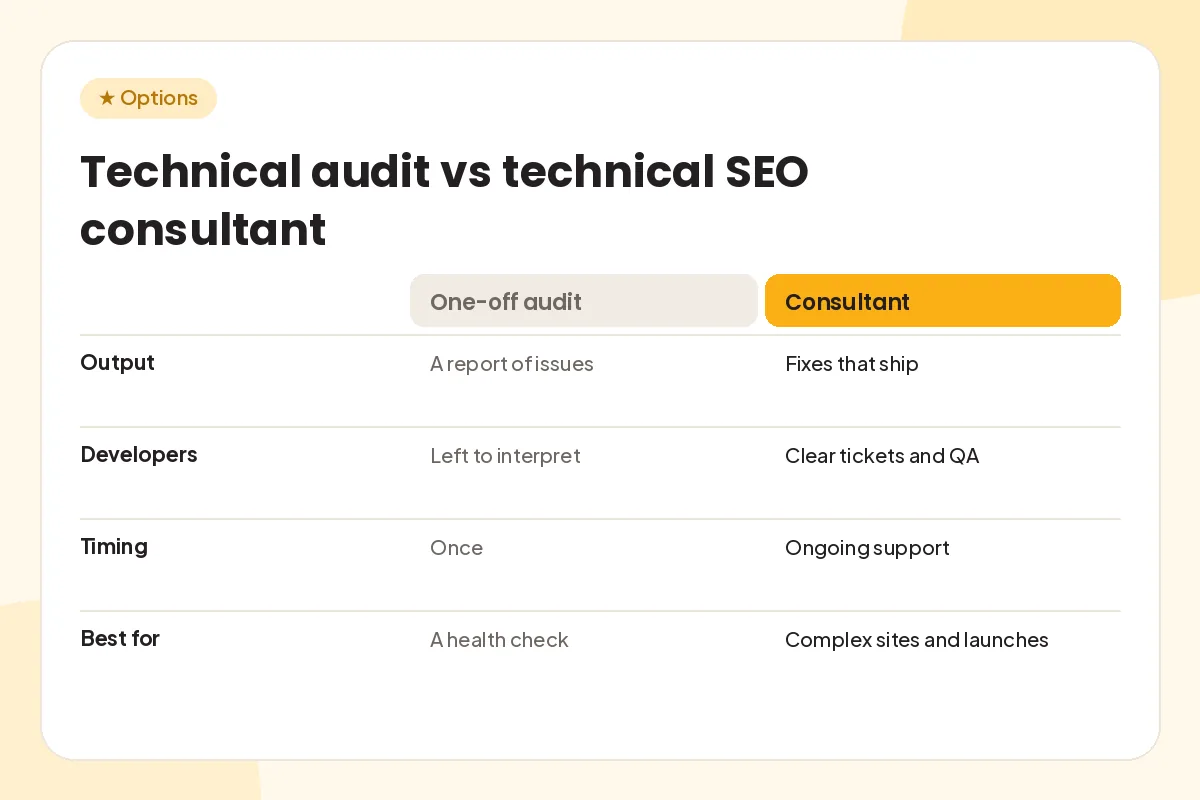
What is the difference between a technical audit and a consultant?
An audit is a one-time report of issues. A consultant goes further: prioritising issues, writing developer tickets, reviewing fixes before release and monitoring results. Many clients start with an audit and then keep a consultant to make sure the fixes actually get done.
Can you work with our developers?
Yes. We write clear tickets with the problem, the fix, examples and test steps, join planning calls when useful and review changes on staging before release. We are used to working with in-house teams, agencies and freelancers on many platforms and frameworks.
How do you prevent traffic loss during a migration?
We crawl and save every old URL, map redirects one to one, check that content, titles and structured data carry over, test on staging and check everything on launch day. Then we monitor Search Console and analytics closely for several weeks and fix problems quickly.
Is JavaScript bad for SEO?
Not by itself. Google can render JavaScript, but it takes longer and can fail if content or links depend on user actions. Server-side rendering or static generation is the safest approach for important pages. We test what Google sees and work with developers on the right rendering setup.
How long until technical fixes show results?
Some fixes, such as removing a wrong noindex tag, can show results within days. Others, such as crawl budget or speed improvements, usually show within one to three months as Google recrawls the site. We monitor indexing, rankings and traffic after each release.
Do you use server log files?
Yes, especially on large sites. Server logs show exactly which pages Googlebot visits and how often. They often reveal crawl time wasted on filters, parameters or redirects, and they confirm whether fixes changed how Google crawls the site. We can work with raw log files or with log data from your CDN or hosting provider.
Can you fix the issues yourselves?
Yes. On WordPress, Shopify and many other platforms we can make changes directly, with your approval. For custom platforms we usually work through your developers, but our team can also take on development work where needed. Every change is tested before release and recorded, so your team always knows what changed and why.
How do you charge for technical SEO consulting?
We price by project, such as a migration, or by a monthly block of hours for ongoing support. The cost depends on the size and complexity of your site. After a short call, we send a clear proposal with scope, deliverables and timing.
Fix what is holding your site back
Book a consultation. We will look at your site and tell you which technical issues matter most.
Brands We Have Worked With
A few of the businesses that have trusted DigiExe and our founder with their marketing.


What our clients say about DigiExe