
AI-powered SEO, GEO & growth marketing since 2014

★ UX Optimization Services

UX Optimization Services That Turn More Visitors into Customers

DigiExe UX optimization finds where visitors get stuck on your website and fixes it. We study your analytics, heatmaps and session recordings, test changes with real users and A/B tests, and improve speed and mobile usability, so more of the traffic you already have turns into leads and sales.

DigiExe at a glance
1,400+
Clients served
28
Countries
20,000+
Copies sold of Inside A Hustler's Brain, by our founder
Led by founder Jitendra Vaswani, New Delhi
★ The problem

Traffic that arrives and leaves

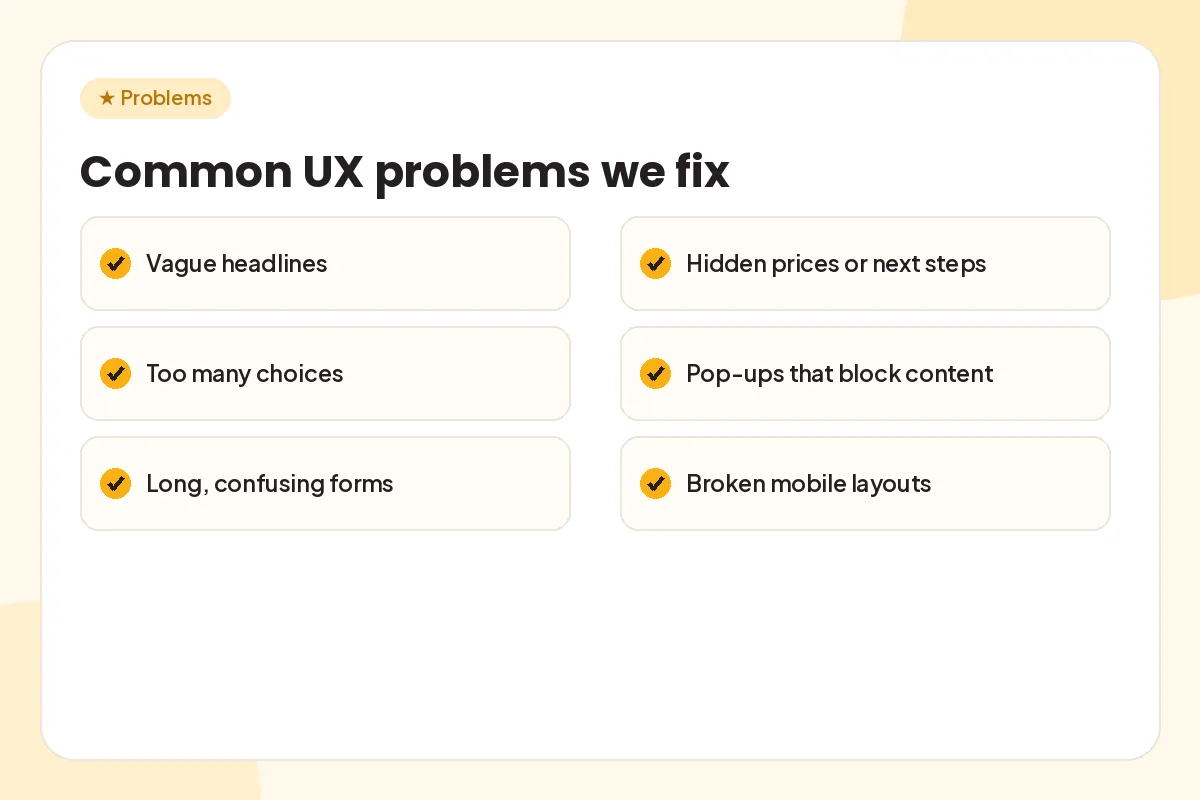
Most websites lose the majority of their visitors without a single click. Vague headlines, slow pages, too many choices, long forms and hidden next steps all push people away. Businesses often respond by buying more traffic, when the cheaper fix is to make the site work better for the visitors they already have.

Without data, teams argue about opinions: the button colour, the hero image, the menu. Nothing gets tested, and nothing improves.

Checklist of common website UX problems
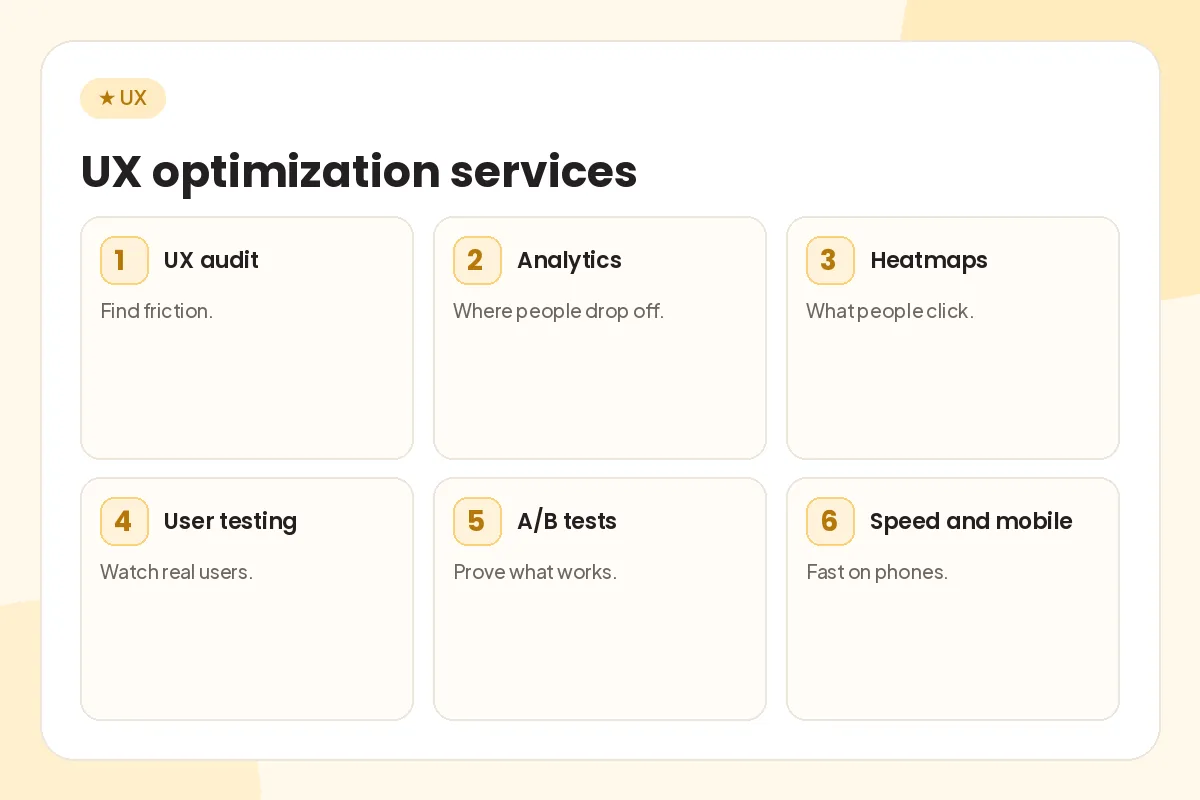
Grid of UX optimization services from audits to A/B tests
★ Our solution

UX optimization based on evidence

UX optimization improves how easy and pleasant it is for visitors to use your site and do what they came to do. We start by measuring where people drop off, then watch how they behave with heatmaps and session recordings and, where useful, test with real users.

From that evidence we suggest specific changes, test the important ones with A/B tests and roll out what works. You get a site that converts better, and you know why.

★ What we do

Our UX optimization services

Find friction, fix it, prove it.

UX audit

An expert review of key pages and journeys.

Analytics review

Funnels and drop-off points in GA4.

Heatmaps and recordings

See what people click, scroll and ignore.

User testing

Watch real people try to complete tasks.

A/B testing

Test changes against the current version.

Speed and mobile UX

Fast, easy pages on phones.
★ Measure

Finding where visitors drop off

We start with your analytics. Which pages bring traffic but few conversions? Where do people leave a checkout or form? Which devices or traffic sources convert worst? A clear funnel report shows where the biggest losses are, so we focus on the pages that matter most.

If tracking is missing or wrong, we fix it first, because decisions based on bad data lead nowhere.

★ Observe

Heatmaps, recordings and user testing

Numbers show where people leave; behaviour shows why. Heatmaps reveal what visitors click, how far they scroll and what they ignore. Session recordings show people hesitating, rage-clicking or giving up on a form. Short surveys ask visitors what stopped them.

For important journeys, we run user tests: we give real people from your target audience a task and watch them try it. Five to eight testers usually reveal most of the big problems.

★ Test

A/B testing that proves what works

Once we know what to change, we test the important ideas. An A/B test shows half your visitors the current page and half a new version, then measures which one gets more conversions. This removes guesswork and protects you from changes that look good but perform worse.

A/B tests need enough traffic to give reliable answers. For smaller sites, we use user testing and before-and-after measurement instead, and focus on changes backed by strong evidence.

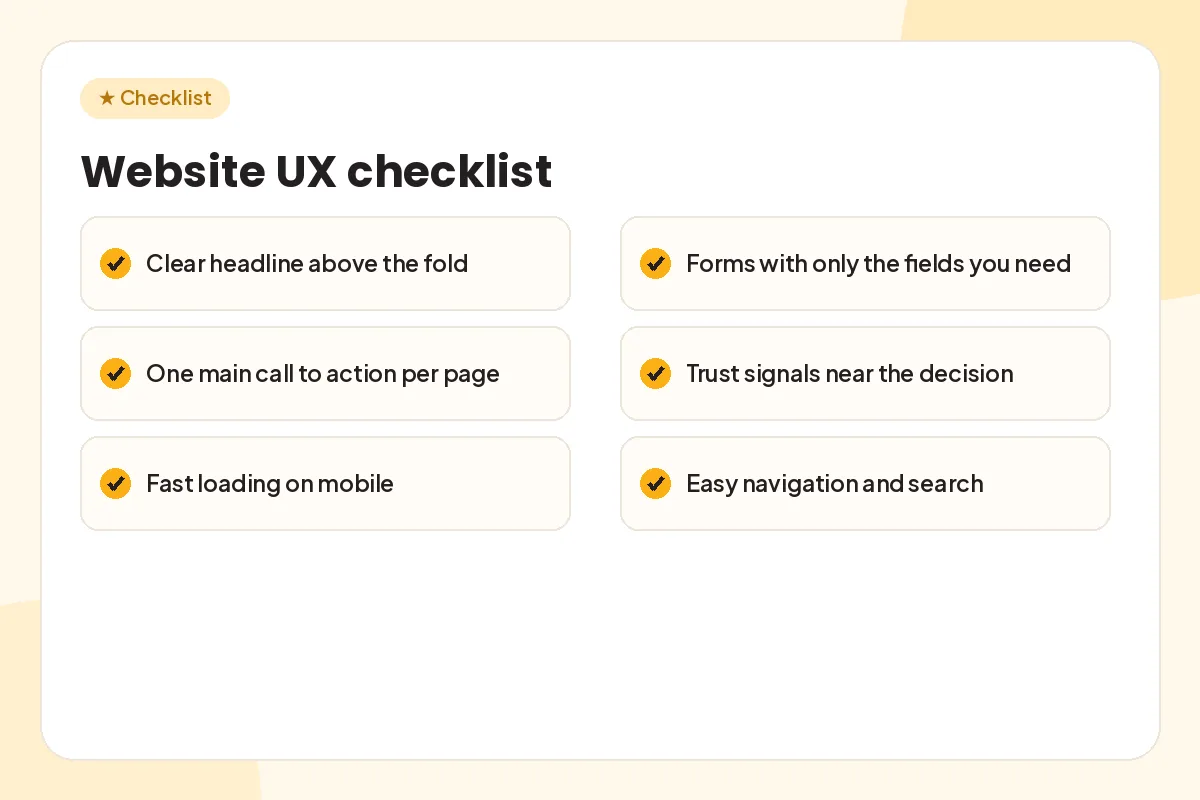
Checklist of website UX basics
★ Basics

The UX basics that matter most

Many gains come from getting the basics right. A headline that says clearly what you offer and for whom. One main call to action per page. Pages that load fast on mobile. Forms that ask only what you need. Prices, delivery or next steps that are easy to find. Reviews, guarantees and credentials placed near the moment of decision.

We check each key page against these basics before suggesting bigger changes.

★ Forms and checkout

Forms and checkout optimization

Forms and checkouts are where intent turns into revenue, and where many visitors give up. We cut unnecessary fields, use clear labels, show errors as people type, add autofill and the right mobile keyboards and make sure guest checkout and popular payment options are available.

We also remove surprises, such as delivery costs shown only at the last step, because unexpected costs are one of the most common reasons people abandon a purchase.

★ Mobile

Mobile UX

For most sites, more than half of visitors use phones, yet many sites are still designed on desktop first. We test key journeys on real phones and fix small tap targets, menus that are hard to use, text that is too small, pop-ups that cover the page and layouts that break on narrow screens.

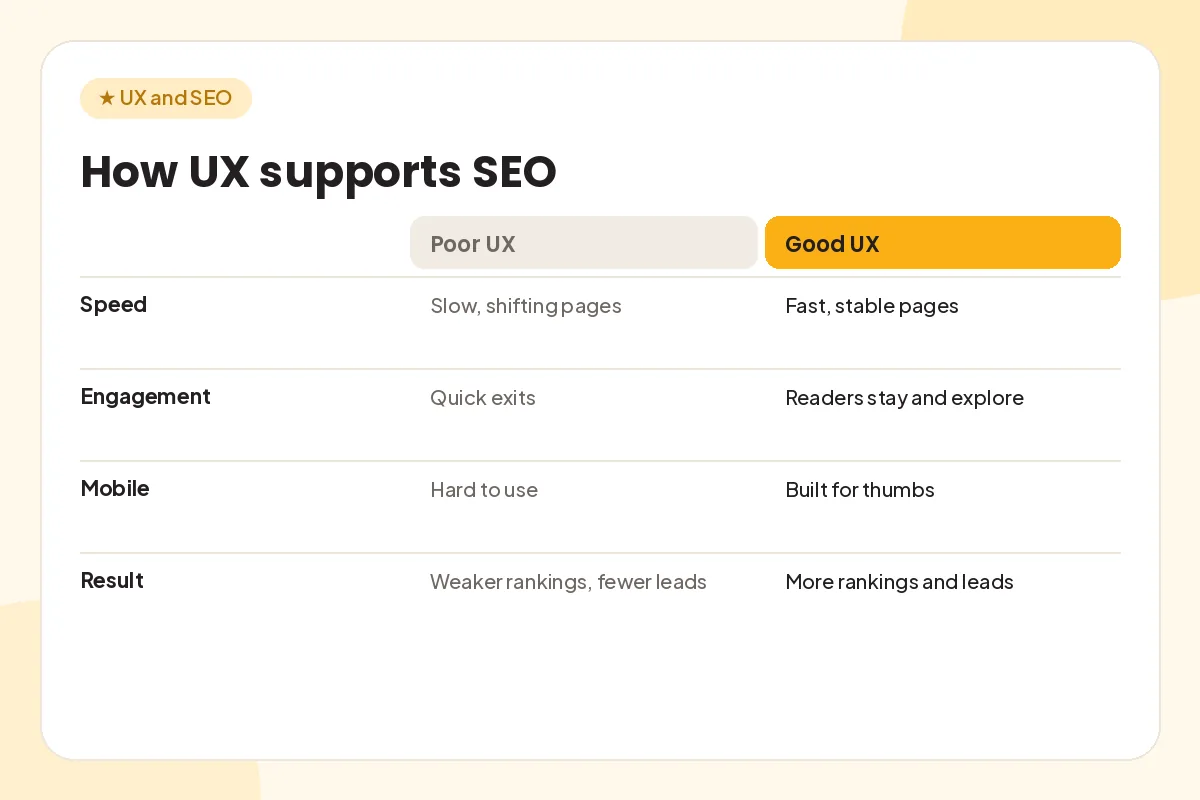
Comparison showing how good UX supports SEO
★ UX and SEO

How UX optimization supports SEO

Google wants to rank pages that help people. Fast, stable pages pass Core Web Vitals. Clear structure and helpful content keep readers engaged. Good mobile UX matters because Google ranks your mobile version. Better UX also means the traffic your SEO brings in turns into more leads and sales.

We work closely with our SEO team, so UX changes never accidentally remove content or links that help you rank.

★ Navigation

Navigation and site search

If visitors cannot find what they want in a few seconds, they leave. We review your menus, labels, page structure and internal search. Common fixes include using the words your customers use instead of internal jargon, cutting the number of top-level menu items, adding clear category pages and making site search forgiving of typos and synonyms.

We check what people type into your site search. Searches that return no results show content or products people expect and cannot find.

★ Readability

Content that is easy to read and act on

Most visitors skim. Long blocks of text, vague headings and buried key facts make pages hard to use. We rewrite headings so they say what each section covers, break up long paragraphs, put the most important information first and use lists and tables where they help. Each page gets a clear next step at the points where readers are ready to act.

We also check reading level. Plain words and short sentences help every visitor, including people reading in a second language or on a small screen, and they make your key messages easier to remember and share.

★ Trust

Trust signals that reduce doubt

People hesitate when they are unsure. Real reviews, case studies, recognisable client logos, clear guarantees, secure payment badges, visible contact details and real photos of your team all reduce that doubt. We place these near the points where visitors decide, such as next to prices, forms and checkout buttons, rather than hiding them on a separate page.

★ Ecommerce

UX optimization for online stores

For online stores, we focus on the steps between landing and buying: category pages with useful filters and sorting, product pages with clear images, sizes, delivery and returns information, an add-to-cart button that is always easy to find, and a checkout with as few steps as possible.

We also look at product recommendations, stock messages and basket reminders, which can lift average order value and recover sales that would otherwise be lost.

★ SaaS and lead generation

UX optimization for SaaS and lead generation

For SaaS and service businesses, we focus on the path from first visit to sign-up or enquiry: a homepage that explains the product in seconds, pricing pages that make choosing a plan easy, demo and trial forms that ask only what is needed and onboarding that helps new users reach value quickly.

Small improvements on pricing and sign-up pages often have a large effect on revenue, because every visitor who reaches them is already interested.

★ Speed

Perceived speed and page performance

How fast a page feels matters as much as how fast it is. We make sure the main content appears first, layouts do not jump while loading, buttons respond instantly and images and scripts below the fold load later. These changes improve Core Web Vitals and make visitors more willing to stay and explore.

★ Getting started

What we need from you to start

  • Your main goals, such as leads, sales, sign-ups or bookings.
  • Access to analytics, Search Console and any heatmap or testing tools you use.
  • Edit access to your website, or contact with your developers.
  • Any customer feedback, survey results or support questions you have.
  • One person who can approve changes and tests.

We handle the research, testing and reporting from there.

★ How we work

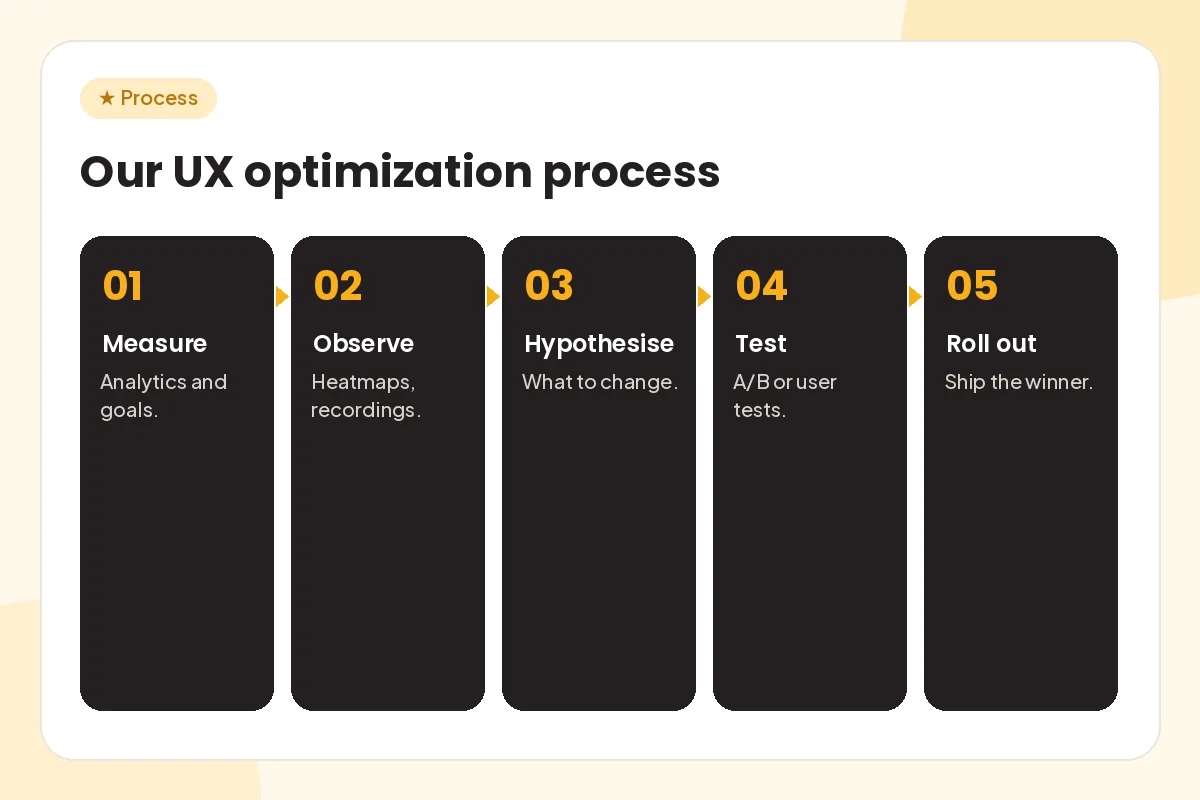
Our UX optimization process

01

Measure

We set goals and review analytics and funnels.
02

Observe

We study heatmaps, recordings, surveys and user tests.
03

Hypothesise

We list changes, ranked by likely impact and effort.
04

Test

We run A/B tests or user tests on the important changes.
05

Roll out

We ship winning changes and measure the results.
★ Reporting

What you get each month

You get a clear list of what we found, what we changed or tested, the results of each test and what we plan next. We report on conversion rate, leads or revenue, and the key steps of each funnel, so you can see the effect of each change on your business.

Five step UX optimization process from measuring to rolling out changes
★ Landing pages

Landing page optimization

Landing pages for ads and campaigns should do one job. We make sure the headline matches the ad or search that brought the visitor, the offer is clear, the proof is strong and there is one obvious next step. Better landing pages lower your cost per lead because more of each click turns into an enquiry. Our PPC team can align ads and landing pages together.

★ Accessibility

Accessible UX helps everyone

Good contrast, readable font sizes, clear labels, keyboard navigation and descriptive links help people with disabilities use your site, and they make the site easier for everyone else too. We check key pages against common accessibility guidelines and fix the issues that block users or hurt conversions.

★ Mistakes

UX optimization mistakes to avoid

  1. Redesigning everything at once. You cannot tell which change helped or hurt.
  2. Testing tiny details first. Button colours rarely matter as much as the offer and headline.
  3. Stopping tests too early. Early results often reverse with more data.
  4. Ignoring mobile. Most visitors may be on phones.
  5. Copying competitors. What works for them may not suit your audience.
★ Why DigiExe

Why choose DigiExe for UX optimization

Short claims you can check.

1,400+ clients in 28 countries

Businesses across 28 countries.

Founder who builds products

Jitendra Vaswani runs AffiliateBooster and SchemaNinja.

Evidence, not opinions

Changes backed by data and tests.

UX plus SEO

Changes that help rankings and conversions.
★ Results

Results from our team

Our published case studies show the traffic growth our SEO team delivers; UX work turns that traffic into customers.

122K
Clicks for Gizmobase in 12 months
111K
Clicks for Affiliatebay in 16 months
4,000
Daily clicks for BloggersIdeas after recovery
1,400+
Clients in 28 countries
★ Who we help

Who we help

We work with ecommerce stores, SaaS companies, lead generation sites, local service businesses, publishers and B2B companies in the USA, India, the UK and Australia.

★ Related services

Services that pair with UX optimization

Get more from every visitor.

Jitendra Vaswani, founder of DigiExe
Written and reviewed by
Jitendra Vaswani, Founder of DigiExe

Jitendra has built and tested landing pages for his own sites and products, including AffiliateBooster and SchemaNinja, since 2013. He reviews our UX recommendations.

Jitendra started BloggersIdeas in 2013, runs AffiliateBooster and SchemaNinja, and wrote the international bestseller Inside A Hustler's Brain (20,000+ copies). He has spoken at Affiliate Summit, Affiliate World, DMSS and TES, and works from New Delhi.

Last updated:

★ FAQs

UX optimization: FAQs

UX optimization is the process of making a website easier and more pleasant to use, so more visitors do what they came to do, such as buying, booking or getting in touch. It uses analytics, heatmaps, session recordings, user testing and A/B tests to find problems, fix them and measure the results.

They overlap. Conversion rate optimization, or CRO, focuses on increasing the share of visitors who convert. UX optimization looks at the whole experience, including ease of use, speed, mobile and accessibility. Better UX usually raises conversions, so we treat them as one process with conversions as the main measure.

We review analytics and funnels to see where people leave, study heatmaps and session recordings to see how they behave, run short surveys and user tests to hear why, and do an expert review of key pages against UX best practice. The combination shows both what is wrong and why.

A/B testing needs enough traffic for reliable results, usually at least a few thousand visitors a month to the page being tested. For smaller sites, we use user testing, expert reviews and before-and-after measurement instead. Many of the biggest gains come from fixing clear problems that do not need testing.

Fixing obvious problems, such as slow pages or broken mobile layouts, can show results within weeks. A/B tests usually run for two to four weeks each. Most clients see clear improvement within the first two to three months, and gains keep building as more tests run.

Yes. Fast, stable pages pass Core Web Vitals, clear structure and helpful content keep readers engaged and good mobile UX matters because Google ranks your mobile version. UX work also turns the traffic SEO brings into more leads and sales, which improves the return on your SEO.

We use GA4 for analytics and funnels, heatmap and session recording tools such as Microsoft Clarity or Hotjar, survey tools, user testing platforms and A/B testing tools that fit your site and budget. We can use the tools you already have or recommend low-cost options.

Usually not. We prefer to improve the pages and journeys that matter most, one step at a time, so we can measure the effect of each change. If the evidence shows your site needs a full redesign, our web design team can help, and we use the UX findings to guide it.

Both options are available. We can make changes directly on WordPress, Shopify and many other platforms, or write clear specifications for your developers. For A/B tests, we set up and run the test, then implement the winning version once the results are reliable.

We agree goals at the start, such as leads, sales, sign-ups or bookings, and track them along with conversion rate and funnel steps. Each test and change is measured against those goals. Monthly reports show what changed, what it achieved and what comes next.

Turn more visitors into customers

Request a free UX review. We will look at your key pages and show you the quickest fixes.

★ Trusted by brands

Brands We Have Worked With

A few of the businesses that have trusted DigiExe and our founder with their marketing.

★ Testimonials

What our clients say about DigiExe