

The AI model arms race accelerated sharply this past week, with Elon Musk confirming on July 18 via a post on X that xAI’s next large language model — a 2-trillion-parameter system widely expected to launch as Grok 4.6 — will complete its initial training run in the coming days.
The announcement came directly in response to competitive pressure from Beijing-based Moonshot AI, which unveiled Kimi K3 just two days earlier and immediately claimed the title of the largest open-weight model ever released.
Musk’s framing was blunt: the 2T model beats Grok 4.5 across every metric, and the company intends to match or exceed Kimi K3’s benchmark scores while preserving the cost efficiency that currently separates Grok from its Chinese rival. You can read Musk’s original post directly here: https://x.com/elonmusk
The Kimi K3 Catalyst
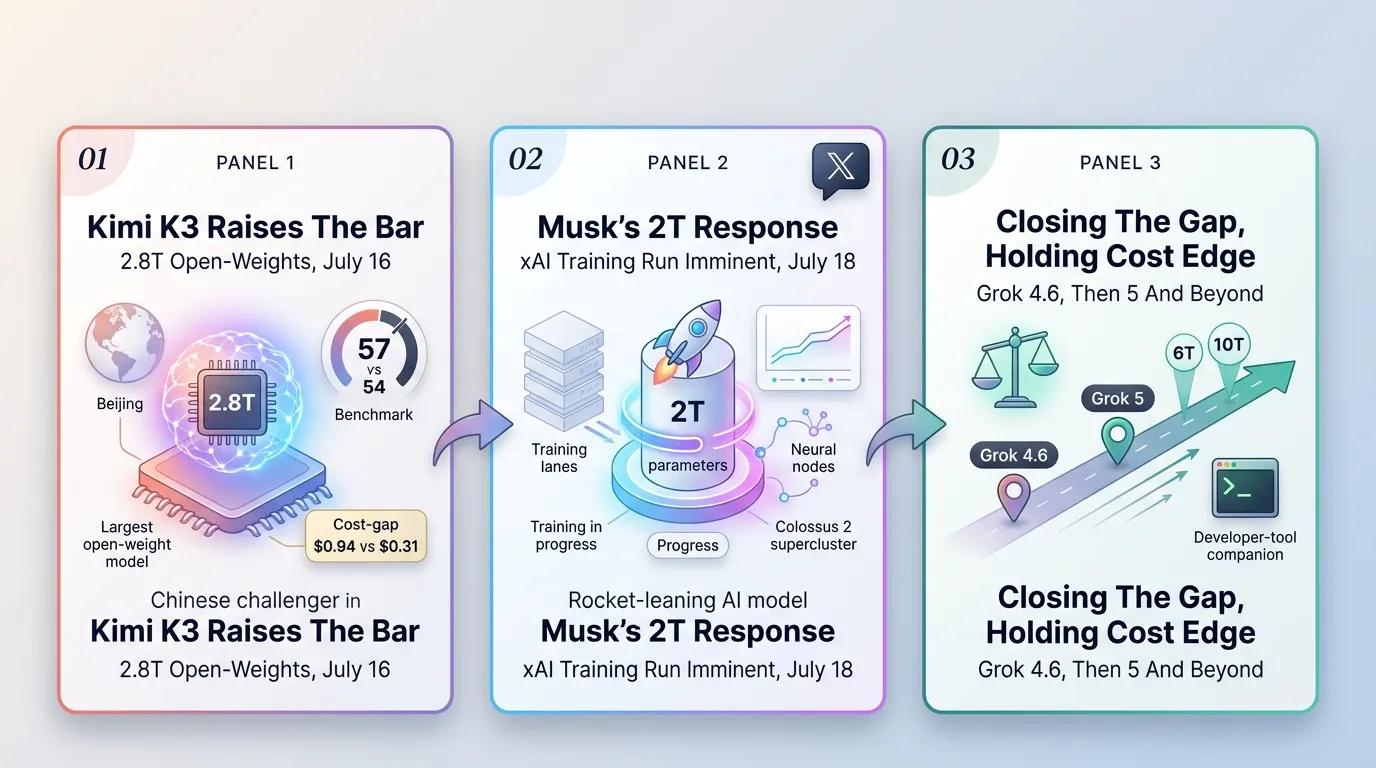
Moonshot AI launched Kimi K3 on July 16 at a scale that caught the industry off guard. At 2.8 trillion parameters, it is the largest open-weight AI model ever made publicly available, timed deliberately ahead of the World Artificial Intelligence Conference in Shanghai, with full model weights scheduled for public download on July 27.
The move was a clear geopolitical as much as a technical statement — China’s most ambitious AI startup going head-to-head with US frontier labs on raw scale and, crucially, on price.
Independent benchmark testing by Artificial Analysis placed Kimi K3 at a score of 57 on the Intelligence Index, compared to 54 for Grok 4.5. The performance gap is real but narrow. The cost gap runs the other direction: Grok 4.5’s per-task cost sits at roughly $0.31, approximately one-third of Kimi K3’s $0.94.
Moonshot AI’s API pricing for K3 also undercuts both OpenAI and Anthropic on comparable tasks, which gives it a commercial edge that raw benchmark scores alone do not capture. Business Insider reported that this pricing structure is already attracting enterprise customers who had been weighing US-based model options.
Musk’s stated goal for the 2T model is to close the benchmark gap on Kimi K3 while maintaining Grok’s cost advantage — essentially building a model that wins on both performance and economics simultaneously. It is an ambitious target that, if achieved, would meaningfully shift the competitive dynamic heading into Q3 2026.
xAI’s Broader Scaling Roadmap
The 2T model is one step within a broader and notably aggressive scaling roadmap at xAI. Grok 4.5, the current production model built on a 1.5-trillion-parameter foundation known internally as V9, entered private beta at SpaceX and Tesla following Musk’s announcement on June 28. Early internal assessments described it as performing close to Claude Opus and surpassing it in certain categories.
Beyond Grok 4.6, xAI’s Colossus 2 supercluster is reportedly training even larger systems in parallel — including 6-trillion and 10-trillion-parameter variants designated as Grok 5. As of April, seven models were training concurrently on the cluster.
Grok Build, xAI’s terminal-based coding agent that works by delegating tasks to parallel subagents, reached version 0.2.101 on July 13 and continues in beta for SuperGrok Heavy subscribers. The pace of releases across both model development and developer tooling suggests xAI is operating with a sense of urgency that the Kimi K3 launch has only sharpened.
Quick Links:
