

China is rewriting its college playbook for the age of AI. In one of the most sweeping education reforms in its modern history, the country has scrapped thousands of degree programs it considers outdated and replaced them with fields tied to artificial intelligence and emerging tech. This is not a quiet tweak. It reshaped roughly a third of the nation’s university programs in five years.
Here is the core of it:
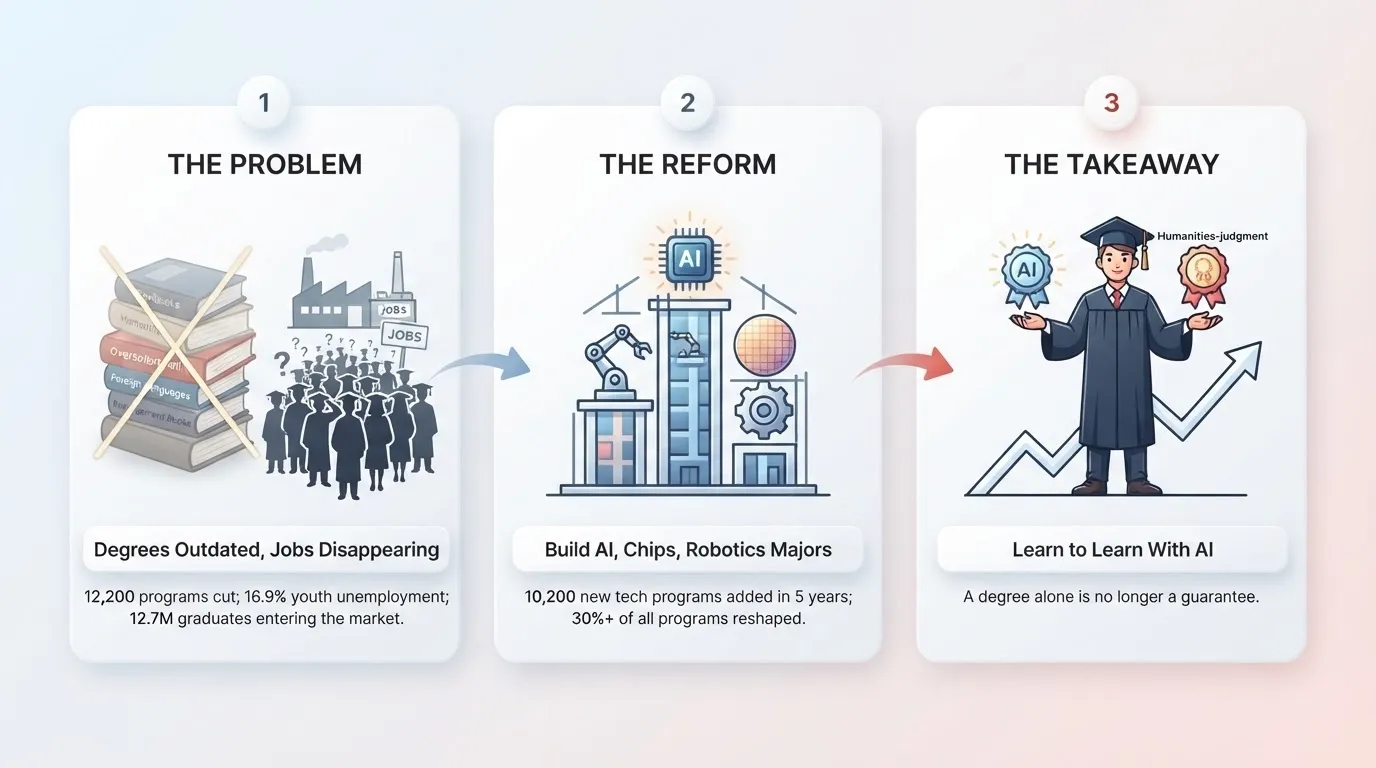
12,200 programs cut. Between 2021 and 2025, Chinese universities revoked or suspended that many undergraduate degrees.
10,200 new ones added. Most are built around AI, robotics, semiconductors, and advanced manufacturing.
Over 30% affected. That share of all university programs nationwide was adjusted in the overhaul.
What is being cut, and what is being built
The cuts are not random. They have hit arts, humanities, foreign languages, and management hardest, fields Chinese officials increasingly view as outdated or oversaturated. The figures trace back to Ministry of Education data cited by state news agency Xinhua.
In their place, universities are racing into strategic tech. Beijing has introduced over 10,000 new courses centered on AI, robotics, and advanced computing, and nine universities now offer specialized degrees in “embodied intelligence,” a field focused on the mechanics of the real world. The new majors map directly onto China’s industrial priorities.
Why now
Two forces are driving this. The first is ambition. China wants to lead in AI, semiconductors, and advanced manufacturing, and it sees universities as part of that industrial machine.
The second is jobs. The country faces a serious graduate employment squeeze. In March, urban unemployment for 16- to 24-year-olds who were not students rose to 16.9%. Meanwhile, roughly 12.7 million graduates are expected to enter the job market in 2026 alone. The reform is as much an employment policy as an education one: stop producing graduates for jobs that are disappearing.
The honest debate
This is bold, but not obviously right. Supporters say universities must adapt or they will keep minting graduates for a vanishing job market. Critics push back on two fronts. One expert warned that simply swapping one major for another is only a short-term fix, and that deeper changes may be needed to keep pace with technological change.
There is also the human cost. The skills that humanities and social sciences build, critical thinking, communication, and judgment, are exactly the ones AI struggles to replicate. A workforce trained only to code may be short on the people who direct, question, and govern the technology.
The takeaway
The real story is not that degrees are disappearing. It is that the definition of a valuable education is being rewritten in real time, and faster in China than almost anywhere. For students everywhere, the signal is clear: a degree alone is no longer a guarantee. The edge goes to people who can keep learning and work alongside AI, not those betting on one fixed skill for life.
Here is a video breakdown of the reform:
https://www.youtube.com/watch?v=grIffveaHd8
Quick Links:
