
Content Audit Services That Turn Old Pages Into Growth
Our content audit services review every page on your site against real Search Console data and the pages that rank today. You get a clear decision for each URL, keep, update, merge or remove, and a ranked plan that shows what to fix first.
Why more content does not always mean more traffic
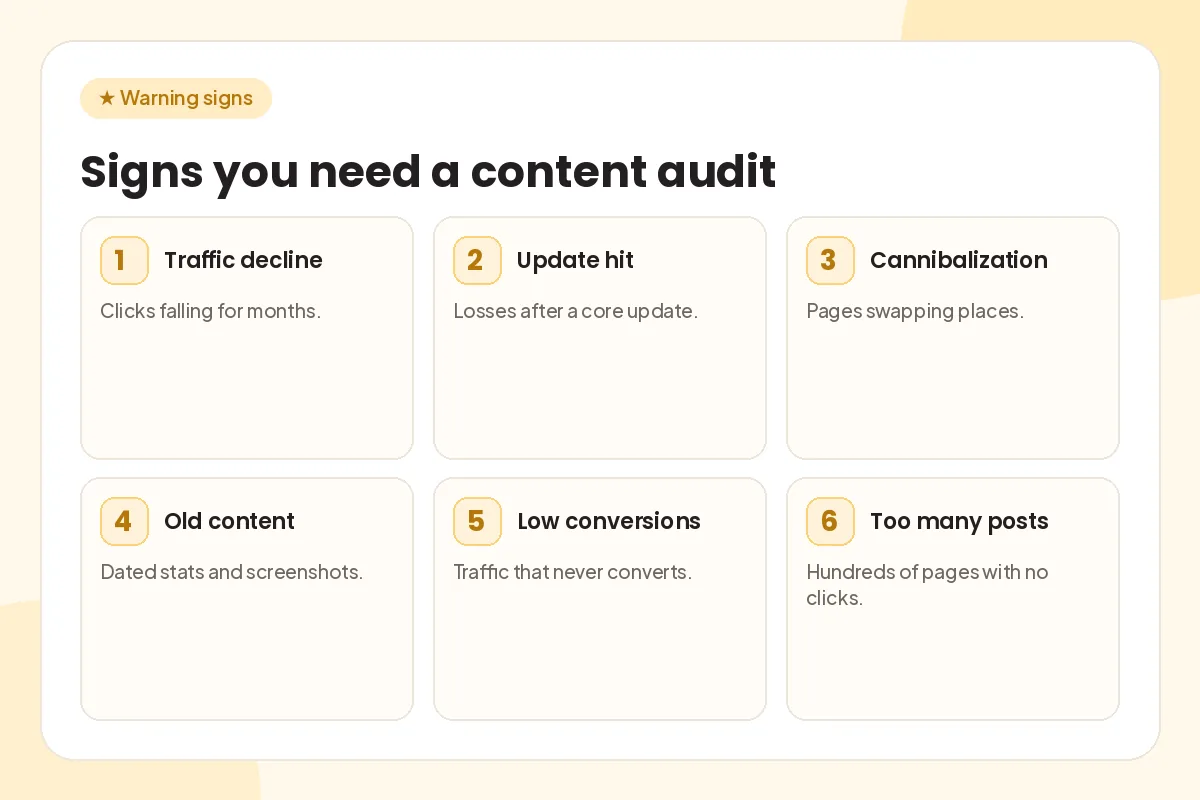
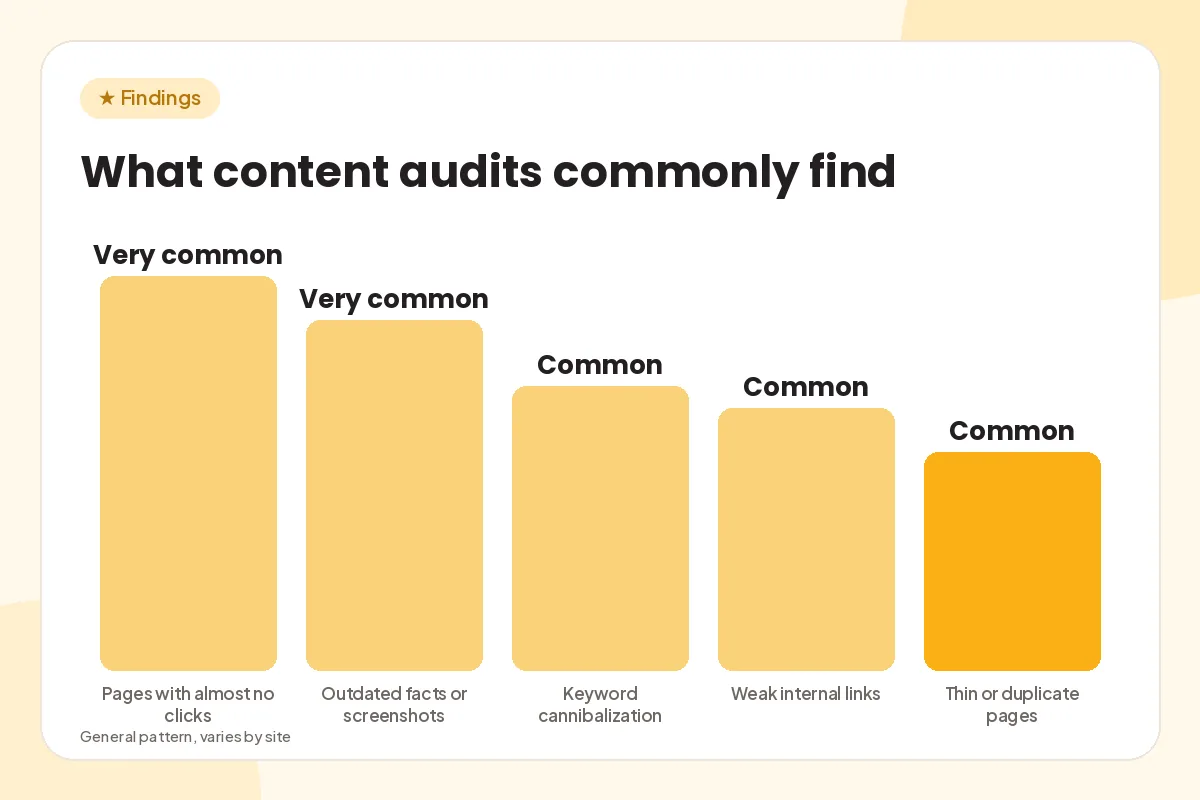
Most sites keep adding new posts and rarely look back. Over time, old articles go out of date, several pages compete for the same keyword and hundreds of posts get no clicks at all.
That weak content does more than sit there. It spreads your authority thin, wastes crawl budget and can lower how Google sees the whole site, especially after a helpful content or core update.


Content audit services built on your own data
We start with what Google already tells you. Search Console, analytics and backlink data show which pages earn traffic, which are slipping and which have never worked.
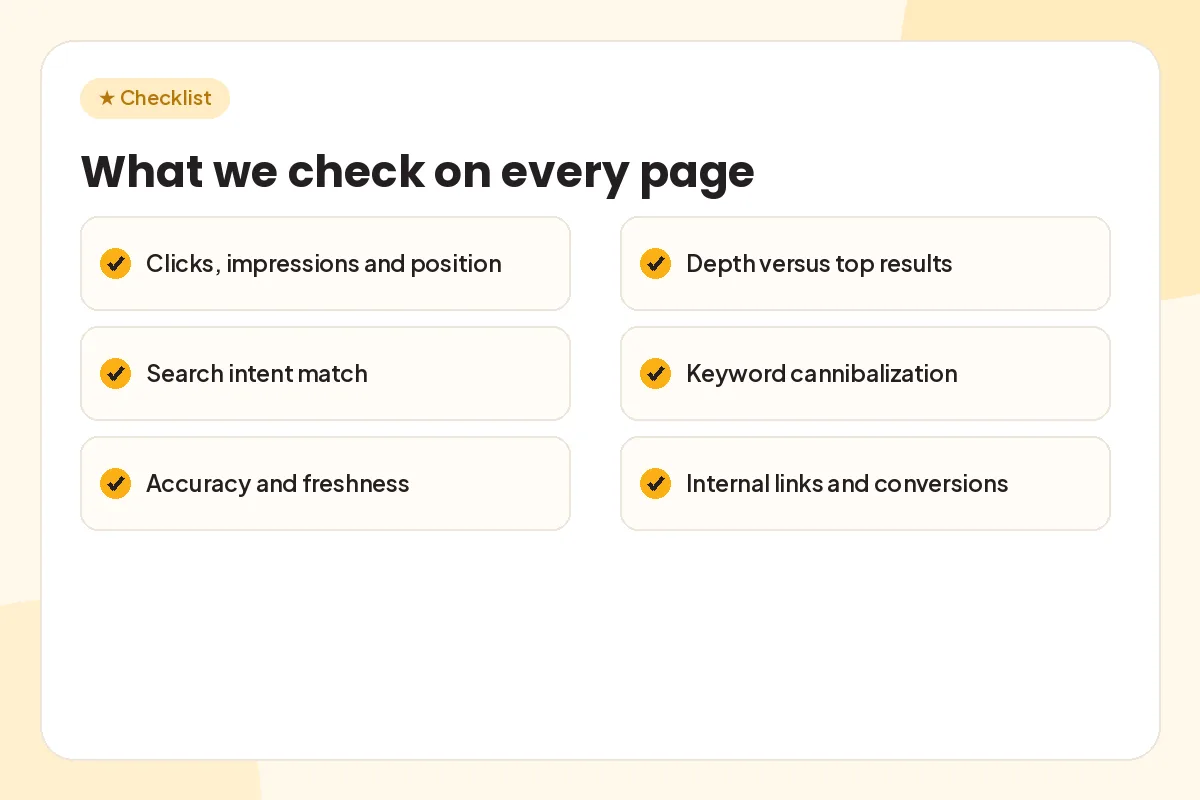
Then we read the pages. We compare each one with the results that rank for its keyword and check accuracy, depth, intent and freshness. Every URL gets one clear action, and the plan is ranked by the traffic and revenue at stake.
What our content audit covers
Data and human review, page by page.
Content inventory
Performance data
Cannibalization
Quality and accuracy
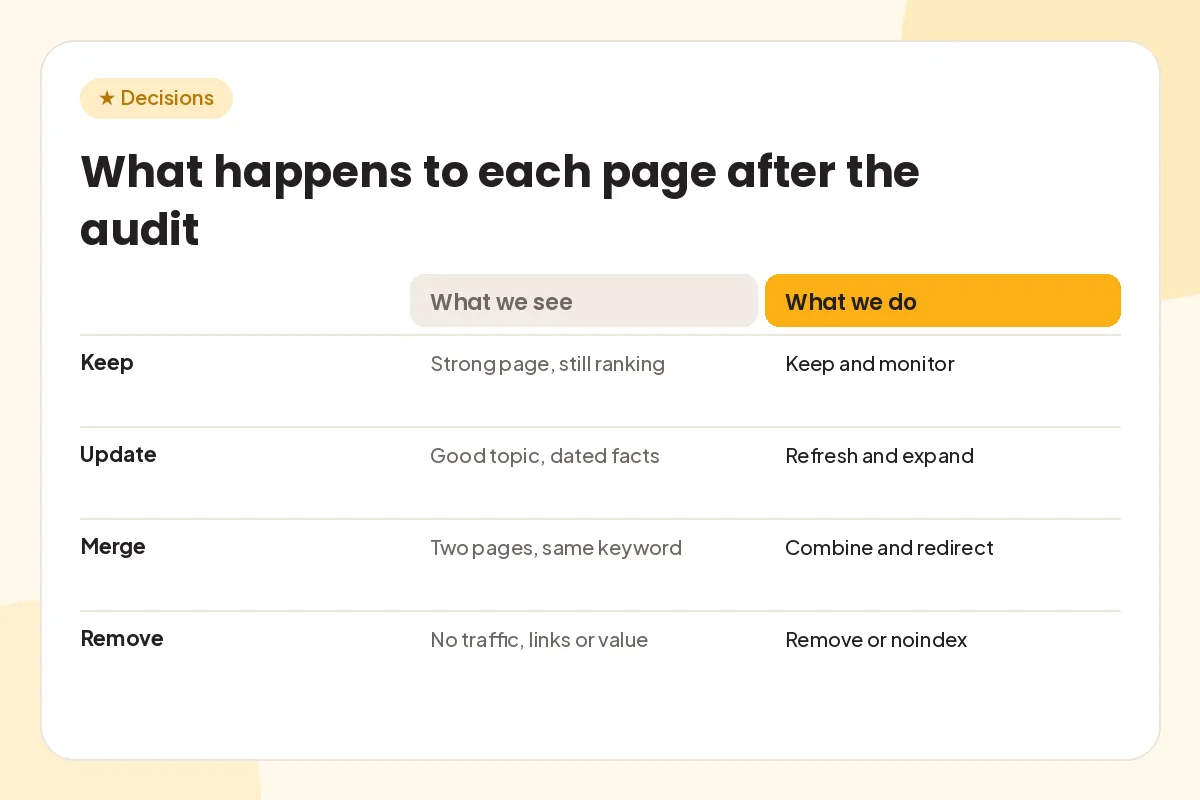
Keep, update, merge or remove
| Action | When we recommend it |
|---|---|
| Keep | The page ranks well, is accurate and meets intent |
| Update | The topic is right but facts, depth or structure have slipped |
| Merge | Two or more pages target the same search and split the signals |
| Redirect | A page has links or traffic but a better page covers the topic |
| Remove or noindex | No traffic, no links and no realistic way to become useful |
We never recommend removal just because a page is old. Each decision comes with the data behind it, so you can check it.

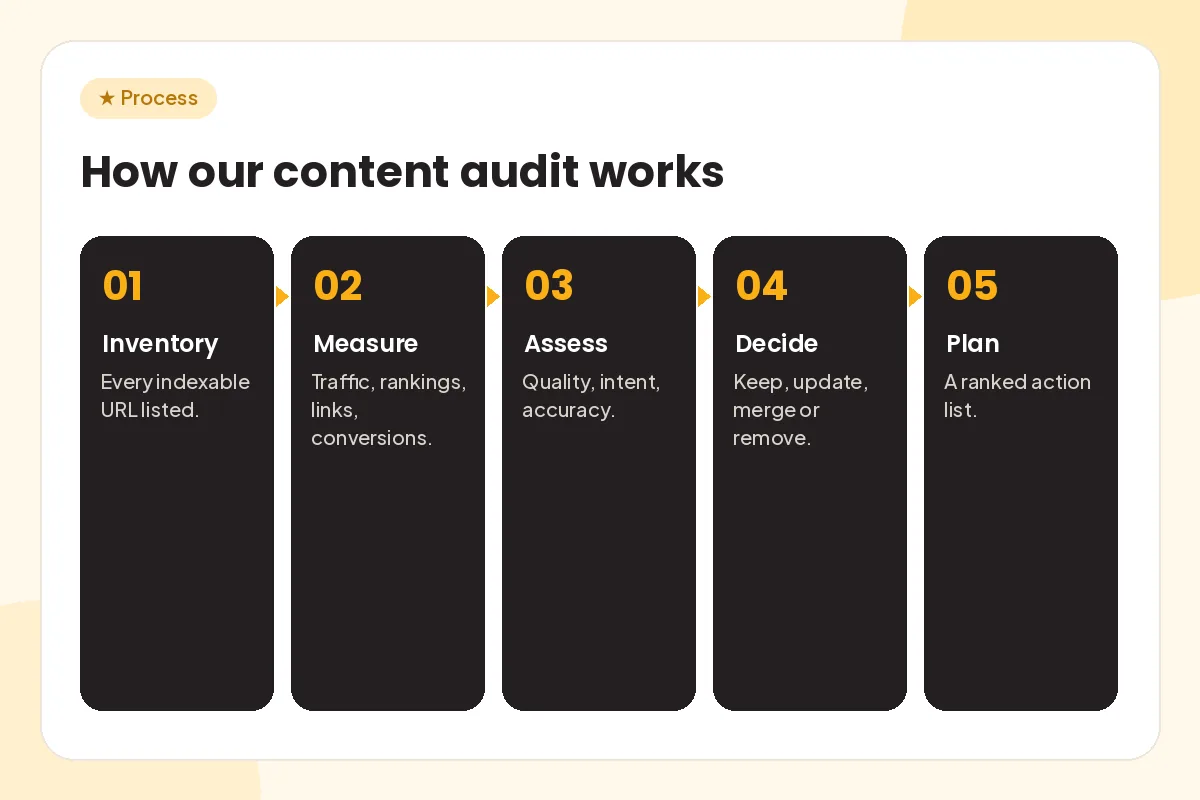
How our content audit works
Inventory
Measure
Assess
Decide
Plan

What you receive
- A spreadsheet of every URL with its data, score and recommended action.
- A short report explaining the biggest problems and opportunities.
- A cannibalization map with the page to keep and the pages to merge.
- A redirect list for merged and removed pages.
- Update briefs for your top refresh opportunities.
- A review call to go through the plan with your team.
Content audits after a Google update
If traffic dropped after a core or helpful content update, a content audit is usually the best place to start. We compare data from before and after the update and group losses by topic, template and page type.
This shows whether a few weak pages are to blame or whether the problem runs across the site. Our founder went through this on BloggersIdeas, which lost about 80% of its traffic after a core update and then grew from 2,500 to 4,000 daily clicks after a content clean-up.

Turning audit findings into traffic
An audit only pays off when the fixes are done. Updating strong pages that have slipped is often the fastest win, because they already have links and history with Google.
You can use our plan with your own writers, or we can do the work. Our content marketing team offers content upgrade packages that include an audit and editing of your best opportunities, and our content creation service can fill the gaps the audit finds.
How often should you audit your content?
A full content audit once a year suits most sites. Large publishers and stores may audit by section each quarter. Run one sooner after a big traffic drop, before a redesign or migration, or when you plan a new content strategy.
Between audits, review your top 20 pages every few months and update anything that is out of date. Small, regular updates are easier than a huge clean-up later.
Tools and data we use
Tools gather the data, and people make the decisions. We use Google Search Console for clicks, impressions and positions, Google Analytics for engagement and conversions, a site crawler for the full URL list and on-page details, and backlink tools to see which pages earn links.
We also look at the live search results for your main keywords, because the pages that rank today show what Google expects. Automated scores can point to problems, but every final action comes from an editor who has read the page and compared it with the top results.
Why choose DigiExe for content audit services
Short claims you can check.
1,400+ clients in 28 countries
Founder-led
Data first
Human review
Content clean-ups that worked
Content audits and refreshes were key steps in our published SEO case studies.
Sites that benefit most from a content audit
Content audits help blogs and publishers with large archives, SaaS companies with resource libraries, ecommerce stores with many category and blog pages, affiliate sites hit by updates and agencies that need a clear plan for a client site. For affiliate sites, see our affiliate SEO audit.
Services that pair with a content audit
Fix what the audit finds.

Jitendra has run BloggersIdeas since 2013 and led its content clean-up after a core update. He reviews the content audit method our team uses.
Jitendra started BloggersIdeas in 2013, runs AffiliateBooster and SchemaNinja, and wrote the international bestseller Inside A Hustler's Brain (20,000+ copies). He has spoken at Affiliate Summit, Affiliate World, DMSS and TES, and works from New Delhi.
Last updated:
Content audit services: FAQs
What is a content audit?
A content audit is a page-by-page review of the content on your website. It combines performance data, such as clicks, rankings and links, with a human review of quality and search intent. The result is a clear action for every URL, keep, update, merge, redirect or remove, and a plan ranked by impact.
How is a content audit different from a technical SEO audit?
A technical audit checks how search engines crawl and index your site, looking at speed, redirects, sitemaps and code. A content audit checks whether the pages themselves deserve to rank: whether they are accurate, helpful, match intent and avoid competing with each other. Most sites benefit from both, often in that order.
Will you tell me to delete pages?
Only when the data supports it. We suggest removal for pages with no traffic, no links and no realistic way to become useful. More often we recommend updating or merging pages, which keeps their value. Every recommendation includes the data behind it, so you can check the reasoning before acting on it.
What access do you need?
We need view access to Google Search Console and Google Analytics. Access to your CMS helps with the inventory but is not required. If you track leads or sales by page, sharing that data helps us rank the plan by revenue as well as traffic, so you fix the pages that matter most first.
How long does a content audit take?
It depends on the number of pages. A site with a few hundred URLs takes less time than one with thousands. We confirm the timeline in your quote after a quick look at the site size and structure, and we schedule a review call as soon as the report is ready.
Can a content audit help after a Google update?
Yes. Comparing data before and after an update shows which pages and sections lost ground. The audit then shows why, such as thin pages, outdated facts or cannibalization, so you fix real causes. Recovery often shows fully only after a later update, so steady improvement matters more than quick tricks.
What is keyword cannibalization?
Keyword cannibalization happens when two or more pages on your site target the same search. Google is unsure which to rank, so the pages swap places or both rank lower. The fix is usually to merge them into one stronger page and redirect the others, which the audit maps out for you.
Do you also update the content?
Yes, if you want us to. After the audit, we can update and expand pages, merge overlapping posts and write new content for gaps. Many clients use our content upgrade packages for this. Others hand the plan to their own writers, and we write the briefs clearly enough for that to work.
How often should I audit my content?
Most sites need a full audit once a year, with lighter reviews of top pages every few months. Audit sooner after a large traffic drop, before a redesign or migration, or when you change your content strategy. Regular small updates keep content fresh and make each full audit faster.
Is a content audit worth it for a small site?
Yes, often more than for large sites, because each page matters more. A small site with 50 to 100 posts can usually see quick gains by updating a few strong pages, fixing cannibalization and improving internal links. The audit makes sure your limited time goes into the changes that matter.
Find out which pages are holding you back
Send us your site. We will confirm the scope and send a clear quote for your content audit.
Brands We Have Worked With
A few of the businesses that have trusted DigiExe and our founder with their marketing.


What our clients say about DigiExe