
Keyword Research Services That Show You What to Write Next
DigiExe keyword research services find the searches your buyers make, sort them by intent and value, and map each one to a page on your site. You get a clear content plan in a spreadsheet you keep, built from real data on your site and your competitors.
Why content without keyword research rarely ranks
Many sites publish week after week and still get little traffic. The usual reason is that the topics were picked by guesswork. Some posts target words nobody searches, others chase terms that big brands own, and several pages end up fighting over the same keyword.
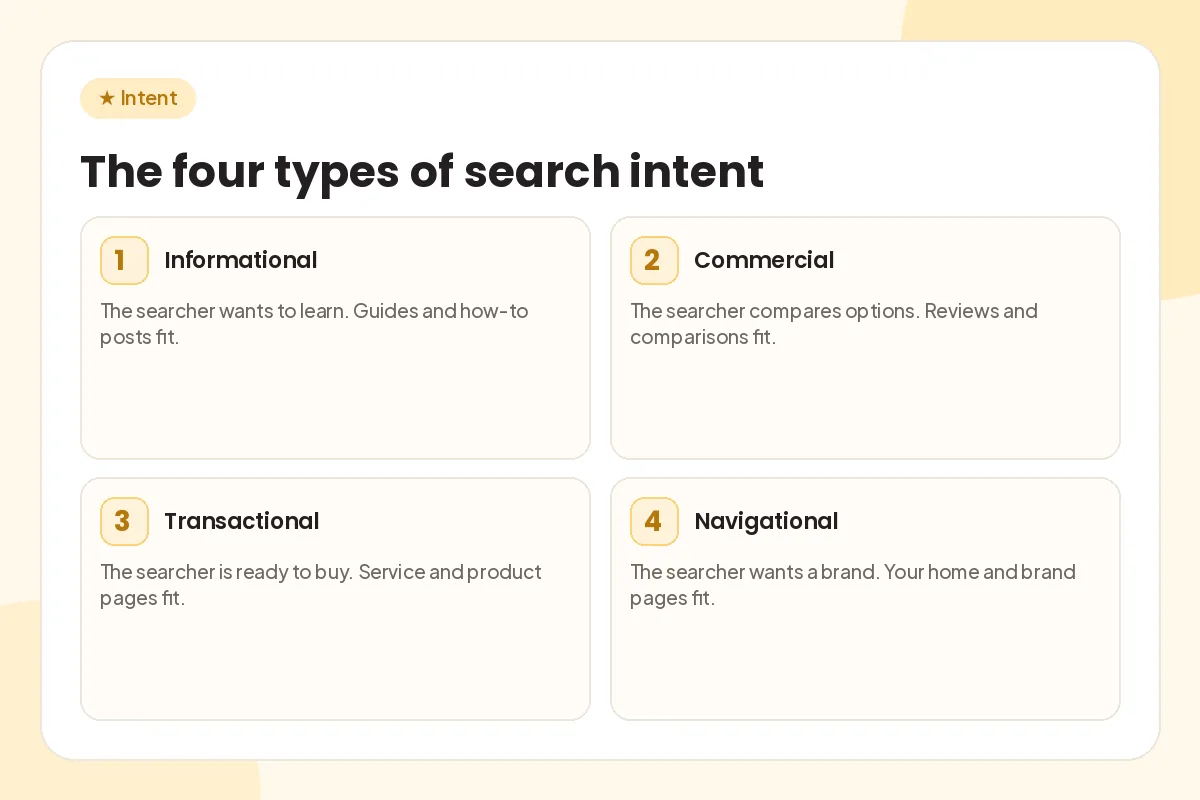
Search intent is the other trap. A page can use the right keyword and still fail if it answers the wrong question. Someone searching “best CRM for dentists” wants a comparison, not a sales page.
What good keyword research prevents
- Writing articles for keywords with no real demand.
- Targeting terms you cannot rank for yet.
- Two of your pages competing for one keyword.
- Pages that match the keyword but not the intent.


Keyword research services built around your buyers
Our keyword research services start with your business, not with a tool. We learn what you sell, who buys it, what a customer is worth and which markets matter. Then we look for the searches those buyers make at each stage, from first question to ready to buy.
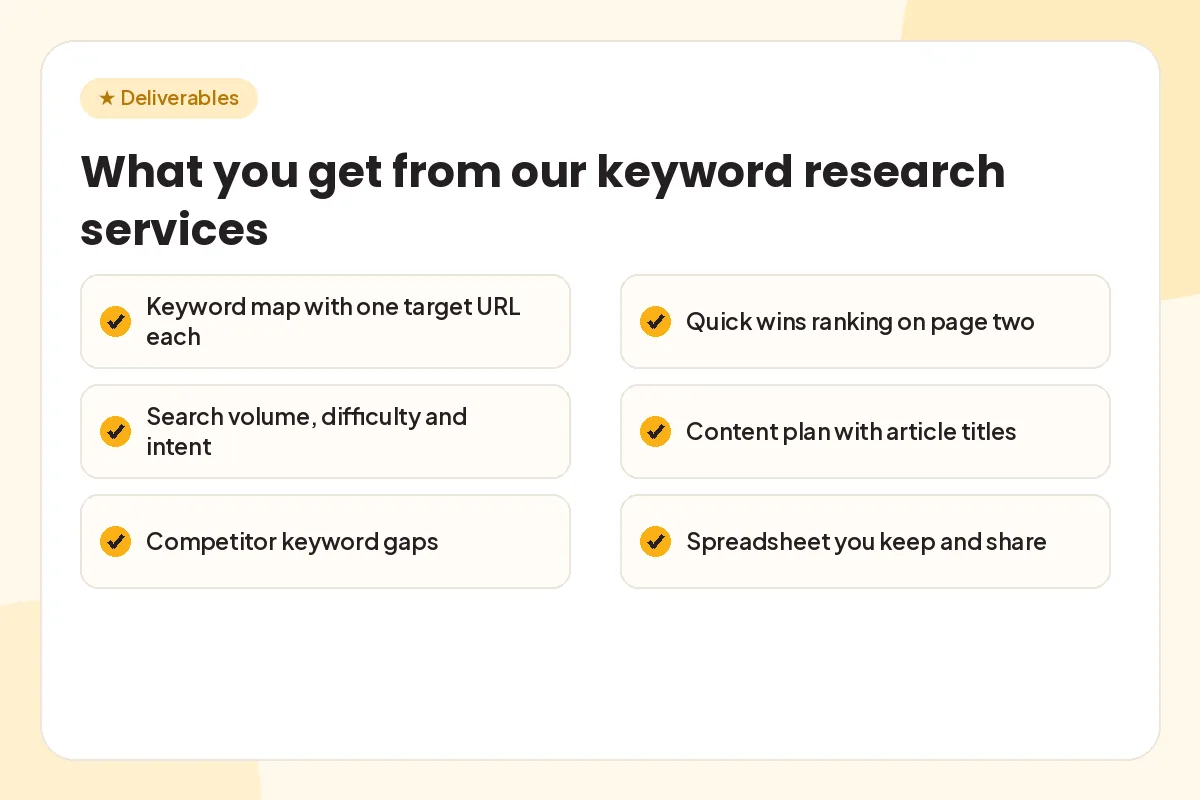
We pull data from your own Search Console, from Semrush and from competitor sites, then filter it by intent, difficulty and business value. The result is a short list of keywords you can win, grouped into topics, with one target page for each group.
Everything comes in a shared spreadsheet: keyword, volume, difficulty, intent, target URL and a suggested title. Your writers or ours can start the same day.
What our keyword research covers
Each package includes the same core work. Bigger packages cover more topics and more articles.
Keyword discovery
Search intent
Difficulty and value
Competitor gaps
Keyword mapping
Content plan
Already ranking? Keyword analysis finds your fastest wins
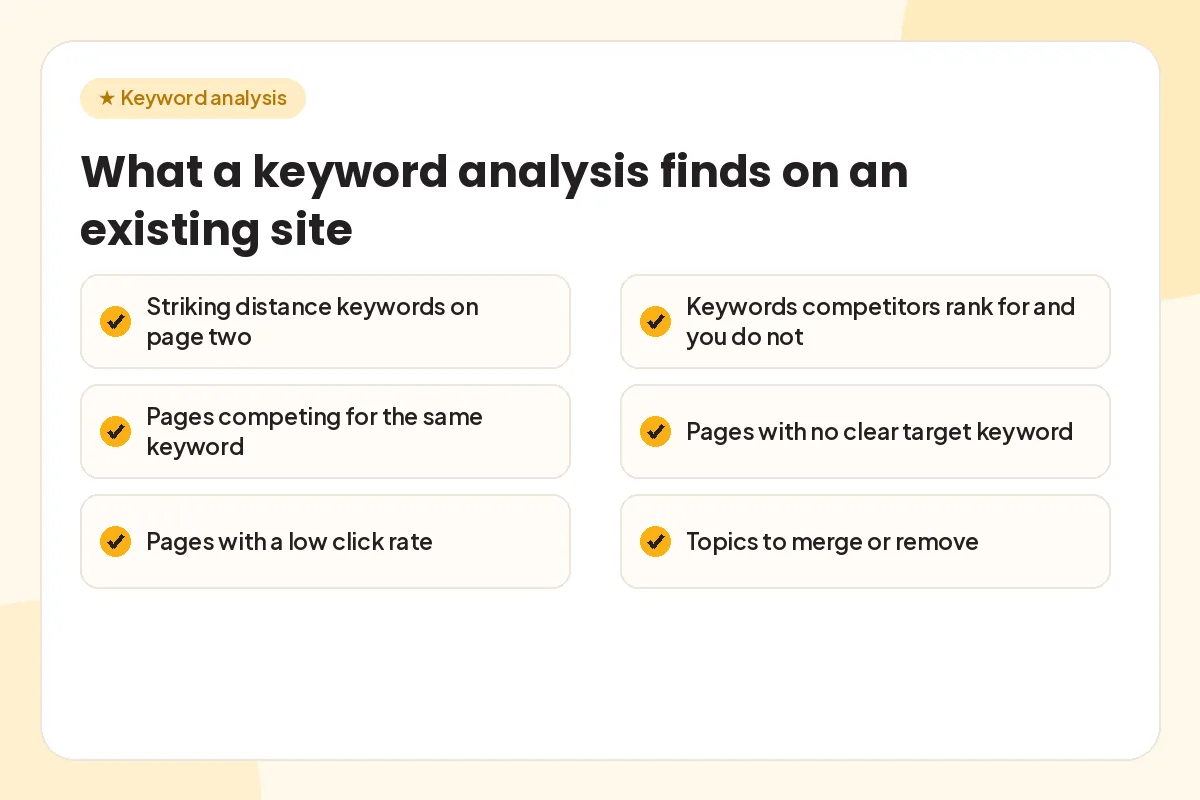
If your site already gets search traffic, keyword analysis often pays off faster than new research. We start from your own Search Console data and look at what you rank for today.
Striking distance keywords
These are keywords where you sit in positions 8 to 20. A better title, more depth or a few internal links can move them onto page one, often within weeks.
Keyword cannibalization
When two of your pages target the same keyword, Google may switch between them and rank neither well. We find these pairs and recommend which page to keep, merge or retarget.
Click rate review
Some pages rank well but get few clicks. We compare their click rate with the average for their position and rewrite titles and descriptions where they underperform.
Keyword analysis is included in every package for sites that already have Search Console data.


Keyword research vs keyword analysis
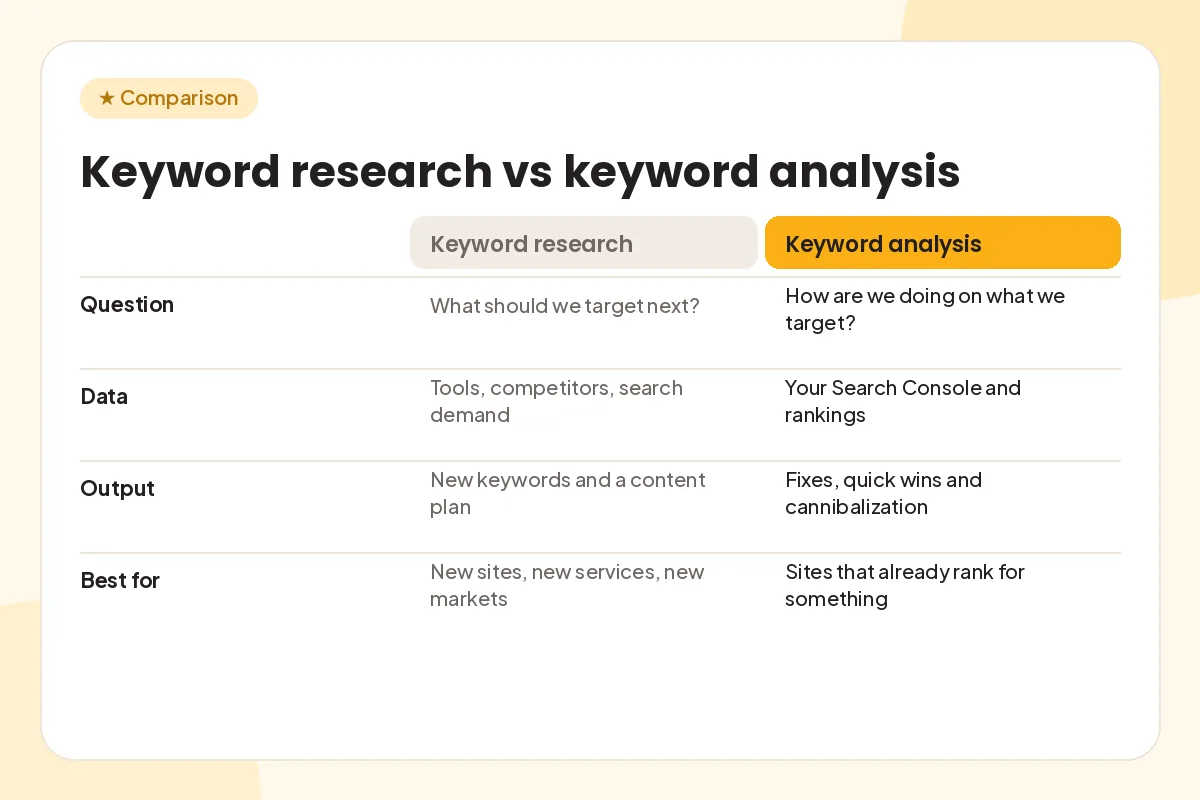
Keyword research asks what you should target next. Keyword analysis asks how you are doing on what you already target. New sites need mostly research, while established sites need both.
| Site stage | What we focus on |
|---|---|
| New site or new service | Research, low difficulty topics, a first content plan |
| Growing site | Research for new clusters plus quick wins |
| Established site | Analysis, cannibalization fixes, gap filling |
Our 4-step keyword research process
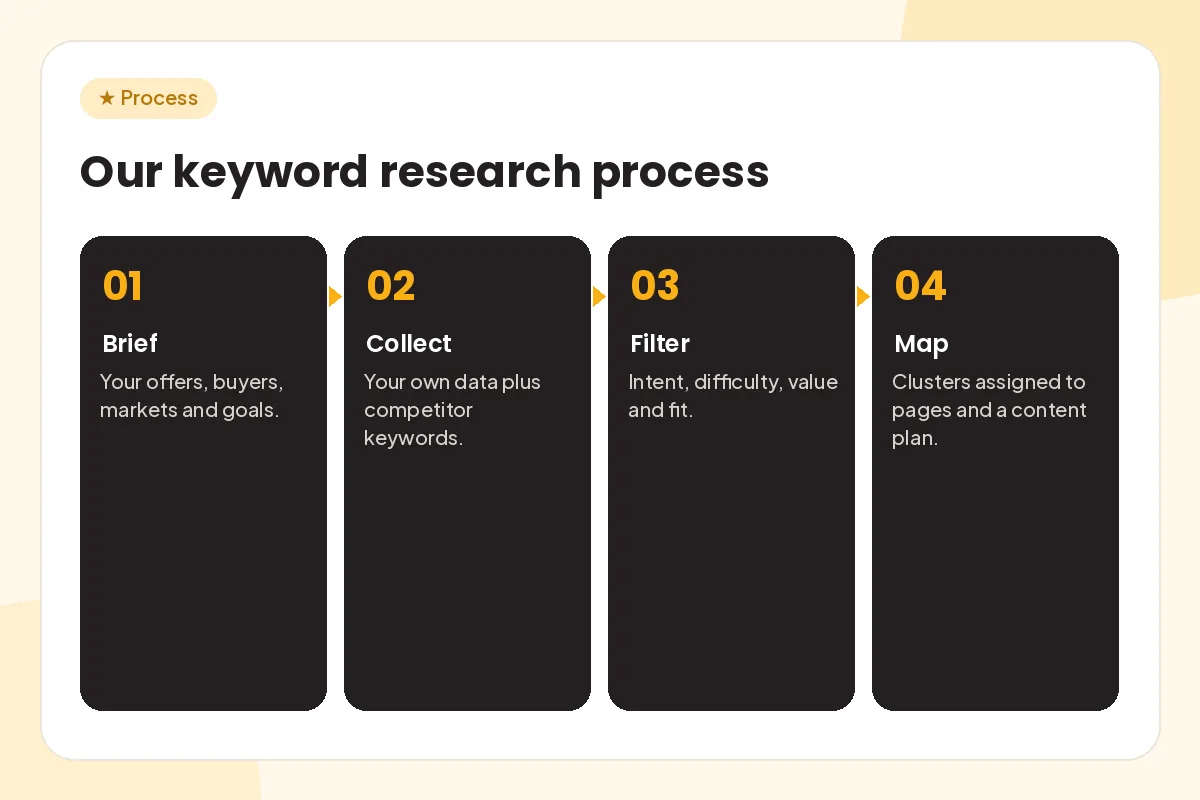
Brief
Collect
Filter
Map and plan
How we score and choose keywords
Search volume alone is a poor guide. A keyword with 20,000 searches a month is worth little if the people searching it will never buy from you, or if the top results belong to sites you cannot outrank this year.
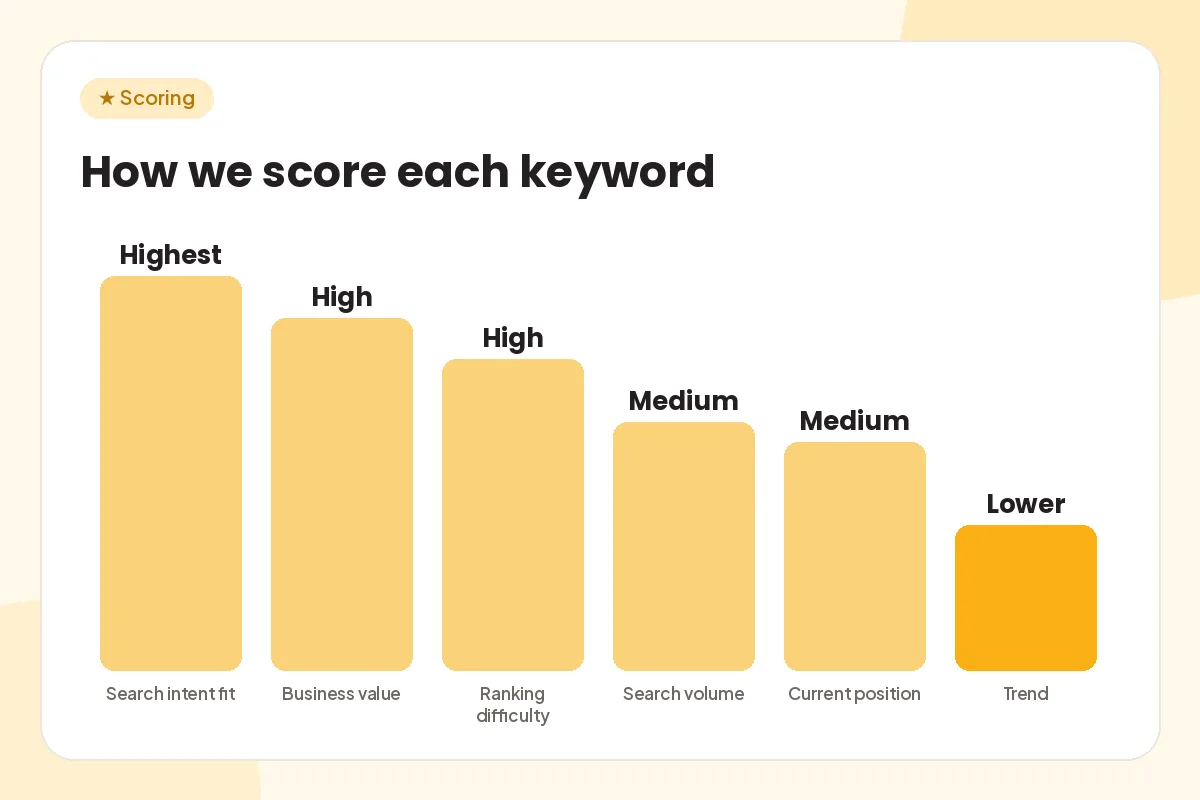
We score every keyword on six factors. Search intent fit and business value carry the most weight, because a smaller keyword that brings buyers beats a big one that brings browsers. Difficulty is judged against your site’s real authority, not a generic score.
Keywords you already rank for in positions 8 to 20 get a bonus, because they are usually the fastest wins. Rising trends get a smaller bonus, so your plan includes topics that are growing.


What happens after you order
After you order, we send a short brief form. It asks about your products or services, your buyers, the markets you sell in and the competitors you watch. A filled brief saves days of back and forth.
Next we pull your own data and your competitors’ keywords, filter and score them, then group them into topic clusters. Each cluster gets one main page and a set of supporting articles with suggested titles.
You receive the full plan in a shared spreadsheet. If you want, we walk you through it on a short call and answer questions about priorities.
Why choose DigiExe for keyword research
The method we sell is the one we use on our own sites.
1,400+ clients in 28 countries
Tested on our own sites
Founder-led
A file you keep
Keyword research packages and prices
Our packages are one-time projects priced in US dollars. Pick one by how many articles you want to plan. Each package includes a site and competitor analysis.
Starter
- Content plan for 10 articles
- Analysis of your site's keywords, backlinks and content (Semrush)
- Analysis of competitor keywords, backlinks and content (Semrush)
- Low competition, high traffic keyword research
- Keyword plan with metrics and article titles in a shared spreadsheet
Pro
- Content plan for 20 articles
- Analysis of your site's keywords, backlinks and content (Semrush)
- Analysis of competitor keywords, backlinks and content (Semrush)
- Low competition, high traffic keyword research
- Keyword plan with metrics and article titles in a shared spreadsheet
Premium
- Content plan for 30 articles
- Analysis of your site's keywords, backlinks and content (Semrush)
- Analysis of competitor keywords, backlinks and content (Semrush)
- Low competition, high traffic keyword research
- Keyword plan with metrics and article titles in a shared spreadsheet
Prices are in USD for a one-time project. Need ongoing SEO? See our search engine optimization services.
Keyword research behind real traffic growth
On the sites our own team runs, topic clusters built from this kind of keyword research were the base of every campaign. These numbers come from Google Search Console.
How to use your keyword map
A keyword map only helps if it shapes what you publish. Here is how we suggest you use it once it arrives.
- Fix existing pages first. Update titles, headings and copy on pages that already target a mapped keyword.
- Publish the pillar pages. Each cluster has one main page. Write those before the supporting articles.
- Add supporting articles. Write the long-tail articles and link each one to its pillar page.
- Link it all together. Internal links tell Google which page is the main one for each topic.
- Review every quarter. Search demand changes. A quick review keeps the plan current.
If you have no writers, our content creation service can write the articles from the plan. For technical issues that block rankings, start with a technical SEO audit.
Services that build on keyword research
Keyword research is the first step. These services turn the plan into rankings.

Jitendra has planned content around keyword research for his own sites since he started BloggersIdeas in 2013, and he reviews the method our team uses for client keyword maps.
Jitendra started BloggersIdeas in 2013, runs AffiliateBooster and SchemaNinja, and wrote the international bestseller Inside A Hustler's Brain (20,000+ copies). He has spoken at Affiliate Summit, Affiliate World, DMSS and TES, and works from New Delhi.
Last updated:
Keyword research services: FAQs
What are keyword research services?
Keyword research services find the words and phrases your potential customers type into Google, then sort them by demand, difficulty, intent and business value. The result is a list of keywords you can realistically rank for, grouped into topics and mapped to pages on your site, with a plan for what to write next.
How much does keyword research cost?
Our keyword research packages are one-time projects: $119 for a 10 article plan, $219 for 20 articles and $319 for 30 articles. Each package includes an analysis of your site and your competitors. The pricing table on this page lists what each package includes, and there are no monthly fees.
What is the difference between keyword research and keyword analysis?
Keyword research finds new keywords to target. Keyword analysis reviews the keywords you already rank for, using your Search Console data, to find quick wins, pages competing with each other and titles that get too few clicks. New sites need research first, while established sites gain the most from both together.
What data do you need from me?
We need your website address, a short brief on your products, buyers and markets, and a list of your main competitors if you know them. Read access to Google Search Console helps a lot, because it shows what you already rank for. We do not need access to your website itself.
What are striking distance keywords?
Striking distance keywords are terms your site already ranks for in positions 8 to 20, just off or near the bottom of page one. They are often the fastest wins in SEO, because a better title, extra depth or a few internal links can push the page into the top results without writing new content.
What is keyword cannibalization?
Keyword cannibalization happens when two or more pages on your site target the same keyword. Google cannot tell which page is the main one, so it may switch between them and rank neither well. The fix is to merge the pages, change the target of one, or make one clearly the main page through links.
How long does keyword research take?
Most packages are delivered within one to two weeks after we receive your brief. Larger sites or projects covering several markets can take longer, and we will give you a date before we start. You get the full spreadsheet in one go, plus a short call to walk you through it if you want one.
Which tools do you use?
We use Semrush for site and competitor data, SECockpit for keyword discovery, and your own Google Search Console for real ranking and click data. We also check live search results by hand, because tools cannot judge search intent or the strength of the pages that rank today as well as a person can.
Will you write the content too?
Keyword research packages cover the plan, not the writing. If you want us to write the articles, our content creation and content marketing teams can work straight from your keyword map. Many clients use our plan with their own writers, which is why every keyword comes with a suggested title and target page.
How often should keyword research be updated?
Review your keyword map every three to six months. Search demand shifts with seasons, new products and new competitors, and your own rankings change as you publish. A quarterly keyword analysis on your Search Console data catches new quick wins and cannibalization early, before they cost you traffic.
Know exactly what to write next
Order a keyword research package or tell us about your site. We will send a keyword map and content plan you can act on straight away.
Brands We Have Worked With
A few of the businesses that have trusted DigiExe and our founder with their marketing.


What our clients say about DigiExe