Digital marketers running paid campaigns across several ad networks simultaneously face an increasingly complicated tracking challenge, which has pushed proper conversion tracking software from a convenience into a core operational requirement.
FunnelFlux Pro takes on this challenge through a distinctly visual, flowchart based method rather than the tabular dashboards most tracking tools default to.
This review examines what FunnelFlux Pro actually delivers, breaks down its pricing structure, and determines whether it earns a place in your marketing toolkit.
Before continuing, know that FunnelFlux is offered in two formats, a self hosted edition managed on your own server, and FunnelFlux Pro, the cloud based product this review focuses on.
What Is FunnelFlux Pro
FunnelFlux Pro operates as a cloud based tracking platform built for people running paid campaigns across Facebook, Google, TikTok, native ad networks, push traffic, and pop traffic. Its most notable characteristic is the interface design itself.
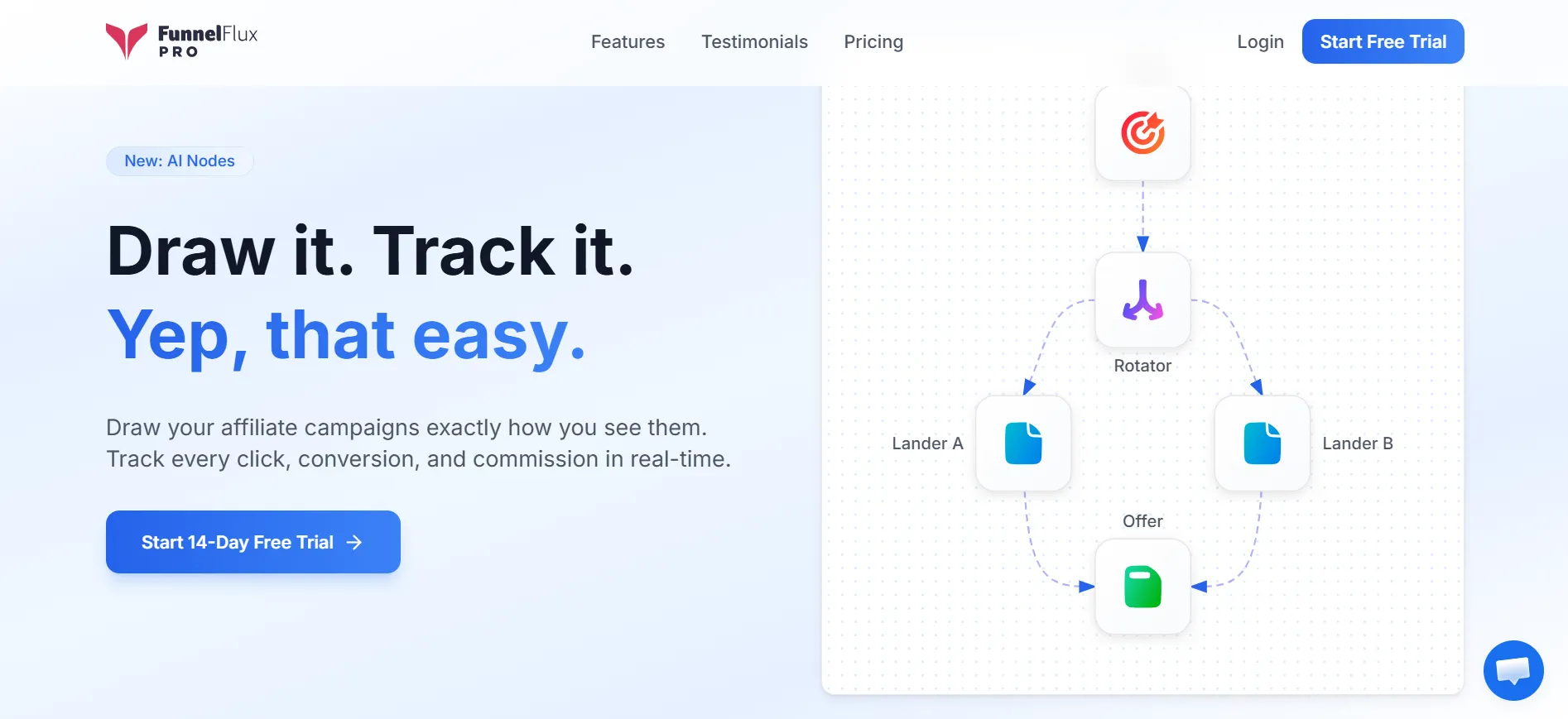
Rather than parsing through rows of raw performance data, you build your entire funnel visually on a canvas, arranging traffic sources, landing pages, offers, and rotators as interconnected nodes, then watching real time conversion numbers appear at every connection point.
That visual approach dramatically speeds up identifying exactly where a funnel is losing effectiveness.
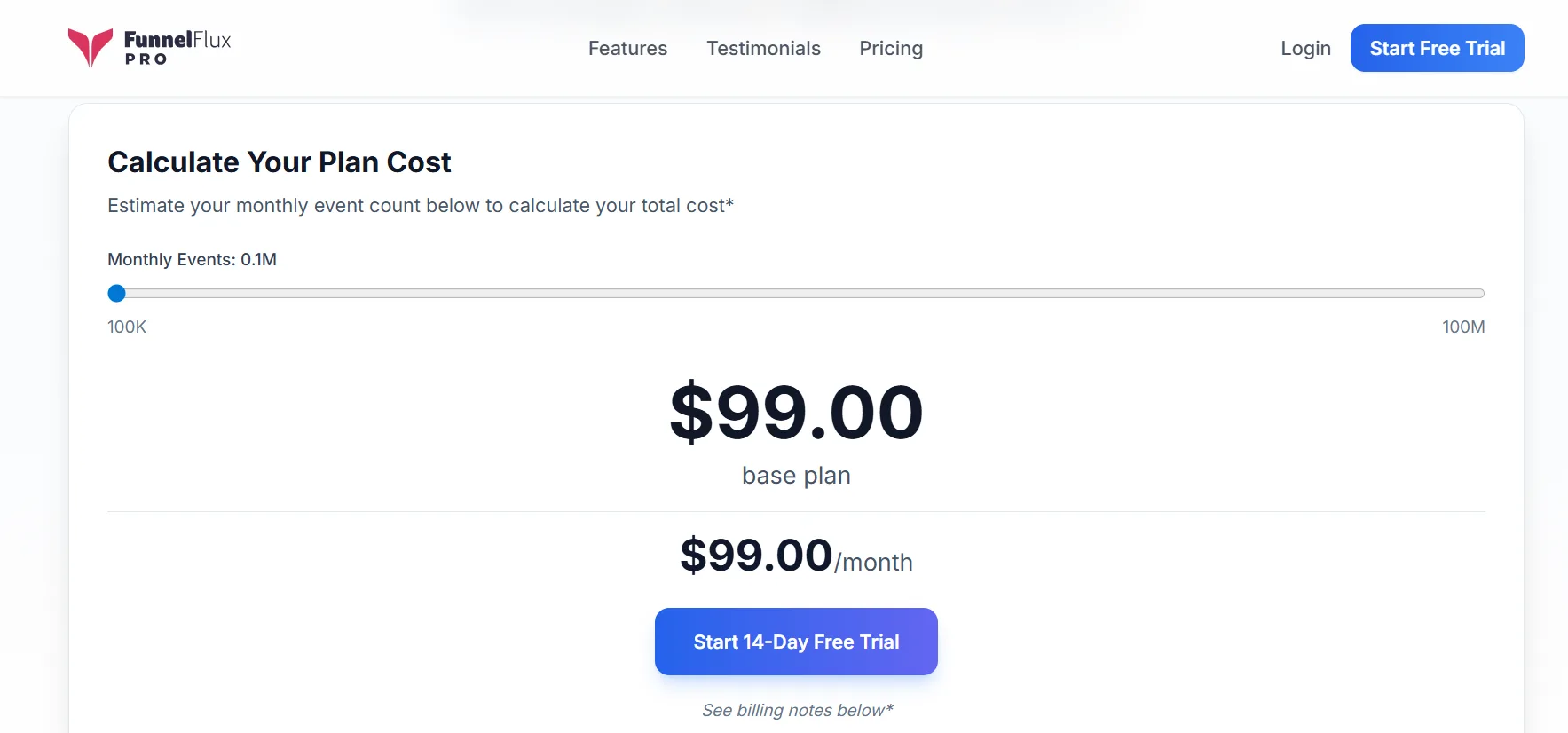
Pricing At A Glance A 14 day free trial applies across every plan, with zero annual contract requirement. Core: $99 per month, includes 2 million tracked events. Growth: $199 per month, includes 5 million tracked events. Scale: $299 per month, includes 10 million tracked events.
Every affiliate and media buyer running paid campaigns runs into the same core problem eventually, fragmented performance data spread across multiple advertising accounts with no unified picture of the actual customer journey or clarity on which specific funnel stage is underperforming.
FunnelFlux Pro was engineered specifically to address this fragmentation.
Here is a closer look at the functionality that provides genuine operational value.
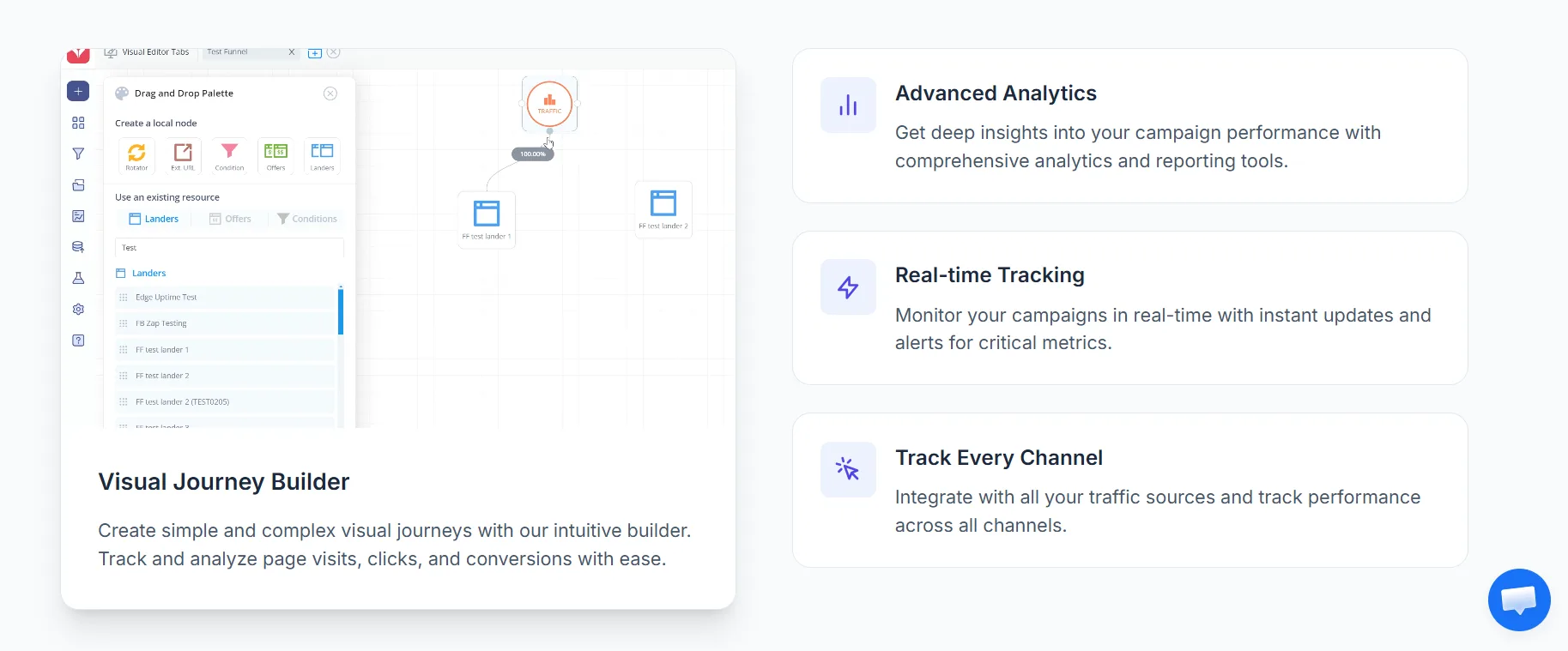
Visually Constructed Funnels Your entire funnel gets built as a flowchart rather than buried inside layered configuration menus, transforming even elaborate multi step campaigns into something readable at a single glance.
Individual Node Level Data Every discrete point within your funnel, whether it is a landing page, offer, or traffic splitter, produces its own distinct conversion figures, allowing you to identify precisely where visitors are exiting rather than viewing one combined campaign statistic.
Postback Driven Conversion Tracking Conversions get recorded through server side postbacks instead of exclusively relying on browser pixels, keeping data reliable even as pixel blocking technology and privacy focused browser settings become increasingly common.
Wide Ranging Ad Network Connections The platform links up with Facebook, Google, TikTok, Bing, Snapchat, and most established native and push traffic networks, pulling in both advertising cost figures and conversion outcomes automatically.
AI Driven Traffic Optimization A separately sold addon introduces a routing node that automatically redirects traffic toward stronger performing destinations based on live statistical calculations, essentially automating what would otherwise be a manually monitored split test.
Custom Conversion Event Configuration You can define up to 10 distinct conversion events per funnel, particularly useful for anyone tracking multiple stages within a longer sales journey rather than a single final action.
Streamlined ClickBank Setup Pasting a single URL connects your ClickBank sales, refund, and rebill activity directly into FunnelFlux reports, bypassing the manual postback configuration process most competing tracking platforms require.
Who Can Use FunnelFlux Pro
Media Buyers Running Multiple Channels Anyone managing ad spend across Facebook, Google, TikTok, and native traffic networks simultaneously benefits substantially from having consolidated cost and conversion data instead of manually assembling information from separate advertising accounts.
Affiliate Marketers Those promoting offers through ClickBank and similar affiliate networks experience a noticeably quicker setup process thanks to the native IPN feature, while the visual builder makes testing different prelander combinations simple without rebuilding entire funnels each time.
Marketing Agencies Agencies coordinating paid campaigns for multiple clients simultaneously gain considerable time efficiency through centralized reporting on cost and conversions, avoiding the need to constantly toggle between separate client advertising dashboards.
Businesses Combining Organic And Paid Traffic Although its core functionality centers on paid traffic tracking, FunnelFlux’s cookieless technology still performs reasonably well when applied to organic website visitors, making it a workable choice for businesses operating both traffic types concurrently.
FunnelFlux Pro As A Funnel Builder
The entire platform revolves around a visual canvas, with every funnel component existing as a node connected by lines representing the actual visitor journey.
Each new funnel automatically begins with a fixed traffic source node that cannot be removed, functioning as the default landing point for any visitor who arrives without a specifically assigned destination.
The unremovable traffic source node establishes a consistent starting reference across every funnel, ensuring visitors arriving without an explicit destination still get properly captured rather than falling into an untracked gap.
Rotator nodes divide incoming traffic across various destinations based on assigned percentages, and multiple rotators can be stacked throughout a single funnel, making parallel offer or lander testing straightforward to configure and visualize.
Condition nodes support routing decisions built around visitor attributes such as country, device type, or operating system, enabling specific treatment for mobile users from a particular region without duplicating an entire funnel structure.
Parameter accumulation built into lander and offer nodes automatically transfers query string data from your traffic source through to subsequent destination pages, removing the need to manually configure URL parameters on each page individually.
The system links functionality generates direct tracking URLs for any individual node within a funnel, especially useful when isolating and testing a later funnel stage without unintentionally triggering earlier condition rules.
Global custom tokens allow creation of a single reusable variable, such as an approved country list, applicable across multiple different funnels rather than requiring identical condition logic to be rebuilt repeatedly.
Advanced configuration settings support traffic source specific overrides for cost per entrance within an individual funnel, valuable when the exact same funnel runs across accounts carrying different cost structures.
Setting up a genuinely tracked, functioning funnel proves considerably simpler than the depth of the feature list might suggest. The process begins by creating a campaign, which serves purely as an organizational container without its own configuration settings, followed by naming and constructing a funnel within it.
Inside the actual builder, you add a rotator node and connect it to your landing pages through the right click node menu, then repeat that step to link in your relevant offers.
With rotator percentages configured and every connection made, generating a tracking link from the traffic source node allows you to drop it straight into whichever ad platform you are using.
Getting from an empty campaign to a fully live tracked funnel generally takes just a handful of minutes once the builder’s layout feels familiar.
Feature Spotlight: AI Routing Nodes
Automated traffic distribution driven by real performance data has become an increasingly critical component of how experienced media buyers scale their operations, since manually reviewing split test outcomes and adjusting percentages by hand quickly becomes unmanageable past a certain traffic volume.
FunnelFlux addressed this specific need through its AI routing node feature, made available as a separately purchased addon.
Here is what actually takes place behind the scenes. Visually, the node presents identically to a standard rotator sitting between your incoming traffic and its various destinations, but internally it executes automated statistical analysis on your conversion or revenue data using Bayesian inference rather than a simple percentage split.
You select between two available optimization approaches, one targeting a specific conversion event like a completed signup, and the other optimizing based on revenue per view across every tracked event combined.
From there you configure a lookback window controlling how far back the system draws historical data, plus a report frequency setting that governs how often routing percentages get recalculated, with FunnelFlux recommending a minimum of 10 conversions before considering the data trustworthy.
You can layer in segmentation by traffic source for funnels operating across multiple ad accounts at once, and select a routing goal that determines whether optimization happens at the node level, individual page level, or a combined two step method suited for funnels mixing different node categories.
More advanced users can further adjust a sensitivity setting controlling how aggressively traffic shifts toward the current top performer, along with caps and floors that prevent any single variant from monopolizing traffic before the data confidently proves it out as the actual winner.
FunnelFlux runs on a usage based pricing model tied to your monthly volume of tracked events, organized across three main tiers.
Core Plan
$99 monthly for up to 2 million tracked events, with extra usage billed at $10 per additional million. Comes with the standard 14 day free trial along with monthly billing and no annual contract commitment.
Growth Plan
$199 monthly for up to 5 million tracked events, matching the identical $10 per extra million overage rate and trial and contract terms found on the Core plan.
Scale Plan
$299 monthly for up to 10 million tracked events, aimed specifically at higher volume media buyers running substantial traffic across multiple campaigns concurrently, with the same overage rate applying.
Each available plan includes two free custom domains, with any additional domains beyond that billed at $2 monthly per domain.
Data retention has no expiration point while your subscription stays active, and canceling grants a 60 day grace period before deletion occurs, unless you enroll in the $9 monthly standby plan to keep your data archived beyond that window.
The AI routing node addon is billed as a separate charge layered on top of your chosen base plan, with lookback window and reporting frequency configuration options scaling according to your specific addon tier.
It is also worth noting that a fully self hosted alternative to FunnelFlux exists, in which you manage your own VPS starting around $20 monthly in raw server costs, or alternatively a managed hosting package starting at $139 monthly should you prefer FunnelFlux’s own team handling infrastructure management entirely.
Reviews And Testimonials
FunnelFlux tends to hold a favorable reputation among experienced affiliates and media buyers, with consistent praise directed toward how substantially the visual builder simplifies configurations that would otherwise take far longer within a conventional tabular tracker.
Independent feedback frequently references responsive, fast turnaround customer support along with reliable bug fixing as ongoing strengths of the platform.
The visual flowchart builder makes multi step funnels significantly easier to interpret and diagnose compared to conventional spreadsheet based tracking tools.
Node specific conversion reporting reveals exactly where a funnel loses visitors rather than forcing reliance on one blended overall campaign metric.
Server side postback based tracking maintains data reliability even as pixel blocking and browser privacy restrictions continue to expand industry wide.
The AI routing node addon offers a genuinely sophisticated, statistically grounded approach to traffic optimization rather than a simplistic automated rule.
The $99 entry price remains genuinely competitive relative to the depth of server side tracking and node level reporting the platform delivers.
Cons
Bot filtering currently only strips known bot user agents from reporting data, rather than actively preventing that traffic from entering funnels.
The node based interface requires a real adjustment period for anyone transitioning over from a simpler, tabular style tracking platform.
FAQs: FunnelFlux Pro Review 2026
It tracks clicks, conversions, and revenue generated across paid channels including Facebook, Google, TikTok, native networks, push, and pop traffic, while also managing standard organic website traffic capably through its cookieless tracking approach.
Yes, every plan tier comes bundled with a 14 day free trial covering complete feature access, and none of the available plans carry an annual contract requirement.
Not through a dedicated blocking mechanism right now. Known bot user agents get automatically excluded from your reporting data, though comprehensive bot blocking functionality is currently listed as a high priority item within FunnelFlux's ongoing development roadmap.
The platform offers a native IPN connection built specifically for ClickBank, allowing sales, refund, and rebill data to flow directly into reports through one pasted URL, alongside broad integration support across most major advertising platforms.
No, AI routing nodes require a separately purchased addon subscription on top of your base plan, with the specific configuration options available varying based on your chosen addon tier.
The original FunnelFlux is self hosted software requiring independent server infrastructure management on your end, while FunnelFlux Pro operates entirely in the cloud with all infrastructure fully managed on your behalf.
For anyone operating layered, multi step funnels where identifying the exact stage a visitor exits genuinely matters to overall performance, FunnelFlux Pro justifies its cost with relative ease.
The visual builder represents a substantive functional difference from other trackers, not just a design choice, fundamentally changing how quickly you can diagnose and correct an underperforming campaign compared to piecing the story together from tabular report data.
Measured against typical spreadsheet style trackers common within this category, FunnelFlux distinguishes itself through detailed node level reporting paired with the AI routing addon, jointly providing a depth of visibility and automated optimization that a standard rows and columns interface simply cannot offer.
That said, expect a genuine adjustment period if migrating from a simpler tracking solution, since shifting toward a flowchart based, node oriented mental model takes real time compared to reading a conventional performance table.
If your operation consists of a single landing page pointed at one offer, much of what makes FunnelFlux genuinely valuable is likely to sit unused.
But for anyone managing branching funnels, conducting regular split tests, or scaling paid traffic across several channels at once, the value delivered relative to price is genuinely compelling, and the trial period is well worth using to confirm the visual workflow suits how you manage your campaigns.
Affiliate disclosure: In full transparency – some of the links on our website are affiliate links, if you use them to make a purchase we will earn a commission at no additional cost for you - none whatsoever.
Jitendra Vaswani
I’m Jitendra Vaswani, a passionate expert in SEO and AI-driven digital marketing with over 10 years of experience helping businesses thrive online. I founded Digiexe, a dynamic digital marketing agency, and Affiliatebooster, a game-changing WordPress plugin crafted for affiliate marketers, to empower others in their digital journeys. I love sharing my insights as a speaker at international events, connecting with audiences eager to master modern marketing. My bestselling book, Inside A Hustler’s Brain: In Pursuit of Financial Freedom, has sold over 20,000 copies worldwide, reflecting my dedication to inspiring and uplifting fellow hustlers and entrepreneurs. I’m driven by innovation and committed to shaping the future of digital success- one strategy at a time. Follow Jitendra Vaswani on Instagram, Facebook, and LinkedIn.