
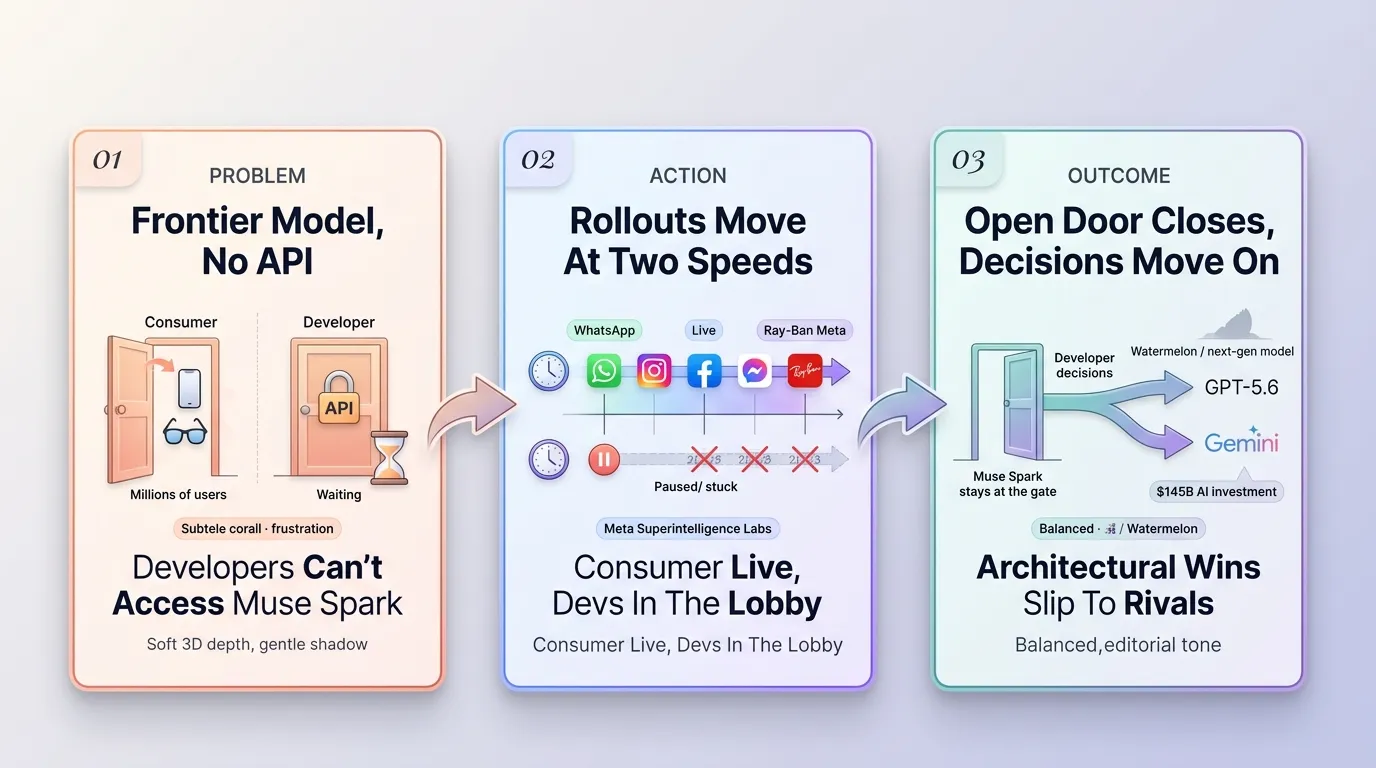
Meta’s most powerful AI model to date launched publicly in April 2026, and by July it had been rolled out across WhatsApp, Instagram, Facebook, Messenger, and the Ray-Ban Meta smart glasses. Muse Spark is the first model developed under Meta Superintelligence Labs, the research organisation Meta formed after bringing in Alexandr Wang of Scale AI and investing heavily in rebuilding its AI infrastructure.
On benchmarks, it delivers multimodal capabilities that put it squarely in the same competitive tier as GPT-5.6 and Claude Opus 4.8. For end users on Meta’s consumer platforms, Muse Spark is already live and powering a rebuilt Meta AI assistant with noticeably stronger reasoning, image understanding, and long-context handling.
The problem is everything that happens after the consumer layer. Meta has repeatedly delayed the release of Muse Spark’s developer API, and as of this week, the Wall Street Journal reported that there is still no scheduled launch date for external API access.
The delays have been attributed internally to infrastructure bottlenecks and persistent bugs in the API layer that Meta has not been able to resolve on any of the multiple timelines it has set internally since the model’s April debut.
A Model Built for Scale, Stuck at the Gate
Muse Spark was positioned at its April launch as Meta’s answer to the argument that open-weight models were falling behind proprietary ones on frontier capability. It powers a completely rebuilt Meta AI assistant with enhanced multimodal features, and it runs natively on Meta’s AI glasses hardware.
The New York Times reported on July 9 that the launch represented Meta’s most serious attempt yet to close the gap with Google and OpenAI on model quality, and by most independent assessments it has succeeded in doing so at the capability level.
What it has not succeeded in doing is making that capability available to the developer ecosystem that would typically build on top of it. For a company that has historically used open access to its models as a competitive differentiator — LLaMA’s open-weight releases were enormously influential in shaping the developer tooling landscape — the extended API delay creates a strategic gap.
Developers building applications who might otherwise have chosen Muse Spark over GPT-5.6 or Gemini 3.5 are making architectural decisions now, and each week without API access is a week those decisions go to other providers. Follow the latest developer reaction on X here: https://x.com/search?q=Muse+Spark+API
What Comes Next
Meta has not publicly commented on the specific technical issues blocking API access. Reuters reported earlier in June that infrastructure problems were the primary cause, but subsequent reporting from the Wall Street Journal suggests that at least some of the delays involve safety review processes that Meta’s internal teams have been unable to complete on schedule, in addition to the infrastructure issues.
A separate model codenamed Watermelon — reportedly matching frontier performance on internal benchmarks and consuming a significant portion of Meta’s $145 billion AI investment — is expected to follow Muse Spark, though timelines for that release are equally undefined.
For now, Muse Spark remains the unusual case of a frontier model that millions of consumers are already using daily while the developer community waits indefinitely for the API keys.
Quick Links:
